Author Archives: vhoagland

2nd Sunday of Ordinary Time: c Cana in Galilee

For this week’s homily please watch the video below.

After his Baptism in the Jordan River Jesus began his ministry in Galilee. The four gospels offer three different places where Jesus began his ministry. Matthew and Mark say it was in Capernaum, a town along the Sea of Galilee where Jesus performed a series of outstanding miracles.Mark’s Gospel emphasizes the miracles he worked there, Mathew his preaching.

Luke indicates Jesus began his ministry in the synagogue at Nazareth when he read from the Prophet Isaiah and proclaimed he was fulfilling what the prophet promised.  

John’s Gospel today has Jesus beginning his ministry at a marriage feast in Cana in Galilee when Jesus changed water into wine. 

Cana and Nazareth are two small towns in Galilee a few miles apart, yet closely related.They played an important role in Jesus’ early life. He was raised in Nazareth and he performed the first sign of the promised kingdom to come in Cana.  (John 2, 1-12)

The two towns weren’t thought much of in Jesus’ day. “Can anything good come from Nazareth?” The same could be said about Cana. Nazareth is located on top of a mountain in upper Galilee; Cana is just down from it on the plain of Esdraelon. 

The couple whose wedding Jesus, his mother and disciples attended were probably farmers from Cana, relatives or friends of Mary and Jesus.  It was a wedding in a small town that took place over some days. like other weddings then. Those who came had to be put up and fed. It was a family embarrassment if anything spoiled the occasion. 

It looks like that was about to happen when the wine for the celebration ran out. “They have no wine,” Mary said to Jesus, her Son. 

Jesus turned large jars of water into wine and it was a better wine than before.  The “first sign” John points to in his gospel is a miracle, yes, but it doesn’t seem to compare to the other “signs” in John’s Gospel, like the raising of Lazarus from the dead or new sight given the blind man. 

Did others notice what happened besides the head waiter? Did most think, perhaps, the new wine was from choice reserves the family drew upon? 

The celebration probably took three days, at least, and Jesus must have been there with his mother and disciples all those days. Just part of the celebration.

Were they signs of God’s ordinary presence in life, God’s unnoticed presence? Is the wedding feast of Cana a sign of God love for places like Cana, for its ordinary people, for couples who names we do not know?

God loves everyplace, everything, everybody, small as they are. God delights in the Canas of this world and the people living in them. Jesus not only brought good wine to that wedding, but he stayed for the feast as a sign of the ordinary presence of God.

Our reading from Isaiah today seems to indicate that. It describes God as a bridegroom taking Israel, small as she is, as a bride:

“No more shall men call you ‘Forsaken’

or your land ‘desolate’.

But you shall be called ‘ My delight’

and your land ‘espoused’

for the Lord delights in you

and makes your land his spouse.

As a young man marries a virgin,

your builder shall marry you,

and as a bridegroom rejoices in his bride

so shall your God rejoice in you.”

Those words were fulfilled when Jesus came to the wedding feast at Cana in Galilee. He was a sign of God rejoicing, delighting in his people, at home with them. He was a sign of the ordinary presence of God.
JANUARY 10-16: Readings and Feasts

10 Mon Weekday (1st Week in Ordinary Time) 1 Sm 1:1-8/Mk 1:14-20 

11 Tue Weekday 1 Sm 1:9-20/Mk 1:21-28

12 Wed Weekday 1 Sm 3:1-10, 19-20/Mk 1:29-39 

13 Thu Weekday [St Hilary, Bishop, Doctor of the Church] 1 Sm 4:1-11/Mk 1:40-45

14 Fri Weekday 1 Sm 8:4-7, 10-22a/Mk 2:1-12 

15 Sat Weekday 1 Sm 9:1-4, 17-19; 10:1a/Mk 2:13-17 

16 SUN SECOND SUNDAY IN ORDINARY TIME Is 62:1-5/1 Cor 12:4-11/Jn 2:1-11

The Christmas Season ends with the Baptism of Jesus. The Christmas celebrations are over. Ordinary time begins. Does that mean there’s nothing to do till Lent and Easter?

Sure there is. Ordinary Time is a time for daily prayer, and daily prayer is never over. The Second Vatican Council’s Constitution on the Liturgy said that daily prayer is at the heart of the Christian life and created a daily lectionary of scripture readings so “ the treasures of the bible be opened more lavishly for the faithful at the table of God’s word.” (SC 51) 

The daily lectionary is a treasure for praying with the scriptures, but don’t take it for granted. Treasures, Jesus said, are usually hidden and you have to dig for them. That’s what we do in daily prayer. The liturgy is always a “work”, our daily work, an important work, a daily prayer. It’s the “summit” of the Christian life. We’re always at the beginning, not at the end.

We begin Monday to read the Books of Samuel and the Gospel of Mark from our lectionary. There are also feasts of the Lord and his saints to celebrate in the days ahead. It’s a lifelong learning we’re into, a school God provides, and we learn day by day.

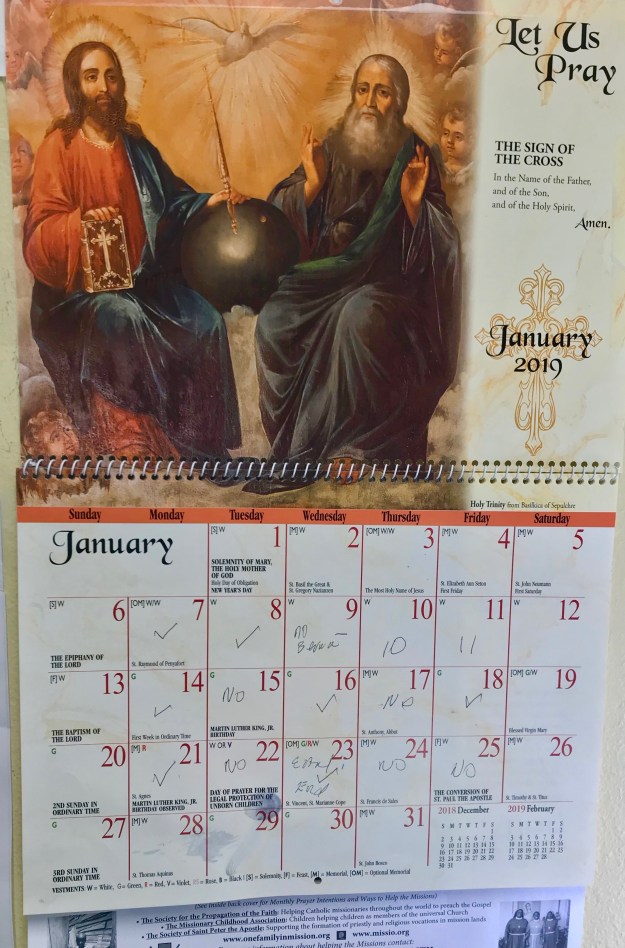
The Calendar on the Kitchen Door


About this time every year when I was a boy, my mother would put up on the kitchen door the calendar we got from church. She marked down the anniversaries of family deaths and birthdays and other celebrations coming along, and she added other dates as the days passed. The pictures on the calendar interested me most then. When we put up the calendar, we were ready for the days ahead.

The calendar’s still a good way to get ready for the days ahead. “Teach us to number our days aright, that we may gain wisdom of heart,” one of the psalms says.

Our calendars today may be on our computers instead of the kitchen door. They’ve also changed in a number of ways since the Second Vatican Council. For one thing, our church calendars today list the scripture readings read at Mass for the weekdays and Sundays throughout the year. They open the treasures of our faith for us.

Our calendars alert us to the main feasts and seasons, Christmas and Easter, advent and lent, celebrated by the whole church throughout the year. The general calendar also lists the days for celebrating saints honored the world over, such as Mary, the Mother of Jesus, the apostles, St. Francis of Assisi, St. Theresa of Avila and others.

The council left countries and regions to decide on some celebrations of their own. In our particular calendar here in the United States, for example, we celebrate Thanksgiving Day and American saints like St. Elizabeth Seton, St. Elizabeth Cabrini and St. John Neumann.

The calendar’s still a good way to keep our lives in order, not only doctors’ and social appointments, birthdays and anniversaries, but our spiritual lives as well. They go together. We’re meant to live from day to day, from feast to feast, and be formed by the mysteries of Christ, his saints and the scriptures.

Every Sunday evening I try to publish the week’s calendar on my blog: http://www.vhoagland.com

It’s my kitchen door. Through the week I reflect on the feasts and seasons and saints on that blog. The calendar’s a teacher helping us to “number our days aright.” It’s our daily catechism.

Feast of the Epiphany

For this week’s homily please watch the video below.

The  story of the Magi who come from the East to pay homage to the Child Jesus, whom they call king of the Jews, is an important part of the Christmas story. It’s found only in the Gospel of Matthew.

Matthew’s gospel was written for Jewish Christians in Galilee and Syria sometime after  Jerusalem was destroyed by the Romans in the year 70. They were shocked by the complete destruction of the temple and the city itself, because these were places where God’s promises would be fulfilled, they believed. The Messiah would appear there. All nations would stream to Jerusalem, prophets like Isaiah foretold. Now they’re gone.

Matthew’s gospel reminds his hearers–and us too–that before he comes again Jesus must be known by all nations. “Go and make disciples of all nations,” are his final words in Matthew’s gospel, “baptizing them in the name of the Father and of the Son and of the Holy Spirit, teaching them to observe all that I have commanded you. And behold, I am with you always, until the end of the age.” (Matthew 28, 18-20)

Can we see the story of the Magi at the beginning of Matthew’s gospel his reminder that even as Jesus is born, even as innocent children are being killed by King Herod, messengers, strangers, wise men from afar, approach him and acknowledge him as their king and their God. 

Jesus Christ came, our gospel story says, not for only one people or nation, he came for all. His ministry was first to the Jews, but Jesus wishes to make the world one. God doesn’t wish to save a few. He wants to save all, all the world. 

The Magi came, our story says, from the east, so they may come from Iran or Yemen; two places we hardly view positively today in our country. More and more, today as we look at the world through the lens of politics and economics, we fear the stranger, we reject the immigrant, we create enemies.  We reject people who are not like us. We’re becoming tribal, not global. As the old song said, “With someone like you, a pal good and true, I’d like to leave it all behind and go and find, a place that’s known to God alone, and let the rest of the world go by.”

Why aren’t we more jealous to bring our faith to others? Why are we so slow to see the promise our faith brings to the world?  Why do we hesitate to talk about Jesus Christ, his teachings and the example of his life? We can’t let the rest of the world go by. We’re living in a big world and God wants it to be one.

 That’s what the story of the magi reminds us. We have a commission on this Feast of the Epiphany to receive them. Next Sunday is the Feast of the Baptism of Jesus. “Go to the whole world, baptizing them in the name of the Father, and of the Son, and of the Holy Spirit,” teaching them to observe all that Jesus commands. And he will be with us, even to the end of time.

And the newcomers come with gifts. 

I like Pope Benedict’s reflection on Matthew’s account of the Magi i: “The key point is this: the wise men from the east are a new beginning. They represent the journeying of humanity toward Christ. They initiate a procession that continues throughout history. Not only do they represent the people who have found the way to Christ: they represent the inner aspiration of the human spirit, the dynamism of religions and human reason toward him.”

Benedict, at the end of his study reflecting on the historicity of the infancy accounts notes a changing attitude favoring their historical reliability. The evangelists do not wish to deceive their readers, but inform them concerning historical facts.

“ With this view I can only agree. The two chapters of Matthew’s Gospel devoted to the infancy narratives are not a meditation presented under the guise of stories, but the converse: Matthew is recounting real history, theologically thought through and interpreted, and thus he helps us to understand the mystery of Jesus more deeply.”

Pope Benedict XVI. Jesus of Nazareth: The Infancy Narratives . The Crown Publishing Group. Kindle Edition.

He Took a Body Like Ours

The Word became flesh, the flesh of Abraham and his descendants, Athanasius writes in his “Treatise on the Incarnation”, one of the great ancient texts on that mystery. It’s the reading for today’s Feast of Mary, the Mother of God. 

“He had to take a body like ours. This explains the fact of Mary’s presence: she provided him with a body of his own, to be offered for our sake. Scripture records her giving birth, and says: She wrapped him in swaddling clothes. Her breasts fed him and were called blessed. Sacrifice was offered because the child was her firstborn. 

Gabriel used careful and prudent language when he announced his birth. He did not speak of “what will be born in you” to avoid the impression that a body would be introduced into her womb from outside; he spoke of “what will be born from you,” so that we might know by faith that her child originated within her and from her.

  By taking our nature and offering it in sacrifice, the Word was to destroy it completely and then invest it with his own nature, and so prompt the Apostle to say: This corruptible body must put on incorruption; this mortal body must put on immortality.

  This was not done in appearance only, as some have imagined. No, our Saviour truly became human, and from this has followed the salvation of humanity as a whole. Our salvation is in no way fictitious, nor does it apply only to the body. The salvation of the human being, soul and body, has really been achieved in the Word himself.

  What was born of Mary was therefore human by nature, in accordance with the inspired Scriptures, and the body of the Lord was a true body: It was a true body because it was the same as ours. Mary, you see, is our sister, for we are all born from Adam.

  The words of St John, the Word was made flesh, bear the same meaning, as we may see from a similar turn of phrase in St Paul: Christ was made a curse for our sake.  Humanity has acquired something great through its communion and union with the Word. From being mortal it has been made immortal; though it was a living body it has become a spiritual one; though it was made from the earth it has passed through the gates of heaven.

  Even when the Word takes a body from Mary, the Trinity remains a Trinity, with neither increase nor decrease. It is for ever perfect. In the Trinity we acknowledge one Godhead, and thus one God, the Father of the Word, is proclaimed in the Church

Merry Christmas

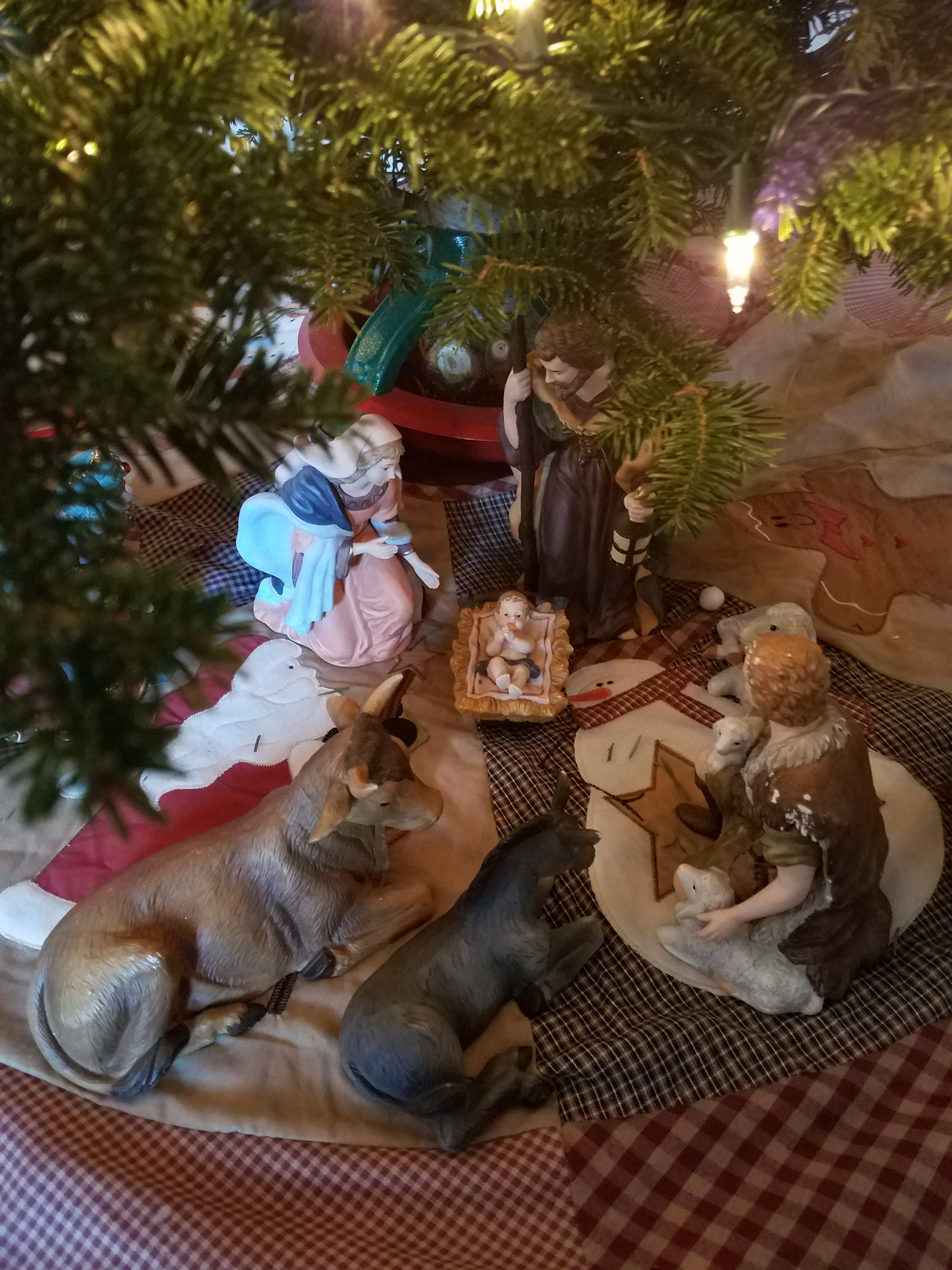
20171225_083206


The softest sound that could ever be.

The slightest touch possible.

The simplest gesture known to God and man.

Humility.

Nothing more powerful.

The Word became flesh.

God became man.

God became you and me.

Now the child leads us:


Merry Christmas.

A Blessed New Year.


—Howard and family


Poor in Spirit

Christmas is a time of poverty. The Spirit of Bethlehem is one of smallness, of tiny new beginnings that open our minds to the infinite largeness of Incarnate Wisdom. The Christ Child heals us of our presumption. The New Born shows us that we simply don’t know what God has in store. His impoverished delivery stops us in our tracks. We stand like beasts in a stable, our knowledge, our understanding, our science, our facts, our truths stripped of eternal value. All that remains, whether we’re shepherds or kings or someone in between, is for us to nod along with the tiny beat of the drummer boy offering his seemingly meaningless gift. Let’s welcome Christ Jesus, Innocence itself, by being poor with Him. Let’s let go of preconceived notions of having control. To stand before the Lord in our nothingness is worth more to Him than any amount of gold, frankincense or myrrh. Our humility before the bright light is pure praise and prayer to the One Who offers us everything.

—Howard Hain

December 20- 26: FEASTS AND READINGS

DECEMBER 20 Mon Advent Weekday Is 7:10-14/Lk 1:26-38 

21 Tue Advent Weekday [Saint Peter Canisius, Priest and Doctor of the Church]

Sg 2:8-14 or Zep 3:14-18a/Lk 1:39-45 

22 Wed Advent Weekday 1 Sm 1:24-28/Lk 1:46-56 

23 Thu Advent Weekday [Saint John of Kanty, Priest] Mal 3:1-4, 23-24/Lk 1:57-66 

24 Fri Advent Weekday  2 Sm 7:1-5, 8b-12, 14a, 16/Lk 1:67-79 

25 Sat THE NATIVITY OF THE LORD (Christmas) Solemnity 

Vigil: Is 62:1-5/Acts 13:16-17, 22-25/Mt 1:1-25 or 1:18-25 (13) Night: Is 9:1-6/Ti 2:11-14/Lk 2:1-14 

Dawn: Is 62:11-12/Ti 3:4-7/Lk 2:15-20 

Day: Is 52:7-10/Heb 1:1-6/Jn 1:1-18 or 1:1-5, 9-14 

26 SUN THE HOLY FAMILY OF JESUS, MARY AND JOSEPH

Sir 3:2-6, 12-14/Col 3:12-21 or 3:12-17/Lk 2:41-52

or, in Year C, 1 Sm 1:20-22, 24-28/1 Jn 3:1-2, 21-24/Lk 2:41-52

We begin reading St. Luke’s Infancy Account this week in our liturgy. I added a reflection on Luke’s account of Zechariah in the temple, which our Sunday readings displaced this year. Be sure to read the Old Testament readings that accompany Luke’s account. They provide the background for Luke’s story; without them we tend to read it too literally.

By neglecting the Old Testament readings we miss understanding New Testament sources like Luke.

I’m reading again Pope Benedict’s “Jesus of Nazareth: the Infancy Narratives” (Image Books 2012), a wonderful commentary on our readings for this week. Benedict engages Luke using the best of modern scripture scholarship (mostly German) and beautifully presents the meaning of Luke’s narrative. 

I remember the headlines when his book appeared: “Pope says the ox and the donkey weren’t around the manger at Christ’s birth.” Far from denying the facts of the Infancy Narrative, Pope Benedict makes them more understandable. The manger of Jesus is the Lord’s first throne, the humble temple where he comes to feed the poorest of the world.

“So the manger has in some sense become the Ark of the Covenant, in which God is mysteriously hidden among men, and before which the time has come for ‘ox and ass’–humanity made up of Jews and Gentiles–to acknowledge God.”

Until now, many of our Advent readings were taken from Matthew’s Gospel, which portrays Jesus teaching on a mountain (Isaiah’s favorite symbol) and working great miracles that benefit all who come. Jesus is the new temple, the new Presence of God, Emmanuel, God with us.  

This week Luke is the primary source for the our gospel readings.        

.

4th Sunday of Advent c: Faithful Women

For this week’s homily, please watch the video below.

Where Do You Come From?

Whenever we read Matthew’s gospel of the genealogy of Jesus, filled with so many unfamiliar names, many hard to pronounce, I am reminded of my mother.  She had a remarkable memory for relationships, whether her own family relations or how other people were related. Honestly, I often tuned out as she probed family trees with delight. After she died I realized I had lost connection with countless relatives and people she had firmly stored in her mind.

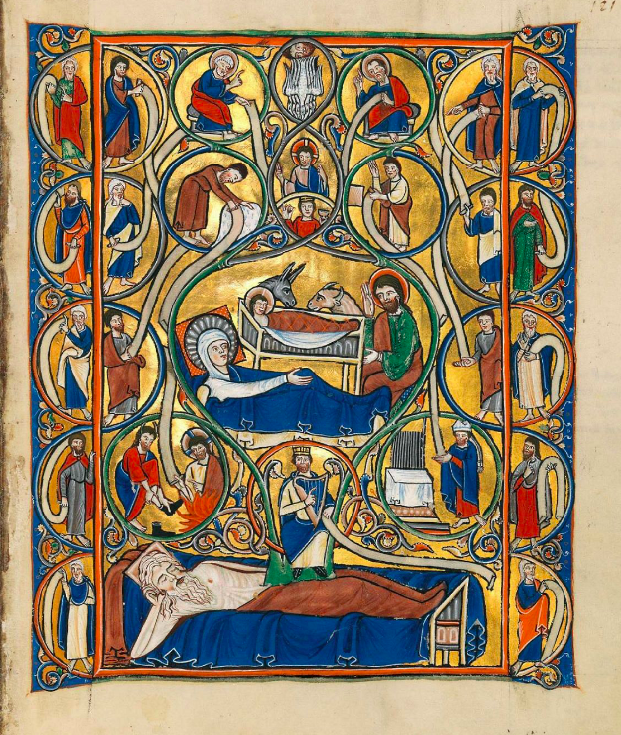
She wasn’t a professional genealogist, but she would be at home with the study of Jesus’ ancestry in the gospels of Matthew and Luke. She would want to know how all those people in the 13th century picture above were related.

The gospel genealogies are not mere formalities, official records proving Jesus’ human identity. Mary and Joseph would have made Jesus aware of these relationships as he grew up among the tight family units of Nazareth. The people of Nazareth knew where they came from.

Jesus would hardly be a protected child, kept safely away from others till his day would come. Jesus knew from the beginning he was part of the human family. His family tree was not just an army of saints, sinners were there for sure. They’re all part of the mystery of his Incarnation.

We will hear about some of his immediate family in the next few days of Advent– Mary, Joseph, Elizabeth and Zachariah, John their son. There were others too we will hear of when he begins his ministry. We shouldn’t be surprised that some of his first disciples were related to him.

Jesus was not an isolated individual, but the Word made flesh, firmly part of the human family he came to save.