Often Mark’s Gospel offers little clues to help us interpret one passage in the light of another. For example, Jesus is sharply questioned by the Pharisees whether it’s lawful for a husband to divorce his wife. The questioning takes place as Jesus “came into the district of Judea and across the Jordan,” on his way up to Jerusalem where he will meet his death.
Mark’s not altogether accurate in his geography but “Judea across the Jordan” was where John the Baptist was put to death for questioning the validity of Herod’s marriage to Herodias, who divorced Herod’s brother Philip to marry him. Mark tells that gruesome story a few chapters before in great detail. (Mark 6, 14-29) The site of John’s death, east of the Dead Sea in what is now the country of Jordan, was lost for more than a thousand years after it was destroyed by the Romans at the end of the First Jewish Revolt in 71/72 A.D. It was definitively identified in 1968, when a German scholar discovered the remains of a Roman siege wall. Since then, the Hungarian architect and archaeologist Dr Győző Vörös has been excavating the site.
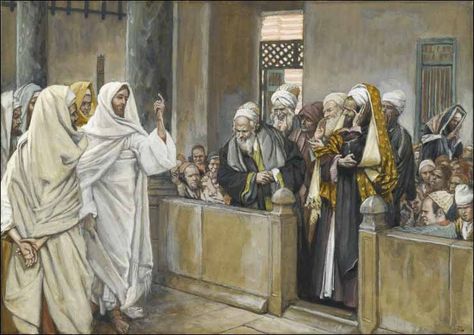
Perhaps the Pharisees thought that questioning Jesus here might have two outcomes. Either it might incite Herodias and Herod to do to Jesus what they did to John, or if Jesus didn’t answer the delicate question about divorce, the crowds gathered around him might see him less brave than the Baptist.
Jesus’ answer is brave, and it’s not an abstract one. Marriage is not to satisfy human ambition, like Herodias’ ambition. From the beginning God willed that man and woman be one flesh. The final lines of our gospel, spoken at this time and place, is also a strong judgment on the man and woman who engineered John’s death:
“Whoever divorces his wife and marries another commits adultery against her; and if she divorces her husband and marries another, she commits adultery.”
The Passionists believe the passion of Christ should always be in our hearts. We should keep it always in mind. St. Vincent Strambi in our previous blog called the passion of Jesus a “ book of life, it teaches the way to live and communicates life. The one who reads this book day and night is blessed.”
How can we read such a book? Three questions help open the book of the Passion of Jesus for us:
What happened?
Who did it happen to?
Why did it happen to him?
If you asked anyone at the time of Jesus what happened when someone was crucified, they would tell you immediately. Everyone in the Roman world knew what crucifixion was. Someone was arrested, imprisoned and judged. If you were found guilty of a major crime and not a Roman citizen, you could be scourged and then crucified publicly, often dying painfully hanging there for days.
The Romans used scourging and crucifixion as a deterrent, a warning. They made sure everybody knew about it. They deliberately publicized it. Those to be crucified were marched through the streets to a public place of execution. In Jerusalem the place of execution where Jesus was crucified was right outside the city gates on a main road. It took place on a raised spot of ground the shape of a skull, Calvary.
People going in and out of the city had to see it. They were meant to see it. The crown of thorns the soldiers put on Jesus was an added touch: Don’t try to be a king here.
Crucifixion was abolished in the Roman Empire in 337 by Constantine, the first Christian emperor, but even before some Romans were critical of the practice. The Roman orator Cicero called it “ a most cruel and disgusting punishment” and he suggested “the very mention of the cross should be far removed not only from a Roman citizen’s presence, but from his mind, his eyes, his ears”. (Verrine Orations 2) In polite society, art and Roman literature at the time of Jesus crucifixion is hardly mentioned.
We’re not acquainted with crucifixion today as the people of Jesus’ time were. Today people may know it from Mel Gibson’s popular film “The Passion of the Christ”, which explores the passion of Jesus in grim visual detail. Gibson has none of Cicero’s qualms about crucifixion. He shows what happened, but doesn’t answer those two other questions much, if at all. Who is this? And why was he crucified?
Bill O’Reilly’s recent book “Killing Jesus ” (2017) also looks at the facts of the crucifixion of Jesus but doesn’t dwell on them as Gibson does. Like other reporters, O’Reilly is interested in the facts. Get the facts, but also find a scoop, something sensational, that might surprise people by your investigation.
Facts are important in our world. We’re living in the period of the Enlightenment that began in the16th century, when science told us to look for facts. But facts aren’t the only thing. Meditation on the passion of Jesus goes beyond the facts.
Mark, Matthew, Luke and John, our primary sources for the story of the passion of Jesus, certainly knew the facts of his crucifixion and death. Their audience also knew what happened then. But the gospel writers and those they wrote for were also interested in those other questions. “Who did this happen to?” And “Why did it happen to him”?
The gospel accounts are not simply same day reports of what happened. They were formed over a period of time involving three levels of development. The first level occurred when Jesus was arrested, judged, crucified, died and was buried.
The second level took place in the decades that followed the resurrection of Jesus, when his followers questioned, reflected and preached on why this took place. This level can be seen, for example, in the story of the two disciples on the way to Emmaus in Luke’s Gospel ( Lk 24:13-35) and in the Letters of St. Paul.
The third level occurred in the last decades of the 1st century when the gospel writers wrote for a particular Christian community of their own time and place . They took into account the life and ministry of Jesus, his death and resurrection, and also the questions, reflections and preaching that followed. They wrote, finally, for people of their day, to strengthen them in their faith. Commentators today, using modern biblical scholarship, are interested especially in this final level of gospel formation.
The Second Vatican Council urged Catholics to read, reflect and pray on the scriptures using these new tools.The four gospels, even the three synoptic gospels of Mark, Matthew and Luke that appear so similar, have their own distinct voice. Instead of harmonizing the accounts, we can learn from their differences.
“Each of the gospels revolves around the crucifixion of Jesus,” Fr. Donald Senior, a Passionist scriptural scholar, notes in his book “The Passion of Jesus in the Gospel of Matthew,” (Collegeville, MN, 1985) Their interest “was not simply in the dramatic historical fact that Jesus of Nazareth was executed by crucifixion. Rather, the evangelists sought the meaning of all this, not only for Jesus’ life, but for all human life. How could this happen? And what purpose might it have? These were the questions that drew Christians to Jesus’ death. Discovering coherence in the sufferings of Jesus might yield the meaning of suffering in their own lives.” ( p 8)
Each gospel writer tells the story of the passion of Jesus in his own distinct way for his own Christian community, and for all the world.
“When we speak of Christ’s passion,” Fr. Senior continues, ‘we refer to the suffering and death he endured. But “passion” has other connotations in English. It can mean intense emotion, feeling, even commitment. People can do things “with passion.”
Both of these meanings are present when we say Jesus “took up his cross.”
The Second Vatican Council, besides approving current biblical scholarship, directed that the treasures of the scriptures be available more widely in our liturgy. We now have, in a lectionary for Sundays and weekdays, an extensive yearly exposure to the gospels and others scriptures. Daily reading of the scriptures for us today is not only a way to grow in faith but also a way to “keep his passion in mind.”
The gospels, which “revolve around the crucifixion,” are also daily meditations on the passion of Jesus, because the mystery of the cross falls on every part of them, from his birth, to his ministry of healing and teaching, to time he is arrested and condemned to death.
In Matthew’s Gospel, for example, Herod haunts his birth, killing infants in Bethlehem, John the Baptist is arrested after his baptism, leaders of the people oppose him as he teaches and heals. Signs of what awaits Jesus appear even before he’s seized and put to death. The same ominous pattern is there in all the other gospels.
For this reason, as we read from Matthew and Luke in the Christmas season and from Mark from the feast of his Baptism by John till Ash Wednesday beginning Lent, we keep his passion in mind. As we read in Lent from Matthew and then from John from the 4th week of Lent till Holy Week, we are reading the book of his cross.
We are best prepared to meditate on the passion narrative itself by meditating on the entire gospel along with the rest of the scriptures. Jesus, in fact, told his disciples at Emmaus they all speak of him.
The scriptures are the best place to learn what happened, who did it happen to, and why did it happen to him. They help us keep his passion in mind.
Always good to listen to St. Augustine when he’s reflecting on a favorite theme: Desiring God.
“The entire life of a good Christian is in fact an exercise of holy desire. You do not yet see what you long for, but the very act of desiring prepares you, so that when he comes you may see and be utterly satisfied.
Suppose you are going to fill some holder or container, and you know you will be given a large amount. Then you set about stretching your sack or wineskin or whatever it is. Why? Because you know the quantity you will have to put in it and your eyes tell you there is not enough room.
By stretching it, therefore, you increase the capacity of the sack, and this is how God deals with us. Simply by making us wait he increases our desire, which in turn enlarges the capacity of our soul, making it able to receive what is to be given to us.
So, my brethren, let us continue to desire, for we shall be filled. Take note of Saint Paul stretching as it were his ability to receive what is to come: ‘Not that I have already obtained this’, he said, ‘or am made perfect. Brethren, I do not consider that I have already obtained it.’
We might ask him, ‘If you have not yet obtained it, what are you doing in this life?’ This one thing I do, answers Paul, ‘forgetting what lies behind, and stretching forward to what lies ahead, I press on toward the prize to which I am called in the life above.’ Not only did Paul say he stretched forward, but he also declared that he pressed on toward a chosen goal. He realised in fact that he was still short of receiving what no eye has seen, nor ear heard, nor the heart of man conceived.”
Let me desire what no eye has seen, nor ear heard, nor the human heart conceived.
When I first saw “The Chair of Peter” I was amazed and delighted. I was a lover of art and a fan of Gianlorenzo Bernini. At the time I was not a believer in God, and I was put off by the opulence of St Peter’s Basilica in Rome. The place seemed to me like an oversized train station. I felt no presence of God in this place. But I was also overcome by the magnificent beauty of the place.
What most impressed me though, was the back of the Basilica, behind the marvelous, massive metal canopy over the altar. Vast quantities of angels and swirling cloud-like shapes surrounded this huge, empty throne, giving the impression that it was being lifted up like some sort of Renaissance-era Space Shuttle blasting off into space. How all this heavy metal could evoke the lightness of cake frosting was indeed marvelous. And on top of it all, seeming small in comparison, was the poignant image of the brooding Spirit of God, shining from a stained-glass window way up high. Wow, Bernini, what a genius, my main man! Not a thought about this Saint Peter.
Nearly thirty years later, I re-entered this great place full of the Holy Spirit and the love of God. My attitude was different. I still loved great art but, after spiritual experiences and much reading of the Gospels, Jesus was my love, and Peter the Fisherman was my “Main Man,” my favorite saint. I was coming here to honor them both.
And yet, the place left me cold. It still felt huge and empty, yet full of aggressive, jostling tourists, making it very hard to be in a prayerful mood. This spectacular building said nothing to me about what the person of St Peter meant in my life. Then, the simplest of objects appeared before me, to remind me of why I was there.
In front of the stairs to the lower levels, where Peter’s tomb was located, there were a number of small tablets mounted on iron stands with typewritten information on them in different languages. I read the English one, and this is what was written on it:
“You are the Christ, the son of the, living God. (Mt 16:16)”
“Master, to whom shall we go? You have the words of eternal life. We have come to believe and are convinced that you are the Holy One of God. (Jn 6: 68-69)”
“Lord, you know everything. You know that I love you. (Jn 21:17b)”
I almost felt dizzy. My heart was filled with so much emotion. It was as if the great saint had personally come to remind me of the mystery and the marvelous miracle that is the love of God. The humble fisherman had for the longest time been my example of what a life with Christ can be like. First, when He calls, I cannot help but recognize who He truly is. When I am confused, in doubt, or afraid of losing my faith, those words of Peter remind me that there really is no other place for me to go. I have walked too far with My Lord. In spite of the many times that I have been confused or felt threatened by His message, in spite of the many times I have denied Him, Peter has been my example every time I feel Jesus’ invitation to love Him. Thank you, Saint Peter, for being such an inspiration in my life!
I stood there for a while, and, as had happened various other times in Churches in Italy, my Lord came to call me. An elderly, stern priest came by ringing a bell, “Ding, ding, ding, ding ding,” announcing the Eucharist in one of the large chapels to the left. The chapel commemorated the crucifixion of Peter. I went joyfully to be with my Lord. I know that Peter, my “Main Man” and guide, was there also with me.
FEBRUARY 21 Mon Weekday [St Peter Damian, Bishop Doctor of the Church] Jas 3:13-18/Mk 9:14-29
22 Tue The Chair of St Peter Feast 1 Pt 5:1-4/Mt 16:13-19
23 Wed St Polycarp, Bishop and Martyr Memorial Jas 4:13-17/Mk 9:38-40
24 Thu Weekday Jas 5:1-6/Mk 9:41-50
25 Fri Weekday Jas 5:9-12/Mk 10:1-12
26 Sat Weekday Jas 5:13-20/Mk 10:13-16
27 SUN EIGHTH SUNDAY IN ORDINARY TIME Sir 27:4-7/1 Cor 15:54-58/Lk 6:39-45
27. ST. GABRIEL, PASSIONIST
The weekday readings from Mark’s Gospel begin this week with the cure of the young boy whose youth has been marred by “a mute spirit.” (Monday) We have a number of reminders in this week’s liturgy that the journey to Jerusalem is meant to make us children of God again. That wasn’t the greatness his disciples seem to be looking for. (Cf. Mark 9: 33ff) Jesus meets opposition on that journey (Friday) Mark 10:13-16 returns to Jesus teaching about becoming children. (Saturday)
Next Sunday the Passionists celebrate the feast of St. Gabriel, a young Passionist from Italy who is honored as a patron of youth.
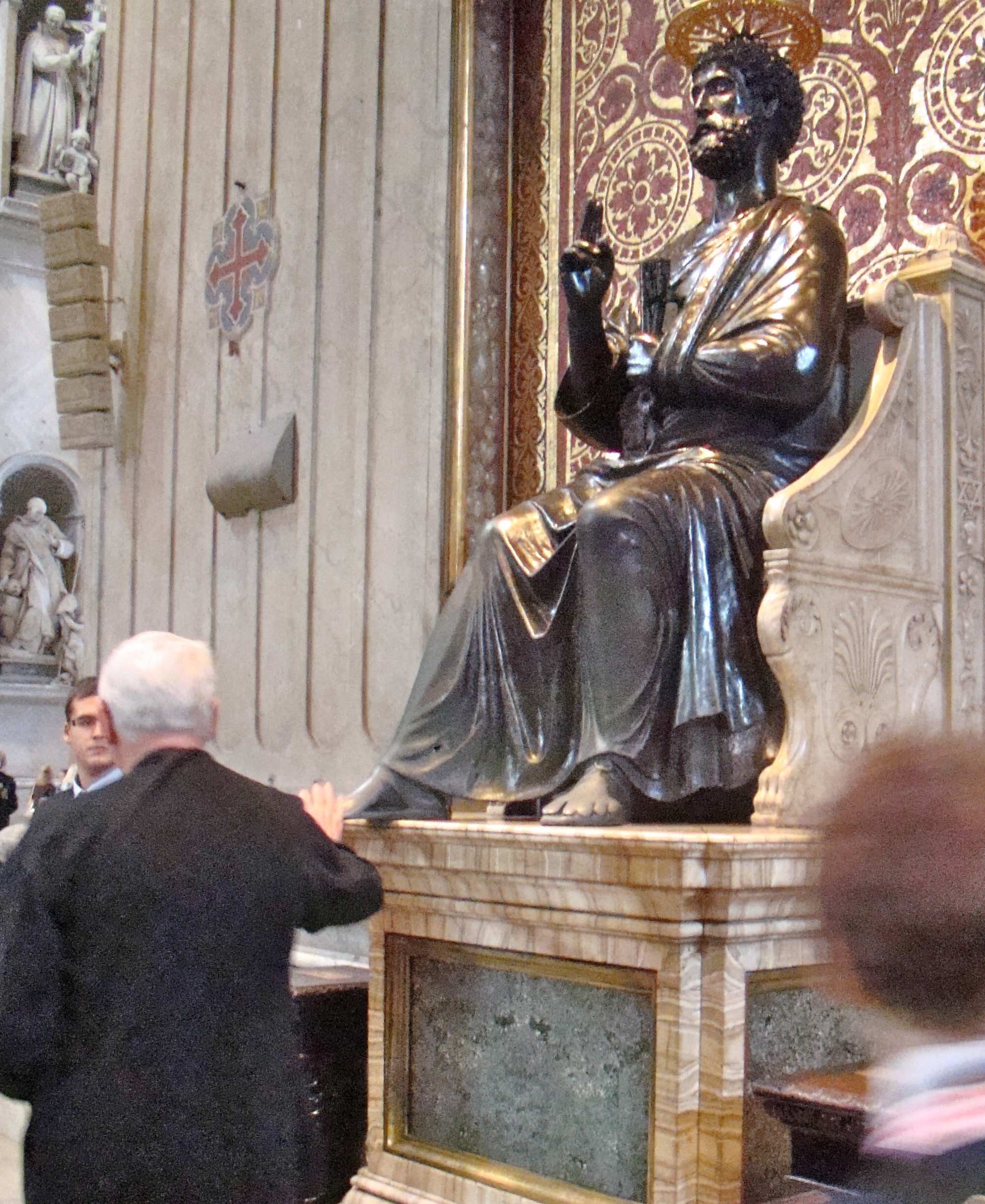
The Feast of the Chair of St. Peter (February 22) reminds us we are children of the church learning from its teaching.
St. Polycarp, an old man, dies professing his faith in the teaching of the gospel he received in his youth. (Wednesday)
We read the Letter of James along with Mark’s Gospel these weeks before Lent. I think the authors of our lectionary placed the Letter of James, which emphasizes the practical teachings of faith, as a balance to Mark’s Gospel, which concentrates on Jesus’ works of healing and casting out demons.
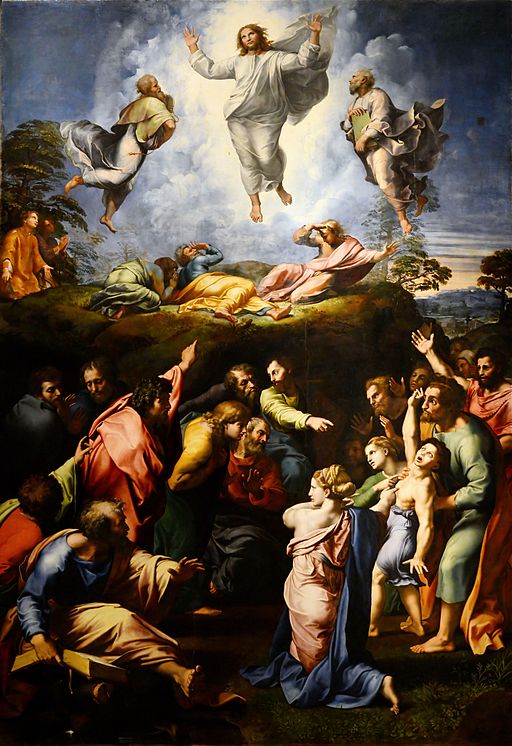
Many art critics say the Transfiguration of Jesus by Rafael is the most beautiful painting ever made. I’m no expert on art, but I think the painting also says a lot about how this mystery in Mark’s Gospel is connected to the rest of his stories.
The bottom part of the painting is the dramatic story of the cure of a young boy brought to Jesus by his father as he comes down from the mountain. (Mark 9: 14-29) The boy’s had seizures since his birth. He’s evidently suffering convulsions even now. The crowd around the boy and his father and the disciples around Jesus are excitedly calling for something to be done. Jesus looks at the poor boy and he will cure him.
But before he does he reminds them about the importances of faith. In Mark’s Gospel, he asks the boy’s father if he believes. “I believe, Lord, help my unbelief.” Jesus also tells his disciples they weren’t able to help because they don’t pray enough.
The story of his Transfiguration on the mountain prepares for the journey to Jerusalem. Rafael hints at what to expect there in the distant mountain to the right of his painting. Commentators call the story of the Transfiguration an apocalyptic vision, a momentary vision preparing Jesus and his disciples for what’s coming. Jesus with his arms outstretched is strengthened for when he will stretch out his arms on the cross. God, his Father, strengthens him with the promise of glory. We may forget that’s part of the mystery.
His disciples with their incomplete faith are strengthened by the promise of glory too. God strengthen us with brief revelations of his glory. Even now, Jesus reveals his glory to us so that we don’t lose hope. Even now, we can see intimations of God’s glory in our lives, brief encounters, transitory moments, transfigurations of a lesser kind, as Jesus leads us on.
Like the man with his son, suffering from seizures, Jesus tells us to believe. Like his disciples, wondering why they can’t do anything, why we can’t believe enough, Jesus tells us to pray.
In this Wednesday’s Gospel (Mk 8: 22-26), Jesus heals a blind man at the town of Bethsaida. This healing does not happen right away:
” People brought to Him a blind man and begged Jesus to touch him. He took the blind man by the hand and led him outside the village. Putting spittle on his eyes He laid His hands on the man and asked, ‘ Do you see anything?’ Looking up the man replied, ‘ I see people looking like trees and walking.’ Then He laid hands on the man’s eyes a second time and he saw clearly; his sight was restored and he could see everything distinctly.”
This passage has been interpreted as an example of how the healing that comes from God happens gradually, in steps. We must be trusting and patient.
In line with this, I see in this Gospel the invitation of Love toward my conversion. I was blind to the marvelous reality of a loving God in my life. By example and prayer, good people ( like my son Frank) brought me to Him. He took me by the hand and led me outside of my sphere (my village) to the intimate place where only He and I interact. He touched me. He questioned me (“Do you believe?”). He enabled me to see, at least a little bit, as if in a “mirror dimly” ( 1 Cor 13:6). He touches me again and again so that I can see Him and ” see everything distinctly”. In a sense I am no longer blind. I can begin to, in the words of Walter Burghardt, take “a long loving look at the real”.
And so this passage also reminds me of His wonderful gift of prayer. He takes me by the hand to the isolated place “the private room” , and many times I cannot see Him in this darkness. Then He works His miracle and opens the eyes of my soul to His presence.
Like Mary Magdalene, I cry within the dark, stony, tomb of my distress, my guilt, my doubt, loneliness and despair. Suddenly He calls to me: ” Woman, why are you weeping? For whom are you looking?”. I look out into the blinding light. I can barely see the hazy human silhouette standing there outside. I cannot recognize Him. Then He calls me by name. I realize this is the Friend who has by now healed me, accompanied me, taught and loved me for so long. In some strange, deep, indescribable way I can see Him! He is my Lord and my God!

 The Victor's Place