St. John Bosco, (1815-1888) was born in northern Italy, then experiencing the beginnings of the Industrial Revolution. His father died when he was two and he was brought up by his mother who struggled financially raising him, yet took care he had a good religious and humanistic education.
At twenty, John entered the seminary and once ordained a priest he devoted himself to helping young men living in a society moving from farms to factories, from an apprentice-based economy to one based on machines. He provided for their education and spirituality. He was joined by Mother Mary Dominic Mazzarello who took on the education of young women.
As young Italians began to immigrate to other countries in search of work, John Bosco and his companions accompanied them to North and South America. The Salesian community he founded spread throughout the world as educators and missionaries.
The opening prayer for his feast calls John Bosco “a teacher and father of the young.” He believed firmly that young people needed a good educational formation, but he also believed they needed teachers who took a fatherly interest in them, as God is Father of us all.
“The young should know that they are loved,” he said. As a boy he himself knew what the loss of father meant. As a young man he enjoyed circus entertainers, so he knew we need entertainment. But he also said, “ I do not recommend penance, but work, work, work.”
“Let us regard those boys over whom we have some authority as our own sons. Let us place ourselves in their service. Let us be ashamed to assume an attitude of superiority. Let us not rule over them except for the purpose of serving them better.
This was the method that Jesus used with the apostles. He put up with their ignorance and roughness and even their infidelity. He treated sinners with a kindness and affection that caused some to be shocked, others to be scandalised, and still others to hope for God’s mercy. And so he bade us to be gentle and humble of heart.” (Letter, John Bosco)
The church must always look at the “signs of the times in the light of faith.” We pray for people like John Bosco to meet the needs of the young today.
Because Jesus is often called “Son of David” in the New Testament and so many of the psalms are attributed to David, we may tend to idealize the great king. David united the tribes of Israel and established a nation with its capitol in Jerusalem. Jesus himself appealed to David’s example when his enemies accused his hungry disciples of eating grain on the Sabbath.
Yet, the long narrative we read in the Book of Samuel today and tomorrow at Mass offers a darker picture of the famous king– he was a murderer and an adulterer. David had Urriah the Hittite, a faithful soldier in his army, killed so that he could have Bathsheba, his wife. (2 Samuel 11, 1-17)
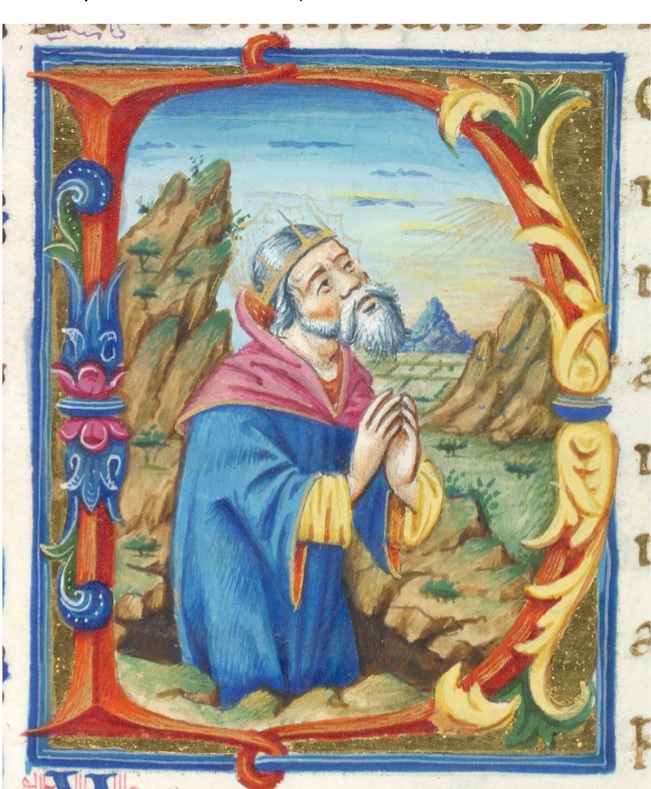
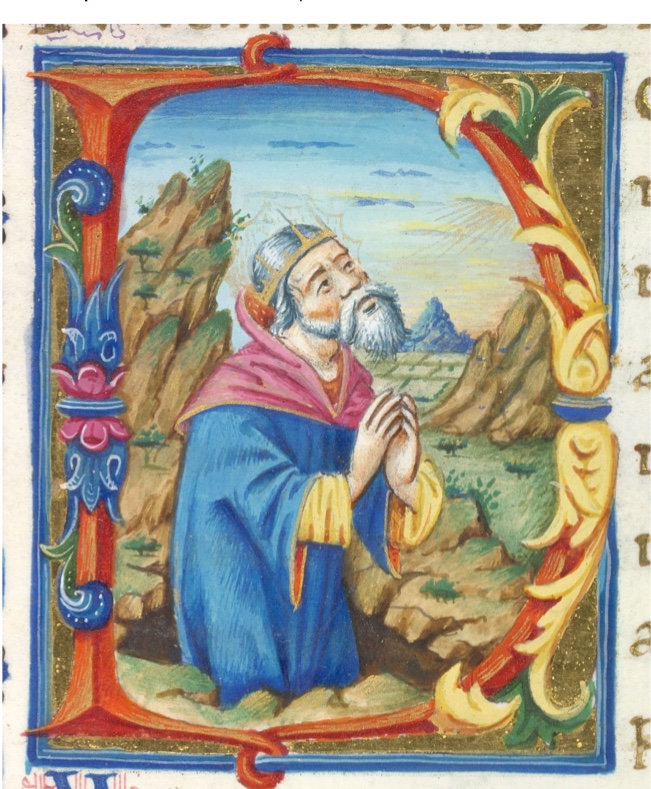
Psalm 51 is the response we make at Mass after listening to the king’s sordid deed. Tradition says it’s David’s own response after he realized what he had done. The Book of Psalms calls Psalm 51: “A psalm of David when Nathan the prophet came to him after he had gone in to Bathsheba.”
“Have mercy on me, O God, in your goodness;
in the greatness of your compassion wipe out my offense.
Thoroughly wash me from my guilt
And of my sin cleanse me.”
The psalm, the first of the Seven Penitential Psalms, asks God to take away both the personal and social effects of our sin, for our sins do indeed have emotional, physical and social consequences. Only God can “wash away” our guilt and cleanse our heart. Only God can “rebuild” the walls that our sins have torn down and the lives they have harmed. Only God can restore joy to our spirits and help us “teach the wicked your ways, that sinners may return to you.” Only God can bring us back to his friendship.
In the scriptures, David is a complex figure– a saint and a sinner. He’s also a reflection of us all. That’s why our response in the psalm at Mass today takes the form that it does –
Here’s Pope Leo latest reflection of the documents of the Second Vatican Council at his Wednesday audience yesterday, on the important subject of scripture and tradition:
“Dear brothers and sisters, good morning and welcome!
Continuing our reading of the Conciliar Constitution Dei Verbum on Divine Revelation, today we will reflect on the relationship between Sacred Scripture and Tradition. We can take two Gospel scenes as a backdrop. In the first, which takes place in the Upper Room, Jesus, in his great discourse-testament addressed to the disciples, affirms: “These things I have spoken to you, while I am still with you. But the Counsellor, the Holy Spirit, whom the Father will send in my name, he will teach you all things, and bring to your remembrance all that I have said to you. … When the Spirit of truth comes, he will guide you into all the truth” (Jn 14:25-26; 16:13).
The second scene takes us instead to the hills of Galilee. The risen Jesus shows himself to the disciples, who are surprised and doubtful, and he advises them: “Go therefore and make disciples of all nations … teaching them to observe all that I have commanded you” (Mt 28:19-20). In both of these scenes, the intimate connection between the words uttered by Christ and their dissemination throughout the centuries is evident.
It is what the Second Vatican Council affirms, using an evocative image: “There exists a close connection and communication between sacred tradition and Sacred Scripture. For both of them, flowing from the same divine wellspring, in a certain way merge into a unity and tend toward the same end” (Dei Verbum, 9). Ecclesial Tradition branches out throughout history through the Church, which preserves, interprets and embodies the Word of God. The Catechism of the Catholic Church (cf. no. 113) refers, in this regard, to a motto of the Church Fathers: “Sacred Scripture is written principally in the Church’s heart rather than in documents and records”, that is, in the sacred text.
In the light of Christ’s words, quoted above, the Council affirms that “this tradition which comes from the Apostles develops in the Church with the help of the Holy Spirit” (Dei Verbum, 8). This occurs with full comprehension through “contemplation and study made by believers”, through “a penetrating understanding of the spiritual realities which they experience” and, above all, with the preaching of the successors of the apostles who have received “the sure gift of truth”. In short, “the Church, in her teaching, life and worship, perpetuates and hands on to all generations all that she herself is, all that she believes” (ibid.).
In this regard, the expression of Saint Gregory the Great is famous: “The Sacred Scriptures grow with the one who reads them”. [1] And Saint Augustine had already remarked that “there is only one word of God that unfolds through Scripture, and there is only one Word that sounds on the lips of many saints”. [2] The Word of God, then, is not fossilized, but rather it is a living and organic reality that develops and grows in Tradition. Thanks to the Holy Spirit, Tradition understands it in the richness of its truth and embodies it in the shifting coordinates of history.
In this regard, the proposal of the holy Doctor of the Church John Henry Newman in his work entitled The Development of Christian Doctrine is striking. He affirmed that Christianity, both as a communal experience and as a doctrine, is a dynamic reality, in the manner indicated by Jesus himself in the parables of the seed (cf. Mk 4:26-29): a living reality that develops thanks to an inner vital force. [3]
The apostle Paul repeatedly exhorts his disciple and collaborator Timothy: “O Timothy, guard what has been entrusted to you” (1 Tim 6:20; cf. 2 Tim 1:12-14). The Dogmatic Constitution Dei Verbum echoes this Pauline text when it says: “Sacred tradition and Sacred Scripture form one sacred deposit of the word of God, committed to the Church”, interpreted by the “living teaching office of the Church, whose authority is exercised in the name of Jesus Christ” (no. 10). “Deposit” is a term that, in its original meaning, is juridical in nature and imposes on the depositary the duty to preserve the content, which in this case is the faith, and to transmit it intact.
The “deposit” of the Word of God is still in the hands of the Church today, and all of us, in our various ecclesial ministries, must continue to preserve it in its integrity, as a lodestar for our journey through the complexity of history and existence.
In conclusion, dear friends, let us listen once more to Dei Verbum, which exalts the interweaving of Sacred Scripture and Tradition: it affirms that they “are so linked and joined together that they cannot stand independently, and together, each in their own way, under the action of the one Holy Spirit, they contribute effectively to the salvation of souls” (cf. no. 10).”
_______________________________
[1] Homiliae in Ezechielem I, VII, 8: PL 76, 843D.
[2] Enarrationes in Psalmos 103, IV, 1
[3] Cf. J.H. Newman, An Essay on the Development of Christian Doctrine, Milan 2003, p. 104.
Numbers seem to indicate power and popularity. We think that way; Jesus’ disciples must have thought that way too. In Mark’s gospel Jesus begins his ministry in Capernaum before an enthusiastic crowd. At the end of his first day, the whole town gathers at the door of Peter’s house and word reaches out to other towns and places that a prophet has come. The numbers go up. (Mark 1, 21-34)
But then enthusiasm dies down as Jesus’ authority is questioned. Religious leaders from Jerusalem and the followers of Herod Antipas cast doubts about him. His own hometown, Nazareth, takes a dim view of him.. Gradually, Capernaum and the other towns that welcomed Jesus enthusiastically turn against him. His numbers go down.
Why are the number going down, his disciples must have wondered? It didn’t make sense. Jesus’ answer comes in Mark’s gospel today. God’s kingdom is coming; God is at work in the world, but human beings are mostly unaware of it:
“This is how it is with the Kingdom of God; it is as if a man were to scatter seed on the land and would sleep and rise night and day and the seed would sprout and grow, he knows not how. Of its own accord the land yields fruit, first the blade, then the ear, then the full grain in the ear. And when the grain is ripe, he wields the sickle at once, for the harvest has come.” (Mark 4, 28-34)
Great power is at work in the scattered seed, but we know little how it grows. The seed takes time, with its own law of growth; a great harvest will come, but still there’s mystery we don’t see. We sleep.
Meanwhile, we worry about numbers. Why are growing numbers giving up going to church or synagogue? Why are there so few vocations to our religious communities? So many of the good things in this world seem to be diminishing.
What can we do? Look into the signs of the time. Treasure the seed we have. Scatter it as we can. Be patient as we sleep. The Kingdom of God comes.
In one of his poems, “Putting in the Seed,” Robert Frost describes a farmer’s love affair with the earth. It’s getting dark and someone from the house tries fetching him to come in. Supper’s on the table, yet he’s a
“Slave to a springtime passion for the earth. How Love burns through the Putting in the Seed On through the watching for that early birth When, just as the soil tarnishes with weed, The sturdy seedling with arched body comes Shouldering its way and shedding the earth crumbs.”
Can’t you see that farmer zestfully casting seed on the waiting earth, eagerly watching it to grow? Jesus sees the Sower as an image of God, casting saving grace onto the world in season and out, because he loves it so much.
If you have ever been to Galilee and seen the lake and the surrounding lands abundant with crops, you know this is a blessed place. It was in Jesus’ time too. Here, the sower scatters his seed with abandon, hardly caring where it goes: on rocky ground, or amid thorns, or on the soil that gives a good return.
God the Sower sows blessed seed, no matter how badly our human world appears, or how badly it receives. In his parables Jesus acknowledges rejection as well as acceptance, but the sower still sows. Grace is never withheld, and that makes us hope.
And is it just the human world God loves? Doesn’t his love extend to all the earth God calls “good” in the Book of Genesis? We worry about our planet earth, and with reason. How fragile it has become, what damage we careless humans do! We are concerned rightly for its future.
The nature parables we are reading in Mark’s gospel tell us to hope for our earth too. Though it is not immune from the threat of destruction and degradation, God loves it still. He’s a Sower at work. Blessed be the Lord God of all creation, may you sow your blessings on all.
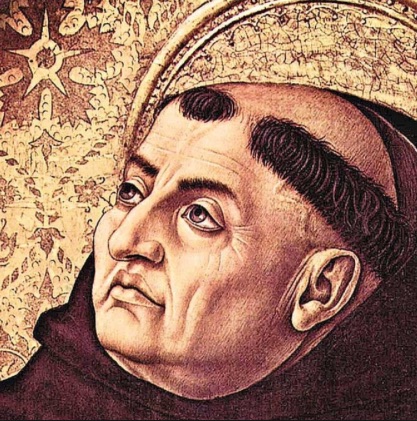
The feast of St. Thomas Aquinas, January 28th, in my student days was a day for presentations honoring the saint. The presentations were not about the saint’s life but his wisdom. Thomas Aquinas was a great theologian dedicated to the search for truth.
He was a man of faith, searching for understanding. That’s the definition of theology–faith seeking understanding, an understanding that draws us closer to God and helps us know God, the source of all truth.
He was a man of questions, who approached great mysteries through questions. That’s the way St. Thomas begins a sermon he once preached, found today in the Office of Readings for his feast:
“Why did the Son of God have to suffer for us?” he asks as he looks at the Cross of Jesus. The passion of Jesus was necessary, the saint says, for two reasons. First, as a remedy for sin, and secondly, as an example of how to act.
Interestingly, the saint doesn’t spend much time asking why it’s a remedy for sin. He’s more interested in the passion of Jesus as an example for us. To live as we should, we need to look at Jesus on the cross, an example of every virtue:
“Do you want an example of love? ‘Greater love than this no one has, than to lay down one’s life for one’s friends.’ That’s what Jesus did on the cross. If he gave his life for us, then it should not be difficult to bear whatever hardships arise for his sake.
“If you want patience, you will find no better example than the cross. Great patience occurs in two ways: either when one patiently suffers much, or when one suffers things which one is able to avoid and yet does not avoid.
“Christ endured much on the cross, and did so patiently, because when he suffered he did not threaten; he was led like a sheep to the slaughter and he did not open his mouth. Therefore Christ’s patience on the cross was great. In patience let us run for the prize set before us, looking upon Jesus, the author and perfecter of our faith who, for the joy set before him, bore his cross and despised the shame.
“If you want an example of humility, look upon the crucified one, for God wished to be judged by Pontius Pilate and to die.
“If you want an example of obedience, follow him who became obedient to the Father even unto death. For just as by the disobedience of one man, namely, Adam, many were made sinners, so by the obedience of one man, many were made righteous.
“If you want an example of despising earthly things, follow him who is the King of kings and the Lord of lords, in whom are hidden all the treasures of wisdom and knowledge. Upon the cross he was stripped, mocked, spat upon, struck, crowned with thorns, and given only vinegar and gall to drink.
“Do not be attached, therefore, to clothing and riches, because they divided my garments among themselves. Nor to honours, for he experienced harsh words and scourgings. Nor to greatness of rank, for weaving a crown of thorns they placed it on my head. Nor to anything delightful, for in my thirst they gave me vinegar to drink.”
St. Thomas’ great theological work, the Summa Theologica can be found here.
We’re reading at Mass from the Second Book of Samuel. The first 8 chapters describe David’s accomplishments as an ideal king. .
Chapters 9-20 of Second Samuel describe the darker side of David, culminating in his murder of Uriah and taking his wife Bathsheba. The Prophet Nathan accused him of sin, promised him God’s mercy, but also told him he must face the consequences of sin.
The consequences? David’s own son Absalom betrays him and turns the people against him. Pursued by his son he escapes from Jerusalem over the Mount of Olives and meets a relative of Saul who curses him and throws rocks at him. The king humbly accepts it all.
A penitent David recognizes his own sin and its consequences in this incident. In refusing to stop the man David recognizes he must bear the burden of sin, not only his sin, but the sin of the world:
‘Suppose the LORD has told him to curse David; who then will dare to say, ‘Why are you doing this?…Perhaps the LORD will look upon my affliction and make it up to me with benefits for the curses he is uttering this day…’ David and his men continued on the road, while Shimei kept abreast of them on the hillside, all the while cursing and throwing stones and dirt as he went.”
We read the Old Testament to hear the promises God makes to Israel in spite of her sinfulness and infidelity. Yet, let’s not forget sin has consequences, as this story makes clear. Do the consequences there match the bad news we face in our time. Like David our penance is to believe in God’s mercy, but also to bear hopefully sin’s consequences .
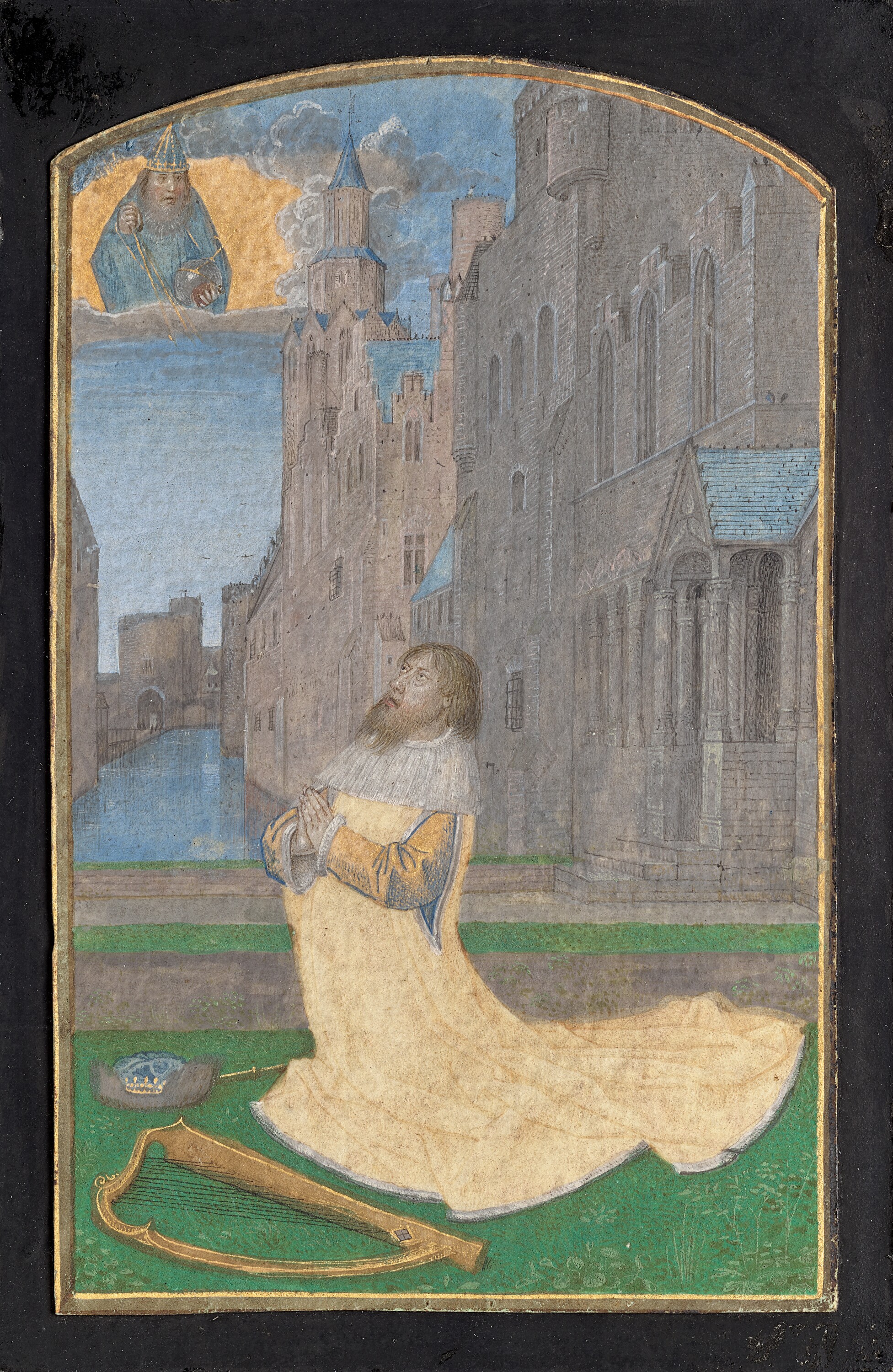
The church makes David’s prayer for mercy its own:
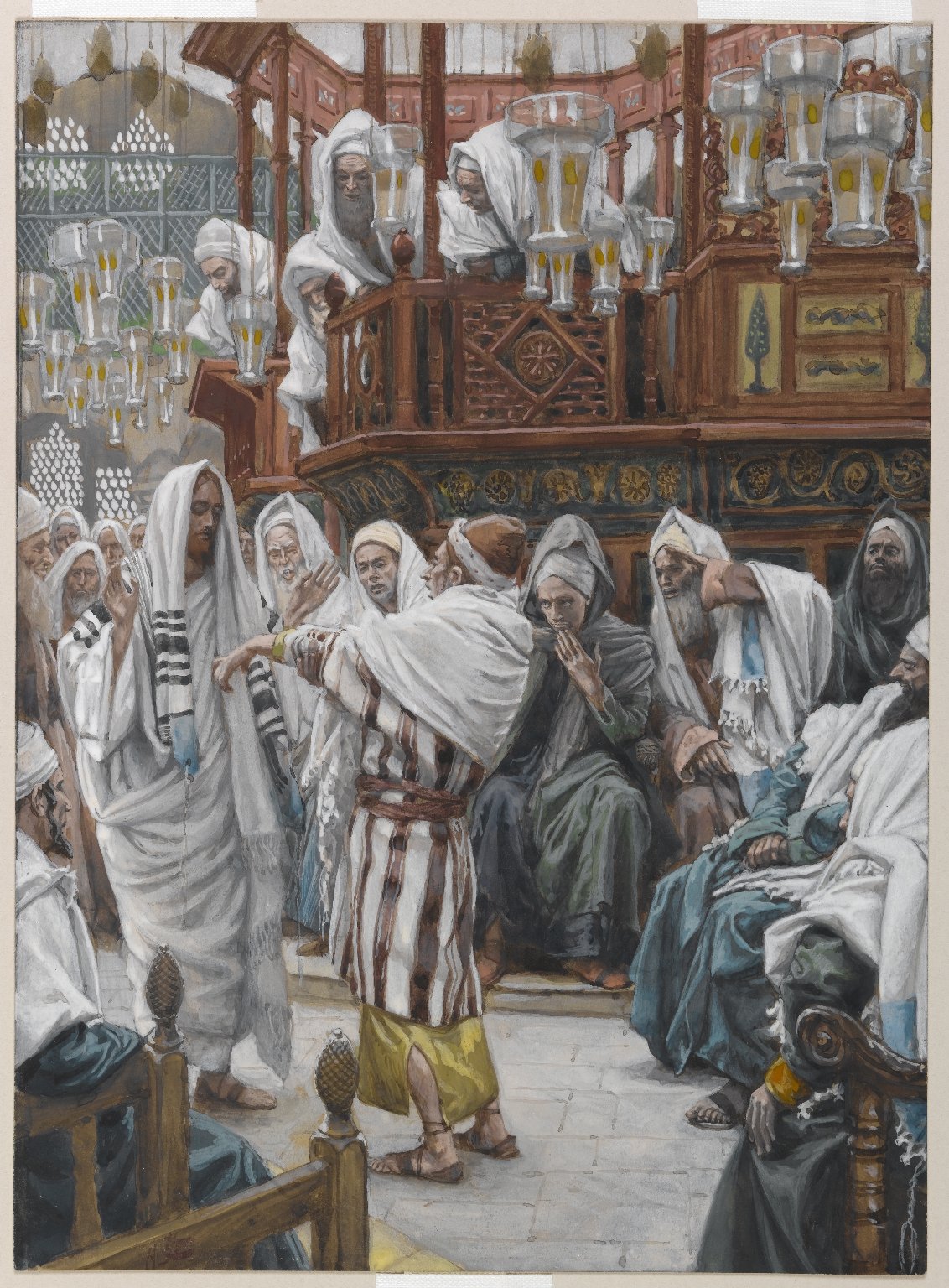
Jesus heals the man with the withered hand. J.Tissot
In the readings from Mark this week the Pharisees challenge Jesus. His hungry disciples eat some grain from a field on a Sabbath day. (Mark 2: 23-28} Then, in a synagogue on a Sabbath Jesus heals a man with a withered hand. (Mark 3: 1-6) The Pharisees object and look for help from the “Herodians”.
Today the Pharisees may seem to us to be a small-minded group opposed to Jesus throughout his ministry. Yet, in his time they were seen differently. They were considered the “real” Jews, faithful people who kept the law and took care of their neighbors.They went to the synagogue, said their prayers, kept the Sabbath, and followed religious customs. They weren’t afraid to say they were Jewish, even the clothes they proudly wore told you who they were.
They were the “good Christians” of their day. They believed they saw things and did things right. But Jesus called them blind. Their blindness appears especially in the way they looked down on others. Think of Jesus’ parable of the Pharisee and the tax-collector in the temple.
We learn a great deal about faith watching the Pharisees. Faith is not simply intellectual conviction or good conduct. It’s not simply knowing your catechism and keeping the church laws. Faith leads to “boundary-breaking activity.” Think of the four men who broke through Peter’s roof to lower the paralyzed man to see Jesus; they disturbed the order of that house. Jesus’ choice of Matthew, the tax-collector, disturbed the model for leadership. Jesus healing a man’s withered hand on the Sabbath broke the order of that day.
Faith breaks boundaries, the Gospel of Mark indicates. Jesus broke boundaries when he drove the demon out of a man on a Sabbath day in the synagogue at Capernaum the first day of his ministry. (Mark 1: 21-28)
So, let’s not look down on the Pharisees either. We need to keep the laws and say our prayers and be proud of who we are. Actually, couldn’t we use more of that these days?
We’re reading from the 2nd Book of Samuel this week at Mass. The first 8 chapters describe David’s accomplishments as an ideal king. Uniting the tribes of Israel he conquers Jerusalem from the Jebusites to make it his capitol– his greatest military victory. (Monday).
Acknowledging God’s primacy over this kingdom, he brings the Ark of the Covenant and places it in a special tent in his capitol city, He listens to the prophet Nathan, acknowledging the prophetic voice, God’s voice, in Israel.
God says to David, through the Prophet Nathan: “Your house and your kingdom shall endure forever before me; your throne shall stand firm forever.’” Unlike Saul’s throne, David’s throne will stand forever. (Tuesday-Thursday)
But chapters 9-20 of 2 Samuel describe David’s darker side, beginning with his murder of Uriah and taking his wife Bathsheba. That brings on him the accusation of the Prophet Nathan. (Friday-Saturday) Though he repents, dire consequences follow his sin. Yet, God remains faithful to David and his people Israel.
One reason we keep reading the Old Testament is to see Israel’s history unfold and hear the promises God makes to her, in spite of her sinfulness and infidelity. It helps us deal with our own times and ourselves.
I don’t think I have ever seen ordinary people and the news media so pessimistic about the future as they are today. There’s even a pessimism about science, once infallible, now with clay feet. There is pessimism about our political system, our church, climate change. No hope, no vision for science, capitalism or politics, even the physical world itself– all the big engines of our society.
The scriptures match the bad news we face, but they never quench hope. That’s why we read them. God has a parent’s love for us, and so we shouldn’t succumb to pessimism. We’re David’s children, through Jesus Christ. “The future of humanity rests with people who are capable of providing the generations to come with reasons for living and for hope.” (Gaudium et spes, 32)
I like the responsory to today’s reading from 2 Samuel about David: “My faithfulness and my mercy shall be with him.” That’s meant for us all.



 The Victor's Place