Monthly Archives: December 2017

Postcards From Happiness: Reading In Bed

Hain's avatarHowie Hain

by Howard Hain

Sometimes in the middle of dinner I find myself smiling. I love to watch her prepare her plate; her little way of doing everything. Other times it’s when she’s cooking one of her little meals or carefully packing her bag for the day. Then there’s bedtime. I check the locks on the front and porch doors and then check the dials on the stove. I flick off the kitchen light and on my way up the stairs I shut the switch for the chandelier in the dining room turned work room. At the top of the stairs I see across the large box-shaped sparsely-furnished hallway into our bedroom. Usually my reading lamp is the only light. And there on the right side of the bed, her pillow seeming not to notice the weight of her delicate head, lies my little Laurie.

She smiles while she sleeps, and there’ve…

View original post 99 more words

Untitled

Hain's avatarHowie Hain

by Howard Hain

Tender caresses

Tender thoughts

Harsh realities

Christ is real

Seek first the Kingdom of God

Sigh

Breathe

Smile

Pause

Just don’t move

Don’t feel guilt

Nor any shame

Be still

The world hates you

It lies to you

It tells you that you have to do something

Something!

Anything!

But you can’t just sit there

That’s what it tells you

But it’s a lie

Yes

Yes you can

You can just sit there

The Kingdom is at hand

Your right hand

And your left

Both your feet

Your head

Even your behind

Heaven is all around you

Please stop moving

Please

I love you

I love you, my dear child

You are so precious to me

Let me look at you

Let me surround you with my thoughts

With my arms

With my love

Let me love you

Please sit still

Please

My child

Let me look…

View original post 10 more words

Wise as Doves

by Howard Hain

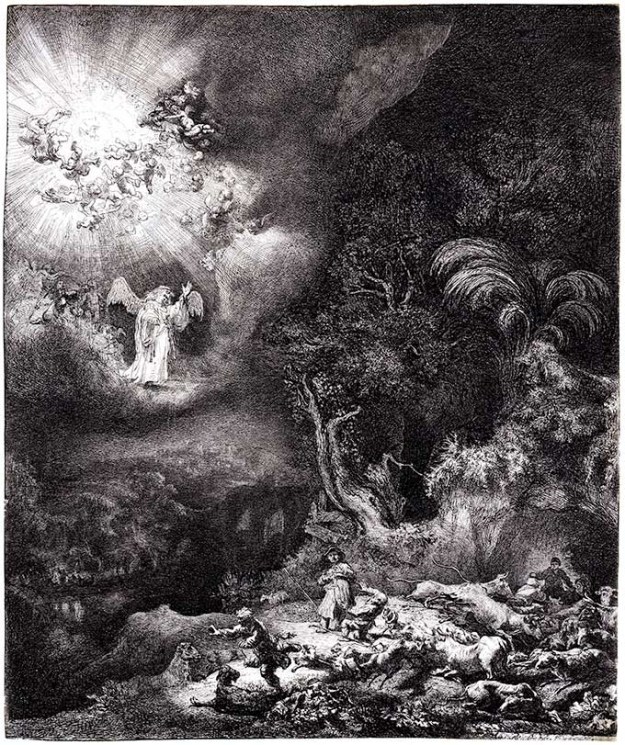
rembrandt-angel-appearing-to-the-shepherds-1634

Rembrandt, “The Angel Appearing to the Shepherds”, 1634


Now there were shepherds in that region living in the fields and keeping the night watch over their flock. The angel of the Lord appeared to them and the glory of the Lord shone around them, and they were struck with great fear.

—Luke 2:8-9


Perhaps the scariest thing to those of us who cling tightly to the things of the world is to accept the job that the Lord assigns us.

Oh, how so many of us are so quick to long for greater adventure!

Yet, when it comes to those humble, little shepherds to whom the angel of the Lord appeared, we are perhaps even quicker to long to be one of them—sitting quietly upon a gentle hillside, effortlessly tending to a passive flock, while the always-full moon provides a soft, ever-so-appropriate illumination from above.

But we are liars. For there’s nothing less romantic in each one of our daily lives, or more mundane. We simply have to be honest, or at least consistent. It all depends on how we look at it. If we see the shepherds in such a delicate light then we also need to see ourselves in the same. For before the angel appears, the shepherds were hardly posing for picturesque landscapes. Perhaps it is for this very reason—their realness, their authenticity, their holy simplicity—that the Lord chose them to be present when He revealed His glory.

It is exciting. We have a wonderful choice, then. Either our “boring” lives make us just the kind of people to whom God prefers to reveal Himself, or our lives are a lot more “exciting” than we ever imagined. Either way, what is vital to making such a decision is true sincerity and genuine gratitude. We need to thank God for who He has made us, for where He has placed us, and for what type of task He has assigned us.

A faithful, humble heart dreams and believes and sees great things among the most ordinary circumstances. Just look at the young virgin and the upright carpenter to whom the shepherds “went in haste” to find in a stable, adoring a child born within the company of the “lowest” of men.

If we spend our time dreaming of being someone else, living somewhere else, and doing something else, we miss the opportunity of being exactly who God intends us to be—and when that happens—we are always in the wrong place, at the wrong time, and most tragically, doing that which matters very little.

For to be the first on the scene, the first to “lay hold”, the first to adore the New Born King, is as good as it gets—even for those whose “normal existence” isn’t standing around all alone—day after day in the scorching sun or biting cold, while picking fleas from matted-down fleece or scaring off hungry wolves.


The angel said to them, “Do not be afraid; for behold, I proclaim to you good news of great joy that will be for all the people…”

So they went in haste and found Mary and Joseph, and the infant lying in the manger. When they saw this, they made known the message that had been told them about this child. All who heard it were amazed by what had been told them by the shepherds.

Then the shepherds returned, glorifying and praising God for all they had heard and seen, just as it had been told to them.”

—Luke, Chapter 2:10,16-18,20


Home Sick

by Howard Hain

I wonder. Did God ever catch a cold?

Did Mary look at Him while He slept, watching carefully His chest rise and fall?

Did Joseph pace around their small home, looking upward, his right hand touching his brow?

I wonder. Did they wince in sync when Jesus coughed from the bottom of His soul?

Was there a day, a single hour, from the moment Jesus was conceived that Joseph and Mary weren’t concerned?

Concerning all this there’s not much to wonder.

Jesus is human.

Of course He experienced “cold” in all its forms.

Of course Joseph and Mary felt they’d rather die than see their child in pain.

And Jesus is divine.

Of course He was homesick.

Of course He longed to return.

Between Mary’s womb and heaven the desert is awfully dry.

He climbed up high, seeking out mountain views.

He returned to the sea, seeking out salt air.

He stopped to hang out with the little ones, seeking out angels.

Jesus is just like you and me.

Only He allows Himself to be loved.

And that led Him to love to the utter extreme.

All flowed from and toward a family reunion.

His pain, His grief, His hope, His love were perfectly ordered.

Even when He coughed or sneezed or tossed and turned, Jesus did so while in the company of a promise.

And He’s extremely contagious.

Joseph and Mary became homesick too.

There’s only one place they could want to be.

With their only child.

Clinging to Him, to their God with all their might.


4th Sunday of Advent: Mary, Woman of Faith

King David wonders, in our first reading today of the 4th Sunday of Advent, what he can do for God after all God has done for him. David had built himself a palace of cedar wood in Jerusalem, while the ark of the covenant, the sign of God’s presence, is in a tent. Should I build God a temple, a place of beauty where God would dwell and be honored,” the king asks?
The prophet Nathan tells the king: instead a building, God wants to dwell with you and your people.

In today’s gospel, God goes further. God will dwell in Mary’s womb, to take flesh from her and be cared by her. 
Our gospel begins:
The angel Gabriel was sent from God
to a town of Galilee called Nazareth,
to a virgin betrothed to a man named Joseph,
of the house of David,
and the virgin’s name was Mary.
And coming to her, he said,
Hail, full of grace! The Lord is with you.

This gospel says so much about Mary. God showered graces upon her: “Hail, full of grace! The Lord is with you.” Just a young girl of 15 or 16, Mary answers: “Be it done to me according to your word. She accepts God’ s call, but she has her questions: “How can this be?”
The power of God will overshadow you, the angel tells her. The only sign she’s given is that her cousin, Elizabeth, “has also conceived a son in her old age, and this is the sixth month for her who was called barren; for nothing will be impossible for God.”
“Nothing will be impossible for God.”

Then, the angel leaves, and never returns, as far as we know. Mary meets the days as they come with faith, gathering her experiences and treasuring them in her heart.
At Christmas, we’ll see Mary in Bethlehem, humbly, silently holding the Infant, her Child, God with us. At Easter, we’ll see her standing beneath the cross of Jesus.
She’s his mother, a woman of faith. We learn from her and ask her to pray for us: “Pray for us, O holy Mother of God, that we may be made worth of the promises of Christ. 

Communion with Saints

by Howard Hain


A man named Paul lives in my home.

He’s an excellent house guest.

He never imposes.

He’s never and always alone.

My daughter and I talk of him often.

He brings wisdom to our kitchen table.

I’m not exactly sure when he moved in.

But it wasn’t so long ago.

Before and with him there are others.

Theresa, Francis, Bruno, John…just to name a few.

But Paul for some reason never seems to leave.

The others, they kind of come and go.

Paul on the other hand always hangs around.

But then again, I could say the same about the rest.

Is it cliché to say it’s a mystery?


Wednesday, 3rd week of Advent


Sacred Heart Church


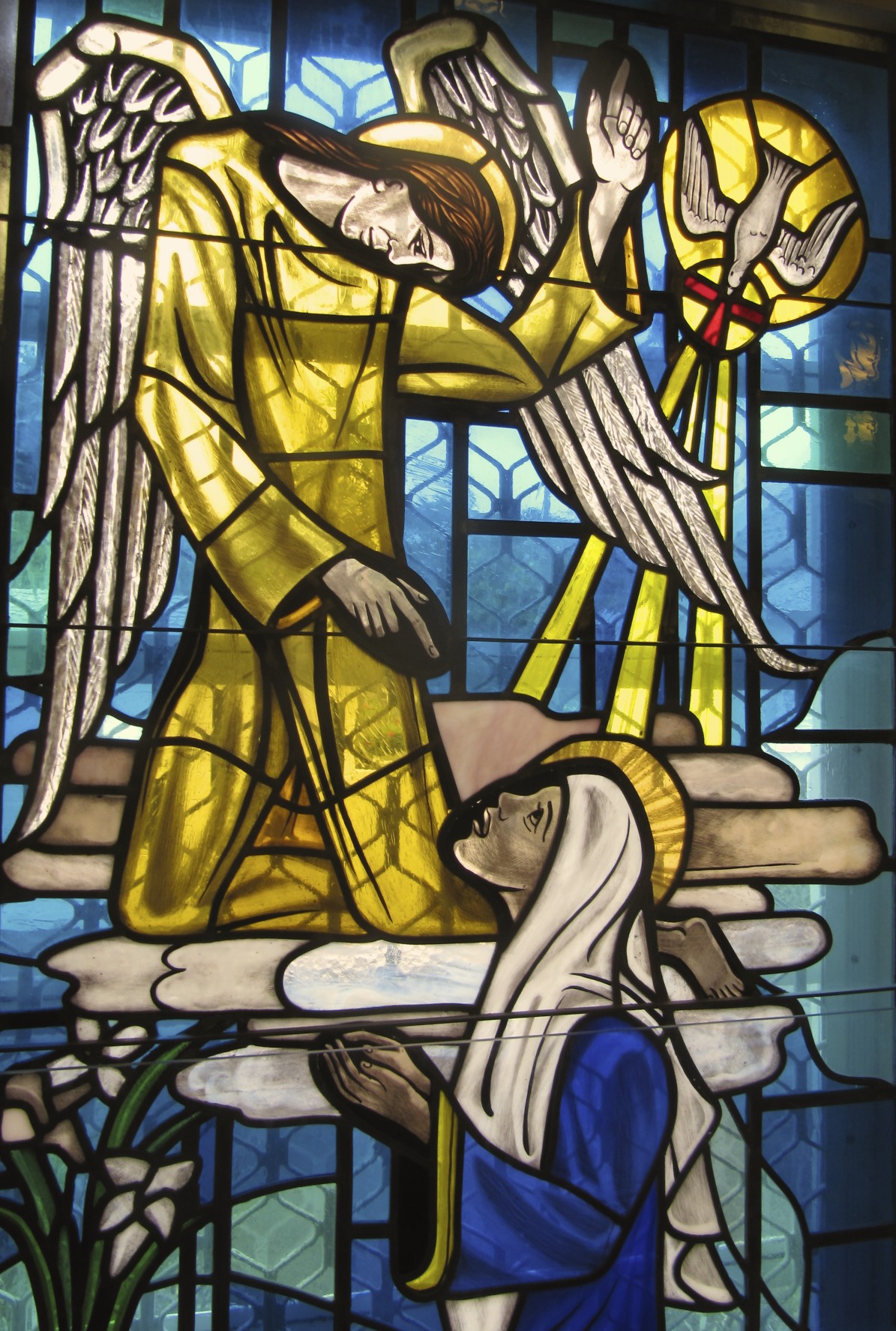
The angel came to Mary in Nazareth, the last place we might expect an angel’s message. In this little known place, Jesus became flesh. In this young unknown woman, he came to dwell among us.

It wasn’t in Jerusalem, in the temple where God’s Presence was proclaimed. It was in Nazareth, in the quiet hills of Galilee, on a routine day, that He came.

We celebrate the mystery of the Incarnation and pray, “Pray for us, O holy mother of God, that we may be made worthy of the promises of Christ.”

Little Drummer Boys and Girls

by Howard Hain

Yesterday I witnessed a “dress” rehearsal for a live nativity. The cast was made up of first and second graders, and the audience was mostly composed of residents of a retirement home for religious sisters, Franciscans. It was spectacular.

Last week I was at Radio City Music Hall to watch the Rockettes in their “Christmas Spectacular”. It was quite a production.

Sitting in the dark this morning I cannot help but contrast the two.

I also cannot help but relate to the seven-year old who played the part of The Little Drummer Boy.

As that child walked so slowly toward the foot of the altar, where the rehearsal was being staged, I saw my vocation in an entirely different light.

The children were all singing their hearts out, and many of the eighty and ninety year-old sisters were mouthing the words. The boy with the drum didn’t utter a sound. He just kept walking, slowly, extremely slowly toward the altar, every once in a while ever so slightly pretending to tap two tiny sticks upon a toy drum. He was beautifully awkward.

There was no greater spectacle on earth at that very moment. Shall I dare to say, no greater event that heaven or earth has ever known?

For a child was born. We were all being born.

———

Come they told me, pa rum pum pum pum
A new born King to see, pa rum pum pum pum
Our finest gifts we bring, pa rum pum pum pum
To lay before the King, pa rum pum pum pum,
rum pum pum pum, rum pum pum pum,

So to honor Him, pa rum pum pum pum,
When we come.

Little Baby, pa rum pum pum pum
I am a poor boy too, pa rum pum pum pum
I have no gift to bring, pa rum pum pum pum
That’s fit to give the King, pa rum pum pum pum,
rum pum pum pum, rum pum pum pum,

Shall I play for you, pa rum pum pum pum,
On my drum?

Mary nodded, pa rum pum pum pum
The ox and lamb kept time, pa rum pum pum pum
I played my drum for Him, pa rum pum pum pum
I played my best for Him, pa rum pum pum pum,
rum pum pum pum, rum pum pum pum,

Then He smiled at me, pa rum pum pum pum
Me and my drum.*


Little Drummer Boy was composed by Katherine K. Davis, Henry Onorati and Harry Simeone in 1958.


Howard Hain is a contemplative layman, husband, and father. He blogs at http://www.howardhain.com


A Man Named John

by Howard Hain

A Man Named John

There is a man named John. He was born and raised to be good. He believes that if he is a good person when he dies he will enter heaven. So while here on earth he prepares for death. The result is John lives a simple life. His home is simple. His occupation is not one many would find out of the ordinary. Yet John spends much of his time quietly bettering himself. In short, John is a good man.

It has been a long process. And John knows that his time is coming to an end. He also knows well that the end of his life is not in his own hands. He tells himself again and again “all one can do is prepare.” And prepare is what John has done since birth: He spent his youth lassoing his passions, his middle years harnessing his ego and pride, and his later years in private reflection upon the afterlife—an afterlife in which he hopes and prays he will be permitted to share. But it is his recent days that have been the most difficult. He battles to stop himself from thinking that he has been good and is one of the few who deserves to enter paradise. So each morning, before he rises and meets the day, John prays in bed. He prays in these final days, the days that matter most, for humility. He asks God for nothing but to remain within His glorious will.

Morning after morning John continues to pray. With each day he senses that his preparation is coming closer to an end. He feels his body slipping away and his spirit being freed. He senses he is on the verge of being born into salvation.

One morning as John is praying in bed the door is thrust open. A man and a woman walk into the room. The woman immediately applies a large metal clamp to John’s head. She holds John in place while the man begins to rip John’s body apart. Piece by piece, limb by limb, the man cuts away. The man and woman chat about their weekends as if John were never alive. Piece by piece John is pulled apart. Oblivious to John’s screams, indifferent to his fear, ignorant of his pain, in denial of his life, the man continues to tear away, as if John never breathed nor was ever born—as if dismantling an unwanted couch that won’t fit through the door.

Now what if I told you that John was never born, never lived, never prepared for the afterlife, never ripped into pieces and pulled from his bed. What if I told you that instead of being born John was conceived, instead of living he developed, instead of preparing for the afterlife he prepared for this life? What if I told you that instead of being ripped into pieces and pulled from his bed he was ripped into pieces and torn from the womb?


Howard Hain is a contemplative layman, husband, and father. He blogs at http://www.howardhain.com