Tag Archives: Van Gogh

Friday Thoughts: On the Cutting Edge of Boredom

vincent-van-gogh-the-stone-bench-in-the-garden-at-saint-paul-hospital-1889

Vincent van Gogh, “The Stone Bench in the Garden of Saint-Paul Hospital” (1889)

.

There is so much “excitement” in the world.

Politics. Sports. Entertainment.

Even in the simple act of kids going back to school there is so much hoopla.

We can’t just do things simply. Everything has to be planned, announced, delved into, broadcast into something “grand”, “life-changing”, “utterly profound.”

But the more we need to insist that something is the case, the less in reality it usually is. For excitement, like authority, is something that by its very nature announces itself—and it decreases in direct proportion to the need to have it proclaimed.

In other words, just because we make “a big deal” about everything doesn’t mean it is. In fact, it is normally quite the opposite.

———

I remember when a child’s birthday party was composed of eight or ten kids sitting around a kitchen table, wearing silly pointy hats, and eating a Duncan Hines cake made the day before by a stay-home mom.

Even catechism lessons seemed a whole lot more straight forward, and effective. For me they took place around that same kitchen table, with those same neighborhood friends, and were taught by that same mom who baked the birthday cake. Now, catechists are expected to act like game-show hosts. And preachers? We’ll they’re expected to be downright celebrities.

Well, there is an answer to all this triviality: The Bench. Whether it’s in the park, in front of your house, or even under one of those little bus-stop canopies on the side of the road.

Sit. Listen. Do nothing. Especially when you are tempted by “boredom”. For that’s exactly what boredom is, a temptation. A temptation to deny the existence of God. For if we are conscious of God’s presence we can never be bored. Every nook and cranny of every “meaningless” daily act and encounter has profound, truly profound significance, if we are conscious of God’s omnipresence and His perfect will.

Sit there peacefully, resting quietly on the cutting edge of boredom. You never know how much good God might do through you: what poor widow you may accompany, what orphan you might help find a home, what angel you may entertain, what authentic prayer you might offer up—now that God and not self-image is in control.

———

Truth flips things on their head. I think it is Saint Bernard who says something along these lines: If we really think about how radical a call the Christian life is, as compared to the way the rest of the world lives, we realize it’s almost the equivalent of us walking down the street on our hands.

If it isn’t Saint Bernard that I’m paraphrasing, well then it is one of God’s other saints, and that is all that matters. For in God’s Kingdom the only credit that is given comes from and returns to God, and God alone. All wisdom is His.

And there it is, there is the crux of it: We have become obsessed with being “original”, with being “special”, with being “one-of-a-kind”—which of course we all are, tremendously so in fact—that is until we stop and think about it, or even worse, try to achieve it through our own means.

Trying to be “original” is the end of all originality. Wanting to be “special” is the death of a truly special purpose.

Pure existence on the other hand can only result in true originality—and it is always special, no matter what Tom, Dick, or Harry it is taking place within.

———

When a human being is existing as God wills, the result is dynamic, truly exciting. And God never wills for us to believe and act as if we are God and He is not.

Put to death once and for all the need to self-promote, to self-proclaim, to self-worship.

Sit on a bench instead. Be still. Exist. You just may be surprised how cool you really are.


.

—Howard Hain

.
Father Quentin Amrhein (1926-2014)


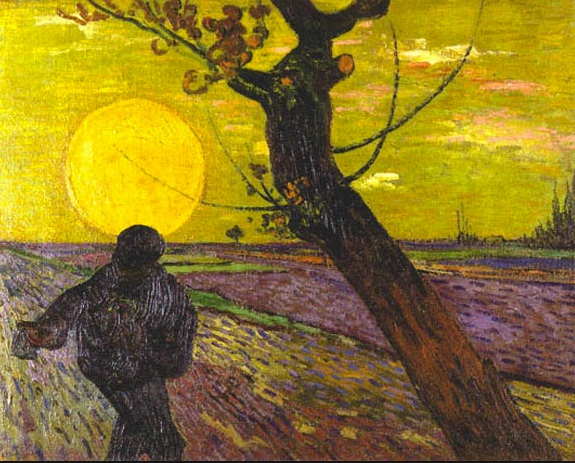
Sower


Yesterday I preached the homily at the Mass for Christian Burial for Father Quentin Amrhein, a Passionist priest who died at Queens Hospital, New York City, on July 31st and was buried at St. Paul’s Monastery, Pittsburgh, Pa., August 7, 2014. He was a member of the community at Immaculate Conception Monastery, Jamaica, New York, at the time of his death.

“Each of us is a witness to the gospel; we’re living gospels, however imperfect we may seem. What gospel did we see in Quentin?

We’ve been reading the parables of Jesus recently at Mass; the parable of the sower; the parable of the treasure hidden in the field, the mustard seed, the parable of the net cast into the sea. I wonder if Quentin’s life might tell what some of those parables mean. Parables need to be explained and sometimes the best explanation comes, not from books, but from people who are living gospels.

God the Sower is one of Jesus’ most important parables. He’s the sower who sows seed in the field of humanity. He never stops sowing; from the first moment of creation, from the first moment of our lives, God is at work sowing good seed. Sometimes the growth is quick and obvious, sometimes it isn’t. Sometimes the growth is delayed, but all our life long, God is the sower sowing good seed. And he doesn’t stop.

In a poem called “Putting in the Seed” Robert Frost describes what he calls “a farmer’s love affair with the earth.” It’s spring and getting dark, but the farmer keeps working his field. Someone from the house goes to fetch him home. Supper’s on the table, yet he’s a

“ Slave to a springtime passion for the earth.

How Love burns through the Putting in the Seed

On through the watching for that early birth

When, just as the soil tarnishes with weed,

The sturdy seedling with arched body comes

Shouldering its way and shedding the earth crumbs.”

Isn’t that a good image of God: a Sower, passionately in love with our world, casting saving grace on it in season and out, and watching it grow?

God blessed Father Quentin. He came from a good Pittsburgh family with strong Passionist roots. His grand uncle, Father Joseph Amrhein, served the Passionist community in Rome and in the United States. His uncle, Father Leonard Amrhein, was a missionary in China and then the Philippines. His younger brother, Raphael, was a Passionist priest, and his sister, Mary, was a Passionist Nun who died a missionary in Japan. Quentin was always proud and grateful for his family.

He was blessed by God with a keen mind and an exceptional memory. Those who knew him marveled at the way he recalled in detail things that took place 20, 30, 40 years ago. I remember him telling me the line-up of the 1944 Pittsburgh Pirates.

But much of Quentin’s life was clouded by sickness of one kind or another, which prevented him from doing many of the ministries a Passionist priest does. He loved preaching, yet for many years he wasn’t able to preach. He loved to study, and yet sickness kept him from doing that as well.

What we noticed in him in recent years, though, was not the sickness but the way he persevered through the suffering and disappointments that sickness brings. He wasn’t beaten by it; he fought the good fight. He was an exceptional fighter. At our wake service for him in Jamaica, a doctor and members of the medical community who cared for him through recent life-threatening crises spoke admiringly of Quentin’s determination to live. He came back again and again from death’s door.

How did he do it? Was it simply him? Was it his strong personality, good constitution, or German determination? We usually explain things like this in purely human terms.

Yet, if the gospel is at work in us, was God at work in him? Do we see in him God the Sower tending the life of his seed and seeing it grow?

Last week before he died, Father Quentin celebrated and preached at the community Mass at our Jamaica monastery. He hadn’t done that in years. The thirty of us who were there that day will remember that Mass for a long time, I think. It was a beautiful Mass: we were watching a promise come true. A resurrection, a Lazarus come to life.

It was like watching the birth of a seed, as Frost describes it in his poem:

“The sturdy seedling with arched body comes

Shouldering its way and shedding the earth crumbs.”

I said to Father Quentin after that Mass, “ I hope you are going to do that again.” “Yes, I am,” he said, “ the vicar has me down for celebrating Mass for the Feast of the Transfiguration.” Then he went on to tell me with his usual enthusiasm, how the Lord shares his glory with us as he did Moses and Elijah and the apostles. But first, we have to follow him in suffering, as he told his apostles when he predicted his passion to them.

Last Wednesday was the Feast of the Transfiguration, but Quentin was not going to preach that day. God was going to bring him up the mountain to share his glory with him.

We’re living gospels and Quentin was a gospel to us. He’s a reminder that God the Sower is always at work in the world, in a world where we think that people with long term disabilities are going nowhere, in a world where we think that life ends with youth, in a world where we think that suffering has no meaning, where we think there’s no resurrection and God has given up on us.

The Gospel of Quentin. I know he would be the last to call it his gospel, because he saw it as the gospel of Jesus, whom he served and love and prayed to and relied on all his life. Today as we commend him to God we read from the Gospel of John a passage he himself chose for this Mass.

“The hour has come for the Son of Man to be glorified. Amen, amen, I say to you, unless a grain of wheat falls to the ground and dies, it remains just a grain of wheat; but if it dies, it produces much fruit. Whoever loves his life loses it, and whoever hates his life in this world will preserve it for eternal life. Whoever serves me must follow me, and where I am, there also will my servant be. The Father will honor whoever serves me.”

The seed has fallen to the ground, but it will bear much fruit.”

(Vincent Van Gogh painted the Sower (above) many times and found the subject filled with spiritual significance. He once said “one begins to see more clearly that life is a kind of sowing time, and the harvest is not here.”).