We follow Christmas Day with the feasts of St. Stephen and St. John. The two saints seem to interrupt the Christmas narrative, but actually they help us understand the Christmas mystery.
The martyr Stephen, whose death St. Luke describes in the 6th chapter of the Acts of the Apostles, faithfully followed Jesus into the mystery of his death and resurrection. He is the first of many faithful followers to come, imitating Jesus, the Savior, who prayed and gave his life to save his people from their sins. Stephen points to the destiny of the Child born of Mary.
St. Fulgentius explains his place in the Christmas mystery:
“Yesterday we celebrated the birth in time of our eternal King. Today we celebrate the triumphant suffering of his soldier. Yesterday our king, clothed in his robe of flesh, left his place in the virgin’s womb and graciously visited the world. Today his soldier leaves the tabernacle of his body and goes triumphantly to heaven.
” Our king, despite his exalted majesty, came in humility for our sake; yet he did not come empty-handed. He brought his soldiers a great gift that not only enriched them but also made them unconquerable in battle, for it was the gift of love, which was to bring men to share in his divinity. He gave of his bounty, yet without any loss to himself. In a marvellous way he changed into wealth the poverty of his faithful followers while remaining in full possession of his own inexhaustible riches.
“And so the love that brought Christ from heaven to earth raised Stephen from earth to heaven; shown first in the king, it later shone forth in his soldier. Love was Stephen’s weapon by which he gained every battle, and so won the crown signified by his name. His love of God kept him from yielding to the ferocious mob; his love for his neighbour made him pray for those who were stoning him. Love inspired him to reprove those who erred, to make them amend; love led him to pray for those who stoned him, to save them from punishment. Strengthened by the power of his love, he overcame the raging cruelty of Saul and won his persecutor on earth as his companion in heaven.
( St. Fulgentius of Ruspe, on the Feast of St. Stephen)
The Feast of Stephen and other martyrs were listed after the Feast of Christmas in the Roman calendar of 336, the earliest calendar mentioning the Christmas feast. The first feast days celebrated by the church were Sundays and Easter. Then, the feasts of martyrs, like Stephen, appear; then the Christmas feast was introduced.
The martyrs offer and important dimension to the Christmas feast. They tell us that the Messiah came to take on the burden of a suffering world. He would experience the mystery of the Cross. Martys, like Stephen and the Holy Innocents, witness to him.
In the Church of San Stephano Rotondo in Rome, pictures of the death of Jesus and Stephen are placed side by side. The church also honors martyrs like Stephen in paintings on its walls.
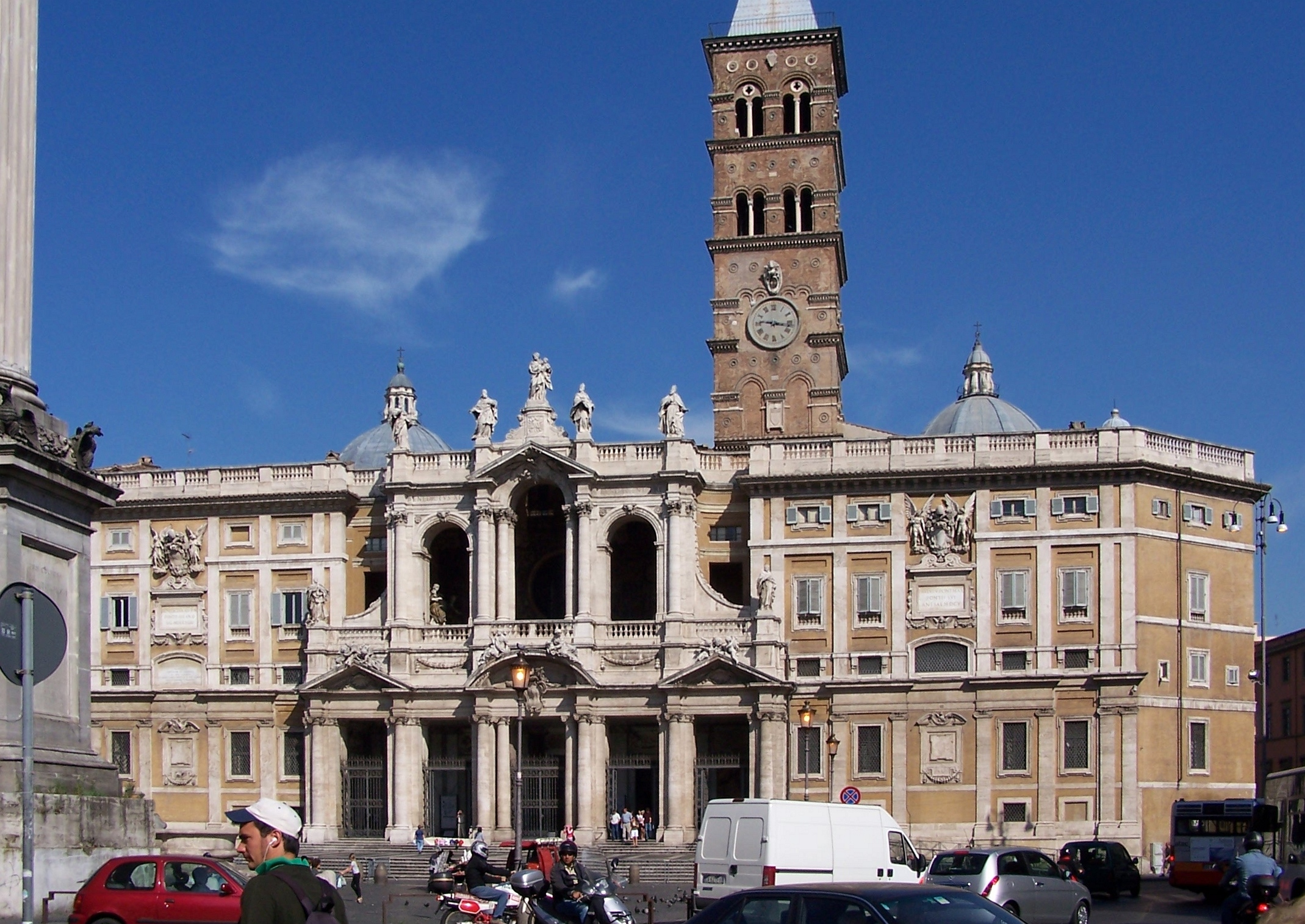
On the summit of the Esquiline Hill, a short distance from the Lateran Basilica, is the church of St. Mary Major, begun in the early 5th century and completed by Pope Sixtus III (432-440.)
Salus Populi Romani, c 5th century
Mary, the mother of Jesus, is honored here as the Mother of God. . In 431, the Council of Ephesus repudiated Nestorius, the patriarch of Constantinople, for refusing to call her “Mother of God.”
The title is important because it safeguards Christian belief in the mystery of the Incarnation: Jesus is God and man, the council said. For the Christian world Mary is the defender of Jesus, her son, who was both human and divine.
Devotion to Mary ran high in the Christian world after the Ephesus council, and churches dedicated to Mary arose everywhere. In the city of Constantinople alone, 250 churches and shrines in her honor were built before the 8th century. Pictures, icons of Mary holding her divine child multiplied, especially in churches of the East, where they became objects of special devotion.
Mary’s title, Mother of God, does not make her a goddess, otherwise how could she have given birth to Christ who is truly human? Yet, she can be called Mother of God, because Jesus who is truly her human son is truly Son of God from all eternity as well.
The 5th century, however, was hardly a good time to build a church in Rome. In 410, Alaric and his Goths shocked the Roman world by sacking a city all thought invincible. In 455 the Vandals under Genseric vandalized Rome. Twice more in the century other barbarian tribes invaded.
In far off Palestine St. Jerome cried out in disbelief at Rome’s misfortunes, which he saw heralding the end of the world. In Africa St. Augustine wrote “The City of God” in response to the followers of Rome’s traditional religions, who said Christian weakness caused the city’s devastation. Christians were not the cause of the city’s misfortunes, St. Augustine wrote; two loves are at work in the world building two cities. One love builds an evil city; Christianity builds the City of God, promoting love and justice.
The English historian Edward Gibbon called this period a time of decline and fall, the end of the Roman Empire. God’s plan does not lead to decline and fall, they say, but to triumph in Christ. God’s plan does not lead to decline and fall, they say, but to triumph in Christ. God’s plan does not lead to decline and fall, this church says. On the walls of St. Mary Major has stories from the Old and New Testaments calling for courage and hope.
In the church of St. Mary Major, Mary appears as Jesus’ mother and closest disciple. To use a phrase of St. Pope John Paul II, this church is “a school of Mary” who teaches mysteries she has learned. A noticeable number of women from the Old and New Testaments surround her: she represents those who seem powerless, but are empowered by God.
The great 13th century mosaic in the church’s apse of Mary crowned by Jesus Christ as heaven’s queen proclaims God’s triumph in her, but also his triumph in the church as well. She is taken up to heaven “to be the beginning and pattern of the church in its perfection, and a sign of hope and comfort for your people on their pilgrim way.” (Preface of the Assumption)
It shouldn’t surprise us that many of the mysteries in which Mary had a special role were first celebrated here as liturgical feasts. The Christmas liturgy, especially the midnight Mass on December 25th , began in this church in the 5th century and spread to other churches of the west.
A replica of the cave under the church of the Nativity at Bethlehem, the traditional site of Jesus’ birth, was constructed here early on.. After the Muslim conquest of the Holy Land in the 7th century, Christian refugees placed relics here purported to be from the crib that bore the Christ Child and relics of St.Matthew, an evangelist who told the story of Jesus birth.
Relics of the Crib from Bethlehem
Besides the Christmas liturgy, other great Marian feasts, such as her Immaculate Conception and Assumption, developed their liturgical forms in this church.
Built on a hill where all could see it, near Rome’s eastern walls so often threatened by barbarian armies, St. Mary Major affirms Christianity’s ultimate answer to its enemies. It is not military might, but the power of faith and love that triumphs in the end.
Visiting St.Mary Major
The church’s 18th century façade was built to enhance the appearance of this important church at a time when many visitors, especially from England and Germany, were traveling to Rome on the Grand Tour to visit its classical and religious sites.
The church’s interior, with its splendid 5th century mosaics along the upper part of the nave, retains its original form better than any other of the major basilicas of Rome.
The Sistine Chapel at the right hand side of the nave was built to house a silver reliquary with relics of the crib brought from the Holy Land in the 8th century. Two popes, Sixtus V and Pius V are buried there.
The Borghese Chapel at the left hand side of the nave honors the ancient icon of the Virgin and Child,”Salus populist Romani”, that Roman Christians have reverenced for centuries. A reproduction of the icon is a nice remembrance to bring home. Pope Francis has requested to be buried here.
The magnificent 13th century mosaic in the apse of the basilica presents the Coronation of Mary in heaven. It’s surrounded by 5th century mosaics depicting scenes from the birth of Jesus and the life of Mary.
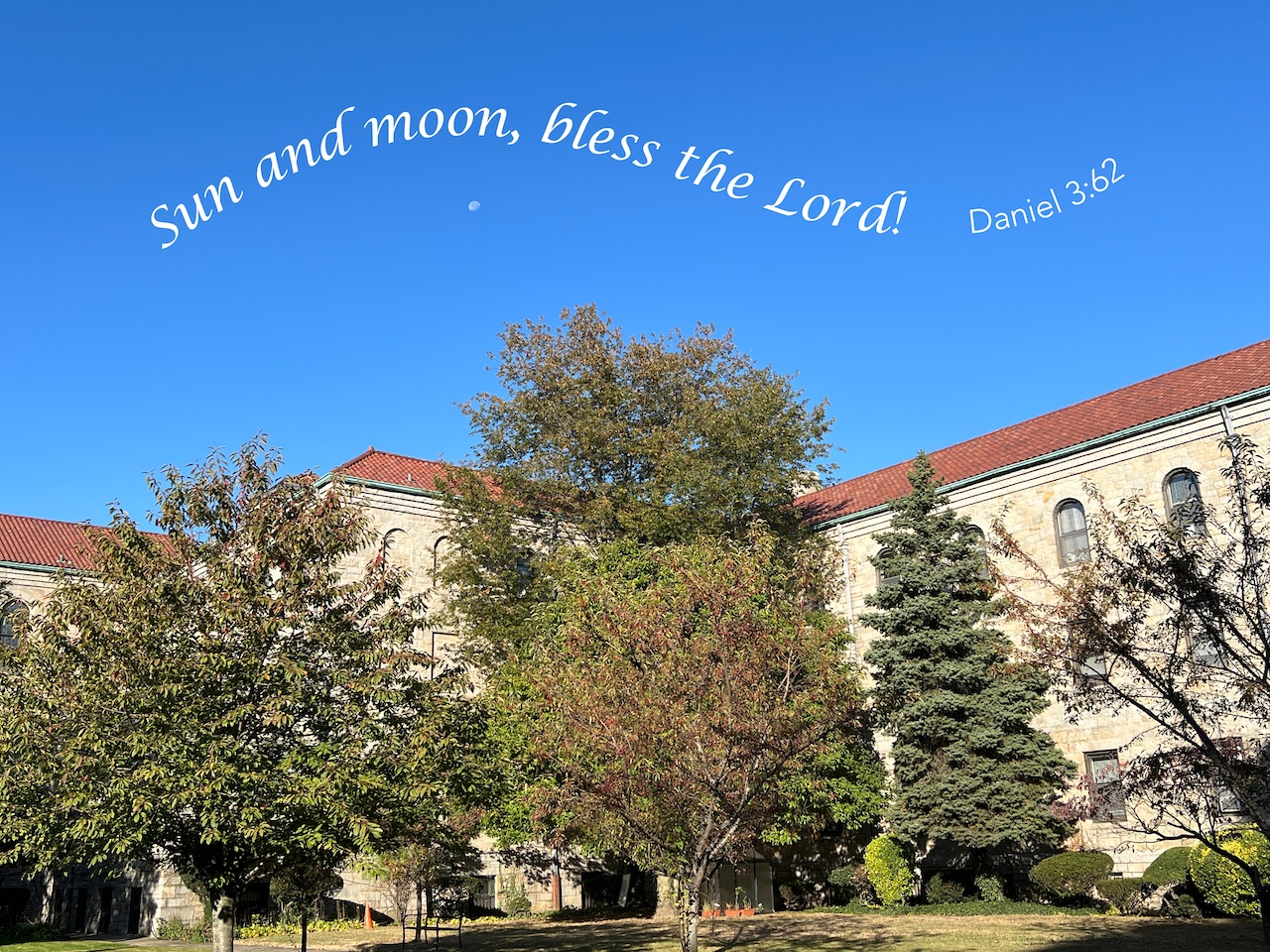
A monastery is a house of prayer to pursue the “happy” or blessed life. Our Passionist priests and brothers in Jamaica, NY faithfully pray the Liturgy of the Hours every morning and evening, which prepares them to give the bread of the Word and the Eucharist at Mass and to serve in various ministries. Prayer and the Eucharist, the daily bread of apostles, fuel works of mercy.
In a letter to a Roman noblewoman named Proba, St. Augustine offers valuable insights on prayer. The bishop of Hippo, whose rule of life continues to guide monastic communities today, understood the value of “prayer at appointed hours.” Although he was an extremely busy bishop, St. Augustine kindled his desire for God throughout the day by lifting his heart in prayer from sunrise to sunset. Forgetfulness of God in the midst of constant work makes the heart “lukewarm” and “chill” over time.
Thankfully, we can redeem the time. As the earth revolves around the sun, children of God revolve in the orbit of the Blessed Trinity. Space and time, the materials of our journey from birth to eternity, belong to the Father, Creator of all things through his Word and Spirit. Jesus, who frequently spent the night in prayer, models our way home to the Father.
Can one pray during a busy schedule? St. Augustine teaches that “even in these actions” (work responsibilities), we pray by continually longing for God. Many words are unnecessary. The desert monks discovered that short but frequent prayers, “hurled like swift javelins,” keep the heart and mind fixed on the Lord.
“Ask and it will be given to you; seek and you will find; knock and the door will be opened to you” (Matthew 7:7). Persistence in prayer with sighs and tears unite us with the ineffable God, “for he has established all things through his Word and does not seek human words.” As a monastery is a house of prayer, so are all of us “temples” of prayer in the Holy Spirit (Romans 8:26-27).
The Passionists Pray website offers resources for daily prayer, which can be accessed here.
From a letter to Proba by Saint Augustine, bishop
Let us turn our mind to the task of prayer at appointed hours
Let us always desire the happy life from the Lord God and always pray for it. But for this very reason we turn our mind to the task of prayer at appointed hours, since that desire grows lukewarm, so to speak, from our involvement in other concerns and occupations. We remind ourselves through the words of prayer to focus our attention on the object of our desire; otherwise, the desire that began to grow lukewarm may grow chill altogether and may be totally extinguished unless it is repeatedly stirred into flame.
Therefore, when the Apostle says: Let your petitions become known before God, this should not be taken in the sense that they are in fact becoming known to God who certainly knew them even before they were made, but that they are becoming known before men through boasting.
Since this is the case, it is not wrong or useless to pray even for a long time when there is the opportunity. I mean when it does not keep us from performing the other good and necessary actions we are obliged to do. But even in these actions, as I have said, we must always pray with that desire. To pray for a longer time is not the same as to pray by multiplying words, as some people suppose. Lengthy talk is one thing, a prayerful disposition which lasts a long time is another. For it is even written in reference to the Lord himself that he spent the night in prayer and that he prayed at great length. Was he not giving us an example by this? In time, he prays when it is appropriate; and in eternity, he hears our prayers with the Father.
The monks in Egypt are said to offer frequent prayers, but these are very short and hurled like swift javelins. Otherwise their watchful attention, a very necessary quality for anyone at prayer, could be dulled and could disappear through protracted delays. They also clearly demonstrate through this practice that a person must not quickly divert such attention if it lasts, just as one must not allow it to be blunted if it cannot last.
Excessive talking should be kept out of prayer but that does not mean that one should not spend much time in prayer so long as a fervent attitude continues to accompany his prayer. To talk at length in prayer is to perform a necessary action with an excess of words. To spend much time in prayer is to knock with a persistent and holy fervor at the door of the one whom we beseech. This task is generally accomplished more through sighs than words, more through weeping than speech. He places our tears in his sight, and our sighs are not hidden from him, for he has established all things through his Word and does not seek human words.
Reference
The passage from St. Augustine can be found in the Office of Readings for Monday of the 29th Week in Ordinary Time.
The sky over the boardwalk at Spring Lake, New Jersey, is sometimes swept with colors before nightfall. Then, a lamp becomes the only light till dawn.
“I came into the world as light,” Jesus says in today’s gospel” so that everyone who believes in me might not remain in darkness.( John 12:44-50)
The sun will rise again and the great Sun will also rise again, Augustine says in one of his sermons. Then “lamps will no longer be needed. When that day is at hand, the prophet will not be read to us, the book of the Apostle will not be opened, we shall not require the testimony of John, we shall have no need of the Gospel itself. Therefore all Scriptures will be taken away from us, those Scriptures which in the night of this world burned like lamps so that we might not remain in darkness.”
Darkness is temporary; we are meant for light.
“I implore you to love with me and, by believing, to run with me; let us long for our heavenly country, let us sigh for our heavenly home, let us truly feel that here we are strangers. What shall we then see? Let the gospel tell us: In the beginning was the Word and the Word was with God and the Word was God. You will come to the fountain, with whose dew you have already been sprinkled.
“Instead of the ray of light which was sent through slanting and winding ways into the heart of your darkness, you will see the light itself in all its purity and brightness. It is to see and experience this light that you are now being cleansed. Dearly beloved, John himself says, we are the sons of God, and it has not yet been disclosed what we shall be; but we know that when he appears we shall be like him, because we shall see him as he is.
“I feel that your spirits are being raised up with mine to the heavens above; but the body which is corruptible weighs down the soul, and this earthly tent burdens the thoughtful mind. I am about to lay aside this book, and you are soon going away, each to his own business. It has been good for us to share the common light, good to have enjoyed ourselves, good to have been glad together. When we part from one another, let us not depart from him.”
Prayer is more than looking for something, like a cure for sickness or getting a job., In prayer we search for something we do not even understand. It’s a hope we have for something beyond anything we know, St.Augustine writes to Proba, a woman asking him about prayer.
“There is one thing I ask of the Lord. This I seek: to dwell in the house of the Lord for years to come. To gaze on the loveliness of the Lord…” The psalms express that hope..
We have an “instructed ignorance,” the saint says, and the Spirit of God helps us in our weakness.
“The Spirit pleads for the saints because he moves the saints to plead… to plead with sighs too deep for words by inspiring in them a desire for the great and as yet unknown reality that we look forward to with patience. How can words express what we desire when it remains unknown? If we were entirely ignorant of it we would not desire it; again, we would not desire it or seek it with sighs, if we were able to see it.”
This weekend we had a program at our monastery in Jamaica, New York, entitled Pope Francis’ Encyclical Laudato Si and the Wisdom of Thomas Berry, Passionist. The main presenters were Mary Evelyn Tucker and John Grim, senior lecturers and research scholars at Yale University.
The program began Friday evening with the award-winning film “Journey of the Universe” produced by Tucker and Grim along with Brian Swimme, which brilliantly portrays the story of our universe as science today explains it. On Saturday Mary Evelyn and John lectured on the pope’s encyclical, the influence of Thomas Berry and the contribution of native peoples to the critical question of the environment. I was among the commentators responding to their presentations:
I was one of Fr. Thomas Berry’s first students. It was at Holy Cross Preparatory Seminary in Dunkirk, NY in 1950. It’s usually not noted in biographical material about him, but Tom taught history to seminarians that year and I was in his class.
I remember the first day he came into class with a stack of booklets in his hands. “We have to know what’s going on today in the world,” he said, “and so we’re going to study The Communist Manifesto.”
Now remember, this was 1950. Senator Joe McCarthy had begun a witch-hunt to root out Communist sympathizers and I think The Communist Manifesto was on the church’s list of forbidden books. We studied it.
Yet, Tom never mentioned Joe Mc Carthy or the threats of a Communist takeover in Europe or what was happening then in China. No, he was interested in where the Communist Manifesto came from. Beyond Karl Marx and Lenin, he traced it back to the Jewish prophets and their demands for justice for the poor and human rights. The long view of history was what interested him.
After the Communist Manifesto, we studied St. Augustine’s City of God. Two loves are building two cities, Augustine said. Again, Tom didn’t dwell much on the historical events used by Augustine to illustrate his theory of history. It was the overall dynamic of the two loves in conflict over time that interested him.
From Augustine, we studied Christopher Dawson and his book The Making of Europe. Dawson, one of the 20th century’s “meta-historians,” wasn’t interested only in Europe; he was interested in the whole panorama of civilizations that came before it. That was Tom’s interest too.
As far as I remember, Tom didn’t speak of the universe and its evolution, his focus in later years, yet you could see him heading that way. He had a mind for the long view of things.
Pope Francis in Laudato Si also has a mind for the long view of things, it seems. The pope doesn’t quote from The Communist Manifesto, but he insists, more strongly than the manifesto, on the rights of the poor, to which he joins a strong insistence on the rights of the earth.
Can we also hear echoes of Augustine’s City of God in Laudato Si? I think so. The pope speaks of two loves in conflict. There’s the love that builds the city of man. How describe it today? How about blind consumerism; we love things too much. We love our vision of material progress too much. We love our technology too much. We love our control over the earth too much. We love ourselves too much. The result is “global indifference” to an environment falling apart. (Laudato Si, 9,14)
Opposing that love is a love the pope sees in Francis of Assisi, “who was particularly concerned for God’s creation, for the poor and the outcast…he would call all creatures, no matter how small, by the name of ‘brother’ or ‘sister’… If we approach nature and the environment without this openness to awe and wonder, if we no longer speak the language of fraternity and beauty in our relationship with the world, our attitude will be that of masters, consumers, ruthless exploiters, unable to set limits on their immediate needs.” (LS, 13)
Berry, like the pope in Laudato Si, accepted science’s view of our environment, yet also like the pope he distanced himself from a major trait of the era of the Enlightenment which unfortunately causes us in the western world “to see ourselves as lords and masters of our environment, entitled to plunder her at will.” (LS, 2)
Science teaches us a lot about our environment and its perilous condition today, but knowledge is one thing and love is another. Two loves are at work. Love doesn’t always follow what we know, especially if our hearts are fixed on something else. Love is hard to change.
I heard the preachers and teachers and ordinary folk in the workshops that followed our workshop presentations bemoan the poor reception the pope’s encyclical has received so far. Why isn’t the environment a critical issue in our parishes, in the media and in the political world? Why aren’t we undergoing what the pope calls “an ecological conversion?”
There are many reasons, I suppose, but one thing seems sure. It’s not going to happen overnight through some quick fix. We need to get ready for the long haul. And what does that mean? We need wise teachers and leaders to guide us, like Thomas Berry and Pope Francis.
“The present time is not a time for desperation, but for hopeful activity.” Thomas Berry, CP
A story’s told that St. Augustine, the great philosopher and intellectual, was walking along the seashore one day when he saw a little boy playing in the sand, taking water from the sea in a small bucket and pouring it into a hole he had dug. Back the forth the boy went.
“What are you doing?” Augustine asked, “Do you think you can put the whole sea into that little hole?”
“No,” the little boy answered, “And neither can you put God into that small mind of yours no matter how smart you think you are.”
The story reminds us that our minds are limited before the mystery of God, even the smartest, most brilliant mind. God is beyond us. The Feast of the Holy Trinity is, first of all, a reminder of our limits before the mystery of God.
And yet, this feast also says that God invites us to know him, as Father, Son and Holy Spirit. As Father, God is the creator of heaven and earth. All creation ultimately comes from God’s hand. Creation itself is God’s gift; through the created world we come to know God.
God has also invited us to known him in Jesus Christ, who was born of Mary over two thousand years ago, who walked this earth and died on a cross, who rose from the dead and remains with us. We have his words, his actions, his promises. He’s our Savior and Redeemer, a sign of God’s love; he’s promised us life eternal..
The Holy Spirit also is God with us, within us, guiding us and our world to our common destiny.
Yet, though God reveals himself, we’re still like the little boy on the seashore. We’re looking at an unmeasured sea that we approach with the little buckets of our minds. We can’t grasp it all. Even the most accessible person of the Trinity, Jesus Christ, remains a mystery to us.
Remember the story of the conversion of Paul the Apostle. Saui, the unbeliever, was on his way to the City of Damascus to persecute the followers of Jesus, when suddenly a blinding light throws him from his horse. “Who are you, Lord?” Paul cries out. “I am Jesus whom you persecute, “ the voice from the blinding light says.
Jesus Christ is like the blinding light of the sun. Yes, he is human like us, but he shares in the nature of God, who is brighter than sunlight. He blinds us when we try to see him. God dwells in light inaccessible, the scriptures say, and so even though we know much about Jesus, even though the scriptures and great saints and scholars describe him, he’s still beyond anything we can know.
Like the sun, Jesus is a blinding light, and yet, paradoxically, his light shines into the darkness of creation to give life and light. St. John says: “No one has ever seen God. The only Son, God, who is at the Father’s side, has revealed him.” (John 1,18)
As people of faith we’re not like those who say you can’t know God at all or like those who say God doesn’t exist because my mind cannot grasp him. Yes, we have to admit that we are children of the Enlightenment, that movement in our western world that says there’s no need to pay much attention to God. Pay attention to the world at hand. Pay attention to yourself. That’s what’s important.
As people of faith we know God is important. God reveals himself to us little by little. God is the most important reality we can know and love.
The Feast of the Holy Trinity is a reminder of God’s invitation to know him, to serve him in this life, to pray to him and to be with him one day where we will know him much more. It’s an invitation God extends every day, all our lives. Father, Son and Holy Spirit.
.
I celebrated a Memorial Mass for one of my oldest friends, Gene Callahan, at St. Mary’s Church in Bayonne, NJ on Saturday, June 13, 2015 at 10 o’clock. We had been friends since the 1st grade at St. Mary’s Grammar School. Gene had a successful career as a banker at Citibank in New York until his retirement some years ago. He never married but he was devoted to his family. His 8 nephews and nieces were there for the Mass, with some of their children and spouses. Three classmates from high school days were there too and a few other friends.
After Mass we gathered for a meal at a restaurant on 2nd Street in Bayonne and told stories about him. There were plenty of them.
I preached this homily at the Mass:
A few weeks ago I went with a family after a funeral Mass to bury their loved one in a cemetery near Paramus, NJ. As we drove to the grave in the cemetery we couldn’t help but notice a large family– dressed like people from the Middle East–having a big picnic at one of the gravesites. It was a big party; they were eating and drinking and having a good time.
The people with me were taken aback by it all. I said, “I think I know what this is. It’s a funeral banquet.” It’s common in some older cultures to gather at the anniversary of death at the gravesite of your family and have a big meal and remember them. In the catacombs in Rome, for example, where the early Christians buried their dead, you can see frescoes of funeral banquets like that, which took place at the gravesites.
In his Confessions (Book 9, 8 fl ), St. Augustine says that his mother, St. Monica, used to go to funeral banquets all the time. Monica had a little drinking problem, according to Augustine, and the bishop Ambrose told her to stay away from funeral banquets. In fact, he tried to ban them altogether. Better to remember your dead at Mass, he said. That’s what Monica asked her son to do for her, as she was dying. “Bury this body anywhere; I don’ t care where. I only ask you this: Remember me at the altar of the Lord, wherever you may be.”
Now, I’m telling you this story because Gene loved stories like that. It would capture his imagination. More importantly, I’m telling you this story because we gather for this memorial Mass at an important place in Gene’s life. This church, St. Mary’s, was dear to him; it’s a place where we can call upon his presence and remember him.
There’s an Irish belief that there are “thin places” in the world. Thin places are where heaven and earth meet. Thin places are where the past, the present and the future are able to come together. This church is a thin place for many of us. Irish immigrants built it as you might guess from the number of statues and paintings of St. Patrick around it. It’s a place where we recall things of the past, where we look at the present and where we look to a world beyond.
So many of the important times of Gene’s life took place here. He was baptized here, he made his First Communion here, he buried his mother and father, his cousins Rose and Florence, many of his friends here. His sister Marie, his brother Joe were regulars in this church as youngsters, and so was I. As kids in St. Mary’s school we were here for the 9 o’clock Children’s Mass each Sunday, with the nuns patrolling the aisles. God help you if you weren’t here. I can still remember the glorious melodies of the chants we sang here, in latin.
A couple of years ago, Gene and I came over to Bayonne to see if it were still here. Bill Dundas met us at the new light rail station at 22nd Street and for the day drove us through Gene’s Bayonne. He had a remarkable memory and love for this place and its people, famous and infamous. The day was a feast of memories. He told us about driving his little nephews and nieces, the Carrol kids and the Callahan kids, through the streets in his little black Volkswagon with the skylight open and telling them to stick out their heads and yell to anyone he knew. He remembered telling them stories, some true some not, about the wonders of Bayonne, and waiting to see if they would bite. He loved to tease.
That day we couldn’t get into this church; it was locked, and that was a disappointment to him.
So where is he now? If we stay only with memories of the past we miss what this thin place wants to tell us. The windows here recall the mysteries of the life, death and resurrection of Jesus Christ. They’re not about the past, the mysteries of Jesus are our mysteries too. At baptism we became one with him. He is our hope.
If we look further there’s the altar where the bread and the wine will be brought and the same Lord of life and death will be here with us. “Take and eat,” he says. The great window over the altar points to a heavenly world. Death is not the end, it says. The journey of our life leads us to another life, beyond what we expect or understand, and Gene has entered it.
We come to pray for him here.
O God, in whose presence the dead are alive,
and in whom your saints rejoice full of happiness,
grant that your servant, Gene,
for whom the light of this world shines no more,
may enjoy the comfort of your light for all eternity.
through our Lord Jesus Christ,
who lives and reigns with you
in the unity of the Holy Spirit,
One God, forever and ever. Amen
A few days before he died, I visited Gene at New York Hospital. His nieces Mary Elllen and Ann were there. It was a wonderful visit. In spite of his weakness and difficulty in breathing and swallowing, Gene was at his best conjuring up his mix of memories, of family stories and Bayonne gangsters. It all had to be said.
When I was leaving, I said “Gene, I’ll be back to see you soon.” He said “Joe, when you come, bring me Holy Communion.” I wasn’t able to bring that to him before he died.
But today, here it is.
Lord God, whose Son left us
In the Sacrament of his Body,
Food for the journey,
Mercifully grant, that strengthened by it,
Our brother, Gene,
may come to the eternal table of Christ,
who lives and reigns forever and ever. Amen
Church and Monastery of Saints John and Paul, Rome
The 5th century church of Saints John and Paul stands on the western spur of the Coelian Hill near the center of imperial Rome, across from the ruins of the emperors’ palaces on the Palatine Hill, the Roman forum and the Colosseum.
The Coelian Hill was an important area in early Christian Rome. In imperial times, wealthy senatorial families lived in quiet walled mansions on the hill. The Emperor Marcus Aurelius (160-180 AD) was raised on the Coelian Hill. Apartment houses (insulae) for the middle class and the poor stretched along the roads crossing it. A garrison of imperial troops was stationed there. Some Christians were among these various groups on the hill early on.
Constantine (312-337 AD) built a baptistery, a residence for the pope and the impressive Lateran Basilica on the eastern spur of the Coelian on land he confiscated from his enemies after conquering the city in 311 AD. The bishops of Rome resided on the Coelian from the 4th to the 14th century, then they moved across the city to the Vatican.
Other prominent Christians were assocated with the Coelian Hilly by the 5th century, when the Church of Saints John and Paul was built. The area was a lively spiritual and intellectual center attracting figures like St. Jerome, St. Augustine and spiritual teachers from the Egyptian desert who frequented the homes and churches on the Coelian.
St. Melania the Younger (+439), from one of Rome’s richest families, lived near Saints John and Paul. Shortly before Alaric’s army invaded the city in 410 she sold her home and lands and left for Africa with her husband to be near Augustine and his community at Hippo. Eventually, Melania began an important monastery for women on the Mount of Olives in Jerusalem.
The lands next to Saints John and Paul belonged to the wealthy Christian family of St. Gregory the Great (590-604 ) which gave the church two popes before Gregory: Pope St. Felix III (483-492) and Pope St. Agapitus (535-536), Gordian, the father of Agapitus, was a priest of the Church of Saints John and Paul. A splendid Christian library–its ruins visible today across the Clivus Scauri from the church– may go back further than its patron, Agapitus. The Church of St. Gregory the Great stands opposite to the Church of Saints John and Paul.
After Constantine freed Christianity in 312 AD, Christians from the Coelian must have taken part in an effort to win over to Christianity the powerful Roman majority that remained distant and sometimes resentful of the new faith. The Church of Saints John and Paul must have been part of an effort of Christian evangelization.
Before 312 AD, Christians promoted their faith cautiously; now they presented it boldly, using the Christian scriptures freshly translated by St. Jerome, along with his learned commentaries. The new faith, St. Augustine argued in his City of God, far from causing the empire to fall, offered it a powerful new wisdom it needed. Roman Christians confidently believed they had something to say to their city and made their appeal from splendid new churches, rivaling Rome’s temples and shrines.
Was the church of Saints John and Paul – the first to be built in the “show area” of the imperial city, next to the Roman temple of Claudius, close to the Roman forum, the heart of Rome – an example of this new Christian assertiveness? Until then, so as not to offend the Roman majority, new Christian buildings were confined to the city’s edge (the Lateran Basilica is an example). Was the church a visual statement that Christianity had arrived?
The builder of Saints John and Paul was a one-time leader of the Roman senate, Pammachius (340-410 AD). His wife was Paolina, daughter of the influential noblewoman St.Paula, who accompanied St. Jerome to the Holy Land. They had no children, and when Paolina died in 360 Pammachius dedicated himself to the spiritual life, promoting scripture study and caring generously for the poor. St. Jerome, a long-time friend and regular correspondent, admired the Roman nobleman’s deep faith and keen mind. Another friend, St. Paulinus of Nola, called Pammachius the “most generous patron the church could have.”
Pammachius built his 5th century church using as its foundations three existing buildings, two of them 3rd century apartment houses facing the Clivus Scauri. Most likely, the Roman senator, saw the church as a spiritual and intellectual beacon in the heart of the city.
Pammachius died in 410 AD, the year Alaric and the Goths invaded Rome, creating panic and uncertainty in the city. Many of the inhabitants on the Coelian Hill fled to safety beyond Rome or to other parts of the city. Almost a century later the great Christian scholar Cassiodorus speaks regretfully of abandoning a joint project to promote Christian learning which he planned to undertake with Agapitus, whose great library stood across the street from Pammachius’ church.
As we have already said, the present 5th century church is built on the structures of some houses that can still be seen beneath it. There’s evidence that Christians met in one of these houses, a “house church,” bearing Pammachius’ name. It’s listed among the twenty five early Christian house-churches that existed in the city.
Pammachius’ house-church had another distinction. Bodies of Christian martyrs were buried and honored there, even before the upper basilica was built. Two soldier martyrs, John and Paul, said to have been put to death by the Emperor Julian the Apostate in 362, are the most prominent of the group. By the time of the church synod in Rome in 595, the church of Pammachius was also known as the Church of Saints John and Paul.
Scholars are still puzzled by the stories of the martyrs, John and Paul. Different versions have appeared, the earliest from the 6th century. According to the earliest “Passion” (an account of martyrdom), John and Paul were two Christian officers of the Emperor Constantine, who made them guardians of his daughter, Constantia. Thanks to his generosity, the two brothers bought a house on the Coelian Hill and retired there.
When Julian the Apostate, became emperor, he called the two brothers back into imperial service as his aides. But they refused, because the emperor had betrayed the Christian faith into which he was baptized. Julian, incensed at their refusal, gave them ten days to reconsider; unless they complied with his request, he would charge them with impiety, which was punishable by death. During the next ten days, the brothers prepared for their martyrdom by giving away their possessions to the poor.
Fearful that open persecution would antagonize the Christians, Julian chose to deal with the two soldiers privately. So he sent one of his captains, Terentianus, to their home to command obedience from them and to sacrifice to the gods. When they remained firm, they were beheaded and secretly buried in their home. To cover up their death, officials started the rumor that they were sent into exile. Three other Christians, the priest Crispus, the cleric Crispinianus and the woman Benedicta were martyred along with the brothers.
Shortly afterwards, the truth came out, and John and Paul, as well as the others, were honored at a shrine built over their graves in the apartments along the Clivus Scauri, which may have been their home. Later, a stairway connected the shrine to the church built above.
The cult of the two soldier saints grew as miracles were reported through their intercession. By the 6th century, their names were listed in the ancient Roman Canon; their feast was celebrated in Rome, Milan and Ravenna on June 23rd, which may be the day of their martyrdom.
The two martyred soldiers would have been favorites of the soldiers stationed on the Coelian Hill, who passed their shrine on the Clivus Scauri regularly. They also reminded Christians of Pammachius’ day – who were becoming increasingly more comfortable in Roman society after the years of persecution – that those who follow Jesus must be ready to bear their cross.
Churches share the fate of the places where they are built. The church of Saints John and Paul’s fortune changed following the invasion of the Visigoths in 410. Other barbarian invaders swept through the empire after them, and Rome’s population dwindled from about 800,000 in 400 AD to perhaps 100,000 by 500 AD. Most of the wealthy families from the Coelian fled to the safety of Constantinople or Ravenna. The remaining population either moved from the city or relocated in its westward section, leaving the hill largely abandoned and depopulated. It remained that way until the end of the 19th century.
After a brief shining mement as a center for early Coelian Christians, the Church of Saints John and Paul came under the papal court located at the Lateran area nearby, and depended upon the fluctuating resources of the popes of the time. An annotation from the Liber Pontificalis in the 8th century says that Pope Hadrian I (772-795) “began to renovate the titulus Pammachii, of Saints John and Paul, which had become run down over the years.” Through the dark ages, to medieval times, until today, the church was kept standing by popes, cardinal protectors, religious communities and benefactors who mended, altered or restored its fabric.
By the 6th century, Saints John and Paul was no longer a thriving parish church, but an isolated martyrs’ shrine in an abandoned area of the city. Yet, as Rome under the popes of the 7th century became a magnet for pilgrims flocking to the city’s shrines (especially the shrines of St. Peter and St. Paul), the church of the soldier martyrs on the Coelian Hill also attracted visitors.
Church of Saints John and Paul, c.16 century
From the 11th to the 13th centuries, cardinal protectors provided the popular church with a beautiful bell tower, solid walls and enlarged monastic buildings. Pilgrim guidebooks of the time give the church a place of honor because, uniquely, it contained martyrs’ tombs within the city walls. The 12th century historian and guide, William of Malmesbury, writes: “Inside the city, on the Coelian hill, John and Paul, martyrs, lay in their own house, which was made into a church after their death.”
From the 8th century onward, monastic and religious communities took up residence next to the shrine. The latest religious community making a home there is the Passionists whose founder, St. Paul of the Cross, was a zealous Italian preacher and mystic of the 18th century. Pope Clement XIV, because of his friendship and admiration for the saint, asked him in 1773 to take over the ancient monastery and church. With seventeen Passionist religious, Paul moved into the monastery of Saints John and Paul, and it has been the seat of administration for his worldwide congregation ever since. Paul spent his last years and died there on October 18, 1775.
Paul of the Cross was proclaimed a saint on June 29, 1867. On April 25, 1880 his remains were brought to the beautiful classical chapel built in his honor on the right hand side of the basilica of Saints John and Paul. The rooms where he lived and died, overlooking the piazza, are carefully preserved in the old monastery. Besides the saintly founder, other Passionists honored by the church are associated with the place. Among them are: Saint Vincent Strambi (1745-1824), former superior of Saints John and Paul, who was named Bishop of Macerata and suffered during the Napoleonic occupation; Blessed Dominic Barberi (1792-1849), who received John Henry Newman into the Catholic Church; Blessed Bernard Mary Silvestrelli (1831-1911), a superior general of the Passionists who prepared for their worldwide expansion in the 20th century; and Blessed Eugene Bossilkov, a Passionist Bishop martyred by the communists in Bulgaria in 1950.
Today the monastery is a residence for Passionist students from many countries and also the site of the community’s administration. In the late 19th century, a Passionist religious, Father Germano Ruoppolo (1850-1909) conducted extensive excavations under the church. He uncovered the remains of the early 2nd and 3rd century apartments and homes that were the foundations of the later basilica, as well as the streets of the ancient site and the confession where the martyrs were honored. Father Germano was also the spiritual director of St. Gemma, an Italian mystic who, from her childhood, was devoted to the mystery of the Passion of Jesus. Today, she is buried in a shrine named in her honor in Lucca. Not far from her rests the body of her saintly guide, Father Germano, Passionist; his own cause for canonization is in process. Father Germano’s successor in the excavations at Saints John and Paul was Passionist Brother Lambert Budde, who worked there from 1909-1911.
Further explorations were conducted from 1956-1958 through the generosity of Francis Cardinal Spellman of New York and Joseph P. Kennedy, father of President John Kennedy. Cardinal Terence Cooke and Cardinal John O’Connor, successors to Cardinal Francis Spellman as archbishops of New York, also had title to this important Roman church..
Visiting Saints John and Paul The bell tower was built in the 12-13th century over the travertine foundations of the 1st century Temple of Claudius and the Claudianum. The large sunken door to the left of the bell tower on the piazza leads to an ancient street before the Claudianum. The buildings to the left of the bell tower belong to the 11-12 century Monastery of Saints John and Paul, built by Cardinal Theobald. Its original entrance, now enclosed, is seen to the right of the narthex (or porch at the entrance to the basilica) on the piazza. The double-arched windows above the door to the Claudianum mark the room where St.Paul of the Cross died. (October 18,1775) The narthex was constructed by Cardinal di Sutri in the middle of the 12th century to protect pilgrims from the weather. Above it is the 13th century gallery, built by Cardinal Savelli, who became Pope Honorius III. The five large pillars above columns on the upper facade of the basilica are from the original 5th century basilica.The large round dome to the right of façade was constructed in the 19th century as part of the shrine to St.Paul of the Cross. On the left hand side of the basilica is the ancient street, Clivus Scauri, connecting the Coelian Hill to the Palatine Hill. Spanned by seven brick arches that buttress the 5th century church, the road runs past the 3rd century apartment houses on which the church is built, parts of which can be seen in the church’s foundations. The excavations under the church can be visited from an entrance on the Clivus Scauri. Inside the church, the story of Saints John and Paul is told in the paintings in the apse. There is a painting of Pammachius above an altar to the upper right of the church.
Do you pray? Often or just occasionally? Is prayer important to you?
These are essential questions for our life of faith. Like breath in the human body, prayer makes our spirits live. Without it, they die. Prayer helps us live and grow spiritually.
Why pray?
Prayer is God’s Gift
Prayer is a gift of God. “Gift” is a good word to describe prayer, because praying is not something we can do ourselves. ” We do not know how to pray as we ought,” scripture says. (Romans 8,26) God gives this gift to us.
Why? Because God loves us and wants to draw near to us as a friend. How strange that sounds! God all-sufficient, all-powerful, all-knowing, wants to draw close to be our friend. God calls us his friends and looks for our company and hears our prayer. What seems unbelievable is true.
At the same time, prayer fulfills a desire we have as human beings to know God. We’re made in God’s image, and something in our being thirsts for the One who made us. It’s a thirst described in the psalms:
“O God, you are my God, for you I long. For you my soul is thirsting. Like a dry weary land without water… so my soul longs for you, my God.”
We can’t be satisfied unless we are draw near to God. “Our hearts are restless,” St. Augustine says, “until they rest in you.” When we pray, we rest in God.
God gives that gift generously, without considering our worthiness or unworthiness. Sinners as well as saints can pray. People of every religious tradition, or no religious tradition at all, receive the gift. It’s given to every human being. We’re all called to pray.
(cf. The Catholic Catechism: The Universal Call to Prayer. 2566-2567)
All are called to pray
“All” are called to pray. Surprisingly, some who think they are unworthy or ungifted may pray best and be graciously heard. That’s what Jesus taught in his parable about the Pharisee and the Publican who together went up to the temple to pray. The Publican, an outsider who thought himself unworthy of approaching God in prayer, was found more pleasing by God than the Pharisee, a professionally religious person, who seemed to pray so effortlessly. (Luke 18,9-14)
Prayer is God’s gift to the strong and the weak, to the smallest child and frailest of the old. It’s given to those who say, ” I’m not really religious; prayer is beyond me.” It’s given to you, no matter who you are.
That’s not to say we can’t refuse to pray or neglect it. Like any gift, prayer has to be received and, as we know, we can throw gifts away. “If you knew the gift of God,” Jesus said to the Samaritan woman at the well. A Gift was there before her eyes. At first she was blind to it, then she enthusiastically received it.
Don’t go through life leaving the gift of prayer unused. Thankfully, it’s always there to be taken up!
In the prayers of the church, you often find an acknowledgment that prayer is God’s gift and a request that God give and strengthen that gift in us. At the beginning of her daily prayers, the liturgy of the hours, the church prays two verses of the psalms.
O Lord, open my lips
and my mouth shall proclaim your praise.
O God, come to my assistance.
O Lord, make haste to help me.
Simple, truthful words. I cannot open my lips in prayer unless God give me the gift. O God, come and assist me; help me approach you.
God graciously gives us this beautiful gift, hastening to help us open our lips and our hearts. Delighting to give us the gift of prayer, God welcomes us into his presence to share his life with ours, his love with our love.







 The Victor's Place