Tag Archives: saints

Friday Thoughts: Heaven Touching Earth

louis-cretey-the-vision-of-saint-bruno-late-17th-century

.

The sound of heaven touching earth is silence.

For silence is the absence of interruption.

And in heaven there is continual praise. A constant, perpetual, ceaseless, indescribable continuation of everything good. There is no interruption of absolute goodness. No interruption of peace or prayer, no interruption of joy or love.

In heaven, then, the eternal roar may perhaps be so inadequately described as an incomprehensible silence—a silence that blissfully deafens.

Deafens us to any pain or fear.

Deafens us to even the thought, the idea, or the conception that there could be any pain or fear.

So then when heaven touches earth, does not that same awesome eternal silence also reign here too, as it does in heaven?

Silence reigns.


.

—Howard Hain

.

(image: Louis Cretey, “The Vision of Saint Bruno”, late 17th century)

Mother Teresa

FullSizeRender

Duk Soon Fwhang, a Korean born artist with a deep respect for Mother Teresa who will be soon be canonized by the Catholic Church, has painted the Albanian born woman a number of times. The one above I find particularly moving.

“She is a world hero as well as a Catholic saint,” Duk Soon told me recently, “We need more world heroes like her today when there are too many poor.” She showed me a prayer for the recognition of Mother Teresa as a saint. I think it says it all:

“Jesus, you made Mother Teresa an example of lively faith and burning charity, and an extraordinary witness to the way of spiritual childhood, and a great and esteemed teacher of the value and dignity of every human life. Grant that she may be venerated and imitated as one of the Church’s canonized saints…

May we follow her example by heeding your cry of thirst from the Cross and joyfully love you in the distressing guise of the poorest of the poor, especially those most unloved and unwanted.”

Reading Churches

door cologne

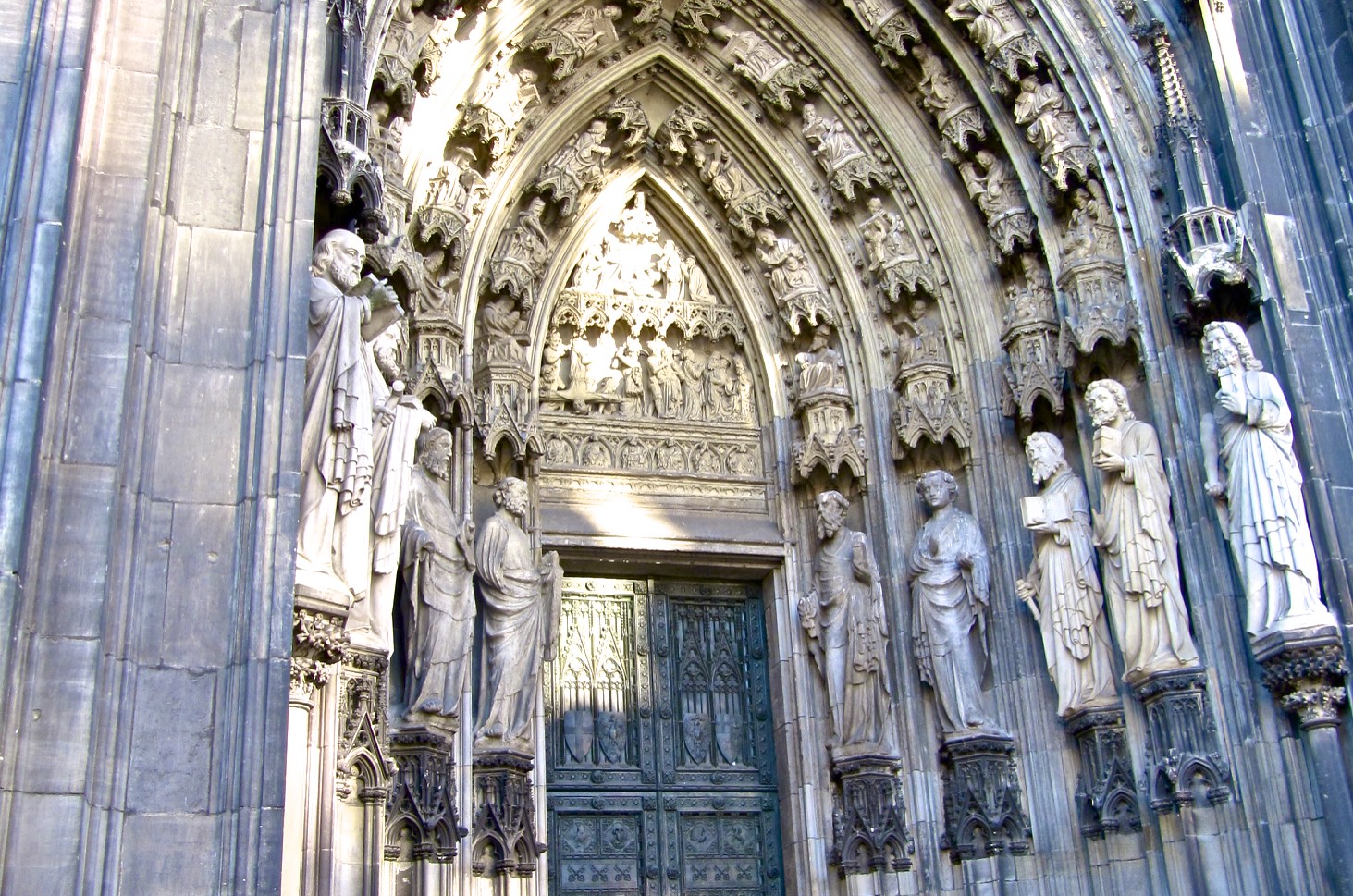
We hurry through doors, because we want to get inside. But cathedral doors are not ordinary doors; they try to slow you down and get you ready for what’s inside.

cologne apostles

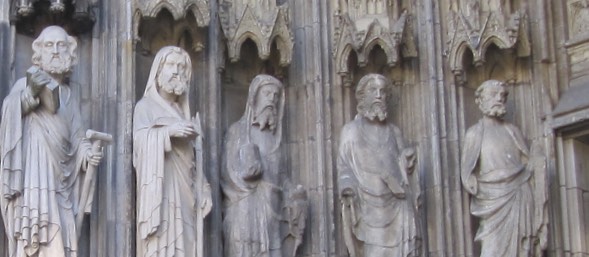
The apostles stand at the western door of the Cologne Cathedral. Peter and Paul are nearest the door itself. Above them is the scene of their martyrdom under Nero. They’ve given their lives to the truth that’s told here, that Jesus Christ, the Son of God, was sent from above, and by his death and resurrection he calls us to follow him to glory. They’re teachers of faith who invite us to believe. You might call this door a version of the Apostles’ Creed.

cologne rulers

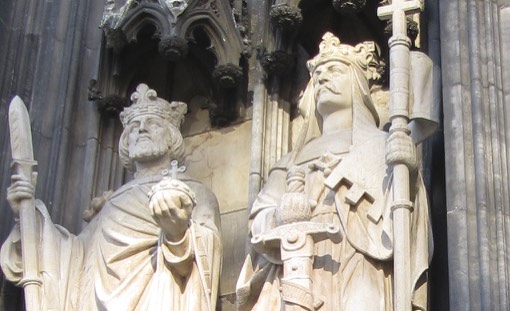
Earthly rulers, like Charlemagne, stand at the door too, witnesses of another authority. The faith is to be lived on earth as well as heaven.

The images of prophets, teachers, martyrs and saints on the outside and within the cathedral echo the same promise. The Cologne Cathedral was an important church that welcomed pilgrims from other parts of northern Europe and so, besides the Three Kings, images of the popular saints honored at other shrines along the pilgrim routes of Europe, like St. James of Compestelo, are found there. It encouraged a common vision of life that made the various peoples one.

IMG_1816

In days when people couldn’t read, they read the cathedral’s stained glass, paintings and sculpture. With them can we see the building’s reach into the heavens pointing to a world above, a world where the promises of God will be fulfilled?

Last Suppercloseup

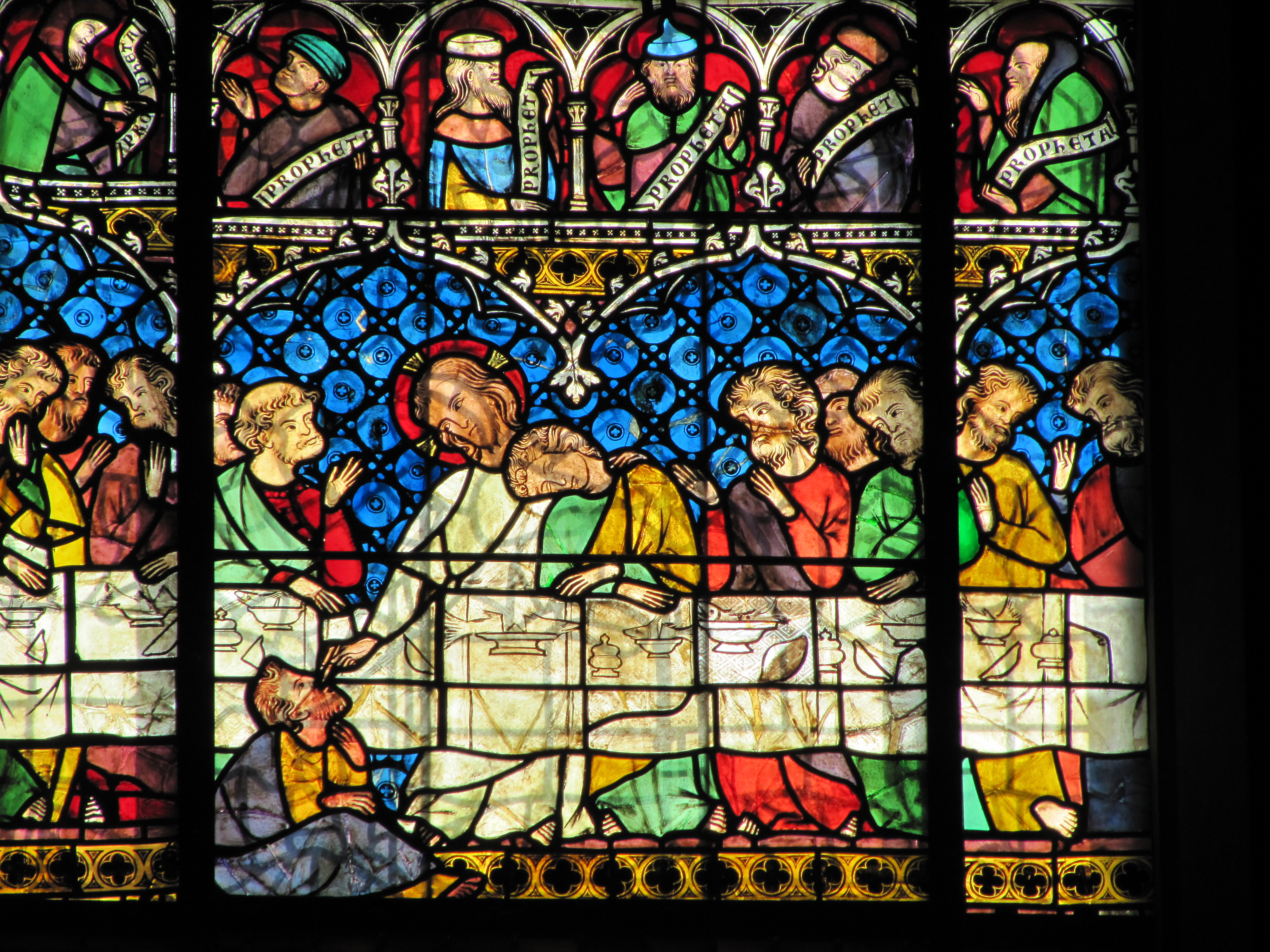
I took a picture of a stained glass window of the Last Supper in the Strasbourg Cathedral. Jesus hands a morsel to Judas, who then goes out into the night. How beautifully the artist captures the sadness of the Lord.

No Nest, No Den

RUN08875
We’re reading from the 9th chapter of Luke’s gospel this Sunday. (Luke 8,51-62) Jesus has completed his mission in Galilee, in the small towns around the lake, and sets out for Jerusalem. That’s how today’s gospel begins:

“When the days for Jesus’ being taken up were fulfilled,
he resolutely determined to journey to Jerusalem.”

Luke doesn’t describe a journey from place to place. Rather, Jesus gathers disciples on the way. He’s not making this journey alone, or just with the twelve. He’s calling many others to experience with him the mystery of his death and resurrection.

It’s a hard call. You have to go through tough places, Jesus says, like the Samaritan town that he and his disciples passed through, where you’re not accepted. You may not feel powerful or secure. If you follow me, Jesus says, you won’t have nests like the birds or dens like the fox. You’ll meet circumstances and difficult situations that may seem unreasonable.

But don’t worry, by following Jesus you’ll made the journey.

Last week I had some visitors from Australia and I took them on a tour of downtown New York, to visit a saint who once lived on Wall Street. She’s St. Elizabeth Seton, Mother Seton; she lived with her family on Wall Street and a number of other places downtown in colonial times. One of the last places she lived in New York City is on State Street, right across from the Staten Island Ferry. A church honoring her is built over that house.
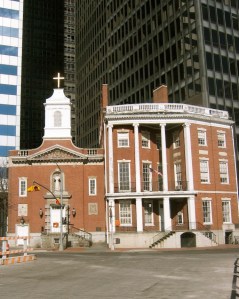
Setonshrine - Version 2

She’s a good example of what it means to follow Jesus, according to today’s gospel.
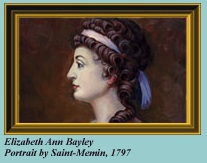
1.Elizabeth Seton 1797

I took my visitors on the Staten Island Ferry to show them where the quarantine stations were in the harbor. Mother Seton’s father, Doctor Richard Bayley, was New York City’s first health officer and his job was to isolate and care for people with diseases like yellow fever who were coming into the country on ships from overseas.
Quarantine 1833

In the summer of 1801, his daughter described the conditions at the quarantine station at Tomkinsville, Staten Island, where she was staying with her father. A boatload of Irish immigrants with yellow fever had just been taken off a ship:
“I cannot sleep–the dying and the dead possess my mind. Babies perishing at the empty breast of the expiring mother…Father says such was never known before: twelve children must die for want of sustenance…parents deprived of it as they have lain for many days ill in a ship without food or air or changing…There are tents pitched over the yard of the convalescent house and a large one at the death house.” (Letter July 28, 1801) Her father contacted yellow fever himself then and died shortly afterwards.

Through her life, Mother Seton experienced hard things like that. She was four years old when her mother died, and her father quickly remarried. Her stepmother never had much time for her, but neither did her father, a good man absorbed in his work as a doctor and away a lot.

She describes how lonely she was as a child. What kept her going was looking up into the clouds and believing that God was her father and he loved her.

Her fortunes changed dramatically when as a young woman Elizabeth Bayley met William Seton, one of the wealthiest young men in New York. They got married and had children and became part of New York’s high society. Alexander Hamilton was a neighbor, George Washington lived down the street. They were on top of the world and blissfully happy.
Wall St. 1825 copy

William Seton was one of the venture capitalists of his day. He was into banking and shipping. But as we know venture capitalists can go bankrupt as well as make millions. That’s what happened to the Setons. They went bankrupt, he died of sickness and his wife became a widow with five kids.

Elizabeth Seton went through a spiritual crisis. She was attracted to the Catholic faith, but the Catholic Church then was looked down on by New Yorkers. She lost most of her friends when she decided to become a Catholic. She had to leave New York and go to Maryland where she began a school and a religious community of women, the Sisters of Charity.
IMG_3158

Her school was the beginning of Catholic Parochial School system in the United States and she’s honored as our first native born American saint. In the new United States Catholic Catechism for Adults she’s presented as an example of how our search for God takes place. Sometimes we’re on top of the world, other times we’re like birds without nests and foxes without dens.

Sometimes we may think that the gospel is an old book about things from long ago. But if you look at it with yourself in mind you can see how it applies. There are times when our lives are transfigured, as the lives of the disciples were when Jesus took them up the mountain. At other times we are not sure where we are. Sometimes we can feel like we’re going through a Samaritan town where nothing makes sense. To follow Jesus is like that.

Saints like Elizabeth Seton are good guides too. Take a look at them. They’re better guides to life than movie celebrities, and more real.
Successful and Unsuccessful Saints

In yesterday’s post I offered a summary of Bishop N.T. Wright’s talk to the Italian Catholic Bishops in which he stated that our understanding of the resurrection of Jesus is influenced today by the thinking of the Enlightenment, which placed God (if God exists) beyond our world. We are the lords of creation, according to that thinking. This life and all in it is in our hands to shape and control as we think best.

Yet, the Risen Christ is Lord of creation, still present in our world, fashioning it to become God’s new creation. He has not just come and now is gone, with us only at our death to take his own into heaven. Nor is he just lord of the perfect. Every knee bows before him.

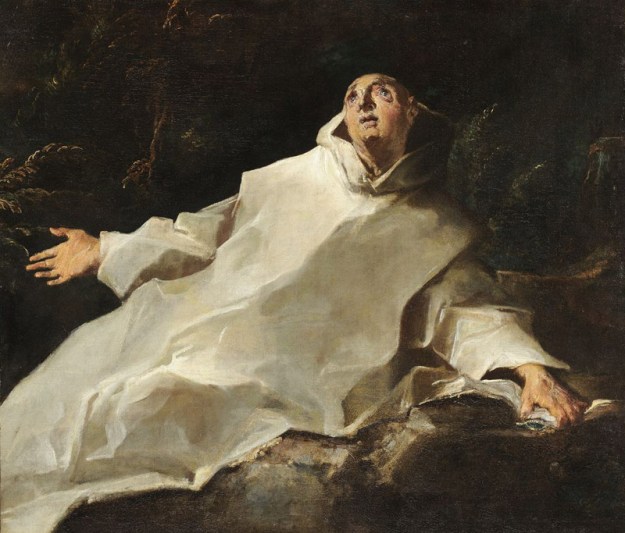
I wonder if the thinking of the Enlightenment has also influenced our thinking about the saints. We like “successful saints” who seem to leave their mark in society by what they accomplish: building schools, hospitals, blazing new trails on the world scene. We like saints who do something big.

What about saints like Saint Gemma, Saint Pio–who seem to be sidelined most their lives without obvious human accomplishments­– aren’t they witnesses to the power of the Risen Christ to reach into humble life and be present there?

I heard recently that Saint Pio is probably the most popular saint in the church right now. Interesting. Books about St. Gemma are the most popular books we distribute at Passionist Press. Interesting.

Is holiness only for the perfect, the bright, the accomplished? Or does the Risen Christ reveal himself to the humble, sometimes giving them the treasures of his wounds? Maybe the voice of the faithful is telling us something.

Catechisms Have Changed

Some of us may have learned our faith through the questions and answers of the Baltimore Catechism, but catechisms have changed in recent years. One big change is that they’re not just for children, they’re for adults too.

The United States Catholic Catechism for Adults, published by the US Catholic Bishops in 2006, is an adaptation of The Catechism of the Catholic Church published in 1992 in Rome after the Second Vatican Council, as a response from the American bishops to Pope Paul VI’s call to the bishops of the world to adapt the universal catechism to the circumstances and culture of their own people.

The American catechism follows the arrangement of the Roman catechism and teaches about the Creed, the Sacraments, Moral Life and Prayer. One of its features is that it begins each lesson with a story of faith, a short biography of a Catholic, usually someone from the United States, who introduces us to the teaching that’s presented.

Many of the stories also help us appreciate how the Church in our country grew and the particular spirituality that’s been expressed here.

For example, St. Elizabeth Seton introduces us to its first question: our search for God. We search for God through creation, through human relationships and through the various circumstances of our lives.

Mother Seton found God in all those ways. As a young girl, neglected by her father and her stepmother after her mother’s death, she found God in the beauties of nature, in the fields around New Rochelle, NY, where she played as a child.

Then, she married a successful man, William Seton, and had children, a happy married life, lots of friends, and was active in her Episcopal church, Trinity Church, on Wall Street in New York City.

Her life changed when her husband’s business failed. His health also failed and Elizabeth took him to Italy to see if a better climate could revive him. When they arrived in Livorno, Italy, he died in her arms in a quarantine station at the seaport.

Some Italian friends took Elizabeth and her daughter into their home and there she began to think about becoming a Catholic. That step caused her to lose some old friends; as a widow with small children she faced hard times.

Resettling in Baltimore, then Emmitsburg, Maryland, she established a Catholic school and gathered other women to form a religious community. One of the great saints and founders of the American Church, her quest for God was lifelong and many sided. She is an example of how our search for God goes on through creation, through the people around us and in the circumstances we face going through life.

Mother Seton is a teacher of faith and played an important role in the history of the church in our country.  She reminds us how important women have been, especially religious women,  in building our American church. She also reminds us that we’re all called by God to teach others.

Saving Santa Claus

Santa’s making his way into Macy’s and Walmart and thousands of stores and countless television advertisements these days.  I’d like to save him and get him back to what he does best.

He’s a saint, and saints aren’t in the world to sell stuff. They give things away.  So instead of hearing Santa Claus say, “What do you want for Christmas? I’ll show you where to buy it.”  We should hear him asking “What are you going to give others, what are you going to do for others, this Christmas?”

The best way to get Santa Claus back to what he does best is to know his story and tell it to others.  I’m going to put up soon a little clip that  may help little children get to know him.

Nicholas  lived way back in the 4th century in the busy seaport of Myra along the Turkish coast. He’s honored today in the great church of St. Nicholas in the city of Bari along the Adriatic Coast in Italy. Let me tell you his story.

Nicholas likely belonged to one of Myra’s wealthy families who made a living on the sea. But he wasn’t spoiled growing up. His family taught him to be generous with others, because that makes you richer than anything else.

One day, Nicholas heard there a man in Myra who lost all his money when his business failed. He had three beautiful daughters who were going to get married, but there was  no money for their marriage and no one wanted to marry them because they were so poor.

They didn’t even have enough to eat, and so the father in desperation decided to sell one his daughters into slavery, so that the rest could survive.

The night before she was to be sold, Nicholas came to the window of their house and tossed in a small bag of gold and then vanished in the night.  The next morning, the father found the gold on the floor. He had no idea where it came from. He thought it was counterfeit, but it was real.

He fell to his knees and thanked God for this gift. Then he arranged for his first daughter’s wedding; there was enough left for them to live for almost a year. But he kept wondering: who gave them the gold?

Before the year ended, the family again had nothing and the father, again desperate, decided his second daughter had be sold. But Nicholas heard about it and came to the window at night and tossed in another bag of gold. Again, the father couldn’t believe it. Who gave this gift?

A year passed and their money ran out once more. One night the father heard steps outside his house and suddenly a bag of gold fell onto the floor. The man ran out and caught the stranger. It was Nicholas.

“Why did you give us the gold?” the father asked.

“Because you needed it,” Nicholas answered. “But why didn’t you let us know who you were?” the man asked. “Because it’s good to give and have only God know about it.”

When the bishop of Myra died, the people of the city along with the neighboring bishops came together in their cathedral to select a new bishop. They prayed and asked God to point out who  would it be. In a dream, God said to one of them that the next morning someone would come through the cathedral door as they prayed. He’s the one.

It was Nicholas who came through the door, and they named him their bishop. This unassuming man, so good, was meant by God to lead them.

As bishop of Myra, Nicholas was always ready to help people. He helped anyone in need and then quietly he’d disappear, without waiting for thanks. He was a holy man, and word about him spread quickly.  He always wanted families to have enough to eat and a good place to live, that children got ahead in life, and that old people lived out their lives with dignity and respect.

And he always loved the sailors on the sea. Without their ships, people wouldn’t have food and the things they need.

Nicholas is known today as Santa Claus. I like him better as St. Nicholas. He’s an example of  a “quiet giver,” the kind of person who gives and wants only God to  know about it. That’s giving of the purest kind.

Steve Jobs. A Secular Saint?

Some years ago that term was used to designate someone without any obvious connection with religion, yet who had the heroic virtue we usually associate with the saints.

As I listened to his address to graduates at Stanford University a few years ago, I thought the term could apply to Steve Jobs who died a few days ago. It was a remarkable address that any Christian preacher would admire and be happy to preach. I was especially moved by his respect for death as an advisor and mentor for life.

A solid spirituality. You hope the next generation would follow his example.

The other night on iTunes, one of Jobs’ wonderful contributions to the new digital world, I listened to a lecture (free) by Charles Taylor, author of The Secular Age, from Columbia University. Taylor objected to new atheists like Richard Dawkins, Daniel C. Dennett, Sam Harris, and Christopher Hitchens who want to banish religion from the world as a worthless and destructive force.

But he also objected to Christians denying the worth of secularists who work for the good of the world and its peoples.

There are secular saints as well as saints honored by the church.

The Saints March In

Last week was the feast of Saint Agatha, a early woman martyr from Catania in Sicily. We mentioned her at Mass that day among the women listed in the 1st Eucharistic Prayer, which many believe comes from the hand of St. Gregory the Great. (540-604 AD)

Some say Gregory’s mother or grandmother, I don’t remember who, got him to put Agatha’s name in the prayer because they had roots in Sicily and were devoted to the young martyr. Could be.

Rome was collapsing in Gregory’s day as barbarian invaders swept over the Italian peninsula, plundering, burning and destroying. It was the worst of times, and lots of people, among them the well-to-do residents of the Celian Hill where Gregory lived, were getting out of the troubled city as fast as they could.

But the saints weren’t marching out, they were “marchin in.” Those two lists of saints in the Roman canon were Gregory’s army, his enduring support. Their nearby  shrines were fortresses that sustained him. John and Paul, soldier saints who opposed a mighty army;  Cosmos and Damian, the doctors who cured and didn’t mind not getting paid,   Lawrence, who saw the poor as the treasures of the church. Besides Agatha, there was Cecilia, Agnes–strong Roman women of faith who wouldn’t give in, not matter what. All of them were still there in their churches. Gregory saw them, I think, as friends at his side, when so many others had left, and he wanted to remind others too that they were there.

And so we pray at the Eucharist “in union with the whole church.” The times may be rough, but we draw strength from the whole church, the saints living among us and those in glory who, in turn, get their strength from Jesus Christ.

Secular Pilgrims

A few days ago at the Vatican with Fr. Franz  I was fortunate to find a book at the Pauline bookstore that had material I’ve been looking for here in Rome. Happily, it was cheap. (8 Euros, on sale)  An Italian book “Viaggio at Roma e nella sua compangna: Pittori e letterati alla scoperta del paesaggio e della magiche atmosfere di un mondo perduto,Roma, 2007”

The book is about secular pilgrims to Rome and its surrounding areas: writers and artists who found inspiration in this ancient world. It’s a big, heavy book of 527 pages; I don’t know yet how I’m going to carry it home. A computer’s one thing, books are another.

The book is filled with pictures painted all the way back to the 16th century and notes about the artists who painted them. Besides religious pilgrims, secular pilgrims have long been attracted to Rome. “We’re all pilgrims looking for Italy,” Goethe said. “We find here something we have lost,” the English poet Samuel Rogers wrote to his friend Lord Byron. So many of them were touched by the ruins of this city.

The book’s author says the artists and writers furnish us today with a “multi-media” look at those times, and that’s precisely what I was looking for.

I’m searching for the secular background of some of our Passionist saints, like St. Paul of the Cross and Vincent Strambi, saints of the 18th and 19th century. This book helps.

We tend to put saints like them into a spiritual world, or a church world, but in reality they also walked in the world painted by the artists mentioned in this book. Besides their links to heaven, they walked on earth.

Some days ago, I was at the shrine of Maria Goretti in Nettuno, and there found some historical pictures of peasant families and how they lived in the poverty-stricken countryside where she lived in the last century. Those pictures were more moving and informative than any holy card I’ve seen of the saint.

Besides holy cards, we need a better appreciation of earthly wisdom and spirituality of the saints and the ground on which they walked.