Tag Archives: Romans 8

House of Prayer

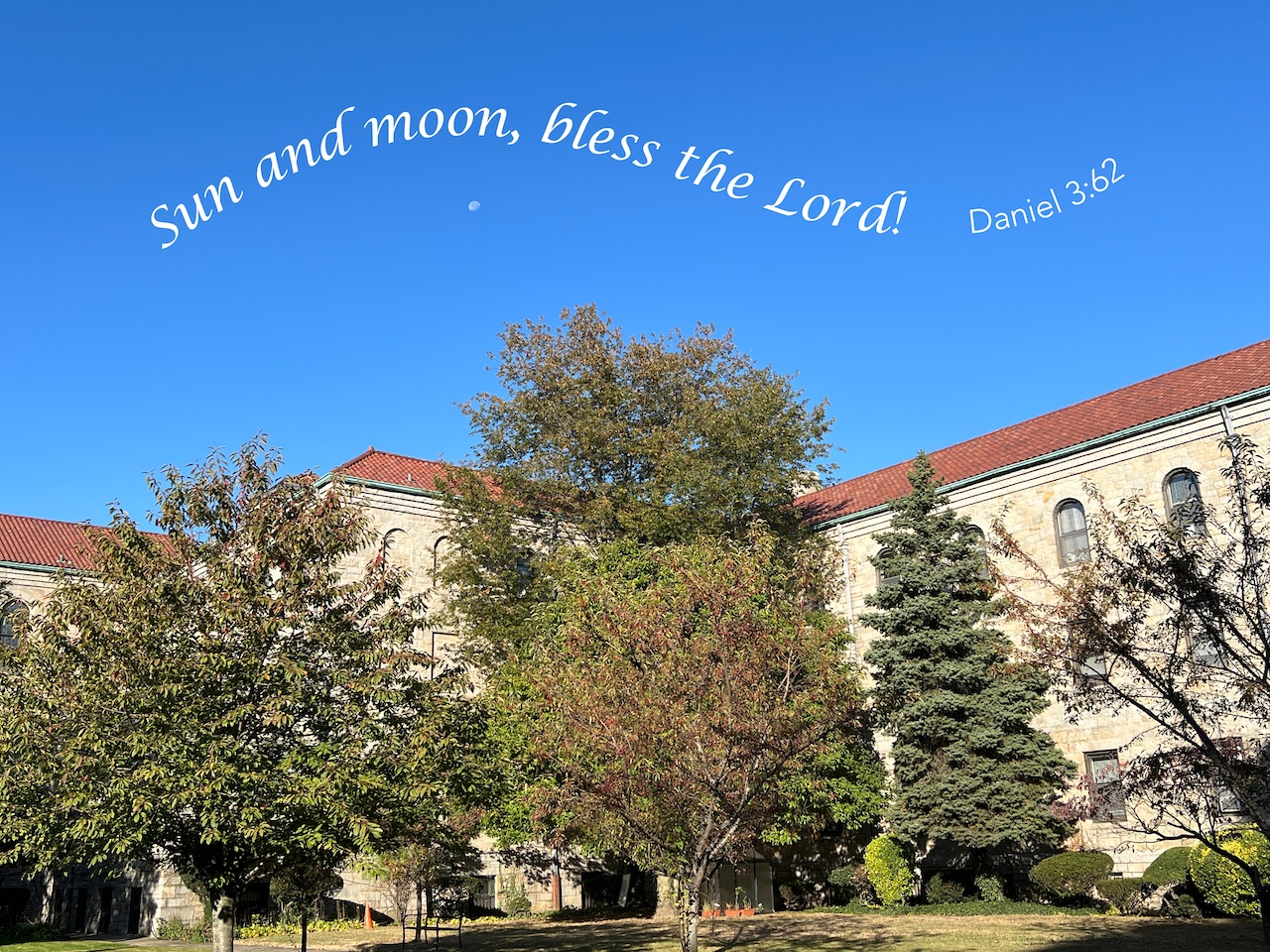
Photo of Passionist Monastery in Jamaica, NY with the text of Daniel 3:62, "Sun and moon, bless the Lord!"
Passionist Monastery in Jamaica, NY

By Gloria M. Chang

A monastery is a house of prayer to pursue the “happy” or blessed life. Our Passionist priests and brothers in Jamaica, NY faithfully pray the Liturgy of the Hours every morning and evening, which prepares them to give the bread of the Word and the Eucharist at Mass and to serve in various ministries. Prayer and the Eucharist, the daily bread of apostles, fuel works of mercy.

In a letter to a Roman noblewoman named Proba, St. Augustine offers valuable insights on prayer. The bishop of Hippo, whose rule of life continues to guide monastic communities today, understood the value of “prayer at appointed hours.” Although he was an extremely busy bishop, St. Augustine kindled his desire for God throughout the day by lifting his heart in prayer from sunrise to sunset. Forgetfulness of God in the midst of constant work makes the heart “lukewarm” and “chill” over time.

Thankfully, we can redeem the time. As the earth revolves around the sun, children of God revolve in the orbit of the Blessed Trinity. Space and time, the materials of our journey from birth to eternity, belong to the Father, Creator of all things through his Word and Spirit. Jesus, who frequently spent the night in prayer, models our way home to the Father.

Can one pray during a busy schedule? St. Augustine teaches that “even in these actions” (work responsibilities), we pray by continually longing for God. Many words are unnecessary. The desert monks discovered that short but frequent prayers, “hurled like swift javelins,” keep the heart and mind fixed on the Lord.

“Ask and it will be given to you; seek and you will find; knock and the door will be opened to you” (Matthew 7:7). Persistence in prayer with sighs and tears unite us with the ineffable God, “for he has established all things through his Word and does not seek human words.” As a monastery is a house of prayer, so are all of us “temples” of prayer in the Holy Spirit (Romans 8:26-27).

The Passionists Pray website offers resources for daily prayer, which can be accessed here.

From a letter to Proba by Saint Augustine, bishop

Let us turn our mind to the task of prayer at appointed hours

Let us always desire the happy life from the Lord God and always pray for it. But for this very reason we turn our mind to the task of prayer at appointed hours, since that desire grows lukewarm, so to speak, from our involvement in other concerns and occupations. We remind ourselves through the words of prayer to focus our attention on the object of our desire; otherwise, the desire that began to grow lukewarm may grow chill altogether and may be totally extinguished unless it is repeatedly stirred into flame.

Therefore, when the Apostle says: Let your petitions become known before God, this should not be taken in the sense that they are in fact becoming known to God who certainly knew them even before they were made, but that they are becoming known before men through boasting.

Since this is the case, it is not wrong or useless to pray even for a long time when there is the opportunity. I mean when it does not keep us from performing the other good and necessary actions we are obliged to do. But even in these actions, as I have said, we must always pray with that desire. To pray for a longer time is not the same as to pray by multiplying words, as some people suppose. Lengthy talk is one thing, a prayerful disposition which lasts a long time is another. For it is even written in reference to the Lord himself that he spent the night in prayer and that he prayed at great length. Was he not giving us an example by this? In time, he prays when it is appropriate; and in eternity, he hears our prayers with the Father.

The monks in Egypt are said to offer frequent prayers, but these are very short and hurled like swift javelins. Otherwise their watchful attention, a very necessary quality for anyone at prayer, could be dulled and could disappear through protracted delays. They also clearly demonstrate through this practice that a person must not quickly divert such attention if it lasts, just as one must not allow it to be blunted if it cannot last.

Excessive talking should be kept out of prayer but that does not mean that one should not spend much time in prayer so long as a fervent attitude continues to accompany his prayer. To talk at length in prayer is to perform a necessary action with an excess of words. To spend much time in prayer is to knock with a persistent and holy fervor at the door of the one whom we beseech. This task is generally accomplished more through sighs than words, more through weeping than speech. He places our tears in his sight, and our sighs are not hidden from him, for he has established all things through his Word and does not seek human words.

Reference

The passage from St. Augustine can be found in the Office of Readings for Monday of the 29th Week in Ordinary Time.

World of Vapor

“World of Vapor”
A reflection on Ecclesiastes 1:1-11
©️2024 Gloria M. Chang

The words of the Preacher, the son of David, king in Jerusalem.
Vanity of vanities, says the Preacher,
vanity of vanities! All is vanity.

What does man gain by all the toil
at which he toils under the sun?

A generation goes, and a generation comes,
but the earth remains forever.

The sun rises, and the sun goes down,
and hastens to the place where it rises.

The wind blows to the south
and goes around to the north;
around and around goes the wind,
and on its circuits the wind returns.

All streams run to the sea,
but the sea is not full;
to the place where the streams flow,
there they flow again.

All things are full of weariness;
a man cannot utter it;
the eye is not satisfied with seeing,
nor the ear filled with hearing.

What has been is what will be,
and what has been done is what will be done,
and there is nothing new under the sun.

Is there a thing of which it is said,
“See, this is new”?
It has been already
in the ages before us.

There is no remembrance of former things,
nor will there be any remembrance
of later things yet to be
among those who come after.

Ecclesiastes 1:1-8 (ESV)

What is the Meaning of Life?

Qoheleth, the “Preacher,” writing in the name of Solomon, the son of David, wrestles with the absolute in the book of Ecclesiastes. The Hebrew word Qoheleth (from qahal, a root that means “assembly” or “congregation”) is Ekklesiastes in Greek, which names the book. Early traditions attribute the book’s authorship to Solomon, but philological evidence dates the book to no earlier than the mid-fifth century B.C., a half-millennium after Solomon’s reign. Thus, Qoheleth, a Hebrew sage, critiques the world through the eyes of King Solomon, the wisest, wealthiest, and most powerful man in the world. He investigates the patterns of nature and human striving, hoping to discover an ultimate purpose behind it all.  

World of Vapor

Qoheleth begins by lamenting that all is “vanity” (in Hebrew hebel, “vapor, breath”), which he pronounces five times in a single utterance (1:2). Finding no ultimate profit in the drudgery of human toil, he rhetorically asks, “What does man gain by all the toil at which he toils under the sun?”

Ephemeral phenomena and superficial impressions shift and slide incessantly “under the sun,” where nothing is constant. The rising and setting of the sun, and the circuitous currents of wind go “round and round” ceaselessly in a futile loop. The sea, too, like human ambition and appetite, never finds fulfillment despite continuous filling: “All streams run to the sea, but the sea is not full” (1:7). Jaded by familiarity, Qoheleth deplores the predictable motions of the earth.

“All things are full of weariness,” he despairs, “a man cannot utter it.” “The eye is not satisfied with seeing, nor the ear filled with hearing” (1:8). Ever restless, human desire insatiably consumes the panorama of sight and sound—representative of all sensory and intellectual stimuli. All impressions eventually evaporate like steam (hebel).

Nothing New Under the Sun

What has been is what will be,
and what has been done is what will be done,
and there is nothing new under the sun.

Is there a thing of which it is said,
“See, this is new”?
It has been already
in the ages before us.

Ecclesiastes 1:9-10 (ESV)

Ecclesiastes affirms the truism that “history repeats itself.” As civilizations rise and fall, human nature remains the same. War and peace, joy and sorrow, strength and weakness, freedom and slavery, profit and loss—the same old human affairs cycle round and round, generation after generation, world without end. A keen observer of human nature and historical recurrence, Qoheleth bleakly concludes, “There is nothing new under the sun.”

Puff of the Past

There is no remembrance of former things,
nor will there be any remembrance
of later things yet to be
among those who come after.

Ecclesiastes 1:11 (ESV)

As the sands of time fade away, so does human “remembrance of former things.” Stars and galaxies, fossils, and artifacts provide clues to the mystery of the 13.8 billion-year-old universe and human evolution. Yet billions of ancestors lie buried in the ground, forgotten by their descendants. Apart from cave paintings, oral traditions, scrolls, books, annals, chronicles, and even modern audiovisual media, which capture only fragments from limited perspectives, the past vanishes like vapor “under the sun.” Can fragmentary memories preserve an unbroken, unified recollection of the past? Can mortals achieve immortality in the minds of posterity? 

The Value of Struggle

Ecclesiastes challenges the assembly of wisdom seekers to find ultimate purpose and profit “under the sun.” Like Job, Qoheleth embraces disputation and wrestling with elemental questions. Sometimes described as “unorthodox,” these books goad the pious to “struggle with God,” the meaning of Israel’s name (Genesis 32:28). Questions do not threaten religion but expand its horizons. 

Without being an atheist, Qoheleth journeys to the edge of human striving to discover its peaks and valleys apart from God. His experiment confirms Paul’s observation that, on account of Adam’s departure from God’s will, “the creation was subjected to futility” (Romans 8:20; Genesis 3:17). The Greek word for futility, mataiotés (“vanity,” “emptiness”), translates the Hebrew word hebel (“vapor,” “breath”) in the Septuagint. Ecclesiastes allows every seeker of meaning to feel the emptiness of a life and vision that never rises above the sun. 

I have seen all things that are done under the sun, and behold, all is vanity and a chase after wind.

Ecclesiastes 1:14 (NABRE)

All is vanity, a chase after wind.
Series and cycles—these I examined.
Under the sun, seasons whirl like vapor.
What do humans gain by all their labor?


This content by Gloria M. Chang was originally published online at Shalom Snail: Journey to Wholeness.