Tag Archives: prayer

Distractions

Gloria Ziemienski kindly gave me a copy of her new book of poems the other day: There are Times:Pages from a Poet’s Journal. This is one of them.

Distractions

I sit in the quiet, praying.

a name comes to my mind.

As I pray for her,

I’m reminded of someone

or something else

and my mind takes off in

unplanned directions

which lead me toward

another someone or something,

until I gather my thoughts

and rein them all in,

trying to collect myself,

trying not to feel guilty

about my wandering mind.


Then I recall that St. Paul urges us

to pray without ceasing,

so I decide to take You with me

in my mind’s wanderings,

and offer you this day as my prayer.


January 21,2008

Songs of the Saints

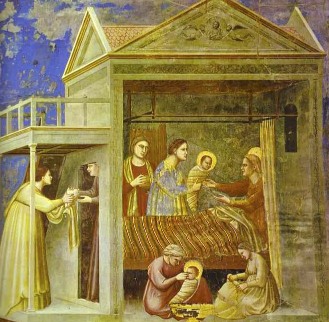
Ann, Mary, the Child Jesus, Massacio

Someone told me about a recent program on NPR on which a scientist said our hearing is wired to hear the song of birds. Our earliest ancestors learned to listen to the song of birds, I suppose because birds could tell them there was water and food nearby–or perhaps their silence warned of enemies.

I wrote about this awhile ago on this blog.

It may be a good analogy for discussing saints.  Saints are like the song of birds telling us there’s another kind of water and food nearby; they point to the presence of God. And we have different saints, just as we have different kinds of birdsong.

What kind of saint is St. Ann? Like all saints she faced challenges in her life. Her greatest challenge was that she and her husband Joachim were not able to have a child for a long time. This was at the time when children were looked upon as treasures and those who did not have children were sometimes seen as cursed by God. Besides, as descendants of David they had a duty to continue his line.

Ann and her husband had a long, hard wait before she conceived Mary, who became the Mother of Jesus. Once, she’s described as bursting into tears as she looked up and saw some sparrows building a nest in a laurel tree. “Why was I born, Lord?” she said, “The birds build nests for their young and I have no child of my own. The creatures of the earth, the fish of the sea are fruitful, but I have nothing. The land produces fruit, but I have no child to hold in my arms.” (Protoevangelium)

You can see why some pray to St. Ann for help in marriage or to have children. Perhaps grandparents today as they’re called to help out with younger grandchildren can see in her an older person who did that too.
Saints have different lessons to teach, but all saints have this in common: they have a deep faith in God’s will and they’re constant in prayer. They’re faithful in prayer, in good times and in bad. Prayer is their daily song to God. It may be a sorrowful song like Ann’s in the example above. Or it may be joyful. But prayer gives them wisdom and strength and peace, from moment to moment, from day to day.

One of the great early saints from the Egyptian desert, St. Anthony, was asked once what’s the hardest thing you have to do in life? “ The hardest thing you have to do in life is pray,” he said, “Everything else you can stop doing, but you can’t stop praying.”

I’m afraid today daily prayer isn’t high on our priorities. I think it’s going the way of Sunday Mass, becoming “occasional prayer.” We only think about prayer when a tragedy like yesterday’s shootings in Colorado happens.

Daily prayer gets us ready for what God gives us to do each day.  Jesus taught his disciples the Our Father; that’s a daily prayer. It tells us who we are each day: we’re children of God and should act like God’s children. We need to remember God’s kingdom is coming and we’re to work for it day by day. We need daily bread of all kinds. We’re part of a messy, noisy world that’s torn apart by selfishness and smallness and pride. We’re bring our share of sin into the world, so we ask for forgiveness each day and forgive others day by day.

“Deliver us from evil” today. Deliver all of us from evil, today.

The Poor at Our Door

The rich man in the parable from Luke that we read at Lenten Mass today is so absorbed in himself and his “good” life that he sees nothing else, not the poor man at his door nor his own inevitable death.

The scriptures often speak of that same kind of blindness: “In his riches, man lacks wisdom; he is like the beasts that are destroyed” (Psalm 49). The warning is not just for the rich, however. The same psalm calls for “people both high and low, rich and poor alike” to listen. A small store of talents and gifts can be just as absorbing and make us just as shortsighted as a great store of riches. Whether we have much or little, we can be blind to the poor at our gate.

We’re destined for a life beyond this one and what we do and how we live here will count there. A judgment is comingJesus’ parable offers another reminder. Even if someone returns from the dead, even if Jesus rises from the dead, some will not believe. In him, God offers a share in his risen life. A great gift has been given, but like the sign of Jonah, some will not believe.

One way to adjust our way of thinking is prayer. Our blindness comes because we only see what’s before our eyes. One proof we see is that we’re not blind to the poor before us.

Lord,

source of all good,

good beyond what we have or can see,

give me wisdom to know you and your gifts

to see as you see and love as you love.

Like the blind man, I want to see.

Amen.

Transfiguration of Jesus

The Transfiguration of Jesus takes place at the midpoint of Matthew’s gospel, after Jesus says to his disciples that “he must go to Jerusalem and undergo great suffering at the hands of the elders and chief priests and scribes, and be killed, and on the third day be raised.” Take up your cross and follow me, he tells his disciples.

“God forbid, Lord,” says Peter who doesn’t understand this at all. We find it hard to understand too. Six days later, Jesus takes Peter, James, and John up a mountain where they experience him glorified, surrounded by Moses and Elijah. It seems to be a transitory experience, one they can’t prolong. After falling to the ground, they looked up and “saw no one except Jesus himself alone.”

But the experience strengthens them for the rest of the journey they make. “The main purpose of the transfiguration was to remove the scandal of the cross from the hearts of Christ’s disciples,” says Pope Leo the Great.

What mountain does Jesus take us to strengthen us on our journey carrying our cross? St. Paul of the Cross and other spiritual guides say it’s the mountain of prayer where we experience intimations of God’s glory, brief encounters, and transfigurations of a lesser kind.

Lord Jesus,

lead me to that mountain place of stronger light and sure sound

where I may see your glory.

Light and truth, bright as blinding snow,

whom Peter, James, and John saw,

“Bring me to your holy mountain,

to your dwelling place.” Amen.

Our Father

Lent is a time of grace, and what grace do we need more than the gift of prayer? Today’s reading offers the familiar prayer Jesus taught, the Our Father. What better prayer can we pray? We know it by rote. What better grace than that Jesus teach us its inexhaustible secrets ?

“Lord, teach us to pray.”

You give us, your children, the words to say,

tell us what they mean;

make them lead to you.

Bring us as we pray into that Presence within,

where words end

and where we rest in you.

Prayers teach us to pray

Prayers teach us how to pray. The collect for  this Thursday after Ash Wednesday is a simple prayer that says so much.  Listen to it:

Lord,

may everything we do

begin with your inspiration,

continue with your help

and reach perfection under your guidance.

We ask this through Jesus Christ, your Son, who lives and reigns with you and the Holy Spirit, One God, forever and ever.

Let’s recognize where we stand before God– empty-handed. And so we look for God to put something into our hand, to give the bread we need, inspire us. We start with nothing.

Then, we ask for help with what we are about now. We can’t continue without God.

Finally, God must guide us to complete what we are about in our lives. It’s not about what we want or plan,  but “your will be done.”

Yet, we pray with a sublime hope:

We ask this through Jesus Christ, who has shown us a God who loves us, who promises to make our prayer his own, who is our advocate, our Savior, our reward.

Reflecting on the Gospels


People came up yesterday after I gave my homily on the paralyzed man in church and said they liked to hear the scriptures, especially the gospels, explained in the light of archeology and the other historical sciences. I think this approach is a way of doing what older meditation methods called the “composition of place,” using one’s imagination and senses to enter the gospels and the scriptures.

Formerly, we would set a gospel scene as best we could, sometimes using the descriptions of mystics or artists who imagined the time and place as they would, often using the topography, the dress, the world they saw around them. Their depictions are still helpful, not so much because they accurately described things, but from the lessons they drew from their meditations.

The picture above from the 1500s or so of the beheading of John the Baptist is an example. Nothing like 1st century Palestine, but the little light in the distant sky tells us what the gospels say: God sees it all and will vindicate his prophet in the end.

Two engineers were listening to my talk yesterday. One said “There were two miracles in that story. Those fellows and the paralyzed man on the roof should have fallen through. No roof I know could have sustained that weight!”

And someone who knows insurance told me: “Peter wouldn’t have any worries if he had a good policy!”

I think we are on to something.

Lord, open my lips

We begin to pray with words like this. St. Ambrose explains what they mean in one of his explanations of the psalms. We are not asking just for help to pray:

“We must always meditate on God’s wisdom, keeping it in our hearts and on our lips. Your tongue must speak justice, the law of God must be in your heart. Hence Scripture tells you: You shall speak of these commandments when you sit in your house, and when you walk along the way, and when you lie down, and when you get up. Let us then speak of the Lord Jesus, for he is wisdom, he is the word, the Word indeed of God.
  It is also written: Open your lips, and let God’s word be heard. God’s word is uttered by those who repeat Christ’s teaching and meditate on his sayings. Let us always speak this word. When we speak about wisdom, we are speaking of Christ. When we speak about virtue, we are speaking of Christ. When we speak about justice, we are speaking of Christ. When we speak about peace, we are speaking of Christ. When we speak about truth and life and redemption, we are speaking of Christ.
  Open your lips, says Scripture, and let God’s word be heard. It is for you to open, it is for him to be heard. So David said: I shall hear what the Lord says in me. The very Son of God says: Open your lips, and I will fill them. Not all can attain to the perfection of wisdom as Solomon or Daniel did, but the spirit of wisdom is poured out on all according to their capacity, that is, on all the faithful. If you believe, you have the spirit of wisdom.”

Sing a New Song

Here’s St. Augustine’s comments on a psalm:

“Sing to the Lord a new song; his praise is in the assembly of the saints. We are urged to sing a new song to the Lord, as new people who have learned a new song. A song is a thing of joy; more profoundly, it is a thing of love. Anyone, therefore, who has learned to love the new life has learned to sing a new song, and the new song reminds us of our new life. The new person, the new song, the new covenant, all belong to the one kingdom of God, and so the new people will sing a new song and will belong to the new covenant.

“There is not one who does not love something, but the question is, what to love. The psalms do not tell us not to love, but to choose the object of our love. But how can we choose unless we are first chosen? We cannot love unless someone has loved us first. Listen to the apostle John: We love him, because he first loved us. The source of our love for God can only be found in the fact that God loved us first. He has given us himself as the object of our love, and he has also given us its source. What this source is you may learn more clearly from the apostle Paul who tells us: The love of God has been poured into our hearts. This love is not something we generate ourselves; it comes to us through the Holy Spirit who has been given to us.

“Since we have such an assurance, then, let us love God with the love he has given us. As John tells us more fully: God is love, and whoever dwells in love dwells in God, and God in him. It is not enough to say: Love is from God. Which of us would dare to pronounce the words of Scripture: God is love? He alone could say it who knew what it was to have God dwelling within him. God offers us a short route to the possession of himself. He cries out: Love me and you will have me for you would be unable to love me if you did not possess me already.”

Tuesday Night at the Mission

Last night at the mission we thought about death as Jesus faced it and accepted it in the Garden of Gethsemane. “Dying you destroyed our death; rising you restored our life,” we say at Mass. He accepted death and changed it forever. He will  be with us as our Savior at the moment of our death.

The two most important moments of our life are “now and at the hour of death.”

http://www.cptryon.org/prayer/season/agony.html

Tuesday evening our reflections will be on prayer. We need to pray, especially today. Is it possible to pray? How do we pray?

There are some reflections on prayer on Bread on the Waters, http://www.cptryon.org/prayer/index.html and some explanations of the common prayers we say as Christians.

You can learn to help your children pray at that site too.

The important days of Holy Week are coming up this week. Find out about them at this same site. It’s for adults and children.

Here’s a sample for introducing a child to Good Friday:

On Friday,

(We call it “Good”)

Jesus was nailed

to hard, hard wood.

Beneath his cross,

his mother stood

and cried for what they had done.

“Oh, if I could hold him,” she said,

“Hold my only Son!”

“Father, take me,” Jesus said,

“Take me in your hands.”

And God reached down

and took him,

and held his only Son.

“I am God who raises up,

your life has just begun.

I am God of the living,

no grave can hold my Son.”