Tag Archives: prayer

Praying in Jesus Christ

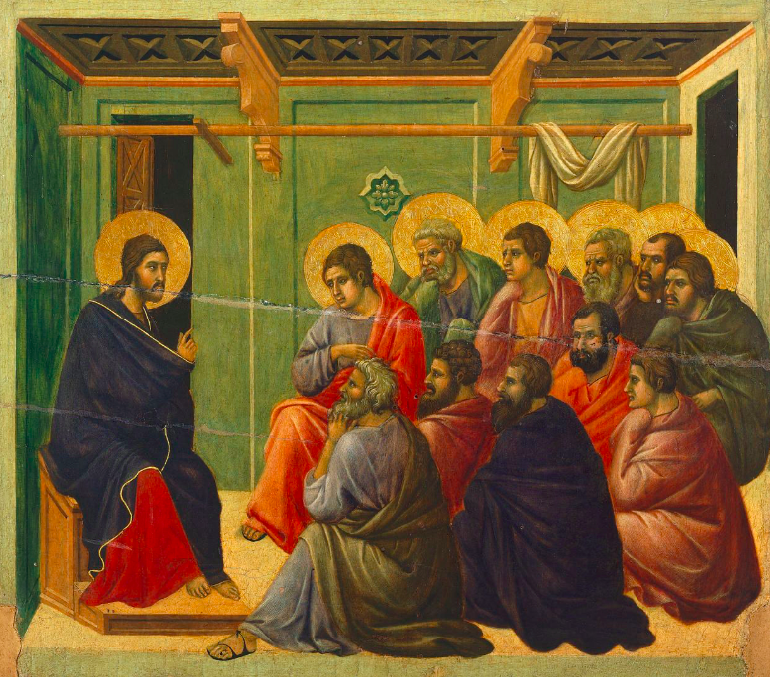
Farewell Discourse of Jesus. Duccio

“I pray for them,” Jesus says in John’s gospel as he looks at his disciples in the supper room and also at us who are his own today. We’re so conscious how poorly we pray. We need to remember Jesus is praying for us and in us. 

Is it possible to speak to God, we ask ourselves? We’re so easily distracted, so weak in faith, so bound to life as it is. How can we approach God in prayer?

“Let the Son who lives in our hearts, be also on our lips,” St. Cyprian says in his commentary on the Our Father. Jesus joins our weak and stumbling prayers to his own. He prays in and for us and assures us we will be welcomed and heard.

“I pray for them,” Jesus said in the supper room. He prayed for his disciples there in the supper room. When they left they entered the Garden of Gethsemani where they fell asleep, forgetful of everything. A stone’s throw away, Jesus prayed. His prayer was not only for himself but for them as well.

“I pray for them,’ Jesus says in our liturgical prayers. We speak to God the Father “through Jesus Christ, your Son, who lives and reigns with you and the Holy Spirit, One God, forever and ever. Amen.”

Whenever we pray, whether with others in public prayer or praying alone, he enters our prayer. “Let us pray with confidence to the Father in the words our Savior gave us,” we say as we begin the Our Father at Mass.

Our confidence in prayer comes, not from our own wisdom, or holiness or faith, but from Jesus who says “I pray for them.”


The Song of Birds

Noah
Before 7 :
AM  I sit for a few minutes on the porch as the weather gets warmer, watching the birds. There are almost 40 different birds in our garden, just up from the E train.   The sparrows and the doves are usual visitors,  singing away, but the other day they couldn’t be seen or heard.  I soon saw why: a big hawk flew by overhead.

After awhile the birds were back,  chirping and moaning  as usual. Someone told me our ears are wired to hear the song of birds. Why? They tell us no dangerous enemies nearby, all is well.

Birds singing tell us the world’s in good hands. Is that why Noah sent a dove from the ark? The dove not only brought back olive branches signifying all was well, but sang the good news to those in the closed boat.

The Holy Spirit descends in the form of a dove. The ancients saw birds as mysterious visitors from heaven. I notice something fearless in the doves at our feeder. The sparrows scatter quickly at the least sign of danger; the doves stay and hold their ground. Like the dove, the Holy Spirit is a giver of life to our land and won’t abandon us.

By baptism we’re wired to hear God’s voice. We listen for God’s good news, despite the dangers. We listen for a world redeemed, a higher plan at play. Good reason to begin the day, listening to birds singing..

7th Week of Easter: Last Instructions

To listen to today’s homily, please select the audio file below:

The Ascension of Jesus into heaven is recalled briefly in Mark’s gospel (Mark 16,19) and described in more detail in Luke’s gospel (Luke 24, 44-53} and in the Acts of the Apostles. (Acts 1, 1-14) As he leaves his disciples, Jesus promises to send them his Spirit.

What are his final instructions to them before he ascends into heaven? They are to be witnesses to him. They will have power from the Holy Spirit to witness, but there’s no promise of security, safety, or immunity from fear or suffering. Just the opposite, Jesus sends them on a mission that’s insecure, unsafe and hard.

Here’s what Jesus says in Mark’s gospel, “Go into the whole world and proclaim the gospel to every creature.” “The whole world?” we might say. “To every creature?” It’s a dangerous world out there, and there are creatures in it I don’t particularly like. Yet, that’s the mission Jesus entrusts to his disciples–and us.

“These signs will accompany those who believe,” Jesus continues. “In my name they will drive out demons, they will speak new languages, they will pick up serpents and if they drink any deadly thing, it will not harm them. They will lay hands on the sick, and they will recover.”

That seems to mean if you really believe in Jesus you confront the evil in this world, you learn new things all your life, you deal with snakes–they’re out there too, you can recover from the deadliest experiences, and you can bring healing to those who need healing.

In Luke’s Ascension account in the Acts of the Apostles the disciples wonder if this is the time when God’s kingdom will come now, her and now. Heaven on earth. “Lord, are you at this time going to restore the kingdom to Israel?”

We have hopes like that too, don’t we? That God’s kingdom come here and now, and everything will be perfect. Jesus tells his disciples they wont know the day or the hour. Perfection doesn’t happen here on earth.

As the disciples stand looking at the Lord ascending, Luke writes, angels ask them “Why are you standing here looking up into the sky?” Jesus will return. Go back into the city and live as he asks you to live. You will receive what he promised there. No standing looking up into the sky. Stay where you are; that’s where the promises will be kept.

Luke goes on to describe the disciples making their way back to Jerusalem and praying there with Mary, the mother of Jesus. Prayer prepares them for the Spirit who comes. Prayer prepares us too.

Saturday, 3rd Week of Lent

Lent 1


Readings
In Luke’s gospel Jesus often sides with people living in complicated situations they find hard, almost impossible to get out of – tax collectors, prostitutes, widows, sinners like the prodigal son. They call out for God’s mercy, and Jesus shows them mercy.

A number of tax collectors appear in the gospels. There’s the tax collector in Luke’s account today, there’s Zachaeus the chief tax collector in Jericho. There’s also Mathew, the tax collector in Caphernaum, whom Jesus asked to follow him. There’s no evidence that Jesus asked all Matthew’s friends– also tax collectors– to leave their posts and give up the dirty profession they’re engaged in.

The chief tax collector Zachaeus promised a substantial gift to the poor after receiving Jesus into his house, but again there is no evidence he gave up his job as chief tax collector in Jericho. Nor did any of the tax collectors under him.

There’s no evidence the tax collector in the parable today from Luke’s gospel did so either. Still, God’s mercy was at work in them all.

We’re reading from Hosea these last two days, the prophet whose wife left him. If I read him right, as Hosea calls out to Israel to come back to God, he’s also calling out to his wife to come back. He seems aware she may not think it possible to come back, so he keeps inviting her. Come back to me. It’s mercy calling out.

The tax collector praying in the back of the temple from Luke’s Gospel, (Luke 18, 9-14) stays at a distance, eyes down; he says only a few words:“O God, be merciful to me a sinner.” He recognizes his distance from God and calls for mercy.

The Pharisee’s prayer is so different, so full of himself. He sees no need for mercy. There’s nothing in him that needs redemption. He seems to ask only for applause and approval.

The tax collector asks only for mercy. His prayer is heard so shouldn’t we make it our own? Tax-collectors,  widows and sinners stand closest to where all humanity stands. We all need God’s mercy. We come to God empty-handed.
“O God come to my assistance. O Lord make haste to help me.”

Call for God’s mercy, St. Paul of the Cross often counseled: “I wish you to remain in your horrible nothingness, knowing that you have nothing, can do nothing and know nothing. God doesn’t do anything for those who wish to be something; but one who is aware of his nothingness in truth, is ready. ‘If anyone thinks himself to be something, he deceives himself,’ said the Apostle, whose name I bear unworthily. (St. Paul of the Cross, Letter 1033)

“O God, be merciful to me, a sinner.”

Following Jesus Christ in Lent

On the 1st Sunday of  Lent we follow Jesus Christ from his baptism in the Jordan into the desert where he is tempted by Satan for forty days. Jesus, the New Adam, conquers Satan and leads us back to a promised Paradise.

On the 2nd Sunday of Lent we follow him up the mountain where he reveals the glory that awaits us. Lent is a time of revelation, the prayer that begins this season says. Jesus reveals his glory to us as well as to the disciples who accompanied him then.

Grant, almighty God, through the yearly observances of holy Lent, that we may grow in understanding of the riches hidden in Christ and by worthy conduct pursue their effects. Through our Lord Jesus Christ, your Son, who lives and reigns with you in the unity of the Holy Spirit, God, for ever and ever. (Collect, 1st Sunday of Lent)

Now is a time to  “grow in understanding”of the Paschal Mystery. We know so little of the mystery we celebrate. The riches are “hidden in Christ” and not immediately obvious. We must pursue them humbly, dig for the treasures hidden in the field, find Jesus Christ in the desert world we live in.

This is not just an intellectual effort either. By “worthy conduct”, good deeds, patient love for others, we uncover the “riches hidden in Christ”.

All our efforts mean little, though, unless the Almighty God grant it, “Through our Lord Jesus Christ, your Son, who lives and reigns with you in the unity of the Holy Spirit, God, for ever and ever. Amen.”

O God, who have commanded us to listen to your beloved Son, be pleased, we pray, to nourish us inwardly by your word, that, with spiritual sight made pure, we may rejoice to behold your glory. Through our Lord Jesus Christ, your Son, who lives and reigns with you in the unity of the Holy Spirit, God, for ever and ever. Amen. (Collect, 2nd Sunday of Lent)

The Transfiguration of Jesus is a strongly visual mystery. Jesus is revealed in  glory on the mountain. Yet, we are told to “listen” to God’s beloved Son. His words we hear within will give us the spiritual eyes we need to behold his glory. 

What about our eyes that long to see? The stories of Abraham who is told to search the starry skies and look at the land he has been given tell us the treasures of the natural world can nourish our  desire to see more, namely, the glory revealed in Jesus Christ, God’s Son. Now we listen, then we shall see.

Thursday, 1st Week of Lent

Lent 1

Matthew 7,7-12

Does God answer prayers? A question often asked. Some say God–if there is a God-doesn’t pay attention to us at all. We’re on our own. No one’s listening and no one cares.

Jesus certainly believed his Father listens and cares. He trusted God and asked God for things. He taught us to pray as he did. His prayer in the Garden of Gethsemane reveals a trust that’s unfailing. Over and over he asks that his life be spared. “Father, let this cup pass from me.” He knocked and the door opened; the answer came, yet not as he willed, but as His Father willed. “An angel came to strengthen him,” to accept that answer.

His experience is a model for us. Yes, God gives good gifts to his children, but according to his will. He knows what we need. He gave his only Son the gift of new life, yet he had to first pass through death.

St. Paul of the Cross recognized the mystery surrounding petitionary prayer. Ultimately our prayer is answered, but often enough in mysterious ways that’s hard to understand. Our faith is tested when we pray for things.

“I thank the Father of Mercies that you are improved in health, and you say well that the Lord seems to be playing games. That’s what Scripture says: “God plays on the earth,” and “My delights are to be with the children of men.” How fortunate is the soul that silently in faith allows the games of love the Sovereign Good plays and abandons itself to his good pleasure, whether in health or sickness, in life or in death!”
(Letter 920)

The first reading today from the Book of Esther is an example of someone who comes late to praying. We might call Esther a non-practicing Jew, who prays when things get worse. Is Lent a time for non-practicing Christians to consider praying again? Faith grows through prayer.

“God of Abraham, God of Isaac, and God of Jacob, blessed are you. 
Help me, who am alone and have no help but you,
for I am taking my life in my hand.
As a child I used to hear from the books of my forefathers
that you, O LORD, always free those who are pleasing to you.
Now help me, who am alone and have no one but you,
O LORD, my God. And now, come to help me, an orphan.” (Esther 12:14-16)

Lord,
I ask, I seek, I knock.
Let me never tire of prayer.
“In the day I called you answered me.”                                                                                 So attentive, so quickly you turn when I call.                                                                   Hear me
and let it be done
according to your will.

For more: http://www.PassiionistPray.org

The Prayer of Jesus in the Garden

Mount Olives 3


The Feast of Jesus Praying in the Garden is another feast St. Paul of the Cross placed at the beginning of the lenten season in the Passionist Calendar. Lent is a season for prayer, fasting and almsgiving, but prayer is the first.

Jesus taught his disciples how to pray, the gospels say. In Matthew’s gospel he brings them up a mountain–a traditional place to draw close to God – and teaches them there the prayer we call the “Our Father” . (Matthew 6, 9-13)

In Luke’s gospel, Jesus teaches his disciples to pray “in a certain place”, on the plain, in the midst of daily life. (Luke 11, 2-4) He prayed daily through life; the prayer Jesus taught them is more basic than the prayer found in Matthew’s Gospel..

“When you pray, say: Father, hallowed be your name, your kingdom come. Give us each day our daily bread and forgive us our sins for we ourselves forgive everyone in debt to us, and do not subject us to the final test.” (Luke 11,2-4)

Mark, Matthew and Luke recall Jesus praying in the garden before his passion; his disciples do not join him, but fall asleep.  

They’re sleeping because the flesh is weak, Mark says.

They’re sleeping because they can’t keep their eyes open, Matthew says.

They’re sleeping because of grief, Luke says.

Stay awake and pray, Jesus tells them. Prayer brings you through times of testing and temptation. Some things can only be done by prayer, Jesus tells his disciples who wonder why they can’t drive out a certain spirit. (Mark 9: 29) On our part, however, we are like the disciples, our flesh is weak, we can keep our spiritual eyes open too long, we can be overwhelmed by grief.

Facing the weakness of the flesh as he faces death, Jesus doesn’t wave it away in stoic resignation or look to his own power. “Not my will, but your will be done,” he says. Facing the consequences of his mission, the limits of human power, the “form of a slave,” he depends on his Father for the strength he needs.

In the garden Jesus teaches his disciples how to face life’s trials. He kneels on the ground and humbly looks beyond himself to his Father, “Abba”, who hears him. He falls to the ground, trusting his Father’s strength and not his own. Troubled and distressed, for an hour’s time he simply pleads for help. . 

“He was in such agony and he prayed so fervently that his sweat became like drops of blood falling on the ground.” Luke says. Then, an angel comes to strengthen him. The cup of suffering isn’t taken away; he will drink from it, but it will not crush him. God will raise him up.

He teaches us pray as he did and promises to pray with us in our trials.

This feast calls us to pray with Christ. It also tells us to pray with the church. Lent is a time to enter into the church’s prayer, to follow the scriptures, to enter its feasts, to use its devotions.

.

Feasts for Tired Believers

Central Italy, 1800s

The Passionists celebrate two feasts immediately before Ash Wednesday. The Solemn Commemoration of the Passion of Jesus Christ on the Friday before Ash Wednesday. The Prayer of Jesus in the Garden on Tuesday before that day.

Both feasts are inspired by our missionary founder, St. Paul of the Cross, (1694-1775). He spent many years announcing the graces of lent in the villages and towns of the Tuscan Maremma in Italy..

It was a challenging task. The Tuscan Maremma was then a place where graces seemed gone. It was the poorest, most troubled part of Italy in Paul’s day, an area in Central Italy facing the Mediterranean Sea, almost 2,000 square miles– roughly the size of Long Island and New York City together. Only gradually, towards the end of the 1700s, after his death, did it begin inching towards recovery.

St.PaulCross.017

Now Tuscanny is a popular tourist destination. Then it was an unhealthily mix of hills and swamplands. Malaria was widespread, roads often impassible, dangerous because of bandits. Farmlands were abandoned; beggars everywhere. The people in isolated villages and hill towns suspected outsiders.

Paul and his companions preached there for many years. Every year it was the same; it never seemed to change. You need other eyes and another kind of heart to work in a world like that and not get tired.

And so as they packed their bags for their lenten journey into the Tuscan Maremma they had to remind themselves what was there before them: the mystery of the Passion of Christ. They needed to pray so they wouldn’t forget. That’s what Jesus did before the mystery of his Passion.

It’s still so today, isn’t it? These two feasts are for all kinds of tired believers, who face the world where things don’t seem to change. We need another way of seeing things and another kind of heart to journey on..

If you want to pray these feasts with the Passionists, go here.

Citizens of Heaven

It’s good to be reminded in these days following our contentious election on Tuesday that “ our citizenship is in heaven.” Paul tells that to the Philippians in today’s reading, but we should hear it too. 

But our citizenship is in heaven, 
and from it we also await a savior, the Lord Jesus Christ.
He will change our lowly body
to conform with his glorified Body 
by the power that enables him also 
to bring all things into subjection to himself.

Therefore, my brothers and sisters,
whom I love and long for, my joy and crown, 
in this way stand firm in the Lord, beloved.  

We ‘re citizens of heaven; we belong somewhere else. We’re temporary, not permanent  residents here. In that place “ the Lord Jesus Christ will change our lowly bodies to conform to his glorified Body by the power that enables him also to bring all things  into subjection to himself.” (Philippians 3:17-4:1)

The responsorial psalm today tells us that even now we’re standing within the gates of a heavenly Jerusalem, the destiny of the tribes of the Lord. Our destiny.

St. Augustine wrote “The City of God” as barbarian armies sacked Rome and were invading North Africa. The world is coming to an end, some were saying, and they blamed Christianity for the critical times. But God is at work beyond human time and events, Augustine wrote. 

Go rejoicing to the city of God and the house of the Lord, we hear today. There is something beyond the politics of today at work. 

“Stand firm in the Lord, beloved. “ 

Contemplating the Face of Christ With Mary

“Contemplating the Face of Christ With Mary”
Our Lady of the Rosary
A reflection on Rosarium Virginis Mariae, Apostolic Letter of St. Pope John Paul II
©️2024 Gloria M. Chang

The Rosary: A Christocentric Prayer

The Rosary of the Virgin Mary, which gradually took form in the second millennium under the guidance of the Spirit of God, is a prayer loved by countless Saints and encouraged by the Magisterium. Simple yet profound, it still remains, at the dawn of this third millennium, a prayer of great significance, destined to bring forth a harvest of holiness. It blends easily into the spiritual journey of the Christian life, which, after two thousand years, has lost none of the freshness of its beginnings and feels drawn by the Spirit of God to “set out into the deep” (duc in altum!) in order once more to proclaim, and even cry out, before the world that Jesus Christ is Lord and Saviour, “the way, and the truth and the life” (Jn 14:6), “the goal of human history and the point on which the desires of history and civilization turn.”

The Rosary, though clearly Marian in character, is at heart a Christocentric prayer. In the sobriety of its elements, it has all the depth of the Gospel message in its entirety, of which it can be said to be a compendium. It is an echo of the prayer of Mary, her perennial Magnificat for the work of the redemptive Incarnation which began in her virginal womb. With the Rosary, the Christian people sits at the school of Mary and is led to contemplate the beauty on the face of Christ and to experience the depths of his love. Through the Rosary the faithful receive abundant grace, as though from the very hands of the Mother of the Redeemer.”

Apostolic Letter, Rosarium Virginis Mariae of St. Pope John Paul II, 1

Our Lady of the Rosary with Saints, 18th century (Brooklyn Museum)

Saints who pray the Holy Rosary
Adore the face of Christ with Mary.


This content by Gloria M. Chang was originally published online at Shalom Snail: Journey to Wholeness