Tag Archives: Pope Francis

Waters of the Jordan and the Sea of Galilee

The land where Jesus lived spoke to him and inspired so many of his parables. The sea did too.

Jesus went out along the sea.
All the crowd came to him and he taught them.
As he passed by, he saw Levi, son of Alphaeus,
sitting at the customs post.
Jesus said to him, “Follow me.”
And he got up and followed Jesus. (Mark 2:13)

From the Jordan where he heard his Father’s voice and the Spirit rested on him, Jesus went to Capernaum on the Sea of Galilee where he taught crowds and called disciples.

I remember looking quietly on the waters of the Sea of Galilee years ago on a visit.. At night a stillness centuries old takes over. The waters of the Jordan flow into it on their way to the Dead Sea. The river winds almost 200 miles from the Golan mountains in the north into the Sea of Galilee, then on to the Dead Sea in the south, a direct distance of about 60 miles. The river falls almost 3,000 feet on its way to the Dead Sea,.

.Jesus’ ministry began in the Jordan River. The waters spoke to him more strongly than they do to us today. The Jordan was sacred to the Jews from the time they miraculously crossed it on their way to the Promised Land. The great Jewish prophet Elijah came from a town near the river’s banks. Later he sought safety from his enemies there.

Elijah’s successor, the Prophet Elisha, also came from the Jordan. He told the Syrian general Namann to bathe in the river to be cured of his leprosy, and he was cured. Ancient hot springs near Tiberias on the Sea of Galilee still witness to the river’s curative powers.

At the time of Jesus, the river’s fresh flowing waters were the life-blood of the land, making the Sea of Galilee teem with fish and the plains along its banks fertile for agriculture. Pilgrims from Galilee followed the Jordan on their way to Jericho and then to Jerusalem and its temple. The river always spoke of life.

The Jordan Today

The river is still life to the region. It’s the primary source of its drinking water and crucial for its agriculture. Its water is a major point of controversy today between Israel and its Arab neighbors.

Nourishing Prophets

The Jordan nourished prophets.  Somewhere near Jericho John the Baptist preached to and baptized pilgrims going to the Holy City. The place– hardly a desert as we may think of it– offered enough food for survival, like the “ grass-hoppers and wild honey” John ate. It was also an uncultivated place that taught you to depend on what God provided.

Jesus taught this too. “I tell you do not worry about your life, what you will eat, or drink, or about your body, what you will wear… Your heavenly Father knows that you need them all.” (Mt 6, 25 ff) The desert was a place for learning to put worry aside and trust in the goodness of God.

Water is a sign of life. When Jesus entered the waters of the Jordan, he acknowledged his heavenly Father as the ultimate Source of Life, the creator of all things.  Like the prophets Elijah and John the Baptist, Jesus remained in this wilderness near the water for forty days before his divine mission. He also baptized and taught there with his first disciples. He readied himself there to depend on God for everything.

The Jordan after Jesus

Later, when the Roman empire accepted Christianity in the 4th century, Christians came to the Jordan River in great numbers on Easter and on the Feast of the Epiphany to remember the One baptized there. They bathed in the sacred waters, and many took some of it home in small containers.

Early Christian pilgrims like Egeria, a nun from Gaul who came to the Holy Land around the year 415 AD, left an account of her visit to the Jordan where Jesus was baptized. Monks who settled near the river knew a place called Salim, near Jericho. The town, associated with the priest Melchisedech, was surrounded by fertile land with a revered spring that flowed into the Jordan close by. Here’s Egeria’s description:

“We came to a very beautiful fruit orchard, in the center of which the priest showed us a spring of the very purest and best water, which gives rise to a real stream. In front of the spring there is a sort of pool where it seems that St. John the Baptist administered baptism. Then the saintly priest said to us: ‘To this day this garden is known as the garden of St. John.’ There are many other brothers, holy monks coming from various places, who come to wash in that spring.

“The saintly priest also told us that even today all those who are to be baptized in this village, that is in the church of Melchisedech, are always baptized in this very spring at Easter; they return very early by candlelight with the clergy and the monks, singing psalms and antiphons; and all who have been baptized are led back early from the spring to the church of Melchisedech.”

A 19th Century Pilgrim at the Jordan

Christians in great numbers visited the Jordan River. Towards the end of the 19th century, an English vicar, Cunningham Geikie, described  Christian pilgrims following the venerable tradition of visiting its waters.

“Holy water is traditionally carried away by ship masters visiting the river as pilgrims to sprinkle their ships before a voyage; and we are told that all pilgrims alike went into the water wearing a linen garment, which they sacredly preserved  as a winding sheet to be wrapped around them at their death.

“The scene of the yearly bathing of pilgrims now is near the ford, about two miles above the Dead Sea, each sect having its own particular spot, which it fondly believes to be exactly where our Savior was baptized…

“Each Easter Monday thousands of pilgrims start, in a great caravan, from Jerusalem, under the protection of the Turkish government; a white flag and loud music going before them, while Turkish soldiers, with the green standard of the prophet, close the long procession. On the Greek Easter Monday, the same spectacle is repeated, four or five thousand pilgrims joining in the second caravan. Formerly the numbers going to the Jordan each year was much greater, from fifteen to twenty thousand….”(Cunningham Geikie, The Holy Land and the Bible,Vol 2, New York, 1890 pp 404-405)

The Jordan and Christian Baptism

Today, every Catholic parish church has its baptistery where the mystery of the baptism of Jesus is celebrated for new believers. Some eastern Christian churches call their baptisteries simply “the Jordan.”

Today the site of Jesus’ Baptism, according to archeologists, is in Jordanian territory at el-Maghtas, where a large church and pilgrim center has been built following excavations begun in 1996 by Jordanian archeologists. It is probably the  “Bethany beyond the Jordan” mentioned in the New Testament where Jesus was baptized and John the Baptist preached.

http://www.lpj.org/index.php?option=com_content&view=article&id=599%3Achurch-of-the-baptism-of-jesus-christ-maghtas-project-jordan&catid=81&Itemid=113&lang=en

The Jordan River offers its own commentary on the mystery of death and resurrection of Jesus, expressed in his baptism.  At one end of the river is the Sea of Galilee brimming with life, and at the other end is the Dead Sea a symbol of death. The river holds these two realities together, and if we reverse its course we can see the gift God gives us through Jesus Christ.

Like him, we pass through the waters of baptism from death to life.
The Little Lost Sheep

Luke 15:1-7

An Excerpt From Pope Francis, General Audience, Saint Peter’s Square
Wednesday, 4 May 2016 

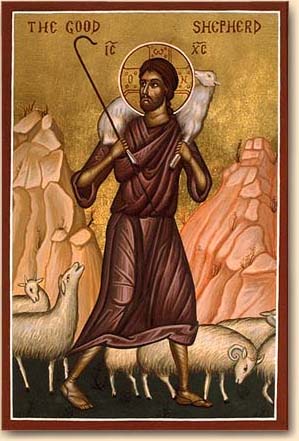
We are all familiar with the image of the Good Shepherd with the little lost lamb on his shoulders. This icon has always been an expression of Jesus’ care for sinners and of the mercy of God who never resigns himself to the loss of anyone. The parable is told by Jesus to make us understand that his closeness to sinners should not scandalize us, but on the contrary it should call us all to serious reflection on how we live our faith. The narrative sees, on the one hand, the sinners who approach Jesus in order to listen to him and, on the other, the suspicious doctors of the law and scribes who move away from him because of his behavior. They move away because Jesus approaches the sinners. These men were proud, arrogant, believed themselves to be just.

The lesson that Jesus wants us to learn is… that not a single one of us can be lost. God’s action is that of one who goes out seeking his lost children and then rejoices and celebrates with everyone at their recovery.

We are all warned: mercy to sinners is the style with which God acts and to this mercy he is absolutely faithful: nothing and no one can distract him from his saving will. God does not share our current throw-away culture… God throws no one away; God loves everyone, looks for everyone: one by one! He doesn’t know what “throwing people away” means, because he is entirely love, entirely mercy.

While he is looking for the lost sheep, he challenges the ninety-nine to participate in the reunification of the flock. Then, not only the lamb on his shoulders, but the whole flock will follow the shepherd to his home to celebrate with “friends and neighbors.”

We should reflect on this parable often, for in the Christian community there is always someone who is missing and if that person is gone, a place is left empty. Sometimes this is daunting and leads us to believe that a loss is inevitable, like an incurable disease. 

In Jesus’ vision there are no sheep that are definitively lost, but only sheep that must be found again. We need to understand this well: to God no one is definitively lost. Never! To the last moment, God is searching for us. Think of the good thief; only in the eyes of Jesus no one is definitively lost. For his perspective is entirely dynamic, open, challenging and creative. It urges us to go forth in search of a path to brotherhood. No distance can keep the shepherd away; and no flock can renounce a brother. To find the one who is lost is the joy of the shepherd and of God, but it is also the joy of the flock as a whole! We are all sheep who have been retrieved and brought back by the mercy of the Lord, and we are called to gather the whole flock to the Lord!

Click here to read the full address by Pope Francis.

Catholic Scholars Visit the Mary Garden

Photos: Gloria M. Chang

“What is theology?” asked Professor Andrea Florendo to a group of young Catholic Scholars in the Passionist Monastery Chapel.

“The study of God,” responded a sophomore brightly in the front row. 

“Yes, and where does theology begin?” Professor Florendo continued. Looking at each of the young faces, she exclaimed, “In a garden!” Following the creation account in Genesis, the story of God and humankind unfolds in the Garden of Eden. Flowers, trees, rocks, soil, animals, sun, moon, sky, water, humans—the whole natural world—declare the glory of God. Prayer and liturgy burst forth among flowering plants and birdsong in God’s garden of paradise. 

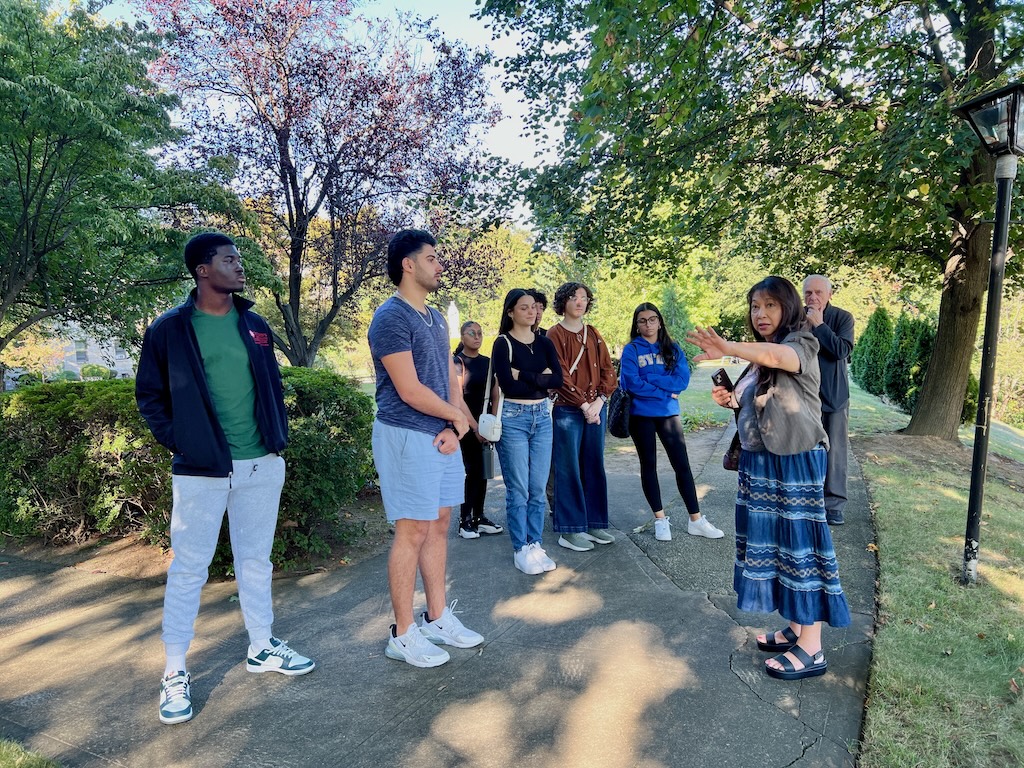
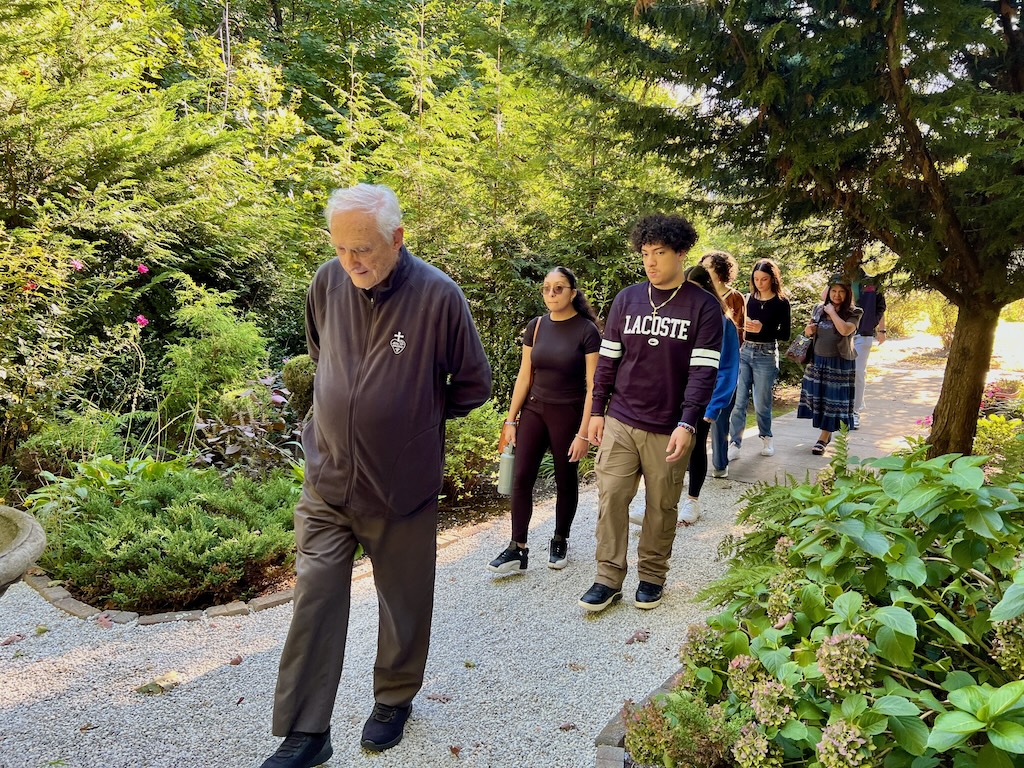
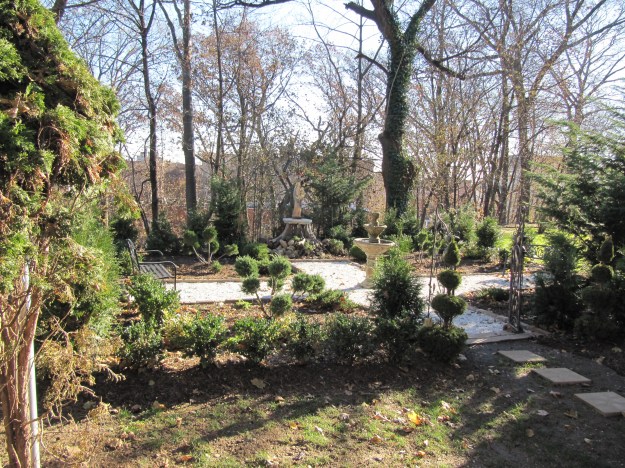
On Sunday, October 6, 2024, seven Catholic Scholars from St. John’s University visited the Mary Garden at the Passionist Monastery in Jamaica, NY. Fr. Victor Hoagland, C.P., Professor Andrea Florendo, and Gloria Chang, founders of the Mary Garden Guild at the Passionist Monastery, welcomed the students warmly. 

Fr. Victor, who has traveled extensively throughout the world on pilgrimages and missions, shared the global Passionist charism with the Catholic Scholars, who are preparing for a life of faith-inspired leadership. The Passionists, who received their mission from St. Paul of the Cross to keep alive in the world the love of Jesus Crucified as seen in His Sacred Passion, have expanded their charism to include the care of creation as taught by Pope Francis in his encyclical Laudato Si. Inspired also by Fr. Thomas Berry, C.P. (1914-2009), a pioneer in ecology, the Passionists have redesigned their retreat center in Jamaica, NY, in his name. 

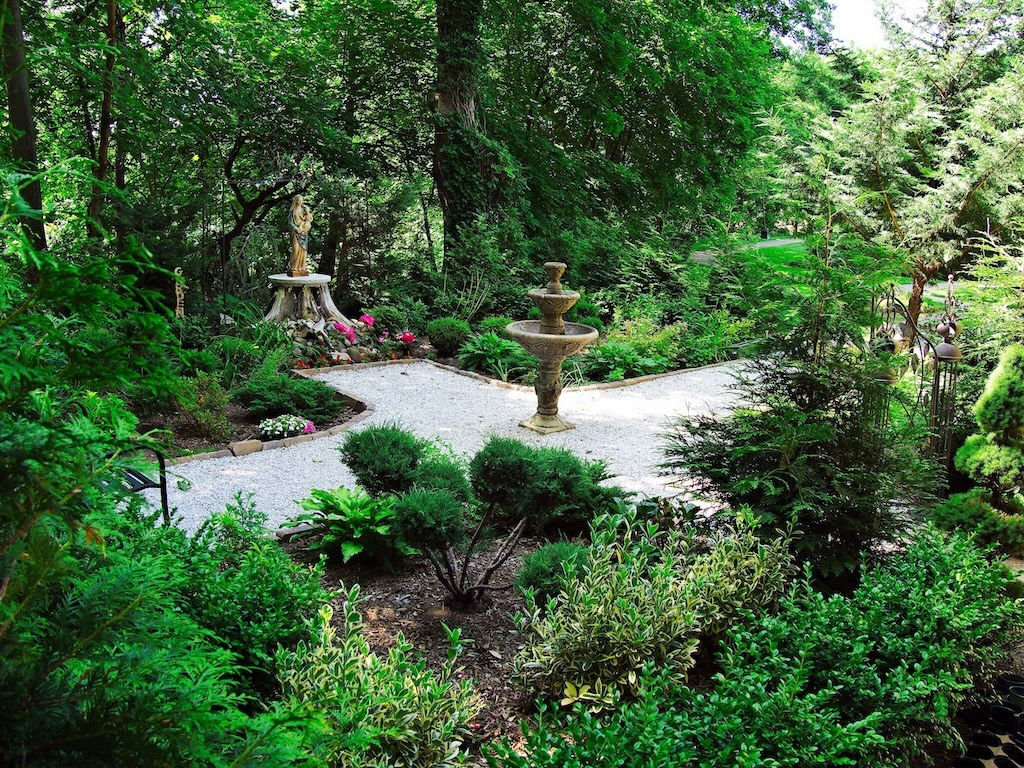
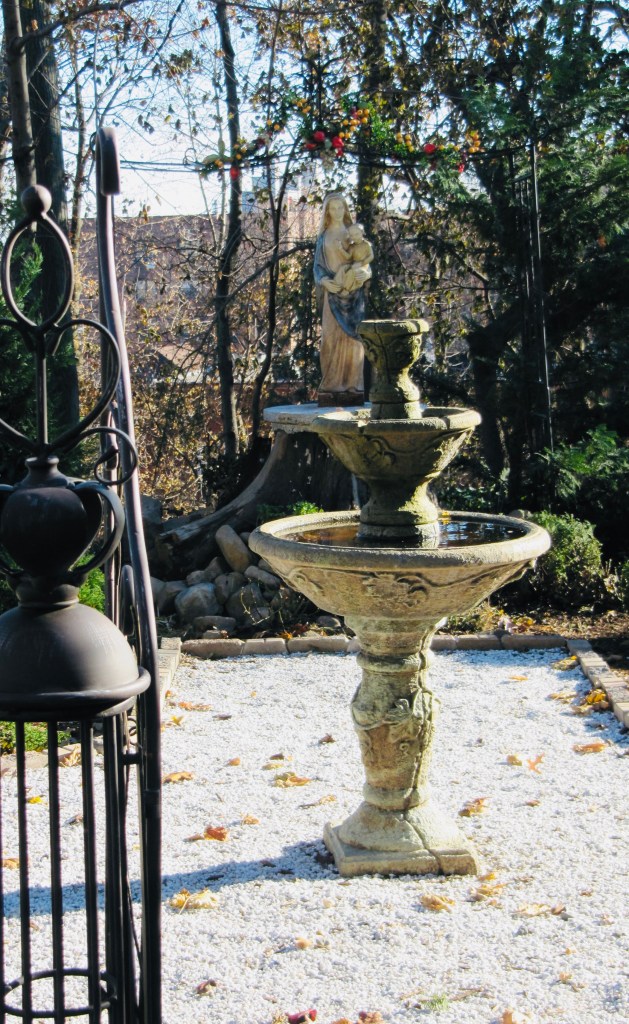
Andrea Florendo, a retired theology professor at St. John’s University and designer of the Mary Garden, gave a tour, pointing out the significance of the enclosed garden as a symbol of Mary’s virginal womb, the fountain as Christ’s “fountain of living waters,” and the cross path as the four rivers in the Garden of Eden. 


Photo: Gloria M. Chang

Our visit in the Mary Garden ended in praise and thanksgiving to God with prayers from Scripture and a reading from the Book of Genesis. May the Lord bless our Catholic Scholars abundantly with faith and grace as they continue their studies and formation at St. John’s University.

How great is your name, O Lord our God,
through all the earth!

Psalm 8:1

Matthew, the tax collector: September 21


Jews  usually turned away as they passed the customs place where Matthew, the tax-collector, was sitting. But look at our gospel for today:

“As Jesus passed by, he saw a man named Matthew sitting at the customs post. He said to him, “Follow me.” And he got up and followed him.”

To celebrate their new friendship, Matthew invited Jesus to a banquet at his house with his friends – tax collectors like himself – and Jesus came with some of his disciples. They were criticized immediately for breaking one of Capernaum’s social codes. “Why does your teacher eat with tax collectors and sinners?”

Jesus’ answer was quick: “Those who are well do not need a physician, but the sick do. Go and learn the meaning of the words `I desire mercy, not sacrifice.’ I did not come to call the righteous, but sinners.”

Hardly anything is known of Matthew’s part in Jesus’ later ministry, yet surely the tradition must be correct that says he recorded much of what Jesus said and did. Tax collectors were good at keeping books. Was Matthew’s task to keep memories? Did he remember some things that were especially related to his world?

The gospels say that wherever Jesus went he was welcomed by tax collectors. When he entered Jericho, Zachaeus, the chief tax collector of the city, climbed a tree to see him pass, since the crowds were so great. Did Matthew point out the man in the tree to Jesus, a tax collector like himself, who brought them all to his house, where Jesus left his blessing of salvation? And did tax collectors in other towns come to Jesus because they recognized one of their own among his companions?

Probably so. Jesus always looked kindly on outsiders like Matthew who were targets of suspicion and resentment. True, they belonged to a compromised profession tainted by greed, dishonesty and bribery. Their dealings were not always according to the fine line of right or wrong.

But they were children of God and, like lost sheep, Jesus would not let them be lost.

Pope Francis said he got his vocation to be a priest on the Feast of St. Matthew, when he went to confession and heard God’s call, a call of mercy.

Matthew’s Gospel?

The gospels themselves recall little about Matthew, an apostle of Jesus. We have his name, his occupation and a brief story of a banquet that took place with Jesus and some of his friends after his call.  ( Mt 9: 9-13; Mk 2:3-12; Lk5:18-26) As it is, the gospels concentrate on the ministry and teaching of Jesus. 

In the early centuries, those who knew Jesus told his story and brought his message to the world. As they died, writings about him gradually appeared, but there are only scarce references to who wrote them. St. Justin Martyr in the early 2nd century speaks of the “memoirs of the apostles”, without indicating any author by name. Later in that century, St. Irenaeus, bishop of Lyons, writing against the Gnostics who claim a superior knowledge of Jesus Christ attributes the gospels to Matthew, Mark, Luke and John. They are eyewitnesses who really know Jesus firsthand; they have given us their “memoirs.” 

Scholars today are less likely to credit Matthew’s Gospel to the tax-collector from Capernaum whom Jesus called. Some of his memoirs perhaps may be there– after all he came from a profession good at accounting for things. But too many indications point to other sources. Why would Matthew, if he is an eyewitness, depend on Mark’s Gospel as he does? Language, the structure of the gospel, the circumstances it addresses, point to a Jewish-Christian area beyond Palestine as its source, probably Antioch in Syria, probably written around the year 8o, after the Gospel of Mark.

Traditions says that Matthew preached in Ethiopia and Persia, but they have no historical basis.

He is remembered as a martyr who died for the faith, but again there is no historical basis. 

Better to see Matthew as the gospel and the prayer at Mass sees him: one of the first outsiders whom Jesus called. And he would not be the last..

O God, who with untold mercy
were pleased to choose as an Apostle
Saint Matthew, the tax collector,
grant that, sustained by his example and intercession,
we may merit to hold firm in following you.
Through our Lord Jesus Christ, your Son,
who lives and reigns with you in the unity of the Holy Spirit,
God, for ever and ever.
Amen.

The Gift of the Old: 1 and 2 Maccabees

This week our first readings at Mass are from the First and Second Books of Maccabees commemorating the Jewish revolt against Antiochus Epiphanes, successor to Alexander the Great. The revolt led to the rededication of the temple by Judas Maccabeus after its profanation by foreign invaders.  The Jewish Feast of Hannukah recalls the event. (Thursday) The revolt took place over a hundred years before the time of Jesus.

The Maccabean revolt is one reason why the times of Jesus were so politically sensitive. On his journey to Jerusalem, some “thought that the kingdom of God would appear there immediately.” (Luke 19,11)  A number of his disciple probably thought that would happen by an armed uprising against the Romans, like the revolt  against Antiochus Epiphanes.

Our readings this week, however, are not battle accounts from the uprising but rather stories of two elderly faithful Jews: Eleazar, a scribe who refused to assimilate to the culture of the conquerors, and a mother who inspired her seven sons to resist the invaders. (Tuesday and Wednesday)

All Eleazar had to do was pretend to eat the meat of sacrifice, but the ninety-year old chose to die rather than give bad example to the young.
“I will prove myself worthy of my old age, and I will leave to the young a noble example of how to die willingly and generously for the revered and holy laws.” (2 Maccabees 6. 30-31)

The Jewish mother, seized with her seven son and witness to their torture and death,  urged them to keep their faith and persevere:
“I do not know how you came into existence in my womb; it was not I who gave you the breath of life, nor was it I who set in order the elements of which each of you is composed. Therefore, since it is the Creator of the universe who shapes each man’s beginning, as he brings about the origin of everything, he, in his mercy, will give you back both breath and life, because you now disregard yourselves for the sake of his law.” (2 Maccabees 7,1, 21-31)

Pope Francis often speaks of the wisdom and influence of the elderly.  We rely on them. Maybe now more than ever.

Calming the Storms (Matthew 14:22-36)

Jesus storm at sea
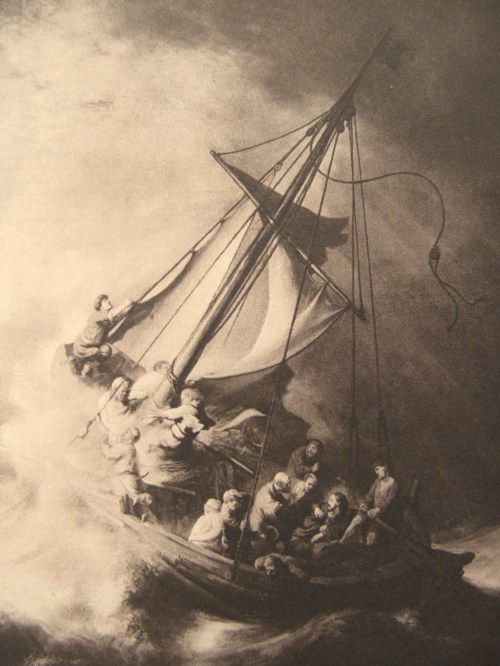
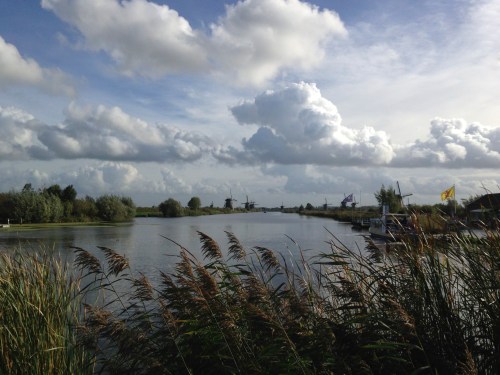
The giant waves on the Sea of Galilee in Rembrandt painting would be hard to survive, let alone walk on, but that’s what Jesus did, Matthew’s gospel today tells us. Jesus walked on the waters and tamed them. Only God does that, the psalms say.

“You uphold the mountains with your strength.
You are girded with power.
You still the roaring of the seas
And the roaring of their waves,
And the tumult of the peoples. “ Psalm 65

We usually read the stories of the disciples in the storm at sea as stories of rescue, and they are. God saves us from the storms we face on our life journey. But first, the stories testify to Jesus’ mastery over creation. On the shore his power touched human beings, like the leper, the deaf and those who could not speak; on the sea he rules creation. “Truly, you are the Son of God,” his disciples say after he gets into the boat and the wind dies down. (Matthew 14,22-36)

In his encyclical on the environment “Laudato Si” Pope Francis emphasizes the power of God over creation. As creator and savior, God gives all things their dignity and purpose. Human beings are not lords of this world, God alone is.

The story of Peter in our gospel takes on new interest in that perspective. Jesus invites him to walk on the water, giving him a share in God’s power. But Peter’s fear and lack of faith overcomes him. He begins to sink.

In our unfolding environmental crisis (storms, winds, floods) are we like Peter, called to share God’s power but turning away from our responsibility to calm the waters? Too big for us to take on. If that’s so, we sink.

Water:Genesis 2

Mary Garden, Passionist Monastery, Jamaica, New York

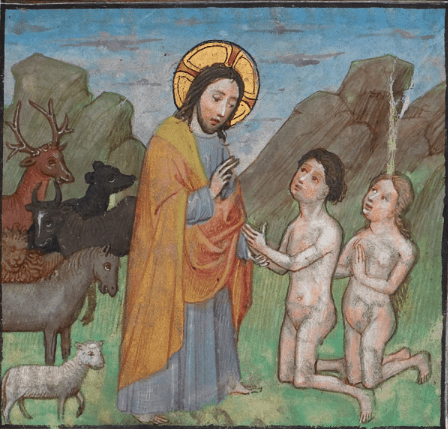
Today’s reading from Genesis begins the second creation account (Genesis 2,4..) which pays particular attention to the creation of human beings. But it begins with water, welling up from the earth bringing life to the earth and finally the human family.

IMG_2381

Water is at the heart of the garden God provides for Adam and Eve. We have a fountain in the center of our Mary Garden signifying water’s vital role in the garden that was Eden and in the world we live in today.

Pope Francis speaks repeatedly of the role of water in our common home of creation and our need to care for it. Here are some of his reflections from his 2018 World Day of Prayer for the Care of Creation. Notice his strong objection to attempts to privatize water by commercial groups.

“On this World Day of Prayer for the Care of Creation, which the Catholic Church for several years now has celebrated in union with our Orthodox brothers and sisters and with participation of other Churches and Christian communities, I would like to draw attention to the question of water. It is a very simple and precious element, yet access to it is, sadly, for many people difficult if not impossible. Nonetheless, “access to safe drinkable water is a basic and universal human right, since it is essential to human survival and, as such, is a condition for the exercise of other human rights. Our world owes a great social debt towards the poor who lack access to drinking water, because they are denied the right to a life consistent with their inalienable dignity” (ibid., 30).
Water invites us to reflect on our origins. The human body is mostly composed of water, and many civilizations throughout history arose near great rivers that marked their identity. In an evocative image, the beginning of the book of Genesis states that, in the beginning, the spirit of the Creator “swept over the face of the waters (1:2)”.
In considering the fundamental role of water in creation and in human development, I feel the need to give thanks to God for “Sister Water”, simple and useful for life like nothing else on our planet.  Precisely for this reason, care for water sources and water basins is an urgent imperative. Today, more than ever, we need to look beyond immediate concerns (cf. Laudato Si’, 36) and beyond a purely utilitarian view of reality, “in which efficiency and productivity are entirely geared to our individual benefit” (ibid., 159). We urgently need shared projects and concrete gestures that recognize that every privatization of the natural good of water, at the expense of the human right to have access to this good, is unacceptable.
For us Christians, water represents an essential element of purification and of life.  We think immediately of baptism, the sacrament of our rebirth. Water made holy by the Spirit is the matter by which God has given us life and renewed us; it is the blessed source of undying life. For Christians of different confessions, baptism also represents the real and irreplaceable point of departure for experiencing an ever more authentic fraternity on the way to full unity. Jesus, in the course of his mission, promised a water capable of quenching human thirst for ever (cf. Jn 4:14).  He prophesied, “If any one thirst, let him come to me and drink (Jn 7:37). To drink from Jesus means to encounter him personally as the Lord, drawing from his words the meaning of life. May the words he spoke from the cross – “I thirst” (Jn 19:28) – echo constantly in our hearts. The Lord continues to ask that his thirst be quenched; he thirsts for love.  He asks us to give him to drink in all those who thirst in our own day, and to say to them, “I was thirsty and you gave me to drink” (Mt 25:35). To give to drink, in the global village, does not only entail personal gestures of charity, but also concrete choices and a constant commitment to ensure to all the primary good of water.”

https://www.vaticannews.va/en/taglist.cultura-e-societa.Diritti-umani.html

God Saw It Was Good

Creation story, BL

Here’s Pope Francis’ commentary on todays reading from Genesis:

“And God saw that it was good” (Gen 1:25). God’s gaze, at the beginning of the Bible, rests lovingly on his creation. From habitable land to life-giving waters, from fruit-bearing trees to animals that share our common home, everything is dear in the eyes of God, who offers creation to men and women as a precious gift to be preserved.

Tragically, the human response to this gift has been marked by sin, selfishness and a greedy desire to possess and exploit. Egoism and self-interest have turned creation, a place of encounter and sharing, into an arena of competition and conflict. In this way, the environment itself is endangered: something good in God’s eyes has become something to be exploited in human hands. 

Deterioration has increased in recent decades: constant pollution, the continued use of fossil fuels, intensive agricultural exploitation and deforestation are causing global temperatures to rise above safe levels. The increase in the intensity and frequency of extreme weather phenomena and the desertification of the soil are causing immense hardship for the most vulnerable among us. Melting of glaciers, scarcity of water, neglect of water basins and the considerable presence of plastic and microplastics in the oceans are equally troubling, and testify to the urgent need for interventions that can no longer be postponed. 

We have caused a climate emergency that gravely threatens nature and life itself, including our own.

In effect, we have forgotten who we are: creatures made in the image of God (cf. Gen 1:27) and called to dwell as brothers and sisters in a common home. 

We were created not to be tyrants, but to be at the heart of a network of life made up of millions of species lovingly joined together for us by our Creator. 

Now is the time to rediscover our vocation as children of God, brothers and sisters, and stewards of creation. Now is the time to repent, to be converted and to return to our roots. We are beloved creatures of God, who in his goodness calls us to love life and live it in communion with the rest of creation.

Pope Francis, September 1, 2019

The Season of Creation, September 1st -October 5th

1 September 2022, Pope Francis writes:

Dear brothers and sisters!

“Listen to the voice of creation” is the theme and invitation of this year’s Season of Creation.  The ecumenical phase begins on 1 September with the World Day of Prayer for the Care of Creation, and concludes on 4 October with the feast of Saint Francis.  It is a special time for all Christians to pray and work together to care for our common home.  Originally inspired by the Ecumenical Patriarchate of Constantinople, this Season is an opportunity to cultivate our “ecological conversion”, a conversion encouraged by Saint John Paul II as a response to the “ecological catastrophe” predicted by Saint Paul VI back in 1970. 

If we learn how to listen, we can hear in the voice of creation a kind of dissonance.  On the one hand, we can hear a sweet song in praise of our beloved Creator; on the other, an anguished plea, lamenting our mistreatment of this our common home.

The sweet song of creation invites us to practise an “ecological spirituality” (Laudato Si’, 216), attentive to God’s presence in the natural world.  It is a summons to base our spirituality on the “loving awareness that we are not disconnected from the rest of creatures, but joined in a splendid universal communion” (ibid., 220).  For the followers of Christ in particular, this luminous experience reinforces our awareness that “all things came into being through him, and without him not one thing came into being” (Jn 1:3).  In this Season of Creation, we pray once more in the great cathedral of creation, and revel in the “grandiose cosmic choir” made up of countless creatures, all singing the praises of God.  Let us join Saint Francis of Assisi in singing: “Praise be to you, my Lord, for all your creatures” (cf. Canticle of Brother Sun).  Let us join the psalmist in singing, “Let everything that breathes praise the Lord!” (Ps 150:6).

Tragically, that sweet song is accompanied by a cry of anguish.  Or even better: a chorus of cries of anguish.  In the first place, it is our sister, mother earth, who cries out.  Prey to our consumerist excesses, she weeps and implores us to put an end to our abuses and to her destruction.  Then too, there are all those different creatures who cry out.  At the mercy of a “tyrannical anthropocentrism” (Laudato Si’, 68), completely at odds with Christ’s centrality in the work of creation, countless species are dying out and their hymns of praise silenced.  There are also the poorest among us who are crying out.  Exposed to the climate crisis, the poor feel even more gravely the impact of the drought, flooding, hurricanes and heat waves that are becoming ever more intense and frequent.  Likewise, our brothers and sisters of the native peoples are crying out.  As a result of predatory economic interests, their ancestral lands are being invaded and devastated on all sides, “provoking a cry that rises up to heaven” (Querida Amazonia, 9).  Finally, there is the plea of our children.  Feeling menaced by shortsighted and selfish actions, today’s young people are crying out, anxiously asking us adults to do everything possible to prevent, or at least limit, the collapse of our planet’s ecosystems.

Listening to these anguished cries, we must repent and modify our lifestyles and destructive systems.  From its very first pages, the Gospel calls us to “repent, because the kingdom of heaven has come near” (Mt 3:2); it summons us to a new relationship with God, and also entails a different relationship with others and with creation.  The present state of decay of our common home merits the same attention as other global challenges such as grave health crises and wars.  “Living our vocation to be protectors of God’s handiwork is essential to a life of virtue; it is not an optional or a secondary aspect of our Christian experience” (Laudato Si’, 217).

As persons of faith, we feel ourselves even more responsible for acting each day in accordance with the summons to conversion.  Nor is that summons simply individual: “the ecological conversion needed to bring about lasting change is also a community conversion” (ibid., 219).  In this regard, commitment and action, in a spirit of maximum cooperation, is likewise demanded of the community of nations, especially in the meetings of the United Nations devoted to the environmental question.  

The COP27 conference on climate change, to be held in Egypt in November 2022 represents the next opportunity for all to join in promoting the effective implementation of the Paris Agreement.  For this reason too, I recently authorized the Holy See, in the name of and on behalf of the Vatican City State, to accede to the UN Framework Convention on Climate Change and the Paris Agreement, in the hope that the humanity of the 21st century “will be remembered for having generously shouldered its grave responsibilities” (ibid., 65).  The effort to achieve the Paris goal of limiting temperature increase to 1.5°C is quite demanding; it calls for responsible cooperation between all nations in presenting climate plans or more ambitious nationally determined contributions in order to reduce to zero, as quickly as possible, net greenhouse gas emissions.  This means “converting” models of consumption and production, as well as lifestyles, in a way more respectful of creation and the integral human development of all peoples, present and future, a development grounded in responsibility, prudence/precaution, solidarity, concern for the poor and for future generations.  Underlying all this, there is need for a covenant between human beings and the environment, which, for us believers, is a mirror reflecting “the creative love of God, from whom we come and towards whom we are journeying”.  The transition brought about by this conversion cannot neglect the demands of justice, especially for those workers who are most affected by the impact of climate change.

For its part, the COP15 summit on biodiversity, to be held in Canada in December, will offer to the goodwill of governments a significant opportunity to adopt a new multilateral agreement to halt the destruction of ecosystems and the extinction of species.  According to the ancient wisdom of the Jubilee, we need to “remember, return, rest and restore”.  In order to halt the further collapse of biodiversity, our God-given “network of life”, let us pray and urge nations to reach agreement on four key principles: 1. to construct a clear ethical basis for the changes needed to save biodiversity; 2. to combat the loss of biodiversity, to support conservation and cooperation, and to satisfy people’s needs in a sustainable way; 3. to promote global solidarity in light of the fact that biodiversity is a global common good demanding a shared commitment; and 4. to give priority to people in situations of vulnerability, including those most affected by the loss of biodiversity, such as indigenous peoples, the elderly and the young.

Let me repeat: “In the name of God, I ask the great extractive industries – mining, oil, forestry, real estate, agribusiness – to stop destroying forests, wetlands, and mountains, to stop polluting rivers and seas, to stop poisoning food and people”.

How can we fail to acknowledge the existence of an “ecological debt” (Laudato Si’, 51) incurred by the economically richer countries, who have polluted most in the last two centuries; this demands that they take more ambitious steps at COP27 and at COP15.  In addition to determined action within their borders, this means keeping their promises of financial and technical support for the economically poorer nations, which are already experiencing most of the burden of the climate crisis.  It would also be fitting to give urgent consideration to further financial support for the conservation of biodiversity.  Even the economically less wealthy countries have significant albeit “diversified” responsibilities (cf. ibid., 52) in this regard; delay on the part of others can never justify our own failure to act.  It is necessary for all of us to act decisively.  For we are reaching “a breaking point” (cf. ibid., 61).

During this Season of Creation, let us pray that COP27 and COP15 can serve to unite the human family (cf. ibid., 13) in effectively confronting the double crisis of climate change and the reduction of biodiversity.  Mindful of the exhortation of Saint Paul to rejoice with those who rejoice and to weep with those who weep (cf. Rom 12:15), let us weep with the anguished plea of creation.  Let us hear that plea and respond to it with deeds, so that we and future generations can continue to rejoice in creation’s sweet song of life and hope.

Rome, Saint John Lateran, 16 July 2022,  Memorial of Our Lady of Mount Carmel

Caring for Creation

f

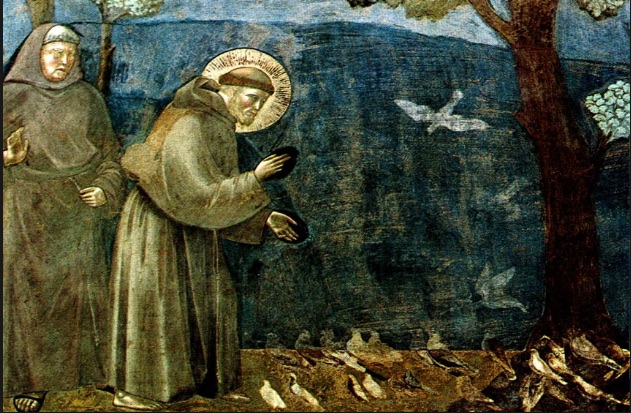
St. Francis is one of those super saints  to keep in mind, even after his feast day. I mentioned in a previous blog the statue of Francis facing St. John Lateran and Pope Innocent’s dream of a young man who, like Francis, held up the church’s walls ready to fall.  Francis helped renew the church.

In his encyclical Laudato Si, Pope Francis paints a verbal picture of Francis, holding his arms out to the created world, caring for our endangered planet:

“I believe that Saint Francis is the example par excellence of care for the vulnerable and of an integral ecology lived out joyfully and authentically. He is the patron saint of all who study and work in the area of ecology, and he is also much loved by non-Christians. He was particularly concerned for God’s creation and for the poor and outcast. He loved, and was deeply loved for his joy, his generous self-giving, his openheartedness. He was a mystic and a pilgrim who lived in simplicity and in wonderful harmony with God, with others, with nature and with himself. He shows us just how inseparable the bond is between concern for nature, justice for the poor, commitment to society, and interior peace.

“Francis helps us to see that an integral ecology calls for openness to categories which transcend the language of mathematics and biology, and take us to the heart of what it is to be human. Just as happens when we fall in love with someone, whenever he would gaze at the sun, the moon or the smallest of animals, he burst into song, drawing all other creatures into his praise. He communed with all creation, even preaching to the flowers, inviting them “to praise the Lord, just as if they were endowed with reason”.

“His response to the world around him was so much more than intellectual appreciation or economic calculus, for to him each and every creature was a sister united to him by bonds of affection. That is why he felt called to care for all that exists. His disciple Saint Bonaventure tells us that, “from a reflection on the primary source of all things, filled with even more abundant piety, he would call creatures, no matter how small, by the name of ‘brother’ or ‘sister’”. Such a conviction cannot be written off as naive romanticism, for it affects the choices which determine our behaviour.

“If we approach nature and the environment without this openness to awe and wonder, if we no longer speak the language of fraternity and beauty in our relationship with the world, our attitude will be that of masters, consumers, ruthless exploiters, unable to set limits on their immediate needs. By contrast, if we feel intimately united with all that exists, then sobriety and care will well up spontaneously. The poverty and austerity of Saint Francis were no mere veneer of asceticism, but something much more radical: a refusal to turn reality into an object simply to be used and controlled.

What is more, Saint Francis, faithful to Scripture, invites us to see nature as a magnificent book in which God speaks to us and grants us a glimpse of his infinite beauty and goodness. “Through the greatness and the beauty of creatures one comes to know by analogy their maker” (Wis 13:5); indeed, “his eternal power and divinity have been made known through his works since the creation of the world” (Rom 1:20). For this reason, Francis asked that part of the friary garden always be left untouched, so that wild flowers and herbs could grow there, and those who saw them could raise their minds to God, the Creator of such beauty. Rather than a problem to be solved, the world is a joyful mystery to be contemplated with gladness and praise.”

I like the pope’s words: “Rather than a problem to be solved, the world is a joyful mystery to be contemplated with gladness and praise.”