
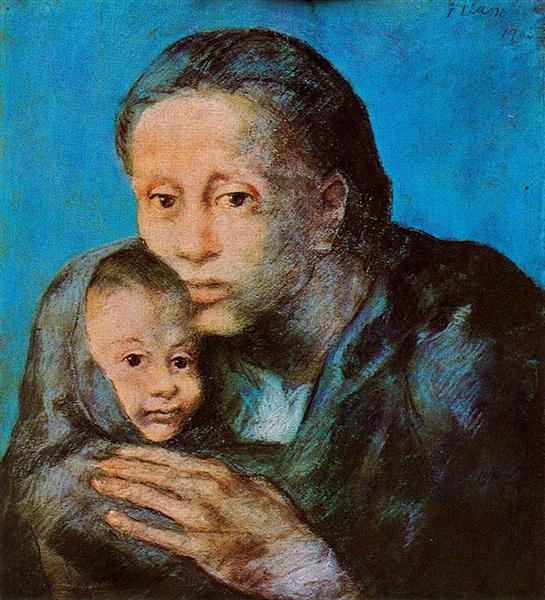
Picasso, “The Blind Man’s Meal”, (1903)
.
The ear that hears, the eye that sees—the Lord has made them both.
—Proverbs 20:12
———
It is the simple times. It is when we are doing life one dirty dish, one utility bill, one ordinary errand at a time that deepened faith creates an awe-filled stir.
For much is said of the bells and whistles of supernatural faith—but what is most supernatural is the presence of “all”, of “everything”, of “heaven and earth” in each dirty dish, each electric bill, each trip to the dollar store. What is most supernatural is the acknowledged presence of God in day-to-day life.
The deeper our trust, the more complete our surrender, the less “exciting” the external signs need to be. Or to express it differently: The least “exciting” times become so overwhelmingly profound that bells and whistles are hardly noticed.
We are told that we need an ear that hears and an eye that sees.
But what is it to have them?
Is it being still within God’s presence while the sponge soaks, the envelope seals, the cash register line slowly shortens?
The skeptic may see such a man as confined by complacency, dangerously satisfied, or simply numb. The skeptic may even call such a man “blind”.
That is certainly one way to look at it.
There is another:
Or is it that the mighty awe of a salvaged life has finally taken hold?
———
Turning to the disciples in private he said, “Blessed are the eyes that see what you see. For I say to you, many prophets and kings desired to see what you see, but did not see it, and to hear what you hear, but did not hear it.”
—Luke 10:23-24
.
.
—Howard Hain
.
 The Victor's Place