Tag Archives: Paul the Apostle

Timothy and Titus: January 26

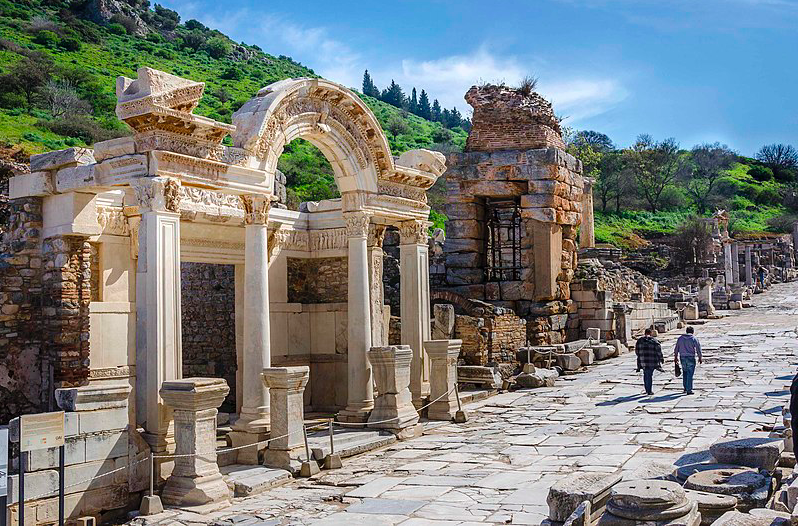
Ephesus, Main Street, Wikipedia Commons

Timothy and Titus were companions of St.Paul on his missionary journeys and continued his mission. Timothy led the church at Ephesus; Titus assumed leadership of the church in Crete. Paul wrote letters of advice to them: one letter to Titus and two letters to Timothy, most likely written from house arrest in Rome.

Like Jesus, Paul never saw himself handing on a church that was completely developed. He ministered to a church evolving from a “way”, a movement, to a church settled in places like Ephesus and Crete. He had men and women companions at his side.

Timothy and Titus were important companions who represent another stage in Paul’s ministry.  While Paul and other apostles went out to the nations, the church had to be firmly established in every place they visited. The roles of bishops, priests and other ministries evolved to fulfill that task. A local church needed to be organized. The church is missionary, global, sent by Jesus to the nations, but it’s also local, part of a town. city, neighborhood.

The feasts of the Conversion of Paul and Timothy and Titus represent those two aspects of the church.

Paul’s  advice to Timothy is especially interesting. “Stir into flame the gift of God that you have through the imposition of my hands. For God did not give us a spirit of cowardice, but rather of power and love and self-control. So do not be ashamed of your testimony to our Lord, nor of me, a prisoner for his sake; but bear your share of hardship for the Gospel with the strength that comes from God.”

Is Paul trying to bolster Timothy’s confidence as he loses a powerful mentor. Timothy needs the gift of God to make the church in Ephesus a flourishing local church. 

Timothy and Titus were given “apostolic virtues” by God to continue the work of Paul and the other apostles, the opening prayer of their feast says. And “May we merit to reach our heavenly homeland” by “living justly and devoutly in this present age.” Like them “we” also are given a task –to work for the church’s growth and development in this present age.

Let’s remember them as our mentors, mindful that God “ does not give a spirit of cowardice, but rather of power and love and self control.” Like the two followers of Paul, we have to hold on to what we’re given and continue their work: “Go into all the world, and proclaim the gospel. I am with you always, says the Lord.”

I see in the notes in the American Bible that the deacons Paul refers to in I Timothy 3, 8-13 may include women as well as men. “This (deacons) seems to refer to women deacons, but may possibly mean the wives of deacons. The former is preferred because the word is used absolutely…”

Why not today? We need women in roles of leadership. I have some in mind who would fit the role very well. I wonder if Timothy’s mother Eunice and grandmother Lois found a home and were involved there. I wonder what my mother would say.

Who are the Romans Paul writes to?

Who are the Romans Paul writes to in his letter to the church in Rome? Historians say Jews were the predominant group that first embraced Christianity in Rome, but there were not many Jewish converts at first. A substantial population of Jews at the time lived in Trastevere, across the Tiber River. Claudius had to expel some of them from the city around the year 47 because of violent disturbances in the Trastevere synagogues over Christ. It’s unlikely there was a large number of converts to Christianity from Judaism when Paul wrote his letter. 

Many Jews in Rome, faithful to Judaism, would strongly question Paul’s argument that the law was a failure.

Not many Romans, Gentiles, embraced the gospel early on either. I doubt the majority of the Romans would agree with Paul that the Roman gods had failed. Rome was a powerful, successful empire in Paul’s day.  I doubt many thought too much about its flaws.

The Christian community made up of Jews and Gentiles was not large, if my reading of Paul’s time is accurate. The Christians of Rome were fervent, but few. 

In his letter, Paul pictures sin as a cosmic reality, but cosmic sin is not always easy to see. It was not easy to see in Paul’s day, nor is it easy to see in our day. We identify sin with personal sin, murder, theft, cheating, adultery. Paul is aware of personal sin, yet his focus is on cosmic sin. Harder to see who’s responsible for cosmic sin. Who’s responsible for the sin in wars, armament races, manipulation of world markets, plundering the environment? 

The Letter to the Romans has a large place in the Sunday and weekday readings of our lectionary. It can be difficult to read, but we need Paul’s larger picture, which calls for a larger hope. Until the final coming of Jesus, we must live in the world pictured by the apostle. 

We thank God for his grace of forgiveness and his promise of new life.

2nd Corinthians: Suffering with Christ

gohistoric_14912_m

For the next two weeks we’re reading at Mass St. Paul’s Second Letter to the Corinthians, a Christian community in the city of Corinth around the year 50, not many years after the time of Jesus.

During the easter season we read about the spread of the Christian church from Jerusalem to Rome from the Acts of the Apostles. Now, in ordinary time we look more closely at a church Paul founded– in Corinth. What was it like? Paul’s two letters to the Corinthians tell us about an early Christian church, but they also tell us about our church today.

The Christian community at Corinth was drawn from different peoples flocking to the great Mediterranean port. It was diverse. It attracted a variety of preachers and teachers, which caused some division, noticeably as they came together to “break bread.” There’s some sexual immorality in this church on a sea port open to the world. Some were wondering about the resurrection of Jesus.

Most of its members were not Jewish Christians, though some there may have wished for the stability a Jewish synagogue might provide. There’s no bishop administering this church as yet. Paul was a minister to the world. There was no one person in charge in Corinth.

It was church  “in the works,” not complete, with glaring weaknesses, struggling to grow in faith, with plenty of loose ends, looking for answers. It was church experiencing great change, a church suffering, not from outward persecution, but from turmoil within.

Maybe a church like ours?

Addressing the Corinthians, Paul sees their suffering as “Christ’s suffering”. He feels that mystery in himself, as he says in the opening chapters of his letter and he returns to that theme over and over.

Yes, problems must be faced, corrections made, restructuring needs to take place, but Paul keeps reminding the Corinthians they’re experiencing the sufferings of Christ and with Christ’s suffering comes his encouragement.

Paul himself knew both the sufferings of Christ and his encouragement. “We were utterly weighed down beyond our strength, so that we despaired of life,” he writes from the province of Asia, but with suffering came an overflowing encouragement, which always accompanies the sufferings of Christ. “We do not trust in ourselves but in God who raises from the dead.” ( 2 Corinthians 1, 5-11)

Paul’s way is the right way, isnt’ it? We’re tempted to judge, analyze, condemn, throw up our hands and lose hope in the world around us. The first way to see it is through the sufferings of Christ, a mystery affecting us all, and the “encouragement” that always accompanies this mystery.

Listen to Paul speaking to the struggling Corinthians:

“Our hope for you is firm, for we know that as you share in the sufferings, you also share in the encouragement,”

Good letter for us to read these days.

Paul’s Conversion: January 25th

Caravaggio, Conversion of Paul

Our yearly church calendar celebrates saints from every age and place because saints are examples of God’s grace present always and everywhere. Some saints are singled out for their importance. St. Paul the Apostle, whose dramatic conversion is celebrated on January 25th, is one of them. His martyrdom, along with Peter, is celebrated June 29th and we read extensively from his writings throughout the church year.

An account of Paul’s conversion ( Acts 22: 3-13) – one of three found in the Acts of the Apostles – is read first at his feast day Mass. Mark’s gospel for the feast recalls Jesu after his resurrection telling his disciples to “Go into the whole world and proclaim the gospel to every creature.” (Mark 16: 15-18)   St. Luke devotes much of the Acts to Paul’s  missionary journeys ending in Rome. The apostle fulfilled that command of Jesus.

Paul writes to the Corinthians: 

“I am the least of the apostles; in fact, since I persecuted the Church of God, I hardly deserve the name apostle; but by God’s grace that is what I am, and the grace that he gave me has not been fruitless. On the contrary, I have worked harder than any of the others: or rather, not I but the grace of God that is with me. (  1 Corthinians 15:9-10)

St. Paul is an example of how far we can rise, from the depths to the heights, and for that reason the church celebrates his conversion.  He never forgot that God’s grace raised him from the dust to become  a powerful force in his church and in the world. He never forgot he was a Pharisee who became one of Jesus’ most loyal disciples. His conversion gave him a boldness to go fearlessly to the ends of the earth 


“Saul, Saul, why do you persecute me?”  Jesus says to him from a blinding light. He never forgot the moment he was blinded by a light that made him see.

“Paul, more than anyone else, has shown us what we really are, and in what our nobility consists, and of what virtue a human being is capable. Each day he aimed ever higher; each day he rose up with greater ardour and faced with new eagerness the dangers that threatened him. He summed up his attitude in the words: I forget what is behind me and push on to what lies ahead. When he saw death imminent, he bade others share his joy: Rejoice and be glad with me! And when danger, injustice and abuse threatened, he said: I am content with weakness, mistreatment and persecution. These he called the weapons of righteousness, thus telling us that he derived immense profit from them… ” ( St. John Chrysostom)                                                                                             

O God, who taught the whole world through the preaching of the blessed Apostle Paul, draw us, we pray, nearer to you through the example of him whose conversion we celebrate today, and so make us witnesses to your truth in the world.Through our Lord Jesus Christ, your Son, who lives and reigns with you in the unity of the Holy Spirit, God, for ever and ever. Amen.

Pope John XXIII called for a Second Vatican Council on the Feast of the Conversion of Paul, January 25, 1959. He called for the church to be converted.

Letter to the Galatians

Our first readings this week at Mass are from the Letter to the Galatians, who were non-Jews St. Paul converted probably on his second missionary journey through Asia Minor. When Paul left, some Jewish Christians arrived and were enticing the new converts to adopt Jewish practices, especially that of circumcision. They also called Paul’s authority into question, saying he wasn’t among the original witnesses to Jesus’ life and resurrection.

Paul responds in this emotional letter written in 54 or 55 AD in which he voices amazement that the Galatians are listening to the newcomers and losing sight of the faith they’ve learned. Paul gives an account of his own call; he defends his authority to preach the gospel and his communion with the other apostles.

But the theme of his letter is belief in Jesus Christ, who was crucified. “Stupid Galatians! Who has bewitched you, before whose eyes Jesus Christ was publicly portrayed as crucified?” ( Gal 3,1) Don’t lose sight of what’s most important, what’s central to your faith–Jesus Christ!

Of course, the Galatians are not the only ones who lose sight of what’s most important ; we do too. That’s especially true in times like ours today.

Some of Paul’s most beautiful expressions of his own faith are found in this letter.  He describes his own conversion as a “revelation of Jesus Christ,” a grace by which God “revealed his Son to me.” It wasn’t a book he read or a blinding light.  Jesus revealed himself to him and that revelation continued. “I have been crucified with Christ,yet I live, no longer I, but Christ lives in me; insofar as I now live in the flesh, I live by faith in the Son of God who has loved me and given himself up for me.” (Gal 2,19-20)

Do  we need to remember too the Lord’s revelation of himself to us today?

Living in Christ means living in his Spirit, Paul continues. The Galatians are enticed by practices of the Jewish law; Paul reminds them of the law Jesus taught. “The whole law is fulfilled in one statement,’ You shall love your neighbor as yourself.’” (Gal 5,14) Bearing one another’s burdens is the way you fulfill the law of Christ, by sharing good things with one another you fulfill his law. Don’t tire of doing good, keep doing it, Paul says to his children in faith. (Gal 6,2;6:9)

Paul doesn’t give the Galatians a book he wrote once about Jesus, he speaks to them from his own faith in Jesus which is living and constantly growing. He’s likely just read the verse from the Old Testament about the curse one bears who hangs on the tree. The Son of God took on that cursed condition of hanging on a tree! What greater love can there be? Paul’s thinking too of the promise Abraham embraced who lived long before the mosaic law existed. That was the promise Abraham saw in faith and that’s the revelation the gentiles see in the Crucified Christ.

The Letter to the Galatians is about forgotten essentials that are replaced by something else. Paul recalls the essentials. “I live by faith in the Son of God who has loved me and given himself up for me.”

Keep before your eyes Jesus crucified.

Voice of the Faithful

Apollos is mentioned  in Saturday’s reading from the Acts of the Apostles (18,23-28).   He reminds us that Peter, Paul and the other apostles were not the only teachers in the early church. Others brought the message of Christ to the cities and towns of the Roman Empire. Apollos was one of them.

He’s an eloquent, learned teacher who came to Ephesus from Alexandria, one of the great centers of Jewish and Christian learning, and he drew a following by preaching about Jesus. But Apollos doesn’t know everything, so a Jewish couple, Priscilla and Acquila, “took him aside and explained to him the Way of God more accurately.”

They were disciples of Paul who supported him with a job in their tent business. They traveled with Paul and certainly listened to his teaching, but I don’t think they were ever considered teachers as he and Apollos were. They were considered “hearers of the word,” more likely. Well informed, for sure, but still among those we would call today “the faithful.”

Yet, let’s not forget what important teachers “the faithful” are, as Priscilla and Aquila remind us.

I remember a story a brilliant priest told me long ago about a baptism he was conducting for an infant born to a member of his family. His father was the baby’s sponsor and according to the rite then was expected to recite the Creed.

“Can you say the Creed, Dad?” the priest said to his father.

“Who do you think taught it to you?,” the father sharply replied.

Faith can’t survive in this world without the faithful, ordinary Priscillas and Aquilas explaining it and  passing it on. It begins with parents, godparents and family passing on the faith to children. It continues in daily life as ordinary Christians share their faith with others. The church today needs to strongly acknowledge this key mission of the laity.

Pope Francis is urging the laity to speak out in his call for a synodal church.

Creator of Heaven and Earth

God reveals himself in creation, Paul the Apostle reminds us as he begins his Letter to the Romans. “Ever since the creation of the world, his invisible attributes of eternal power and divinity have been able to be understood and perceived in what he has made.” (Romans 1:16-25)  God reveals himself in creation, not just to one people, the Jews, but to all people.

“The heavens declare the glory of God,” our psalm response for Tuesday declares. Yet human beings, blind to the God of creation, turn from this revelation and create gods of their own, and they lose sight of the One who made all things.

As an apostle sent by God into a world blinded by this sin, Paul announces a message of recreation and grace. God sends Jesus Christ, his Son, as our Savior and Lord.

Paul’s message takes on added meaning in a world failing to care for creation itself.

In his letter Laudato sí , on caring for the earth our common home, Pope Francis notes that certain times in history provoke a spiritual crisis which leads to a deeper faith in God. The Babylonian captivity when the Jewish people went into exile in the 6th century before Christ and the fierce Roman persecution of Christians at the beginning of the 4th century AD are examples he cites.  

These crises led to  “a growing trust in the all-powerful God: ‘Great and wonderful are your deeds, O Lord God the Almighty! Just and true are your ways ‘ (Rev 15:3). The God who created the universe out of nothing can also intervene in this world and overcome every form of evil.” (74) 

Our world now is paralyzed and will not be the same. Are we at one of those crucial moments? Will God intervene?  God, the Father, Creator of heaven and earth, God who is surprisingly creative? 

Don’t forget God, the Creator, the pope says. If we do ” we end up worshipping earthly powers, or ourselves usurping the place of God, even to the point of claiming an unlimited right to trample his creation underfoot. The best way to restore men and women to their rightful place, putting an end to their claim to absolute dominion over the earth, is to speak once more of the figure of a Father who creates and who alone owns the world. Otherwise, human beings will always try to impose their own laws and interests on reality.” (75)

Important as it is, science alone is not enough, the pope says. We need to look also to our own tradition for hope and inspiration. Our prayers, our sacraments, currents of our spirituality waiting to be recognized and developed can guide us now to what God has planned from eternity.

Paul’s Letter to the Romans speaks for today as well as yesterday.

If sacred history tells us anything, God the Creator never stops fashioning a beautiful unknown.

Paul’s Letter to the Romans, a basic statement of faith, is timely. We need to follow the path that leads to creation.

God doesn’t demonize

We’re reading Paul’s Second Letter to the Thessalonians and the Gospel of Matthew this week at Mass. Paul’s letter was written about the year 55 AD, 20 years or so after the death and resurrection of Jesus. The Gospel of Matthew was written about the year 85 AD, some 40 years later.

Paul’s letters illustrate his practice of going first into Jewish synagogues to preach the gospel. Before his conversion to Christianity, he went to the synagogues as a Pharisee to pursue and arrest Christians. Now members of the Pharisaic movement sharply confront him..

The Gospel of Matthew reflects this same confrontation. Matthew’s gospel was written at a highpoint of Jewish-Christian controversy, after the destruction of the temple in 70 AD.  Passages from the 23rd chapter of Matthew’s gospel would lead you to think that the Pharisees were Jesus’ fiercest enemies.

In reality, a number of Pharisees, like Nicodemus and Paul himself, became his most important followers, The Pharisees were certainly antagonistic to Jesus in his lifetime; he was angry with them for their blindness to him and his message, but he didn’t see them as mortal, eternal enemies.

We have to read the scriptures with an eye on the time they were written; It helps us understand the hot rhetoric we hear in Matthew’s reading for today.

What lesson can we learn from learn from readings like these? Don’t demonize your enemies. God doesn’t do that and neither should we.

That’s an important lesson to remember today as we look at the Muslim world. Jesus didn’t demonize people; he turned to the thief on the cross, he told the story of a prodigal son, he received back the disciples who abandoned him.,

When we bring the bread and wine to the altar at Mass, we bring to God all of creation, not just a part of it. “Blessed are you, Lord God of all creation,” we say. All creation is God’s creation. He wishes to bless it and see it at peace and harmony. God wishes us to see things as he see them.

God doesn’t demonize.

Barnabas and Paul

St. Barnabas, Anonymous. 18th century

Today’s reading from Acts of the Apostles (Acts 11: 19-26) describes the beginning of Paul’s work as missionary to the gentiles. He was sponsored by Barnabas.

After his dramatic conversion, Paul preached in Damascus, but was forced out of the city and returned to Jerusalem, but the disciples of Jesus there received him warily. They “were all afraid of Paul” because he persecuted the followers of Jesus. Barnabas believed in him and “took charge of him and brought him to the apostles.” (Acts 9, 26-30) He gained acceptance for Paul.

Later, as great numbers came to believe in Antioch, Barnabas was sent there by the Jerusalem church. Convinced the Spirit was at work, Barnabas went to Tarsus to get Paul. Together they spent a whole year teaching a large number of people. (Act 11, 26) Barnabas was the first to recognize Paul’s gifts.

Then, commissioned by the church at Antioch, Barnabas and Paul went to bring the gospel to other places. Their missionary journey took them to Cyprus (Barnabas’ birthplace) and a number of cities in Asia Minor. They preached in Jewish synagogues with mixed results, but increasingly gentile hearers accepted their message.

The Acts of the Apostles highlights Paul’s preaching, but the ministry involved the two of them. Barnabas, in fact, is initially mentioned before Paul .“They appointed presbyters … in each church” and returned to Antioch. (Acts 14, 21-23)

A dispute arose between them: “After some time, Paul said to Barnabas, ‘Come, let us make a return visit to see how the brothers are getting on in all the cities where we proclaimed the word of the Lord.’ Barnabas wanted to take along John Mark, but Paul refused to take him, because he deserted them at Pamphylia. So sharp was their disagreement that they separated. Barnabas took John Mark and sailed to Cyprus. But Paul chose Silas and traveled through Syria and Cilicia “bringing strength to the churches.” Acts 15, 36-41

Why “sharp disagreement?” Two strong personalities can’t get along? Paul’s vision against Barnabas’ vision? A clash like this reminds us that God’s plan advances even as humans disagree.

I also find it strange that Paul never mentions Barnabas in his later descriptions of his work. Barnabas, humanly speaking, got him his start.

The Conversion of Paul

Saints show us our capabilities, how far we can rise, from the depths to the heights. That’s why the church recalls the conversion of St.Paul a number of times in the church year. Today we hear it as part of our readings from the Acts of the Apostles.  As he readily acknowledges, Paul rose from the dust and became a powerful force in his church and in the world through God’s grace.

St. John Chrysostom says of him:  “Paul, more than anyone else, has shown us what we really are, and in what our nobility consists, and of what virtue a human being is capable. Each day he aimed ever higher; each day he rose up with greater ardour and faced with new eagerness the dangers that threatened him. He summed up his attitude in the words: I forget what is behind me and push on to what lies ahead. When he saw death imminent, he bade others share his joy: Rejoice and be glad with me! And when danger, injustice and abuse threatened, he said: I am content with weakness, mistreatment and persecution. These he called the weapons of righteousness, thus telling us that he derived immense profit from them…

The most important thing of all to him, however, was that he knew himself to be loved by Christ.”

May God raise up the Paul in us.