Tag Archives: Passionists

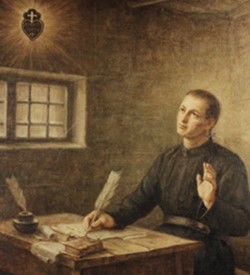
Morning Thoughts: Who is Paul of the Cross?

st-paul-castellazzo


..

Who is Paul of the Cross?

He’s a saint, canonized by Pope Pius IX in 1867.

He’s the founder of the Passionists , a religious community of priests, brothers, sisters, and laypeople.

He lived in northern and central Italy during most of the 18th century and was originally called Paul Francesco Danei.

There are books written about him. His letters have been collected and printed in large, thick volumes. And time on the internet will easily identify many short biographical sketches, prayers, and sayings. There is also much available about the Passionists, and their life after the death of Saint Paul of the Cross—their growth, history, struggles, saints, and their current configuration, focus, and works.

There are also the many individual members of the Congregation of the Passion of Jesus Christ, living today and based all around the world, and they each have their own story to tell.

But there is also the man named Paul.

And somehow this kind, gentle, humble, and beautifully-flawed human being seems to get lost in all this.

His weaknesses greatly interest me.

Christ’s courage and strength in and through him inspire me.

If we prayerfully put aside the constitutions, the history, the legacy, and even his incredibly personal and guidance-filled letters (that he never intended anyone other than the recipients to read) we just may find a stripped-down saint whose essence and example we badly need in times such as these.

We just may find what we find in each and every great man and woman of God throughout Christian history—that same occurrence that appears again and again through the lives of our brothers and sisters who have truly renounced all their possessions in order to become true disciples of Christ.

———

In Saint Paul of the Cross we just may find…

…a cold, naked infant in a cradle, desperate for his mother’s breast…

…a frightened and insecure child running to keep pace with the visions of his father…

…a tired, distraught, beaten-down young man offering his life for the benefit of his brothers…

We just may find ourselves.

Or we may find someone that we used to know.

Or we may find someone that we should get to know.

But what really matters is that we find the Word made flesh.

And that is the heart of the matter. The fleshy heart that matters.

For while hearts of stone are hard to wound, they are not really hearts at all. They are the hearts of the walking dead, of those whom Jesus Himself says, “let the dead bury their dead.”

Jesus wants our hearts, our entire hearts. He wants undivided, tenderized hearts. Soft and fleshy hearts.

Yes, that type of heart is easily pierced, but in being wounded they are transformed, in being merciful they begin to bleed, and in forgiving they become His. They become sacred. Our hearts become His Most Sacred Heart.

———

The saints show us Jesus. They show us ourselves. They show us where we come from, where we currently need to stand, and where it is that we should go.

And the answer is always the same: With God.

Born of a virgin. Dying on a cross. Raised from the dead. Ascending into Heaven.

———

I am no expert on Saint Paul of the Cross. But I am his friend, and he has been very good to me. And I hope that you get to know him too.

As far as me telling you more about Paul Danei, you probably fall into one of three categories: you already know the details, you have never even heard of him, or you are about to meet a man with a striking resemblance.

For you see, the best thing I can say about Paul is that he is a lot like Jesus—a man in history but not met through it, a man who wore a robe but not defined by it, a man who submitted himself to the law but didn’t let that stop him from transcending it.

A man who at the end of the day, knows that it is all about love.


.

—Howard Hain

.

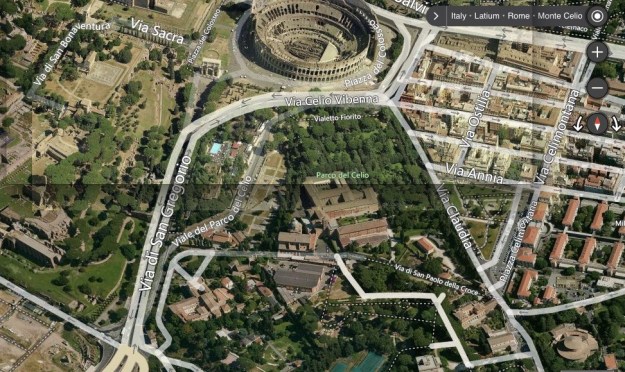
Visiting Gregory the Great; September 3

Church of St. Gregory the Great, lower left, off Via di San Gregorio (google maps)

Silent Clay

The daily Mass readings for Eastertime, from the Acts of the Apostles and the Gospel of John, are so different in tone. The Acts of the Apostles is a fast-moving account of a developing church spreading rapidly through the world through people like Paul of Tarsus and his companions. Blazing new trails and visiting new places,  they’d be frequent flyers today, always on the go.

The supper-room discourse of Jesus from the Gospel of John, on the other hand,  seem to move slowly, repeating, lingering over the words of Jesus to his disciples. Listen, be quiet, sit still, they say. Don’t go anywhere at all.

St. Paul of the Cross, the founder of the Passionists, was inspired by St. Paul, the Apostle, to preach and to teach. Many of his letters end telling readers he has to go, he’s off to preach somewhere. He was a “frequent flyer.”

But the Gospel of John also inspired him; it was the basis for his teaching on prayer. Keep in God’s presence, in pure faith, he often said. Enter that inner room and remain there. Don’t go anywhere.

“It’s not important for you to feel the Divine Presence, but very important to continue in pure faith, without comfort, loving God who satisfies our longings. Remain like a child resting on the bosom of God in faithful silence and holy love. Remain there in the higher part of your soul paying no attention to the noise of the enemy outside. Stay in that room with your Divine Spouse…Be what Saint John Chrysostom says to be: silent clay offered to the potter. Give yourself to your Maker. What a beautiful saying! What the clay gives to the potter, give to your Creator. The clay is silent; the potter does with it what he wills. If he breaks it or throws away, it is silent and content, because it knows it’s in the king’s royal gallery.”  (Letter 1515)


Weekday Readings: Third Week of Easter


Monday Acts 6,8-15; John 6,22-29
Tuesday Acts 7,58-8,1; John 6,30=35
Wednesday Acts 8,1-8; John 6,35-40
Thursday Acts 8,26-40; John 6,44-51
Friday Acts 9,1-20; John 6,52-59
Saturday Acts 9,31-42; John 6,60-69

The Mass readings this week continue from the Acts of the Apostles with the story of the Greek-speaking deacon Stephen. His fiery preaching against temple worship and “stiff-necked” Jewish opposition to Jesus results in his death and a persecution that drives Hellenist Christians out of Jerusalem. (Monday and Tuesday) But Stephen’s death, like the death of Jesus, brings new life. The church grows. “The death of Christians is the seed of Christianity.” (Tertullian )

Philip the Deacon, one of those displaced, preaches to the Samaritans north of Jerusalem. Then, led by the Spirit, he converts the Ethiopian eunuch returning home after his pilgrimage to Jerusalem. (Wednesday and Thursday} Following Philip’s activity, Paul, the persecutor, is converted by Jesus himself. (Friday)

Before Paul’s ministry begins, Peter leaves Jerusalem to bless the new Christian communities near the coast; at Joppa he’s told by God to meet the Roman centurion in Caesarea Maritima. The mission to the gentile world begins with that meeting. (Saturday)

Stephen, Philip, Peter and Paul serve God’s mysterious plan. It’s not human planning. The Holy Spirit is at work.

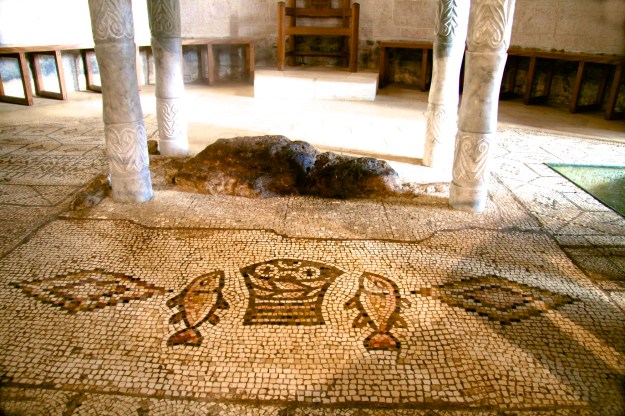
The gospel readings this week are from St.John’s gospel– segments of Jesus’ long discourse on the Bread of Life to the crowd at Capernaum after the miracle of the loaves. (John 6) In the Eucharist we meet the Risen Christ.  He not only feeds us personally, but a growing church is fed.

Light in Darkness

IMG_5910

The Easter readings tell us  Jesus Christ is the light of the world, who shines in our darkness. Mary comes to the tomb while it’s still dark. The dark of evening comes as the disciples hide in the Upper Room. The disciples fish all night, in the dark, and catch nothing. Then, Light comes.

Listen to Maximus of Turin’s reflections on Jesus Christ, “Light from Light.”

“Yes, we have the light of Christ, but it is a light that shines in darkness.  The light of Christ is an endless day that knows no night. Christ is this day, says the Apostle; such is the meaning of his words: Night is almost over; day is at hand. He tells us that night is almost over, not that it is about to fall… This is why John the evangelist says: The light shines in the darkness, and the darkness has never been able to overpower it.

And so, my brothers and sisters, each of us ought surely to rejoice on this holy day. Let no one, conscious of his sinfulness, withdraw from our common celebration, nor let anyone be kept away from our public prayer by the burden of his guilt. Sinner he may indeed be, but he must not despair of pardon on this day which is so highly privileged; for if a thief could receive the grace of paradise, how could a Christian be refused forgiveness?”

I like sitting on the porch this morning watching the light come in the morning. It always comes, sometimes muted, sometimes bright and clear, but it always comes.

Today, the feast of St. Athanasius, I was thinking of the Word proclaimed by the heavens and the earth.

“When I see your heavens, the work of your fingers,

…O LORD, our Lord,

how awesome is your name through all the earth!”

I l

The Easter Season: a School of Faith

Nicodemus

Nicodemus reminds us that faith doesn’t depend on how sharp our minds are or how many books we’ve read. Faith is God’s gift to us. We are all still in the school of faith.

On Friday of the Second Week of Easter we begin reading from John’s gospel about Jesus multiplying the loaves and fish near the Sea of Galilee. (John 6) There’s a lot of unbelief in the crowd that Jesus feeds, according to John. “Many of his disciples drew back and no longer went about with him,” . Besides those who radically reject Jesus’ claim to be the bread come down from heaven,  others appear to have little appreciation for this great sign. Commentators suspect this this section of John’s gospel may indicate there were troubles over the Eucharist and over the identity of Jesus in the churches John is writing for.

Most of the gospel readings for the last weeks of the Easter season are taken from the Farewell Discourse in John’s gospel. There too the disciples seem far from perfect. They’re fearful, they seem to understand Jesus so little. He calls them “little children,”  not far removed from the children making their Communion this season.

There are no perfect believers  in the gospels of our Easter season. Plenty of imperfect believers, like us, which tells us that faith is something to pray and struggle for. More importantly, they reveal the goodness of Jesus, who showed the wounds in his hands and his side to Thomas, who never dismissed Nicodemus to the night, who came to table with his disciples and fed them again, who called them “his own” and prayed that they would not fail.

We’re in a school of faith in the Easter season where the Risen Christ speaks to us in signs like water, bread and wine, words that promise a world beyond ours and teach us how to live in our world today.  He is our Teacher and Lord.

7th Sunday c: Love Your Enemies

For this week’s homily, please play the video file below.

Fixing Our Eyes on Jesus


We’ve been reading the Letter to the Hebrews at Mass for two weeks now. It’s a good example of how time-conditioned our scriptures are. Those who listened to the letter long ago knew more about the temple in Jerusalem and its round of worship than we do today.  They were more familiar with the story of the exodus and they knew “the great cloud of witnesses” better than we do.. We’re far removed from their times.

We’re people of our age, wired to the absorbing images of our time. Hard as we try, the language of the bible can be hard to appreciate.

Still, one image from those times stands fresh and strong.. It’s the image of Jesus on the Cross.  We must “keep our eyes fixed on Jesus, the leader and perfecter of our faith,” the Letter to the Hebrews says. “For the sake of the joy that lay before him, Jesus endured the cross, despising the shame, and has taken his seat at the right of the throne of God. Consider how he endured such opposition from sinners, in order that you may not grow weary and lose heart.”

The passion of Jesus  speaks to every time and place. It’s a book anyone can read, a sign to get the attention of every age, for it makes  a startling claim. The Son of God, through whom all things were made, endured the shame of dying on a cross.  Jesus, wise and powerful, fell into the hands of his enemies. And it was all because of a wondrous love.

Fixing our eyes on him, our faith in God grows, the Letter to the Hebrews says. If we keep this mystery before us we won’t tire or lose heart. Fixing our eyes on Jesus means fixing our eyes on the eternal God.

So utterly simple. Beyond past images and time.


Facing “Unclean Spirits”

Edvard Munch: The Scream


When Jesus and his disciples cross the sea into pagan territory– an important new step in his ministry– they meet a man in the tombs and Jesus drives the unclean spirit out of him. (Today’s reading: Mark 5, 1-20) 

Throughout  his ministry “whenever unclean sprits saw him they would fall down before him and shout, ‘You are the Son of God.’ (Mark 3,11) Unclean spirits were favorite targets for Jesus in his ministry.

What’s an “unclean spirit”?

In their fine commentary on Mark’s gospel John R. Donahue, SJ, and Daniel Harrington, SJ, say “In this context ‘unclean’ (akatharton) primarily connotes not a moral (even less a sexual) fault), but something opposed to the “holy.” In the command of the Old Testament to be holy (Leviticus 11,44) it implies life, wholeness and completeness,( Leviticus 21, 17-21) whereas uncleanness implies something that should not be, something out of place ( e.g. soil in a farmer’s field is productive, while in a house it’s dirt). The opposite of the realm of the holy is the demonic, hence the spirits there are “unclean”. Physical defects or psychological aberrations can make a person “unclean”in a sense of incomplete, imperfect and out of order.”
(The Gospel of Mark, Sacra Pagina, Liturgical Press 2002 page 80.)

Jesus did not focus on the intellectual establishment or the religious establishment in his ministry. He engaged the chaotic world of the “unclean spirits.” He set up a “field hospital” to use a phrase dear to Pope Francis.

That can be a messy, scary world, as we see in Mark’s gospel. Just think of the poor man in the tombs, chained and hurting himself. Who wants to deal with him? But Jesus gives his disciples “authority” over unclean spirits. His followers have the power to take them on.

Jesus commissioned  his apostles for this ministry. He summons “the twelve and began to send them out two by two and gave them authority over unclean spirits.” (Mark 6, 7) We’re not out of place in our chaotic world today.

The Conversion of St. Paul

January 25th is the Feast of the Conversion of St. Paul. It came in a blinding moment, so different than the call of Jesus’ other apostles.

Caravaggio’s dramatic painting of Paul on the flat of his back, arms outstretched, helplessly blind is a vivid picture of humanity before God.

Conversion is God’s work; God alone gives the gift of faith.

The first reading for his feast tell the dramatic story of his conversion. (Acts 22, 3-16)  In the gospel of Matthew,Jesus announces why he was called – to preach the gospel to all nations.(Matthew 16,15-18)

“May the Spirit fill us with that light of faith.”

For St. John Chrysostom  “Paul, more than anyone else, has shown us what we really are, and in what our nobility consists, and of what virtue a human being is capable. Each day he aimed ever higher; each day he rose up with greater ardour and faced with new eagerness the dangers that threatened him. He summed up his attitude in the words: I forget what is behind me and push on to what lies ahead.

“When he saw death imminent, he bade others share his joy: Rejoice and be glad with me! And when danger, injustice and abuse threatened, he said: I am content with weakness, mistreatment and persecution. These he called the weapons of righteousness, thus telling us that he derived immense profit from them…

The most important thing of all to Paul was that he knew himself to be loved by Christ.”

May God give us that grace .

Today ends the Week of Prayer for Christian Unity.

May God give us all that grace.