Tag Archives: Passionists

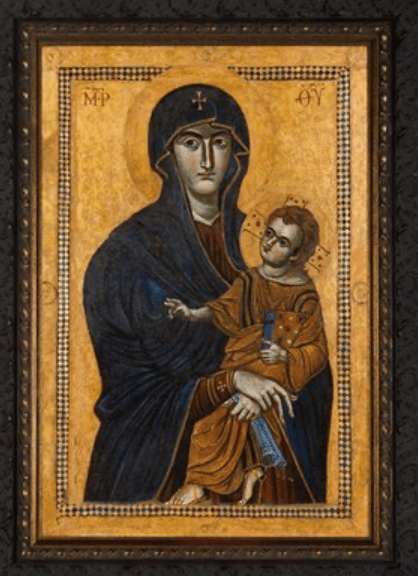
Hail Mary


Praying the Hail Mary, we ask Mary the Mother of Jesus to lead us to God.  The prayer’s earliest form  developed  in the middle ages with the simple greeting of the angel Gabriel at Nazareth, from St. Luke’s gospel:


Hail Mary,
full of grace,
the Lord is with you.

You are favored by God, the angel announces to her. She brought Jesus Christ into the world. That message continues through the ages and is reflected in us.  Like her, we are favored by God and called to bring God’s Son into the world.  God’s promise of grace to Mary echoes in God’s promise to us. As  promised  to Mary, God will be with us.

Over time her cousin Elizabeth’s greeting to Mary, also recorded in St. Luke, was added to the prayer:
Blessed are you among women
and blessed is the fruit of your womb.

Finally by the 15th century, the remainder of the prayer appeared:
Holy Mary, mother of God,
pray for us sinners
now and at the hour of our death.

The prayer asks Mary, full of the grace of her Son, to intercede for us sinners now and at the hour of our death. She is a model for believers and she knows what it means to believe. She who knew her Son so well, can teach us  the way to him.

On Calvary Jesus entrusted her to us as a mother when he said to his disciple “Behold your mother.” Ever since, she brings Christ into this world. She knew Jesus from the beginning and witnessed his life, death and resurrection. She helps us to know him. She also knows our needs. Aware of  the needs of the newly married couple at Cana in Galilee, she approached Jesus, her Son. She is aware of our needs too.

By the end of the 16th century the practice of saying 150 Hail Marys in series or decades of 10 became popular among many ordinary Christians. Helped by her they remembered  the life, death and resurrection of Jesus. That practice of prayer is known now as the Rosary.

Mary is a model of faith for Christians. When the angel Gabriel came to her, she believed the words he spoke even to the dark test of Calvary. She helps the family of believers on their journey to believe..

The Hail Mary and the Rosary are blessed prayers,  simple and profound. They’re not beyond anyone’s reach; their repetition brings peace to the soul. They draw us into  the joys, sorrows and glory of Jesus, the world Mary knows so well.  We hope to “imitate what they contain and obtain what they promise, through Christ, Our Lord. Amen”

We will be celebrating the Feast of the Assumption of Mary this month..

The Journey of the Mind: St. Bonaventure

You would expect a great theologian like St. Bonaventure (July 17) to tell you to hit the books if you would want to go to God. After all, his treatise we read on his feast is called “The Journey of the Mind to God.”

Instead he directs us to Christ and the Cross as our way to God.

” If you ask how such things can occur, seek the answer in God’s grace, not in doctrine; in the longing of the will, not in the understanding; in the sighs of prayer, not in research; seek the bridegroom not the teacher; God and not man; darkness not daylight; and look not to the light but rather to the raging fire that carries the soul to God with intense fervour and glowing love.”

A shelf of scripture commentaries and theology books wont bring us wisdom of themselves, St. Bonaventure says in his Breviloquium, otherwise only scholars would enter the kingdom of heaven.

“The stream of holy Scripture flows not from human research but from revelation by God. It springs from the Father of lights, from whom all fatherhood in heaven and on earth takes its name. From him, through his Son Jesus Christ, the Holy Spirit flows into us; and through the Holy Spirit, giving, at will, different gifts to different people, comes the gift of faith, and through faith Jesus Christ has his dwelling in our hearts. This is the knowledge of Jesus Christ which is the ultimate basis of the solidity and wisdom of the whole of holy Scripture…

If we are to follow the direct path of Scripture and come straight to the final destination, then right from the beginning – when simple faith starts to draw us towards the light of the Father – our hearts should kneel down and ask the Father to give us, through his Son and the Holy Spirit, true knowledge of Jesus and of his love. Once we know him and love him like this, we shall be made firm in faith and deeply rooted in love, and we can know the breadth, length, depth and height of holy Scripture.”

Sounds like Gregory of Nysaa, doesn’t it?

Learning in Bad Times

I find myself turning away from the news on television these days. I don’t think I’m the only one. The pandemic only seems to be getting worse, and we’re getting worse with it.

So we turn to the Good News.

I’m finding the Gospel of Matthew, which we’re reading these weekdays and on Sundays, helpful. It was written for people struggling with bad times.

The bad times were around the year AD 90 when the followers of Jesus in Galilee were reeling from the attacks of a resurgent Judaism. Those attacks are described in Chapters 10-12 of Matthew’s gospel.

Instead of closing their eyes and hanging on tight, Jesus tells his disciples to open their eyes and their ears, because there’s something for them to learn. “Blessed are your eyes, because they see and your ears because they hear. Many prophets and righteous people longed to see what you see but did not see it and hear what you hear and did not hear it”  (Matthew 13:16-17). He says that as he teaches them in parables.

Bad times can be the best times to learn. Some of the best things we know; some of the best insights we have;  some of the most creative thoughts may come in bad times. God doesn’t stop speaking or teaching in bad times; God sows seeds and opens new avenues. New treasures, new pearls are there to be discovered in the ground we walk over and the jumble of things that seem to overwhelm us.

We will be reading soon the parables of the treasure hidden in the field and the pearl of great price and the net that pulls up a bewildering variety of things from the sea.  It’s a message continued in the mystery of the Passion of Jesus. The disciples saw only death and failure there at first, but then they saw treasures in the wounds, the blood and water that flowed from his side, the words he said.

We don’t have to turn away from bad times. They’re times to keep your eyes and ears open, Jesus says. Like his first disciples, we should pray, not for blinders, but for “understanding hearts.”

Your Kingdom come on earth

The wise St. Teresa of Avila says, “We’re people who don’t feel rich until we feel the money in our pocket.” So, we have to pray, “Your kingdom come… on earth.”

We’re earthy people with our feet on the ground, today’s ground. We find it hard to pray: “Give us whatever is good for us.” We find it hard to grasp that God’s kingdom is coming with blessings far beyond what we ask for.

We’re earthy people. We find the prayer of Jesus in the garden hard to imitate: “Not my will, but yours be done.”

“But you know us, my Lord, and you know that we have not given ourselves up to the will of your Father as completely as you did. For us, it is best to pray for specific things…or else we won’t accept what God chooses to give us (even if it is far better than what we asked for) because it’s not exactly what we asked for.”

So we pray that God’s kingdom come “on earth” –for my cousin’s friend who’s paralyzed, for Dennis, Joan, Camille, Mary, and Betty who lost their jobs, for the disturbed woman who visits our garden, for our President and our country, for Vincent in the hospital.” Our prayer is about “specific things” because we live our lives in them; we only know through what we see and feel and experience.

And so, “the good Jesus places these two petitions – Hallowed be thy name and Thy kingdom come next to each other, so that we can understand what we are asking for and why it is important to beg for it and to do all we can to please the one who is able to give it to us.”

The petitions lead us to the prayer of Jesus, “your will be done.”

A wise woman, St. Teresa. No wonder she’s a Doctor of the Church. (The Way of Perfection)

An Immense Sea

View_of_Cliffs_of_Moher
Cliffs of Moher, Ireland

Did St. Gregory of Nyssa ever stand at a place like this? He must have:

“The feelings that come as one stands on a high mountain peak and looks down onto some immense sea are the same feelings that come to me when I look out from the high mountain peak of the Lord’s words into the incomprehensible depths of his thoughts.

“When you look at mountains that stand next to the sea, you will often find that they seem to have been cut in half, so that on the side nearest the sea there is a sheer drop and something dropped from the summit will fall straight into the depths. Someone who looks down from such a peak will become dizzy, and so too I become dizzy when I look down from the high peak of these words of the Lord: Blessed are the pure in heart, for they shall see God.
“These words offer the sight of God to those whose hearts have been purified and purged. But look: St John says No-one has seen God. The Apostle Paul’s sublime mind goes further still: What no man has seen and no man can see. This is the slippery and crumbling rock that seems to give the mind no support in the heights. Even the teaching of Moses declared God to be a rock that was so inaccessible that our minds could not even approach it: No-one can see the Lord and live.
“To see God is to have eternal life – and yet the pillars of our faith, John and Paul and Moses, say that God cannot be seen. Can you understand the dizziness of a soul that contemplates their words? If God is life, whoever does not see God does not see life. If the prophets and the Apostle, inspired by the Holy Spirit, attest that God cannot be seen, does this not wreck all the hopes of man?
 “It is the Lord who sustains our floundering hope, just as he sustained Peter when he was floundering in the water, and made the waters firm beneath his feet. If the hand of the Word stretches out to us as well, and sets us firm in a new understanding when these speculations have made us lose our balance, we shall be safe from fear, held safe in the guiding hand of the Word. Blessed, he says, are those who possess a pure heart, for they shall see God.”

Saturday, 5th Week of Lent

Lent 1

Readings

Our readings today set the stage for Holy Week

After Jesus raises Lazarus from the dead, some Jewish leaders raise the prospect of his death. (John 11,45-59) Their meeting anticipates the final meeting of the Sanhedrin, which will seek the death sentence from Pilate, the Roman procurator, before the feast of Passover.

The meeting was unlikely a cabal of his enemies. Some who favored Jesus must have also been there. From them news of this meeting must have gotten to Jesus. He had his friends among the Jewish leaders. 

Caiaphas, the high priest, sees political consequences if Jesus isn’t stopped– the Romans will step in at the slightest sign of a political troublemaker. But John’s gospel sees divine consequences– evil is pitted against good. 

The high priest unknowingly predicts God’s reversal of it all John’s Gospel says:: “ he prophesied that Jesus was going to die for the nation, and not only for the nation, but also to gather into one the dispersed children of God.”

Good always triumphs.

The passion and resurrection of Jesus is God’s great sign that good triumphs over evil. God has the last word; we’re called to believe in his power over evil, difficult as that is.

Today’s readings also prepare for what’s coming tomorrow– Palm Sunday, when Jesus enters Jerusalem. While leaders plot in the temple area, Jews in that same place, who have come to Jerusalem for the feast– many from Galilee we would suspect– wonder whether Jesus will come there. “What do you think? That he will not come to the feast?”

He will come.

.

Lord, in our day we wonder

“Will you come?”

God of all, help us all,

Come to us today in our need..

Deliver us from all evil. Amen.

,

A Meal in Bethany

IMG_0065
On the Monday of Holy Week John’s gospel (John 12,1-11) calls us to a meal honoring Jesus in Bethany following the resurrection of Lazarus. It’s the last meal mentioned in the gospels before the Passover supper. The gift of life that Jesus gives his friend leads to a sentence of death.

Faithful Martha serves the meal; Lazarus newly alive, is at the table. But the one drawing most of our attention is Mary, their sister who, sensing what’s coming, kneels before Jesus to anoint his feet with precious oil and dry them with her hair. “And the house was filled with the fragrance of the oil.”

The precious oil is an effusive sign of her love and gratitude; it also anoints Jesus for his burial. Only in passing does the gospel mention that evil is in play here. Judas, “the one who would betray him,” complains that the anointing is a waste, but his voice is silenced. Believers are honoring the one they love.

How fitting that Holy Week begins with this gospel when, like Mary, we kneel and pour out the precious oil of our love upon him who pours out his precious life for us.

Friday, 2nd Week of Lent

Lent 1


Readings

Rejection is a special kind of pain. Matthew’s gospel today describes the rejection Jesus experienced when he entered Jerusalem before his death. At first, he’s acclaimed by a large crowd as “the prophet Jesus from Nazareth in Galilee.” They spread their cloaks and cast branches before him. “Hosanna to the Son of David. Blessed is he who comes in the name of the Lord.”

Then, Jesus goes into the temple and drives out those who were buying and selling there, a symbolic act that indicates he has come to restore this place of prayer. (Matthew 21, 1-18)

Reacting strongly, the Jewish leaders reject him and question his authority to do such things. He has been sent by God, Jesus says, and responds with a parable that condemns leaders like them who reject prophets sent by God.

Jesus remains convinced of his mission, but conviction does not insulate him from the pain that comes from rejection. Like the prophets before him he suffers from it, and his suffering only increases as the crowds that first acclaimed him fall silent and his own disciples deny and abandon him. All turn against him and he is alone.

The events described in today’s gospel and the parable Jesus told throw light on one suffering Jesus endured in his passion and death¬– rejection. Rejection and death will not be the last word, however: “the stone rejected by the builders will become the cornerstone.”

You went to Jerusalem, Lord,

to announce a kingdom come

a promise of God fulfilled.

a hope beyond any the mind could conceive.

Teach us to keep your dream alive

though we see it denied.

STATIONS OF THE CROSS: Friday is a traditional day. for remembering the Passion of Jesus

Stations of the Cross:   Video  https://www.youtube.com/watch?v=waaMOBJ5e1Q&list=PLLUFZUgOPMFxkmfgBNS4Kfm8XxEwoAd6f&index=11

Stations of the Cross; Text    https://passionofchrist.us/stations-adults/ 

Stations of the Cross for Children: https://passionofchrist.us/stations-of-the-cross-children/

Prayers :  https://passionofchrist.us/prayers/

Human versus Divine Thinking

DSC00804“Who do you say that I am?” Jesus asks his disciples on the way to Caesarea Philippi. “You are the Christ,” Peter says in reply, going beyond what the crowds were saying then of Jesus.

But then as Jesus speaks of suffering greatly, being rejected, killed and rising after three days, Peter rejects his prediction. In reply Jesus says to him “Get behind me Satan. You are thinking not as God does, but as humans do. ” (Mark 8,27-33)

The Gospel of Mark, more than the others, presents us with the human Peter, thinking as humans do. He appears in the story of the Passion of Jesus failing miserably as he denies Jesus three times and deserts him in his last hours. If Peter is the voice behind Mark’s gospel, he certainly hasn’t made himself a hero nor does he excuse his failures. Many times he seems to say as he says elsewhere in the gospel; “I’m a sinful man.”

Yet, he was called upon by Jesus to lead and teach.

In a few days (February 22nd) we’re going to celebrate the Feast of the Chair of St. Peter. The chair is in the Vatican Basilica beneath the window of the Holy Spirit which sheds its bright light upon it. It’s a teacher’s chair, not a throne, and from Mark’s gospel we get a picture of the one who, with the Spirit’s help, leads and teaches the church.

A human hand reaches from the darkness to the divine.

All Saints Day


Christ alpha om

We usually think of Mary, the mother of Jesus, apostles like Peter and Paul, or extraordinary individuals like Mother Teresa when we think of saints. True friends of God.

Besides  them, the Feast of Saints reminds us of unnumbered others in God’s company. In a vision of heaven, St. John saw “a great multitude, which no one could count, from every nation, race, people, and tongue.” {Revelations 7, 9-13} We hope we will join them one day.

Our hope rests on a promise Jesus made:

“See what love the Father has bestowed on us
that we may be called the children of God.
Yet so we are…
Beloved, we are God’s children now;
what we shall be has not yet been revealed.” (1 John 3,1-3)

How shall we reach that place where we’ll be revealed as children of God? Jesus says to follow him and live as he taught. He shows the way in his Sermon on the Mount, our gospel reading for this feast. He will be the way, the truth and the life.

We haven’t seen yet that promised  life. We haven’t completed our lives here yet. This feast reminds us of the hope God reveals.

Extraordinary saints are not the only ones in heaven. There is a multitude of others, not a few. God welcomes countless others, saints unnoticed here on earth, saints with little to show, saints who were sinners. People like us.

Celebrating  this feast, remember your destiny, St. Bernard says:

“Rise again with Christ and seek the world above and set your mind on heaven. Long for those who are longing for us; hasten to those who are waiting for us, ask those who are looking for our coming to intercede for us. Desire their company and seek a share in their glory. There’s no harm in being ambitious for this. No danger in setting your heart on such glory.

“Remembering the saints inflames us with a yearning that Christ our life may appear to us as he appeared to them and that one day we may share in his glory.”