Tag Archives: Passionists

The Conversion of Paul

Saints show us our capabilities, how far we can rise, from the depths to the heights. That’s why the church recalls the conversion of St.Paul a number of times in the church year. Today we hear it as part of our readings from the Acts of the Apostles.  As he readily acknowledges, Paul rose from the dust and became a powerful force in his church and in the world through God’s grace.

St. John Chrysostom says of him:  “Paul, more than anyone else, has shown us what we really are, and in what our nobility consists, and of what virtue a human being is capable. Each day he aimed ever higher; each day he rose up with greater ardour and faced with new eagerness the dangers that threatened him. He summed up his attitude in the words: I forget what is behind me and push on to what lies ahead. When he saw death imminent, he bade others share his joy: Rejoice and be glad with me! And when danger, injustice and abuse threatened, he said: I am content with weakness, mistreatment and persecution. These he called the weapons of righteousness, thus telling us that he derived immense profit from them…

The most important thing of all to him, however, was that he knew himself to be loved by Christ.”

May God raise up the Paul in us.

Speak Now to God

St. Anselm of Canterbury (1093-1109)

Here’s St. Anselm, whose feast we celebrate today, calling himself a “little man” seeking God:

“Little man, rise up! Flee your preoccupations for a little while. Hide yourself for a time from your turbulent thoughts. Cast aside, now, your heavy responsibilities and put off your burdensome business. Make a little space free for God; and rest for a little time in him.

Enter the inner chamber of your mind; shut out all thoughts. Keep only thought of God, and thoughts that can aid you in seeking him. Close your door and seek him. Speak now, my whole heart! Speak now to God, saying, I seek your face; your face, Lord, will I seek.

And come you now, O Lord my God, teach my heart where and how it may seek you, where and how it may find you.

Lord, if you are not here, where shall I seek you when you are absent? But if you are everywhere, why do I not see you present? Truly you dwell in unapproachable light. But where is unapproachable light, or how shall I come to it? Or who shall lead me to that light and into it, that I may see you in it? Again, by what signs, under what form, shall I seek you? I have never seen you, O Lord, my God; I do not know your face.

What, O most high Lord, shall this man do, an exile far from you? What shall your servant do, anxious in his love of you, and cast out far from your presence? He is breathless with desire to see you, and your face is too far from him. He longs to come to you, and your dwelling-place is inaccessible. He is eager to find you, but does not know where. He desires to seek you, and does not know your face.

Lord, you are my God, and you are my Lord, and never have I seen you. You have made me and renewed me, you have given me all the good things that I have, and I have not yet met you. I was created to see you, and I have not yet done the thing for which I was made.”

Accounts of Jesus’ Resurrection

Wednesday, 3rd Week of Lent

Lent 1


Readings
In Matthew’s gospel, chapters 5-7, Jesus speaks to his disciples from a mountain, a place Moses once chose to speak to the Jews, but Jesus speaks God’s revelation to a wider world from a mountain. His words are loyal to the Jewish traditions and laws that Moses taught. He’s not abolishing them. He came “not to abolish them but to fulfill them.”

First, remember them. That’s what the Jewish scriptures tell us to do. “Take care and be earnestly on your guard not to forget the things which your own eyes have seen, nor let them slip from your memory as long as you live, but teach them to your children and to your children’s children.”

Lent calls us to remember.

Second, practice them, from the greatest of the commandments to the least. Lent leads us to great thoughts and great visions of faith, but this season reminds us to remember and to do small things as well. “A cup of cold water,” a prisoner, someone sick visited, someone naked clothed, someone hungry fed, “a word to the weary to rouse them.”

The law of God often comes down to small things like these. They’re always at hand, readily available. They’re within our power to do, and the greatest in God’s kingdom are best at doing them.

Lord, may your teaching from the mountain

reach the whole world and bring us peace.

Never let us forget your words,

and help us to live by them.

Never let us forget the small acts of love.

Tuesday, 3rd week of Lent

Peter’s question about forgiveness in today’s gospel ( “How many times must I forgive my brother?”) isn’t just his question. He’s asking the question for all of us.

Measure your forgiveness by God’s forgiveness, Jesus says to Peter. It’s beyond measure, and he gives Peter and all of us a story of two servants. Both are involved in a money operation gone wrong. As we know money brings out the worst in people.

There’s a big difference in the money owed. The first servant owes ten thousand talents, a huge sum, and in a unexpected display of mercy, his master forgives the entire debt.

After being forgiven so much, however, that servant sends off to debtors prison another servant who owes him a few denarii, a small sum. The ten thousand talents his master has forgiven him would be worth about 10 million denarii. Big difference!

The story isn’t our only teacher, however.  God’s unmeasurable forgiveness finds its greatest expression in the passion and death of Jesus: “Father, forgive them for they know not what they do,” he cries out from the cross. He pleads, not for one, or a few, but for the whole world. Jesus reveals the mercy of God beyond measure.

We’re called to measure our forgiveness of others against his.

Lord, let me hear your call for forgiveness from the cross,

and let me make your call mine.

Saturday, First Week of Lent: Loving Enemies

Lent 1

“Jesus said to his disciples: ‘You have heard that it was said,

You shall love your neighbor and hate your enemy.

But I say to you, love your enemies,

and pray for those who persecute you,

that you may be children of your heavenly Father,

for he makes his sun rise on the bad and the good,

and causes rain to fall on the just and the unjust.” (Matthew 5: 43-48) 

When people talk about love today,  they’re usually focused on romantic love, “falling in love”, or loving yourself. Not much talk about loving others or loving your enemies today.

 “Love your enemies”, Jesus says in today’s gospel. Have a love that imitates God’s love,  our heavenly Father “who makes his sun rise on the bad and the good and causes rain to fall on the just and the unjust.”

Is that love beyond us?

We’ve been told from earliest years that there are some people you can’t trust; they’ll take advantage of you; they’ll harm you. You have enemies in this world. Be careful.

Certainly Jesus doesn’t condemn reasonable caution. He had enemies too and he was careful what he said and how he dealt with them. Evil exists. Rather, Jesus warns against  a pessimism that leads us to condemn someone or some groups absolutely. We see no possible goodness or possible change in them, only intractable evil.

We don’t see as God sees when we think like that. The sun of God’s goodness shines on this world; the rain of his mercy softens its hardest places. His love changes people for the good.

We can’t just reason our way to a love of enemies, we must pray to grow in this love.  Jesus not only taught us, but showed us by his own example how to love our enemies. Look at him in his Passion, says St. Aelred:

“Listen to his wonderful prayer, so full of warmth, of love, of unshakeable serenity – Father, forgive them.  Is any gentleness, any love, lacking in this prayer?
 
  Yet he put into it something more. It was not enough to pray for them: he wanted also to make excuses for them. Father, forgive them, for they do not know what they are doing. They are great sinners, yes, but they have little judgement; therefore, Father, forgive them.
 
They are nailing me to the cross, but they do not know who it is that they are nailing to the cross: if they had known, they would never have crucified the Lord of glory; therefore, Father, forgive them.
 
They think it is a lawbreaker, an impostor claiming to be God, a seducer of the people. I have hidden my face from them, and they do not recognise my glory; therefore, Father, forgive them, for they do not know what they are doing.”
 

Teach us, Lord, a love like yours,
that never gives up or draw limits,
or settles for those in its small circle.
Help us to love like the sun and the rain
that reach everywhere.

A Book for Lent

St. Paul Cross

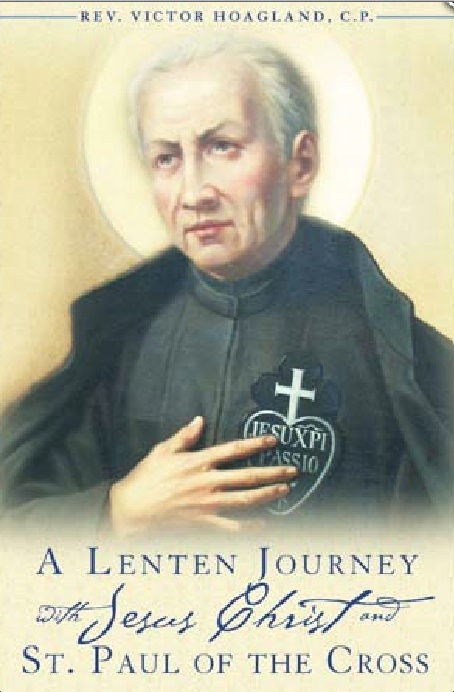
Lent begins next Wednesday, February 14th. Some years ago a publisher asked me to write a book entitled A Lenten Journey with Jesus Christ and St. Paul of the Cross, to be part of a series of reflections on the daily lenten gospels that included thoughts of saints of different religious orders. The book has just been translated into Japanese.

I was initially skeptical about the project. From early on I’ve seen lent as a time to give up something and take up some devotional practice like the Stations of the Cross. Yes, Lent was a journey with Jesus, and I appreciate the daily scriptures that take us through the season with him, but where does a saint come in, even a saint important to me, like St. Paul of the Cross, the 18th century founder of my community the Passionists ?

Working on the book made me see lent differently. First, for St. Paul of the Cross lent was a time to leave the quiet mountain at the edge of the Mediterranean Sea where he lived and prayed and go to work in the Tuscan Maremma, then a swampy, malaria infested region of Italy, overrun with robbers and desperately poor. All through lent, carrying a cross and a bible Paul went from village to village preaching God’s love to people whose lives were often on edge with fear and lost hope.

Lent isn’t a time for turning inward, away from world you live in, Paul reminds me. Lent is a time to go out to the wounded world before you.

Secondly, Paul engaged his world, the world of the Tuscan Maremma, in the light of the gospel, especially the Passion of Jesus Christ. For him that mystery was not limited to a time long ago, when Jesus suffered on a Cross; it was there in the people before him. From village to village, he held up a Cross to anyone who would hear as a mirror of their reality and a pledge of the great mercy of God. Jesus died and rose again.

The Passionists celebrate two feasts immediately before Ash Wednesday to prepare for Lent. Last Friday we celebrated the Commemoration of the Passion of Jesus Christ. Tomorrow, Tuesday before Ash Wednesday, we celebrate the Prayer of Jesus in the Garden. Both feasts come from our missionary founder.

I can see him packing his bags for his lenten journey down the quiet mountain for the villages and towns of the Tuscan Maremma. He must remind himself what he will see. He must pray so he doesn’t forget.

“May the Passion of Jesus Christ be always in our hearts.”

His Kindness Has Appeared

These are days to reflect on the mystery of the Incarnation. A decisive revelation of God, the Letter to the Hebrews says:

“At various times in the past and in various different ways, God spoke to our ancestors through the prophets; but in our own time, the last days, he has spoken to us through his Son, the Son that he has appointed to inherit everything and through whom he made everything there is.(Hebrews 1, 1-2)”

What does Jesus Christ reveal about God? He is the Word of God who reveals God to us, St. Bernard says, and in him “the kindness and love of God has been revealed and  we receive abundant consolation in this pilgrimage, this exile, this distress.”

Before he appeared as human, God’s kindness lay concealed, Bernard says. “Of course it was already in existence, because the mercy of the Lord is from eternity, but how could we know it was so great? It was promised but not yet experienced: hence many did not believe in it. At various times and in various different ways, God spoke through the prophets, saying I know the plans I have in mind for you: plans for peace, not disaster…”

“What greater proof could he have given of his mercy than by taking upon himself what needed mercy most? Where is there such perfect loving-kindness as in the fact that for our sake the Word of God became perishable like the grass? Lord, what is man, that you make much of him or pay him any heed?”

“See how much God cares for us. See what God thinks of us, what he feels about us. Don’t look at your own sufferings; look at God’s sufferings. Learn from what he was made for you, how much he makes of you; let his kindness be seen in his humanity.”

“ The lesser he has made himself in his humanity, the greater has he shown himself in kindness. The more he humbles himself on my account, the more powerfully he engages my love. The kindness and humanity of God our Saviour appeared says St Paul. The humanity of God shows the greatness of his kindness, and he who added humanity to the name of God gave great proof of this kindness.”

How Do We Learn and Pray Now?

Education is up in the air these days. Our schools are struggling. How will kids be educated?

Our faith formation programs are struggling too. The Mass and sacraments–ordinary ways we pray–are drastically curtailed. What do we do?

Could our homes and families become our churches? Can we find teachers and  temporary sacraments there?

A friend of mine was in prison for awhile and ended up once in solitary confinement after a fight he had with another inmate. He told me he remembered in the dark what a nun had told him about the rosary. Ten Hail Mary’s and an Our Father. He started counting the prayers on his fingers and, after awhile, he found a great peace came over him, so much so that after getting out of confinement he asked the chaplain for a rosary. It led to a profound conversion. He was changed by the experience there in the dark.

We’re living in the dark these days, but do these days have to diminish us? Maybe we can learn to pray more simply these days. Simple prayers we may have abandoned, maybe there’s a bible or a prayerbook lying forgotten in a drawer. Simple prayers are always the best,  because God takes simple form to come to us. Jesus came “in the form of a slave,” remember, he used simple things like bread and wine to bring us his greatest gift. 

This could be a time to pray simple prayers and to teach them to our kids. You never know when they’ll bring them peace.

Little Prayers

Little prayers are just that–the small, taken-for-granted prayers we pray all the time. Like “Amen.” How many times do we say that word in prayer? Usually we end all our prayers with it.

What does it mean? I suppose we could say it means “yes” in English. “Si” in Spanish or Italian. “Ya” in German. If you look it up in the dictionary, you find it traced back into the Greek and then to the Hebrew. Amen means “so be it”; a strong “yes,” and it’s been part of the language of our faith for centuries.

Here we are in the 21st century using a word generations before us have used; we draw on the faith of generations before us to say, “Yes, I believe,” “Amen” to God’s word to us and our word to God.

“The Lord be with you,” “And with your spirit.” Another little prayer, wishing that God be with us and bring us together in faith. We can trace that little prayer back generations too.

Little prayers can give us a way to express what we can hardly put into words or understand. Besides words, they can also be simple gestures, like the Sign of the Cross; they can be moments of listening or seeing and waiting in silent attention before God.

Psalm 123 describes a servant waiting and watching before her mistress.

“To you I lift up my eyes,
you who dwell in the heavens.
My eyes like the eyes of slaves
On the hand of their lords.
Like the eyes of a servant
On the hand of her mistress,
So our eyes are on the Lord our God
Till he show us his mercy.”

Little prayers can be a cry or even tears. You often hear that kind of prayer in the psalms:

“I cried to you, Lord, and you heard me,” the psalmist says in Psalm 30.

Remember the simple cry of the Canaanite woman: “Have pity on me, Son of David…Please, Lord” (Matthew 15:21).

Little prayers are important, they’re not little at all.