Tag Archives: Passionists

Praying for Christian Unity

We celebrate a Week of Prayer for Christian Unity every year from the 18th to the 25th of January.

Pope Francis, speaking about ecumenism, said that like the Magi, whom tradition represents as representatives of diverse cultures and peoples, Christians today are “challenged to take our brothers and sisters by the hand… and move forward together.”

Some of the journey together is easier than others, the pope noted, like works of charity together, for example. which draw us closer not only to the poor but to one another.

On the other hand, the journey toward full unity is sometimes more difficult, which “can lead to a certain weariness and temptation to discouragement.

The Pope encouraged Christians to remind themselves “that we are making this journey not as those who already possess God, but as those who continue to seek Him.” He called for courage and patience along the way, in order to encourage and support one another.

The restoration of unity among all Christians is one of the principal concerns of the Second Vatican Council.” (Decree on Ecumenism n.1). Ecumenism affects the mission of the church, because the division of Christians prevents the preaching of the gospel and deprives many people of access to the faith” (Ad Gentes, n. 6). Divisions among Christians cause a confusion that hinders people from accepting the gospel today.

Passionist Father Ignatius Spencer, an early pioneer in ecumenical activity, strongly urged more prayer together. Might be a good idea to consider . How can we do it?

“Absalom, Absalom, my son”

Stories from the Old Testament often have a raw quality that may cause us to turn away from them. Too much murder, rape, lies and disloyalty in them, we say. Not uplifting at all.

After the Prophet Nathan accuses David of his sins of murder and adultery, he tells him “the sword shall never depart from your house.” (2 Samuel 12, 10) In our first reading today at Mass the prophet’s message is fulfilled. David’s son Absalom  betrays his father and tries to take his throne. (2 Samuel 15, 13 ff) All that’s said about Absalom points him out as a bad kid.

“An informant came to David with the report, ‘The children of Israel have transferred their loyalty to Absalom.’” David flees from Jerusalem to escape Absalom and his army; he crosses the Kidron Valley to the Mount of Olives and then heads for the wilderness around the Jordan River for safety.

Jesus came to Jerusalem by that same route, we remember. He also crossed the Kidron Valley to the Mount of Olives to pray as he faced betrayal and death.

David’s advisors want him to kill his scheming son, but David refuses, because of his deep love for him. He becomes inconsolable when the young man meets a tragic death. “Absalom, Absalom, my son!” His love seems unexplainable.

And so is the love of Jesus, unexplainable.

The Bird of Good Hope

I found this Christmas story called “Aidan of the Cows” in an old book.

A young woman named Aidan had a herd of  choice cows producing the best milk and cheese anywhere in the village of St.Koatsven in a distant land near the shore of a distant sea.

Unfortunately, Aidan fell on bad times because the young man she loved spent her fortune and all her cows had to be sold  to moneylenders.

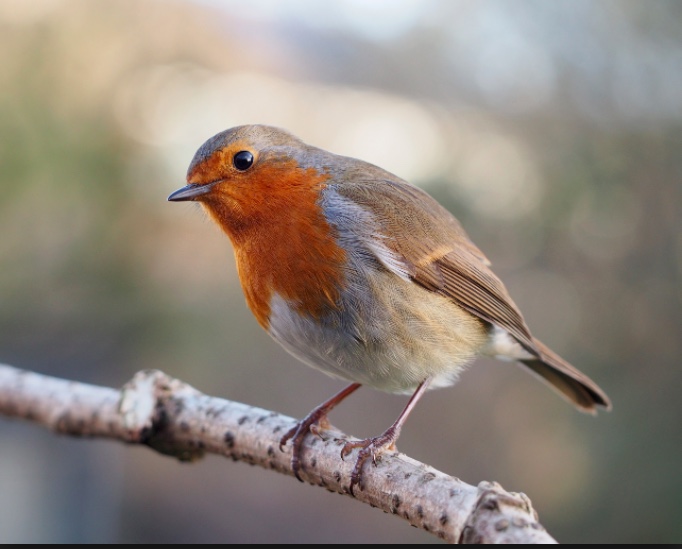
Christmas morning Aidan wandered sadly down a meadow near the sea and  heard a robin singing:

She listened with amazement, with fear and trembling,  with a fearful joy, because the bird sang in human speech.
“I am Robin Redbreast,” he sang, ” the Bird of Good Hope, much admired among birds. For in ancient times when He was toiling up the heavy hill bearing the bitter Cross, I was moved by Heaven to alight on His head, and I plucked from out His bleeding brow one thorn from the cruel crown that bound His temples. One drop of His blood bedewed my throat as I stooped to the blessed task and dyed my breast in a hue of glorious beauty for ever.”

Aidan listened with all the ears of her heart.
“In remembrance of what I did, a blessing was given me—that once  every year, on Christmas-eve, I can give a good gift to the first maiden, good but unhappy, who should put her foot upon the herb Marie, as you, Aidan, have done.”

The girl looked down. Her foot was lightly- pressing the pretty little yellow trefoil plantret, an herb called Marie. “As you have done, Aidan of the Cows,” the robin repeated with a confident chirrup.

Of course, Aidan got her cows back and even got her repentant young man, whom she married, and they live happily ever after. All this took place in a Distant Land where things like this take place.

May the Bird of Good Hope speak to you today.

Unfortunately, we’ve lost this wonderful imaginative tradition that sees divine mysteries allied to the ordinary plants and creatures of creation. Science has taken over our Christian imagination. May we get it back some day; maybe the Christmas mystery so closely allied to a simple stable and donkeys and cattle and camels and straw may help us.

Visits and Gifts

Visits, gifts, greeting cards ( now by email) are a good part of the holiday experience.  How can we love everyone all at once? I don’t know.

But Luke’s gospel makes visiting a part of the Christmas mystery. Mary goes into the hill country to visit her cousin Elisabeth after she hears the angel’s message. They meet, not just to trade family news and pass the time together, but they share faith.

They’re two believers who reveal to each other the mystery hidden within them in their unborn children. And they rejoice in their common gift.

We gather with others at Christmas time; people of faith, believers in a mystery we do not see. At Christmas, believers meet, even believers to a degree.

More than we know, we’re signs to each other, like the bread and wine, sometimes hardly evident. In his commentary today on the gospel of the visitation, St. Ambrose says we’re like Mary and Elizabeth; “Every soul that believes–that soul both conceives and gives birth to the Word of God and recognizes his works.”

So we visit and give our gift.

The Last Days

In a week that began with  the Feast of Christ the King we’re reading from the Old and New Testament about the last days. It’s a world turned upside down, but we share in the kingly power of Jesus, even in floods, earthquakes, plagues and famines, when “awesome sights and signs will come from the sky.” (Luke 21,11) Our days even now can seem like the last days.

It’s no accident the Feast of Christ the King opens this week. By baptism we share in the kingly, priestly and prophetic power of Jesus, so it’s  not enough  just to hold on. We should face these days bravely, Jesus says, they’re a time to give testimony. Don’t worry about what words to say or what you are going to do:  “I myself shall give you a wisdom that all your adversaries will not be able to refute.” Don’t worry, “not a hair of your head will be destroyed.”

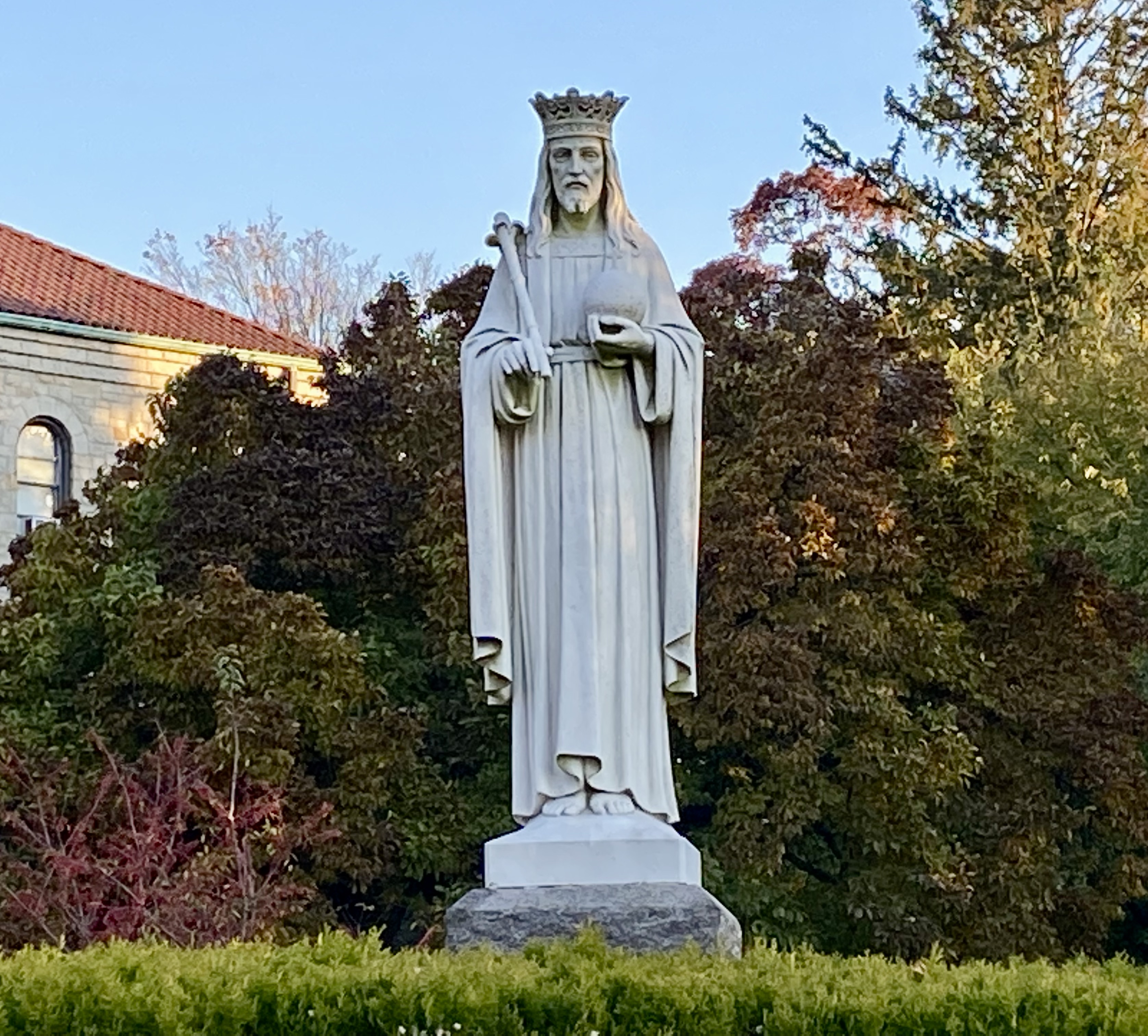
We have this majestic statue of Christ the King in our garden. Don’t forget, too, as the gospels for the Feast of Christ the King remind us, Jesus was king, priest and prophet on Calvary. He holds the world in his hands. 

Hanukkah and Christmas

Hanukkah, an eight day Jewish celebration, which can occur in late November to late December, and Christmas, the Christian celebration on December 25th, are celebrated close together in time. Are they connected beyond that?

The quick answer usually given is no, but think about it a little. Hanukkah celebrates the rededication of the temple in Jerusalem after its desecration by Antiochus Epiphanes IV in 167 BC. After conquering Judea, the Syrian leader plundered the temple, ended Jewish services and erected an altar to Zeus in it.

Leading a Jewish revolt, Judas Maccabeus reconquered the city, cleansed the temple and initiated an eight day celebration in memory of the event. Eight lights lit successively call people to God’s holy place.

Christmas celebrates the birth of Jesus Christ approximately 167 years later.

Both of these feasts are about the Presence of God. For the Jews God was in the temple as Creator and Savior. For Christians God reveals his presence in Jesus Christ, who proclaimed himself God’s Son, “the light of the world” as he celebrated the Jewish feasts in the temple. (John 7-10)

All the gospels report that Jesus cleansed the temple  and spoke of himself replacing it. Luke’s gospel  begins in the temple with the promise to Zechariah of the birth of John the Baptist and ends as the Child Jesus enters his “Father’s house.” (Luke 1-2) Our readings today link the restoration of the temple by Judas Maccabeus and the Jesus cleansing the temple: 1 Mc 4:36-37, 52-59/Lk 19:45-48

Far from being separate, Hanukkah and Christmas are connected in their celebration of God’s presence. Hanukkah reminds us of the temple, the place of God’s provisional presence. The Christmas mystery reminds us of the abiding presence of God with us in Jesus Christ, Emmanuel, the Light that never fails, who gives life to all nations.

The Gift of the Old: 1 and 2 Maccabees

This week our first readings at Mass are from the First and Second Books of Maccabees commemorating the Jewish revolt against Antiochus Epiphanes, successor to Alexander the Great. The revolt led to the rededication of the temple by Judas Maccabeus after its profanation by foreign invaders.  The Jewish Feast of Hannukah recalls the event. (Thursday) The revolt took place over a hundred years before the time of Jesus.

The Maccabean revolt is one reason why the times of Jesus were so politically sensitive. On his journey to Jerusalem, some “thought that the kingdom of God would appear there immediately.” (Luke 19,11)  A number of his disciple probably thought that would happen by an armed uprising against the Romans, like the revolt  against Antiochus Epiphanes.

Our readings this week, however, are not battle accounts from the uprising but rather stories of two elderly faithful Jews: Eleazar, a scribe who refused to assimilate to the culture of the conquerors, and a mother who inspired her seven sons to resist the invaders. (Tuesday and Wednesday)

All Eleazar had to do was pretend to eat the meat of sacrifice, but the ninety-year old chose to die rather than give bad example to the young.
“I will prove myself worthy of my old age, and I will leave to the young a noble example of how to die willingly and generously for the revered and holy laws.” (2 Maccabees 6. 30-31)

The Jewish mother, seized with her seven son and witness to their torture and death,  urged them to keep their faith and persevere:
“I do not know how you came into existence in my womb; it was not I who gave you the breath of life, nor was it I who set in order the elements of which each of you is composed. Therefore, since it is the Creator of the universe who shapes each man’s beginning, as he brings about the origin of everything, he, in his mercy, will give you back both breath and life, because you now disregard yourselves for the sake of his law.” (2 Maccabees 7,1, 21-31)

Pope Francis often speaks of the wisdom and influence of the elderly.  We rely on them. Maybe now more than ever.

Teach Us To Number Our Days Aright

Cover photo credit: ©2020 Gloria M. Chang
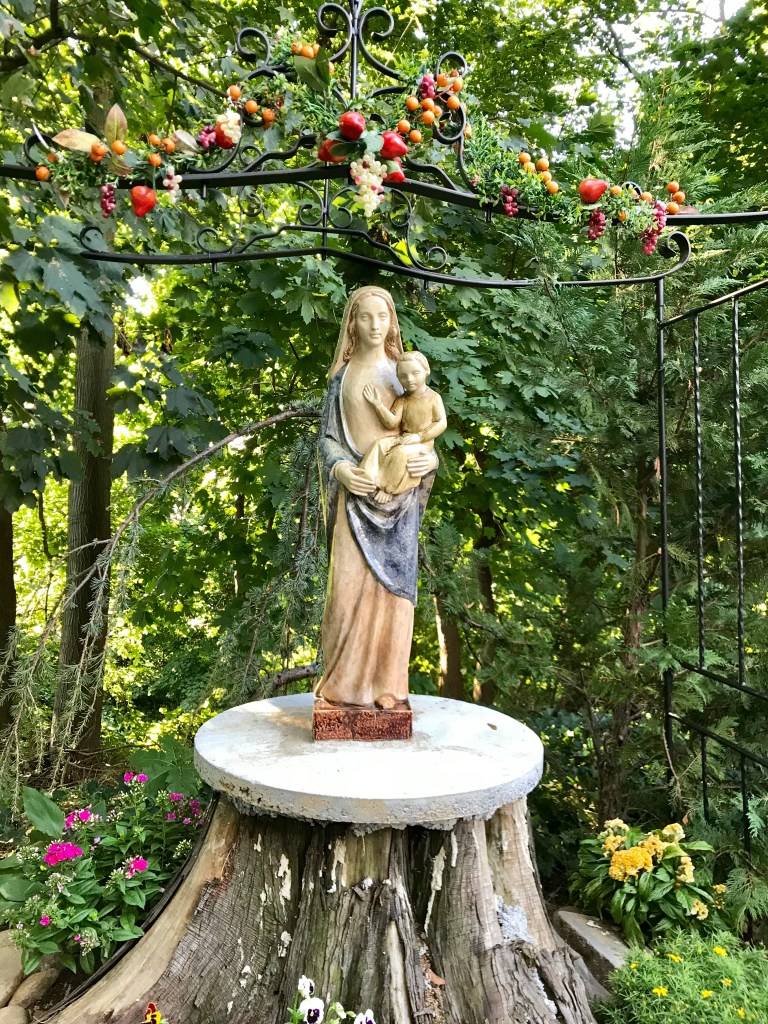
Mary Garden design: Andrea Oliva Florendo

Learning takes place day by day; it goes on and on. That’s true about faith as well. We’re learning each day, which is why our church calendar is so important.

John Chrysostom, one of this month’s saints, complained that people of his time didn’t know much about the church’s calendar; they were hardly aware of it: “Many people today just about know the names of the feasts we celebrate in church. They know hardly anything about their history and meaning…What a shame.”

Chrysostom loved the feasts of our Lord and his saints, seasons like Lent and Advent, which teach us how to live and what to hope for. They’re an ongoing school; they “teach us to number our days aright and gain wisdom of heart.”

September’s a good example, with a parade of interesting saints, like Gregory the Great, John Chrysostom himself, Peter Claver, Matthew the tax collector, Cornelius and Cyprian, Vincent De Paul, Jerome. All important teachers of faith.

There are two big feasts of Mary, the mother of Jesus, this month, her birth on September 8th and her sorrows on September 15, right after the great feast of the Triumph of the Cross, September 14.

I like the way the Feast of our Mother of Sorrows, September 15th, follows the Lord’s Triumph of the Cross. Mary’s greatest sorrow was standing beneath the cross of her Son, but sorrow spanned her whole life. She teaches that bearing the Lord’s cross is not the same as sharing his physical sufferings. Her patient waiting, her struggle to understand God’s plan, her experience of faith’s darkness show the mystery of the cross in other forms.

I just got from the printer this week our new 2024 Passionist Calendar (above). It combines the 2024 Roman Calendar, the 2024 USA Liturgical Calendar, and the 2024 Passionist Calendar and lists the feasts, seasons, saints, and scripture readings for the year. The 2024 Passionist Calendar is linked to this blog www.vhoagland.com which follows the liturgy through the year.

The 2024 Passionist Calendar features reflections by Pope Francis on the environment. It’s a calendar for laypeople, religious and priests. It’s sponsored by the Confraternity of the Passion. $7.00

God doesn’t demonize

We’re reading Paul’s Second Letter to the Thessalonians and the Gospel of Matthew this week at Mass. Paul’s letter was written about the year 55 AD, 20 years or so after the death and resurrection of Jesus. The Gospel of Matthew was written about the year 85 AD, some 40 years later.

Paul’s letters illustrate his practice of going first into Jewish synagogues to preach the gospel. Before his conversion to Christianity, he went to the synagogues as a Pharisee to pursue and arrest Christians. Now members of the Pharisaic movement sharply confront him..

The Gospel of Matthew reflects this same confrontation. Matthew’s gospel was written at a highpoint of Jewish-Christian controversy, after the destruction of the temple in 70 AD.  Passages from the 23rd chapter of Matthew’s gospel would lead you to think that the Pharisees were Jesus’ fiercest enemies.

In reality, a number of Pharisees, like Nicodemus and Paul himself, became his most important followers, The Pharisees were certainly antagonistic to Jesus in his lifetime; he was angry with them for their blindness to him and his message, but he didn’t see them as mortal, eternal enemies.

We have to read the scriptures with an eye on the time they were written; It helps us understand the hot rhetoric we hear in Matthew’s reading for today.

What lesson can we learn from learn from readings like these? Don’t demonize your enemies. God doesn’t do that and neither should we.

That’s an important lesson to remember today as we look at the Muslim world. Jesus didn’t demonize people; he turned to the thief on the cross, he told the story of a prodigal son, he received back the disciples who abandoned him.,

When we bring the bread and wine to the altar at Mass, we bring to God all of creation, not just a part of it. “Blessed are you, Lord God of all creation,” we say. All creation is God’s creation. He wishes to bless it and see it at peace and harmony. God wishes us to see things as he see them.

God doesn’t demonize.

Blessed Dominic Barberi

img-Blessed-Dominic-Barberi

August 26th,  the Passionists remember one of their great missionaries, Blessed Dominic Barberi, born in Viterbo, Italy, in 1792. Early on, God inspired him to be a missionary to England. The desire to work for Christian unity grew after Dominic entered the Passionist community, where he taught theology and was a spiritual director.

In 1840, Dominic left Italy to bring the Passionist community to Ere, Belgium. In 1842, he went to England and became a popular preacher of missions and retreats, establishing a Passionist retreat at Aston Hall, near Stone. Initially,  he tried to engage the leading religious scholars at Oxford in dialogue. The Industrial Revolution was changing that country, however, and thousands of poor Catholic immigrants from Ireland and England were flocking to the great English factory towns, fleeing poverty and looking for work. Priests were needed and Dominic, though he never spoke English well, tirelessly preached and ministered to them.

Dominic never got his wish to engage the learned scholars of England as a lecturer at Oxford, but he was noticed by them all the same. One of  England’s greatest intellectuals, John Henry Newman, was attracted to Dominic, not by the religious tracts he sent to him, but by his zeal and humility. Newman was looking for those qualities in the Roman church at the time.

“If they want to convert England,” Newman wrote earlier, “let them go barefoot into our manufacturing towns, let them preach to the people like St Francis Xavier–let them be pelted and trampled on, and I will own they do what we cannot…Let them use the proper arms of the Church and they will prove they are the Church.”

Dominic, humble, zealous and faithful, used the proper arms of the Church of his time, popular missions and retreats which stressed basic catechesis and devotional prayer. They were the primary way the Roman Catholic Church reached out then to the peoples of Europe and also the Americas.

When Newman decided to enter the Catholic Church, he asked for Father Dominic Barberi to receive him. He said he was Dominic’s “convert and penitent”.

Domenic died in Reading, near London, England on August 27, 1849. His grave in Sutton, St. Helens, England is a place of pilgrimage for the English people. Pope Paul VI declared him “Blessed” on October 27, 1963 during Vatican II, calling him an example of ecumenism and an apostle of unity.

Lord, you sent Blessed Dominic to seek out the lost sheep of your flock by preaching your truth and witnessing to your love.

May we follow his example and build up the unity of your Church as a sign of faith and love. Through our Lord Jesus Christ, your Son, who lives and reigns with you in the unity of the Holy Spirit one God, for ever and ever.

Longer biography here:

Writings of Blessed Dominic can be found here.