Tag Archives: Nazareth

December 20: The Annunciation

St. Luke’s account of the Annunciation to Mary, read today at Mass,  follows the announcement of the birth of John to Zechariah in yesterday’s advent readings. Mary responds to the angel so differently than the priest Zechariah. (Luke 1, 5-25,)

In the temple where great mysteries are celebrated, the priest won’t believe he and his wife can conceive a child. They’re too old. He doubts.

In  Nazareth, an unlikely place for a great revelation, the angel approaches Mary with a message far more difficult to grasp. “ The Holy Spirit will come upon you and the power of the Most High will overshadow you. Therefore the child to be born will be called holy, the Son of God.”

Mary believes and does not doubt and by God’s power conceives a Son who will be born in Bethlehem. “Behold, the handmaid of the Lord, be it done to me according to your word,”

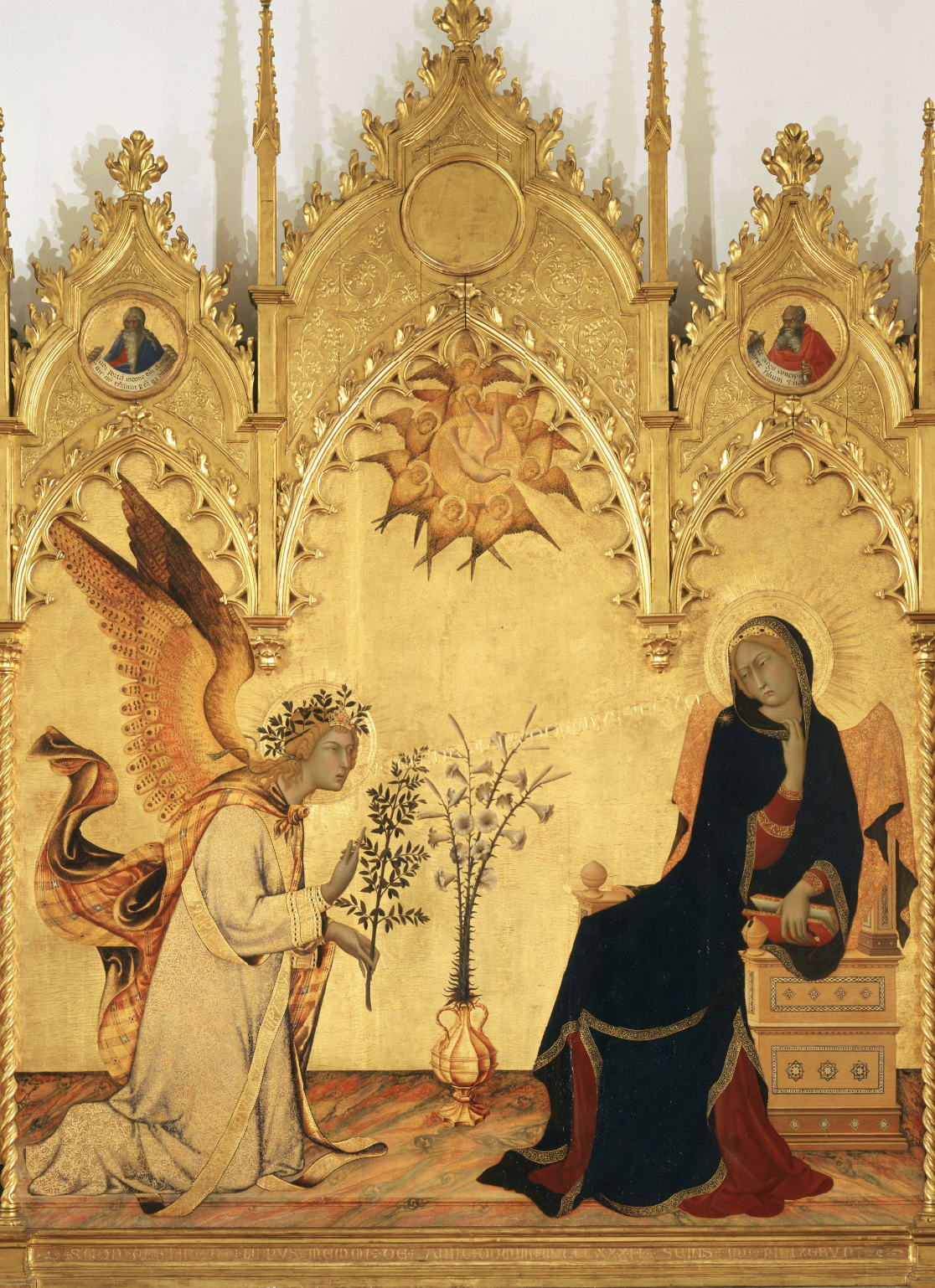
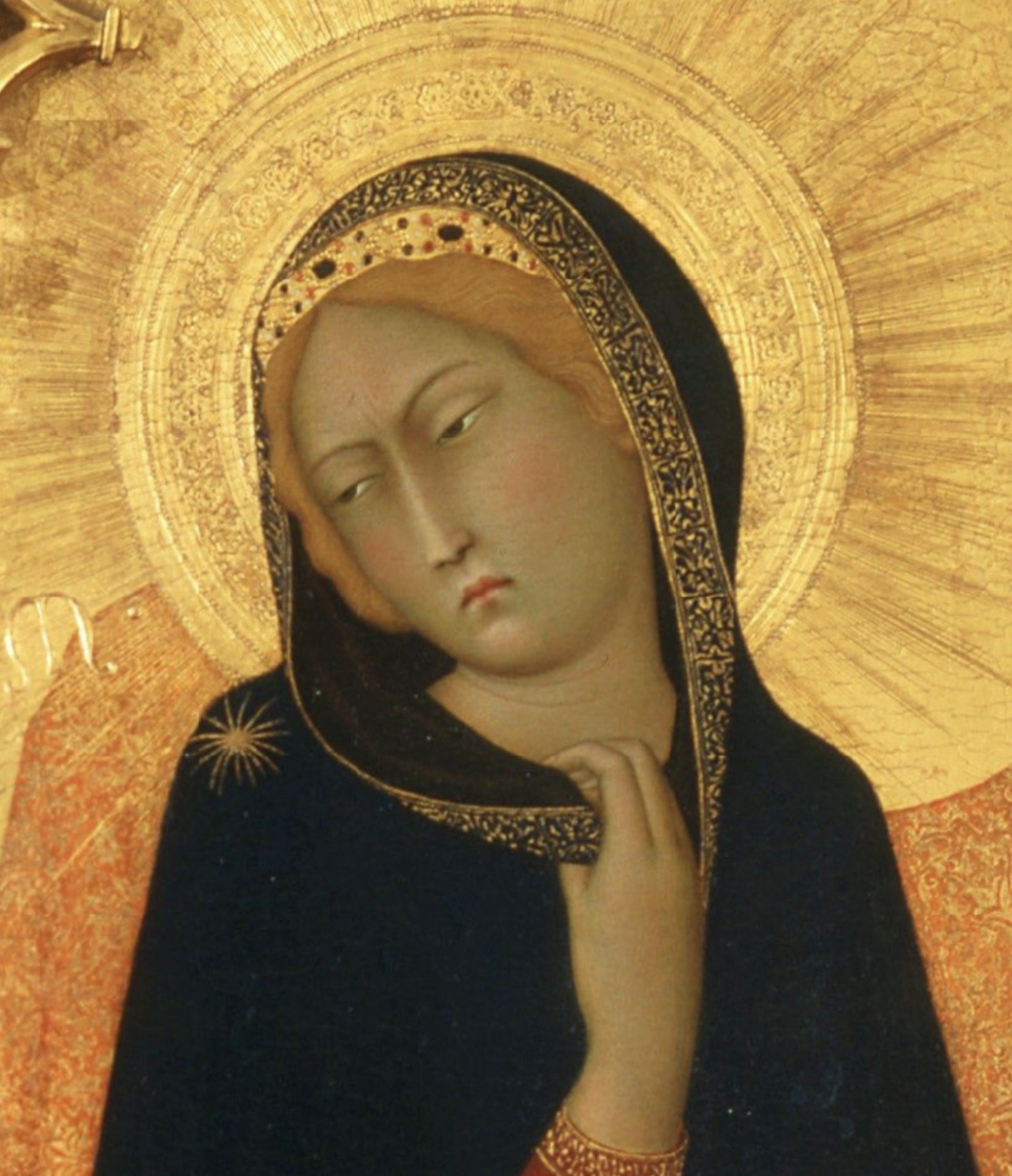
This is a golden moment, the 13th century painting above by Simone Martini and Lippo Memmi indicates. Mary is at home in prayer when the angel comes. Prayer enables her to believe and accept what is revealed. That’s true for all of us: prayer helps us discern and say yes to what God reveals.

“How can this be. I do not know man?” Mary says to the angel. Our painting seems to capture that moment in our gospel passage, but Mary will go on to respond in faith, “Be it done to me according to your word.” Mary is a woman of faith; we learn from her.

Today we pray:

O Flower of Jesse’s stem, you have been raised as a sign for all peoples; kings stand silent in your presence; the nations bow down in worship before you. Come, let nothing keep you from coming to our aid. 

Readings www.usccb.org

The Visitation of the Blessed Virgin Mary: May 31


Faith gives you life and calls you to a mission. That’s what it did for Mary, the mother of Jesus. Mary believed in the message of an angel at Nazareth. She welcomed the Son of God to be born of her, and he brought life to her and to the world.

He gave her a mission, Luke’s gospel says today.  Mary set out “in haste” for the hill country of Judea to visit Elizabeth, the wife of Zechariah, who also was with child. Mary has a mission.                                                                                                                        

When Elizabeth heard Mary’s greeting, the infant leaped in her womb.” The infant who would be John the Baptist, leaped for joy, the gospel says.

Both of these women had exceptional faith. Mary, the younger woman, accepted what the angel asks, even as she questions how it will take place and the meaning of it all.                                                                                                                                 

Elizabeth, the older woman, conceives with her husband, Zechariah. But she’s an old woman, pregnant with a child. However miraculous her pregnancy was, she must have felt fear and uncertainty for having a child in her old age. Like Mary, she must have asked, “How can this be?” “What does this all mean?”

Mary’s visit took those fears away from her. The child in Elizbeth’s womb leaped for joy. Elizabeth’s fears were turned into joy. Faith gives you life and sends you on a mission. Exceptional faith, in the case of Mary and Elizabeth led to exceptional missions. 

In spite of what some people think, faith is not a burden that cripples you. Faith is a gift that empowers you. It takes you beyond your dreams and what you hope for. 

“Blessed are you who believed,” Elizabeth says to Mary.

“You too, my people, are blessed,” comments St. Ambrose, “ you who have heard and who believe. Every soul that believes — that soul both conceives and gives birth to the Word of God and recognizes his works.

“Let the soul of Mary be in each one of you, to proclaim the greatness of the Lord. Let the spirit of Mary be in each one of you, to rejoice in God. According to the flesh only one woman can be the mother of Christ, but in the world of faith Christ is the fruit of all of us.”

As with Mary so with us, faith gives life and sends us on a mission..

Monday, 3rd Week of Lent

Lent 1


Readings

Luke’s Gospel begins the ministry of Jesus with his rejection in his hometown of Nazareth. Rejection is an important part of the mystery of his death and resurrection.  Jesus lived most of his life in Nazareth among “his own.” (Luke 4,24-30) Yet, as he begins his ministry he is rejected by ” his own”  in their synagogue, a rejection Jesus must have carried with him;  how could he forget it?

Crowds welcoming  him to Jerusalem on Palm Sunday call him “the prophet Jesus from Nazareth in Galilee,”  but not many from Nazareth accompanied him there.  Some women from Galilee, most importantly his mother Mary, stand by his cross as he dies. Still, Jesus didn’t find much acceptance in Nazareth.. “He came to his own and his own received him not.”

The people of Nazareth reject Jesus because they see him as “the carpenter’s son.” He seems too small to be entrusted to a large mission. Our first reading, recalling the cure of the Syrian general Naaman, sees a humble Jewish servant girl God’s instrument. Jesus takes the “form of a slave” to fulfill God’s plan.

The Cross on Calvary draws attention to the physical sufferings of Jesus in his passion–the scourging, the thorns, the crucifixion. But let’s not forget his interior sufferings, especially rejection from “his own, who knew him from the beginning and counted him too small. Only a few from Nazareth followed him to Jerusalem.

The lenten gospels tell us rejection doesn’t stop God’s mercy and love. On Calvary Jesus shows God’s love in his outstretched arms, arms outstretched even towards Nazareth.

We share in the great mystery of his death and resurrection. We may never be nailed to a cross as he was, but there are other ways to bear a cross. Rejection by “our own,” perhaps someone close to us, or perhaps its the world we live in, where we don’t fit in? There are more than one way we share in the sufferings of Jesus.

Lord, help me  face the slights the come from those close by, from my Nazareth, from “my own.” The mystery of your Cross is not played out on Calvary alone, It’s played out in places and people close by, where we live now. Give me the grace to live in my Nazareth as you did in yours.

Saint Joseph: March 19th

St. Joseph – by Bro. Paul Morgan,CP


Readings

“Each year Jesus’ parents went up to Jerusalem for the feast of the Passover, and when he was twelve years old they went up according to festival custom.” Luke 2,41

At twelve, Jesus entered a new stage in life – his “Bar Mitzvah,” when he took on the responsibilities of the law, which later he summarized as: “Love the Lord, your God, with your whole heart…Love your neighbor as yourself.”

Who led him to that new stage? It had to be Joseph and Mary. Matthew’s Gospel gives Joseph a major role in Jesus’ birth. He provides Jesus with a genealogy going back to Abraham. He’s told by the angel not to be afraid to take Mary as his wife; he shouldn’t divorce her as Jewish law called for, and he should name the child, Jesus, “for he will save his people from their sins.”

After the visit of the Magi, Joseph was directed to take the child and his mother and flee to Egypt. Then, the angel tells him to return to Israel with them after Herod’s death. Finally, he makes a home in Nazareth in Galilee, where his family would be safer away from Herod’s heir, Archelaus, who ruled in Judea.

Clearly, according to Matthew’s gospel, Joseph is an important figure in the birth and early life of Jesus Christ. Then, he silently disappears from the gospels. There’s no record of his role at Nazareth or his death.

The gospel calls Joseph an “upright” man. He was upright because, like his neighbors at Nazareth, he observed all the Jewish laws. But not from lip service. Joseph firmly believed in his heart in the God of Israel, who loved all things great and small, yes, even Nazareth and a humble carpenter.

An inward man, Joseph saw in the simple, ordinary world about him more than others saw. His neighbor casting seed on the family field he loved – wasn’t God’s passionate love for the land of Israel like that? Even as he built a village house or a table, his thoughts sometimes turned to another world: was not God building a kingdom for his people?

An inward man, Joseph saw beyond the fields and mountains and the small town of Nazareth, but he said little about his inmost dreams to others. A quiet man, he kept his own counsel.

Jesus, the Son of God, was known through his earthly life as Jesus, the son of Joseph, “the carpenter’s son.” As children do, he naturally would acquire some of Joseph’s traits, perhaps the way he walked and spoke.

From Joseph, Jesus first learned about the people of the village, their sorrows and their joys. He saw his love for Mary and the people of his village. Jesus learned from him how to use a carpenter’s tools and worked at his side. The rabbis said: A father who does not teach his son a trade teaches him to steal.

The two were constant companions at the synagogue in Nazareth. Together they celebrated regularly the great Jewish feasts, listened to the Scriptures, and journeyed as pilgrims to Jerusalem.

Jesus must have seen in Joseph a simple, holy man who trusted God with all his heart. Someone like Joseph, so unassuming, so steady, so quietly attentive to God, was like a treasure hidden in a field. He could go unrecognized.

Later, would Jesus remember lessons and tell stories he learned earlier at Nazareth from Joseph, the carpenter?

The opening prayer for today’s feast describes Joseph’s spirituality. He intercedes for the church that it may be aware of “the unfolding mysteries of human salvation.” Joseph was there when “the unfolding mysteries of salvation” began. Joseph listened to angels and prophets and followed them.

In the first reading for his feast God promises King David he would have an God-given heir. Joseph, a son of David, saw that promise fulfilled in Jesus Christ. The second reading from Paul’s Letter to the Romans presents Abraham as the father of many nations. Joseph saw that promise also fulfilled in Jesus. “Do not be afraid to take Mary as your wife,” the angel says to Joseph. He was not afraid, but believed in the “unfolding mysteries of salvation.”

Two Passionist brothers remembered St. Joseph in a painting and a sculpture, which I’ve added to this blog: Brother Paul Morgan and Brother Michael Stomber.

St. Joseph and the Boy Jesus by Brother Michael Stomber, CP

Belief and Unbelief

Mark’s gospel today describes the arrival of Mary his mother and some of his relatives from Nazareth. (Mark 3: 32-35) They’re outside a house crowded with people gathered around Jesus, some looking to be cured, some to listen to what he has to say. Jesus and his disciples don’t even have time to eat, Mark says.

His family come because they want to take him home; some think he is out of his mind . (Mark 3:20-21) When people tell him ‘Your mother and your brothers and your sisters are outside asking for you.’ Jesus said to them in reply, ‘Who are my mother and my brothers?’ And looking around at those seated in the circle he said, ‘Here are my mother and my brothers. For whoever does the will of God is my brother and sister and mother.’” (Mark 3: 32-35)

Jesus sees people of faith as his family, his mother, brother and sister. He considers us who believe in him his family. 

But we continue to ask: Why does his own family think he is out of his mind?

His mother Mary is with them. What does she think? 

The gospels, Matthew 13:54-58, Mark 6: 1-6, Luke 4:16-30 all point to Nazareth as a place where Jesus is rejected.  Luke’s gospel sees the rejection of Jesus at Nazareth in the harshest terms. They are ready to hurl him from the hill after the claims he makes in their synagogue. His visit to Nazareth is headed for violence, but a violence postponed, and no one takes his part. ( Luke 4:16-36 )

Mary lived there. What was it like for her?  What was it like to be with family members who thought her son was mad? What was it like to be day after day with people who didn’t believe in her son? No one from Nazareth is among the 12 disciples Jesus chooses. The rejection of Jesus by the people of his own town, his own family and relatives, was a sword that pierced her heart.

We might say Mary’s faith was strong and kept her secure, but was it a faith that knew everything? Did it save her from questioning?

I wonder if we can see Mary’s appearance at Lourdes and Fatima in some way related to her own experience at Nazareth. She appears in places when the faith of ordinary people is severely challenged by a world increasingly hostile to belief. 

She knows how to believe when everyone else does not. We welcome her today to be with us.

Bartholomew, the Apostle: August 24

IMG (160)
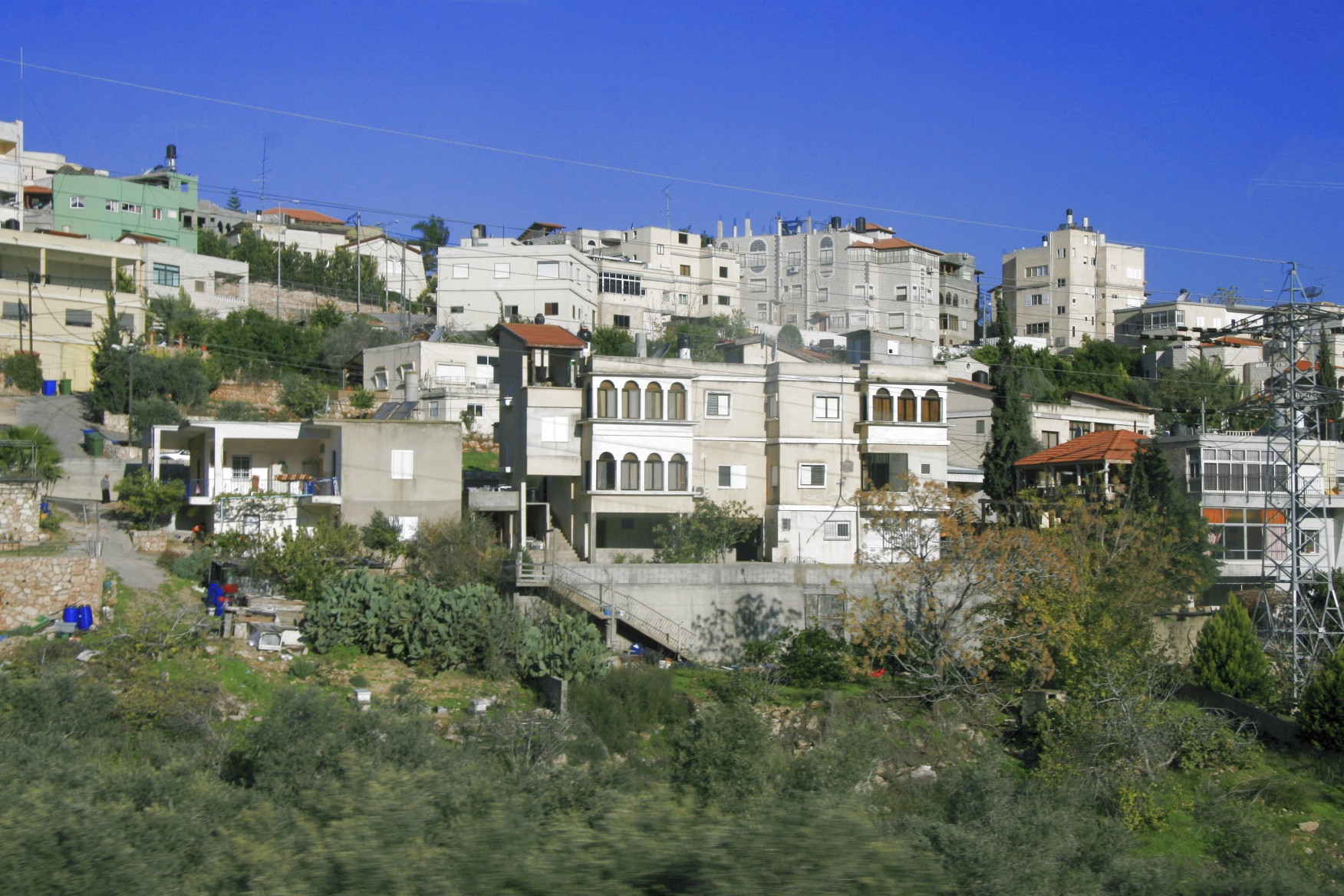
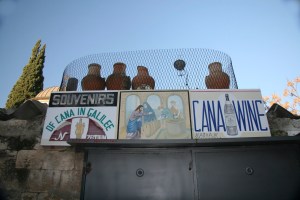
Cana today

August 24th is the feast of the apostle Bartholomew, also identified as Nathaniel,  from Cana in Galilee, only a few miles from Nazareth.  Like Nazareth, Cana attracted little interest in Jesus’ time, yet it played  a major role in Jesus’ early life and  mission.

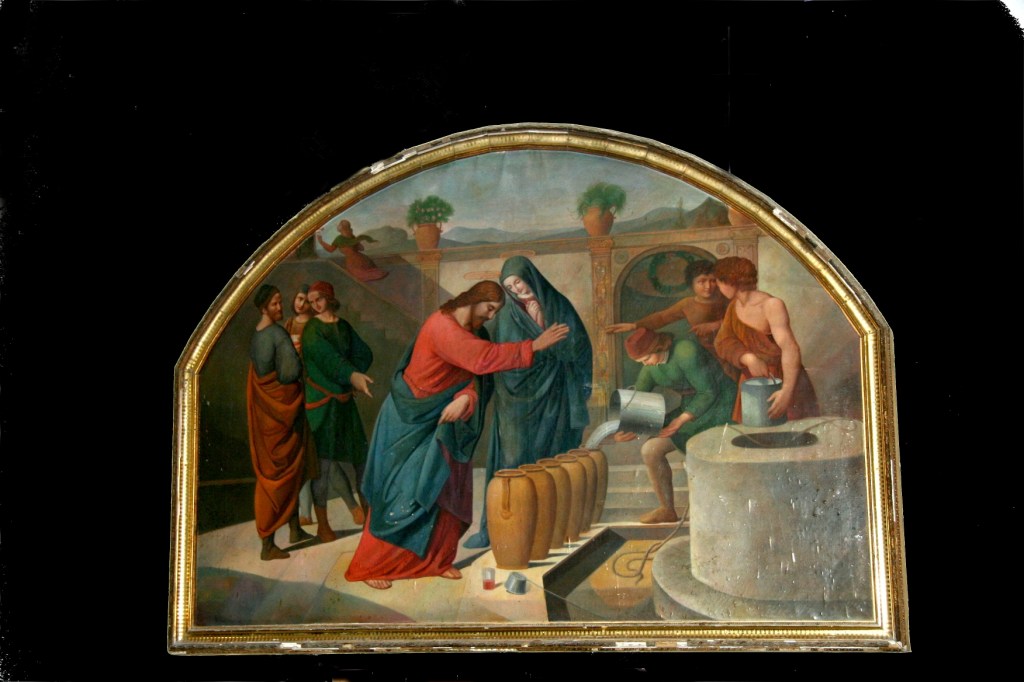
In John’s gospel,  Jesus turns water into wine at a wedding in Cana, his first “sign” that God’s kingdom would come. (Jn 2, 1-12) The family faced a wedding nightmare: the wine was running out and embarrassment was sure to come.

Catholic Church, Cana
cana carol rothstein 7

Was the family related to Jesus? Or Bartholomew?  At least they were close. Why else would Jesus, his mother and his disciples be at the celebration?

The miracle was special,. More than saving a family from embarrassment, it’s a sign in John’s gospel of God’s great love for ordinary people in ordinary towns everywhere. God delights in them, says the Prophet Isaiah, whose words often accompany the Cana miracle,  Cana signifies poor Israel, whom God loves with all the ardor of a “young man marrying a virgin,” God’s love, bountiful, restoring, overflowing with delight, goes out to this poor place, as well as poor places everywhere.

Jesus performed another miracle at Cana, John’s gospel says, another sign of the coming kingdom. Besides the miracle at the wedding, Jesus cured the dying son of a government official from Capernaum, whose ” father came to Cana because he heard that Jesus was there. (John 4.46-54) Jesus saved his son from death.

cana carol rothstein

Through the centuries Cana hasn’t prospered much. It’s not much to look at today.  In the late 19th century, a visiting English vicar described it this way:

“ (Kefr Kenna) lies on high ground, but not on a hill…A broad prickly pear led to the group of houses which perhaps represents the New Testament Cana. Loose stones were scattered around the slope. There may be, possibly, 150 inhabitants, but one cannot envy them their huts of mud and stone, with dunghills at every corner. Huge mud ovens, like great beehives, stood at the sides of some of the houses.

“ In one house a worthy Moslem was squatting on the ground with a number of children, all with slates on which verses of the Koran had been written, which they repeated together. It was the village school, perhaps like that at Nazareth eighteen hundred years ago.

“ A small Franciscan church of white stone with a nice railed wall, with a beautiful garden at the side, had over its doorway these startling words in Latin: ‘Here Jesus Christ from water made wine.’ Some large water jars are shown inside as actually those used in the miracle, but such mock relics, however believed in by simple monks, do the faith of other people more harm than good.”

Cana’s still a poor town. Like other poor places in the world it’s waiting to be raised up to share in the splendor of the heavenly Jerusalem. God loves poor places like this, the Cana miracle says. Bartholomew came from here.

cana carol rothstein 11
Church of St. Bartholomew, Cana

Mary, Mother of Mercy

olp


“Hail Holy Queen, mother of mercy, our life, our sweetness and our hope.” Why is Mary called “mother of mercy?” First of all, because she knew she had received the mercy of God which, like the oil poured on kings and priests, gave her power “to fulfill what is beyond human capabilities.” (Anthony Bloom)

Her cousin Elizabeth declared her “blessed among women and blessed is the fruit of your womb.”
Mary’s responded: ‘The Lord who is mighty has done great things to me, holy is his name.” She knew God’s mercy was a work in her to restore the human race. (Luke 1, 43-48)

How, then, was Mary merciful? How did she do what Jesus taught “Be merciful as your heavenly Father is merciful?” How did she live a merciful life? How did she do those works of mercy that tradition ascribes to the merciful person:
• Feed the hungry
• Give drink to the thirsty
• Clothe the naked
• Shelter the homeless
• Visit the sick
• Visit the imprisoned
• Bury the dead

• Admonish the sinner
• Instruct the ignorant
Comfort the sorrowful
Bear wrongs patiently
• Forgive all injuries
• Pray for the living and the dead

The scriptures say hardly anything about her. “Do whatever he tells you.” she says at the marriage feast of Cana. She had no teaching of her own, but always  points  to the teaching of her Son. The mystery of the Incarnation says that  Jesus took his human nature from Mary, his mother. Can we say he who became like us became like her and Joseph, the man who raised him as a child and into his adult years? From Jesus we can tell what Mary was like, a woman of mercy, and her first school was Nazareth. Now she is a teacher in the church.

Mary, Mother of Jesus, Mother of God


Mary is an important figure in the events of Advent and Christmas Time. The angel visits her at Nazareth, she visits  her cousin Elizabeth, the birth of Jesus in Bethlehem, the coming of the Magi, the flight into Egypt, the presentation of the Child Jesus in the temple, the finding of the Child Jesus in the temple after his loss for three days. All events in Luke and Matthew’s gospels where Mary has a role.

We remember her especially on her feast during Christmas time:  the Feast of Mary, the Mother of God. (January 1st)

Because they focus on Jesus, the gospel writers touch lightly on Mary, but she is an important witness to his humanity and divinity just the same. “For us and our salvation he came down from heaven, and by the Holy Spirit was incarnate of the Virgin Mary and became man.” (Creed)

Through her, the Christmas liturgy reminds us, Jesus took “a body truly like our own.” (Collect, Monday of Christmas Time) Jesus “accepted from Mary the frailty of our flesh.” (Collect, Monday of Christmas Time) She’s the way the Word became flesh.  The First Letter of John, read in Christmas Time, calls this a fundamental truth of faith.

By taking a body “truly like our own” and accepting “from Mary the frailty of our flesh,” Jesus humbled himself, assuming the limitations that come from being human. Mary is his way, giving him birth, nursing him as a infant and raising him as a child.

“Can anything good come from Nazareth?” For 30 years Jesus led a silent hidden life in that small town in Galilee, and Mary was his mother. “I confess I did not recognize him,” John the Baptist says twice when Jesus comes to the Jordan to be baptized. (John 1,29-34) His own in Nazareth did not recognize him either.

He went unrecognized, and so did Mary, who shared his hidden life. She performed no miracles, did not publically teach; no angel came again after the first announcement to her.

We can pass over the Hidden Life that Jesus embraced too quickly, even though the Christmas mystery invites us to keep it in mind. We forget that to be transformed into glory means accepting “the frailty of our flesh,” which Jesus did.

“…though invisible in his divine nature, he has appeared visibly in ours;
and begotten before all ages, he has begun to exist in time;
so that, raising up in himself all that was cast down,
he might restore unity to all creation
and call straying humanity back to the heavenly kingdom.”
(Preface II of the Nativity)

St. Mary Major is the main church in Rome dedicated to Mary, the Mother of God. You can visit it in the video above. It was built in the 5th century to honor Mary’s role as witness to his divine and human natures. The church is also called “Bethlehem in Rome” because many of the Christmas mysteries were first celebrated there; relics from Bethlehem were brought there after the Moslem invasion in the 8th century.

SuperStock_1788-1275[1]

The great mosaic of Mary in heaven crowned by Jesus, her Son, stands over the altar in the church as its focal point. Companion in his hidden life, she was raised up by her Son, who was human and divine,  through the mystery of his resurrection.

Nazareth: Where Jesus Was Raised


What was Nazareth like? We might think it was a quiet little town far from anywhere else in Jesus’ time; the gospels indicate his early years were spent in such a place.  Recent historical studies tell a different story. The town was not as isolated as once believed.  Just four miles away was the thriving Greco-Roman city of Sepphoris, recently uncovered by archeologists, and nearby were roads to Tiberias, Jerusalem, the sea coast and the rest of the world.

 Galilee’s economy was booming then, thanks to the rich soil of the Esdraelon plains, the fishing villages along the Sea of Galilee, the stability of Roman rule and Herod Antipas, a skillful administrator and builder who was firmly in charge then.  His new regional capital, Tiberias–a model of Greco-Roman city planning– dominated the shores of the Sea of Galilee. A new port, Caesaria Maritima linked Galilee to the rest of the Roman world. 

Could Nazareth, 15 miles east of the Sea of Galilee and 20 miles west of the Mediterranean Sea, situated in a thriving province, be shut off from this world?

How did Jesus get there?

Some historians say Joseph and Mary were not from Nazareth in Galilee, but from Judea.  Matthew’s gospel, in contrast to Luke’s, indicates that Joseph was a Judean associated with Bethlehem, David’s city. Mary’s family may have been associated with the temple in Jerusalem. The Church of St. Ann there claims to mark Mary’s birthplace in that city. 

Another tradition, however, says Mary was born in Sepphoris, near Nazareth. After Jesus’ birth in Bethlehem, the gospels indicate his family moved north to the small town of Nazareth to escape the clutches of Herod the Great, who ordered the slaughter of infants. When Herod died, he was succeeded by his son Archelaeus, who was just as unstable as his father. Herod Antipas, another of Herod’s sons yet slightly less dangerous than Archelaeus, inherited power in Galilee after his father’s death in 6 BC and ruled till about 36 AD, in the lifetime of Jesus. He began building the city of Sepphoris in 3 BC. Workers from nearby Nazareth would likely have been recruited to build that city.

Jesus and his followers rejected

Whatever its history, Nazareth will always be a mystery. Instead of supporting Jesus, the Nazareans turned their backs to him, the gospels say. They drove him out of their synagogue when he announced his mission and said he was mad. (Mt 13,54-58)  After his resurrection, there is no evidence Jesus appeared there; his followers in Nazareth were few. “No prophet is without honor except in his native place,” Jesus said. (Mt 13,54)

A Christian Minority through the Centuries

Followers of Jesus in the town where he was raised continued to be few, it seems. By the time Matthew’s Gospel was written, around the year 90, after the destruction of Jerusalem and the temple in 70 AD,  scribes and temple officials as well as the pharisees from that city had moved to the Galilean cities of Tiberias and Sepphoris, near Nazareth, and began a powerful new movement in Judaism.

Did they drive the followers of Jesus out of the Galilean synagogues just as his contemporaries drove him out of Nazareth?  Matthew’s gospel offers numerous warnings that the disciples would be handed over to the courts and scourged in the synagogues. (cf. Mt 10, 17)

“Slender evidence suggests that a Jewish Christian community survived in Nazareth during the C2 and C3 AD, “ writes Jerome Murphy-O”Connor. (The Holy Land, 423) The nun Egeria, one of the few early Christian visitors to Nazareth, found a cave considered part of Mary’s house in the 4th century,  but she did not stay long in the town.  In 570 AD a pilgrim from Piacenza found Nazareth a hostile place:  “there is no love lost in the town between Christians and Jews.” Two Christian churches were built at that time, but after the Muslim conquest of Palestine in the 7th century the number of Christians in Nazareth declined further and their churches were destroyed.

When the Crusaders conquered the town in the 11th century, they rebuilt the Byzantine shrines and added their own buildings; some remains are visible today. But after the defeat of the Christians in the 12th century, Nazareth once more became a Muslim stronghold and Christians a minority.

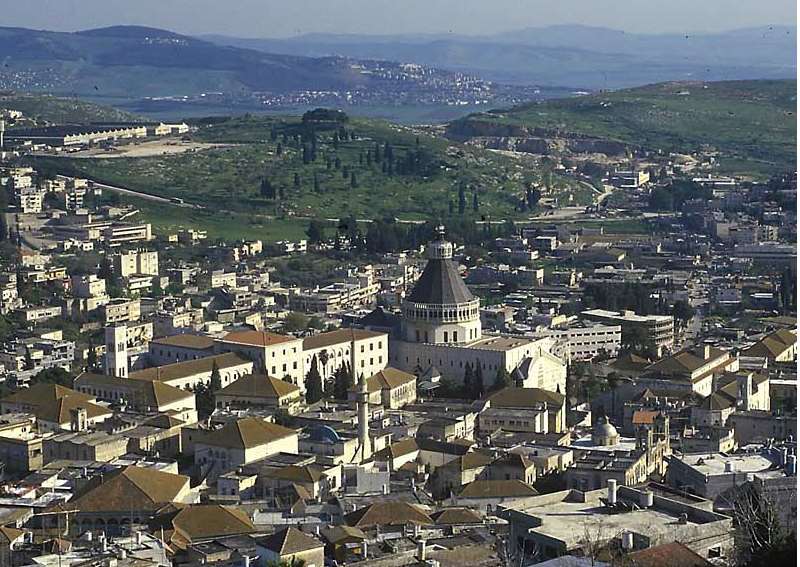
Through the ages, the Christian presence in Galilee remained small, dependent mostly on Christian pilgrims to the Holy Land. After the crusades, it was considered dangerous for Christians to enter Nazareth.  In 1620 the Franciscans bought a site in the  town where the house of Mary was said to be and they continued to nourish a Christian presence in the town. Through their efforts the large Basilica of the Annunciation, built over the early Byzantine and Crusader churches and archeological remains from the ancient town, was dedicated in 1968. The Greek Orthodox church also continued its ministry in this revered spot.

Nazareth itself remained poor and undeveloped from the time of Jesus until recently, when it became the provincial capital of Galilee and its population soared. From less than 1,000 inhabitants in Jesus’ time, the number has grown today to 70,000, mostly Muslim.

The large basilica of the Annunciation, with its extensive collection of art from all over the world honoring this mystery, is a gathering place for Catholic pilgrims. Here faith attempts to interpret this mysterious town “where our feeble senses fail.”

19th Century Nazareth

An English vicar left this quaint description  as he approached Nazareth towards the end of the 19th century. Unlike its neighbor, Cana, the town then was experiencing a modest revival:

“Our horses began to climb the steep ascent of 1,000 feet that brings one to the plateau in a fold of which, three miles back among its own hills, lies Nazareth.

“At last, all at once, a small valley opened below, set round with hills, and a pleasant little town appeared to the west. Its straggling houses of white soft limestone, and mostly new, rose row over row up the steep slope. A fine large building,with slender cypresses around it, stood nearest to us; a minaret looked down from the rear.

“Fig trees, single and in clumps, were growing here and there in the valley, which was covered with crops of grain, lentils and beans. Above the town, the hills were steep and high, with thick pasture, sheets of rock, fig trees now and then in an enclosed spot.   Such was Nazareth , the home of our Lord. (p 513)

“The town is only a quarter of a mile long, so that it is a small place, at best; the population made up of about 2,000 Mohammedans, 1,000 Roman Catholics, 2,500 Greek Catholics and 100 Protestants – not quite 6000 in all; but its growth to this size is only recent, for thirty years ago Nazareth was a poor village.”  (p 516)

The Catholic shrines of Nazareth were not among the English vicar’s favorite places to visit, but he does recognize one of the town’s enduring holy places:

“The water of Nazareth is mainly derived from rain-cisterns, for there  is only one spring, and in autumn the supply is precarious. A momentous interest, however, gathers around this single fountain, for it has been in use for immemorial ages, and, no doubt, often saw the Virgin and her Divine Child among those who frequented it morning and evening, as the mothers of the town, many with children at their side, do now.” (p.515)

“The Virgin’s Spring bursts out of the ground inside the Greek Church of the Annunciation, which is modern, though a church stood on the same site at least as early as 700 AD.They say that it was on this spot that the Angel Gabriel appeared to the Virgin; and if there is nothing to prove the legend there is nothing to contradict it.  Indeed, the association of the visit with the outflow of living water from the rock has a certain congruity that is pleasing. “ (p.516)

The Word Made Flesh

Nazareth, where Jesus lived most of his time on earth, offers few traces of the town he knew. Those were hidden years when the Son of God “humbled himself” by living inconspicuously, immersed in the steady, ordinary rhythms of a small 1st century Jewish town.  Jesus “became flesh” in Nazareth,  “one like us in all things but sin.”

Instead of Nazareth of the past, then, we may find him just as well in Nazareth of the present–or in any town or city or anyplace today, for that matter.

Jesus did not come only for the world then, he comes also for the world now, to dwell among us. Nazareth may help us understand the mystery of his Incarnation in our town and place.

He Came to Nazareth

The gospel readings this week are not just from one gospel, as they usually are. The readings this week after the Epiphany to the Baptism of the Lord ( January 7-12) are from the four gospels and each tells us that Jesus Christ, the Word Incarnate, manifested himself to all. In Psalm 2 (Monday) God says “I will give you all the nations as an inheritance.” Jesus gives himself to all.

This week each gospel points to the universal mission of Jesus already evident as he ministers to the people of his own time and place. Matthew’s gospel on Monday says he began his ministry in the “Galilee of the Gentiles.” “Great crowds from Galilee, the Decapolis, Jerusalem, and Judea, and from beyond the Jordan followed him.” Gentiles from the Decapolis and beyond the Jordan as well as Jews were already approaching him. Matthew 4,12-17, 24-25)

In the readings from Mark’s Gospel for Tuesday and Wednesday, Jesus multiplies the loaves and the fish on the Jewish side of the Sea of Galilee and then sets out on the sea for the other side, the pagan side, to bring the blessings of these signs to them also. (Mark 6)

On Thursday and Friday, there are excerpts from Luke’s Gospel. On Friday Luke recounts the cure of the leper. The leper’s cure promises that Jesus will reach out to all the abandoned throughout the world.

On Saturday, in the reading from John, John the Baptist recognizes that Jesus “is baptizing and everyone is coming to him.” Jesus will bring the waters of life to all.

Luke’s reading for Thursday, though, is somewhat puzzling. Jesus goes to Nazareth where he was raised and is rejected, but notice Luke’s reading for that day ends before the account of his rejection: “And all spoke highly of him and were amazed at the gracious words that came from his mouth.” (Luke 4, 14-22)

That’s the way we would have liked Nazareth to respond to the presence of Jesus when he first came there, but the town rejected him and Jesus never returned, the gospels say.

Do our readings this week offer the promise that Jesus, as the Risen Christ entrusted with the mission to save all, always returns to the hard places and most resistant people?

That means we’re not to give up on the Nazareths of this world that seem too far gone, too faithless, to ever hear the gospel. “Lord, every nation on earth will adore you,” our psalm says.