Tag Archives: mercy

Healer of Withered Hearts

      The Gospel for this Wednesday, January 18th, once again reminds me of our purpose as a church, to bring the healing power of God’s love to each other and to this wounded world, as soon as possible, without delay or excuse:

     “Jesus entered the synagogue. There was a man there who had a withered hand. They watched Jesus closely to see if He would cure him on the sabbath so they might accuse Him. He said to the man with the withered hand, ‘Come up here before us.’ Then He said to the Pharisees, ‘ Is it lawful to do good on the sabbath rather than to do evil, to save life rather than to destroy it? ‘ But they remained silent. Looking at them with anger and grieved at their hardness of heart, Jesus said to the man, ‘ Stretch out your hand.’ He stretched it out and his hand was restored.” (Mk 3: 1-5)

     With all eyes upon Him Jesus took the opportunity to challenge,teach, and also to heal. Once again Jesus was breaking the rules of His Jewish religion, putting His own life at risk to show us how to live in the Kingdom.

     His challenge : paraphrasing the words of Pope Francis, are we, the Church, an empty museum for “saints”, or are we called to be “a field hospital” for the wounded, the lost, the withered, the sinner? We have many rules that damn the divorced, the gay person, the addict, the non-believer. Can we begin by welcoming, in our hearts and lives, those outsiders, the errant ones, hungry for the meaning in their lives that Jesus can most certainly provide? I don’t know that Jesus will turn them away because “it’s the sabbath “, or for any other reason. Maybe neither should we.

     His lesson: the time to accept and heal is now, today, with everyone we meet. Let us truly stop and see our brothers and sisters. Let us show interest, empathy, love. Let us risk our own lives and dare to reach out to the ones who might not even trust us. Let us risk criticism or rejection for the sake of love of neighbor.

     The healing: with every little act of mercy for others, the love of Christ reaches within our own withered hearts, and heals us as it changes us. With these hearts open to Jesus, let us accept His light, to change our hardened hearts into hearts of flesh and blood, sources of love to the world.

     Our Lord gave His life for us. May we give our lives to Him, and to the healing of His people.

     Orlando Hernandez

Fidel

fidel

Dear Lord,

     The death of Fidel Castro, Cuban dictator, brought joy to many and sadness to others. In Miami there were celebrations in the streets of Little Havana. In Cuba there were nine days of mourning. Many of my friends ask how I feel about the death of Fidel. I’m neither happy nor sad. As a Christian I don’t rejoice in someone’s death. What I do is put them in Your capable hands, my Lord. I’m no one to judge!

     I’ve been praying for Fidel’s soul. Unfortunately I can’t forget that because of his political views and cruel policies generations lost their country and way of life. Torture, executions, imprisonment, all took place if you dared to disagree with any of his policies. Freedom no longer existed. Indoctrination began! Your churches, Lord, were closed. Prayer and religion were no longer necessary, we now had Fidel.

     My mother decided that she needed to leave Cuba for my sake and her own. In 1962 we became refugees. Thanks to the U.S., which opened its arms to us, we began a new life. It wasn’t easy, my God. Here we were penniless in a new land facing a new language and new obstacles. But with the help of family, the U.S. government, and the Catholic Church hope began to spring up and we survived.

     We left Cuba, my God, afraid and without much hope. We left Cuba because one man lost his way and the need for power overwhelmed his ideals. Fidel did have wonderful ideals, but the dark side won, in his case.

     I’ve been in the U.S. now for over fifty years. I’m in love with You, my Lord Jesus and I have to admit that happened here in the U.S.. Good things happened to most Cuban refugees. Most of us survived. We progressed. We lived full lives. But we never will know what could have been. The Cuba of today is nothing like the Cuba of yesterday. For some it’s very sad, for others it’s life. For me it is Your will, my God! May You, our Lord and Savior have the mercy on Fidel that he neglected to have for many of his people.

Berta Alvarez-Hernández

Morning Thoughts: The Bad Thief

rembrandt-self-portrait-c-1668

Rembrandt, “Self Portrait”, c. 1668 (detail)


.

The Bad Thief
.


.
.
good thief
bad thief
Savior in between
how is it
that you and i
can be all three?
.
we know of Jesus
as perfect
as perfect can be
speaking faith
breathing forgiveness
the Word
bound up
still
completely free
.
we know too
of the good thief
turning
turning toward Goodness
our Goodness
so gracious
hanging there
tortured
beside him
beside the good thief
Jesus nailed
one with the tree
.
we know too
what happened
what happened then
to the prodigal thief
humility
contriteness
a humble heart
spurned not
yes
true repentance
sorrow for sin
painful sorrow
paid forth
by a sinless man
and God
God the father
accepting the fee
the precious blood
of Jesus Christ
setting him
the good thief free
.
but what
what of the other one
what of the thief
named bad
what of him
unrepentant
deserving to hang
what of that poor man
that poor
prideful soul
just like you and me
that poor
nameless sinner
just like you and me
also hanging
hanging there
hanging above Mary
and the disciple
Jesus loved
hanging there
upon a third
a third
rarely talked about tree
.
who is he?
but you and me
.
i am the bad thief
.
and so are you
.
i have stolen
stolen so much
.
especially time
.
what have you
in your pocket
that isn’t thine?
.
Jesus makes it
perfectly clear
what happens
what happens to thieves
thieves like us
who simply say
i’m sorry
yet even His promise
His promise
full of mercy
His promise
of paradise
of paradise in fact
that very day
doesn’t stop
his good thieving legs
from being smashed
his repentant body
completely broken
head to toe
no
not even Christ’s promise
the promise
from the King Himself
removes the good thief
from the gift
from the gift that is his cross
.
but what of the other one
what of you and me
what of us
thieves who also lie
who reject justice
Justice hanging
right next-door
what of the bad thief
can be redeemed
what of the bad thief
in you and me
God only knows
.
mercy
mercy
mercy
Father
upon the dead
both the living
and the deceased
mercy
mercy
mercy
Father
upon us all
upon Your children
Your children turned thieves
whose faith
and sorrow
is known
by You
and You alone
.
good thief
bad thief
Savior in between
how is it
that you and i
and all the rest
of all humanity
can lack
to such a degree
true repentance
true humility
.
good thief
bad thief
Savior in between
how is it
that you and i
are all three?
.


.

.
—Howard Hain

.

Friday Thoughts: Innocence Itself

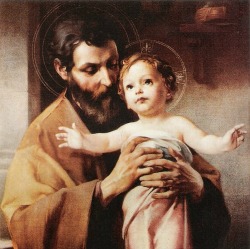
saint-joseph-and-child-jesus

.

A small, beautiful child.

What could be more innocent?

The tiny face of one born a few days before.

What could be more pure?

At what age does that stop?

When is it that we no longer see an innocent child, but instead, just one more man or woman walking the crowded streets?

If the child is our own, probably never.

Parenthood is a gift.

A gift beyond telling.

Yet every person we shall see this day was once a child.

Every person we shall see this day is still a child.

A small, beautiful child.

What could be more innocent?

The tiny face of one born a few days before.

———

Can you imagine what Saint Joseph felt?

What it was like to hold Jesus in the crook of his arm?

To present Innocence Itself to the world?

———

True humility has little to do with wanting to be humble.

It has nothing to do with wanting to look small, tiny, and somewhat sad.

True humility comes through grace.

The grace of knowing that no matter what you do, no matter how hard you try, you on your own cannot stop innocence from being slaughtered.

———

Somewhere, right now, the infant Jesus is being rejected.

Saint Joseph can hardly believe it:

Here He is. The Son of Man. Please don’t do anything, don’t say anything, don’t even think anything that offends His dignity.”

———

The next time we are tempted to judge anyone perhaps we should remember that.

Perhaps we should use our imagination, our faith, our hope, our love—all the gifts and talents that come from God, that return to God, but that God Himself lends us for the time being—to find a child.

For wasn’t that very person, the one who is about to be judged, once too only a few days old?

———

Think of Saint Joseph holding Innocence Itself.

Think of Saint Joseph humbly holding a tiny child, a tiny innocent child reaching out to all mankind with outstretched arms—so innocent that it’s hard to even imagine that all the world, that each and every one of us doesn’t immediately reach back with all our might to tenderly embrace this most precious gift—the most precious gift that a guilty world could receive.

Innocence Itself.


.

—Howard Hain

.

Morning Thoughts: Stench of the Cross

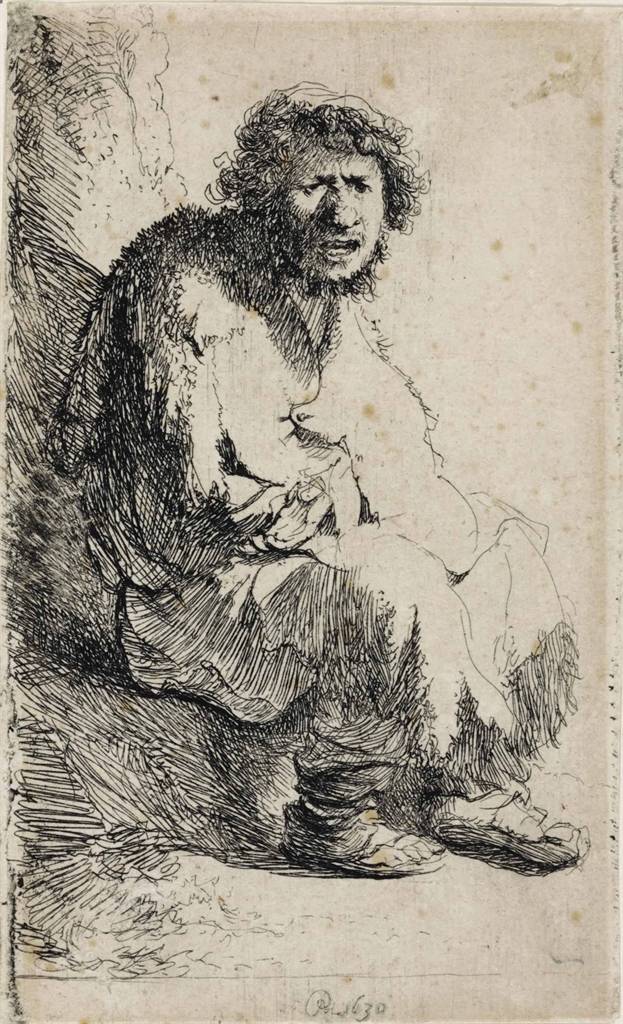
Rembrandt Begger Seated on a Bank (1630)

Rembrandt, “Beggar Seated on a Bank”, (1630)


For we are to God the sweet aroma of Christ among those who are being saved and those who are perishing...

—2 Corinthians 2:15


.

We see so many images of Christ Crucified. Museums and churches are full of them. And they should be. It is the greatest paradox ever told.

And to go along with the abundance of visual representations, there are of course also many artworks in written form depicting the Passion of Jesus Christ. Shelf after shelf can be filled with books containing the seemingly endless repertoire of poems, plays, and musical compositions based on the subject.

But none can capture the stench of death.

Smell moves us like no other sense.

It is so powerful. So quick. So nauseating.

Think of that the next time you’re riding the subway on your way to a museum. Think of that when a homeless man enters your subway car. Think of that when you’re tempted to switch trains at the next stop due to the stench.

Breathe deep instead.

Think of the stench. Think of that poor man—that poor sorrowful man dying right in front of you. The stench of rotting flesh. The stench of death.

No artwork that you’re on your way to see will bring Jesus and His Cross more to life.

Take a deep breath, and pray. You’re on holy ground.

Pray for yourself. Pray for the man. Pray for all those on board. Pray for the entire world.

Pray that that particular stench, that stench of death, right then and there, brings life.

That it brings life to hardened hearts.

That it brings life to senses numbed to the utter poverty of human suffering—suffering that manifests itself in oh so many ways.

That it brings life to what the world says can’t and shouldn’t be redeemed.

And give that gentleman a few bucks.

———

The Metropolitan Museum of Art recommends an entrance fee of twenty-five dollars. Do you know how much consolation that poor suffering Christ riding right next to you would receive if you gave him that much?

Do you know how cheap a price that is to pay to be able to get so close to a living breathing masterpiece of sacrificial life?

Dig in deep. Dig into your pockets. Dig deep into the reserves of your heart.

You will be amazed how such a prayer, such an act of compassion, such a “living faith”, will transform the stench of death into the aroma of life.

Breathe deep. Pick up your cross. Die daily.

Get over yourself.

What a breath of fresh air!

Now that’s truly an entrance fee.

And it’s worth every drop.


.

Then Mary took about a pint of pure nard, an expensive perfume; she poured it on Jesus’ feet and wiped his feet with her hair. And the house was filled with the fragrance of the perfume.

—John 12:3


.

—Howard Hain

.

11th Sunday C: The Mercy of God

To listen to today’s homily, please select the audio file below:

This Sunday there are two stories about forgiveness in our liturgy at Mass. From the Second Book of Samuel we hear the story of King David whose sin is pointed out to him and then declared forgiven by the prophet Nathan. The gospel reading from Luke tells the story of Jesus forgiving a sinful woman in the house of a Pharisee, who can’t seem to believe in forgiveness when he sees it.

The two stories complement each other. They remind us that forgiveness is not a simple matter; it’s a mysterious gift of God.

King David’s sins are well known and nothing to be proud of. He lusts after Bathsheba, the wife of Urriah, one of his officers. When David fails to disguise his adultery, he arranges to have Urriah killed and then marries his wife. The king’s sins are more than sins of lust or murder; his sin is an abuse of power. David’s the king, with absolute power over his subjects, answerable to no one, he thinks. He can do anything he wants and no one stands in his way. Unfortunately, he’s lost a sense of guilt; his conscience doesn’t bother him. He’s a king who can do no wrong.

Notice, though, that David recognizes sin and injustice in others. When the prophet Nathan tells him the story of someone who robs a poor man of his precious lamb, David immediately wants to right the wrong. Nathan says “ You are that man.” But David’s blind to his own sin, and so the prophet must awaken him to see what he has done. If you’re blind to sin, how can you be forgiven?

Finally, David admits; “‘I have sinned against the LORD.’ Nathan answered David: ‘The LORD on his part has forgiven your sin, you shall not die.’”

Now, the woman in Luke’s gospel who goes to the house of the Pharisee, unlike David, knows she’s a sinner and rejoices in the forgiveness she finds in Jesus. She expresses herself with that extravagant gesture of love. “Bringing an alabaster flask of ointment, she stood behind Jesus at his feet weeping and began to bathe his feet with her tears. Then she wiped them with her hair, kissed them, and anointed them with the ointment.”

In Luke’s story, it’s the Pharisee who’s blind. He can’t see forgiveness or the love behind it. He’s blind to God’s love, first of all, welcoming the sinner, and to the woman’s love that comes from being loved so much. He doesn’t seem to think forgiveness exists and he doesn’t understand it.

Simon, the Pharisee in our story, is like the Pharisee in Luke’s parable about the two men praying in the temple. He sees himself “unlike the rest of humanity, greedy, dishonest, adulterous.” He’s too good to need forgiveness. His blindness comes from self-righteousness.

Luke’s gospel is filled with sinners. Let’s be like them: the sinful woman, the prodigal son, the tax-collector Zacchaeus. They all recognize they’re sinners and they end up rejoicing at a banquet. They enjoy the mercy of God.

2nd Sunday of Advent: The Merciful Way of the Lord


To listen to today’s homily, please select the audio file below:

Last year, CNN ran a series on television called Finding Jesus: Faith, Fact, Forgery. One of the segments was about John the Baptist. I’m afraid I didn’t like John as he was portrayed. He shouted a lot about the coming judgment. There was something scary and unstable about him and I thought to myself: “I don’t know if I would follow this man.”

In the CNN presentation scholars periodically commented on John and his relationship with Jesus. They seemed to say that Jesus was a copy of John, that he got everything from John; he learned everything from John. That made me wonder if I would follow Jesus, if that was the way he was.

I find the scriptures offer a more reliable picture of John and Jesus. Luke’s gospel sets the stage for John’s appearance. “In the fifteenth year of the reign of Tiberius Caesar,
when Pontius Pilate was governor of Judea,
and Herod was tetrarch of Galilee,
and his brother Philip tetrarch of the region
of Ituraea and Trachonitis,
and Lysanias was tetrarch of Abilene,
during the high priesthood of Annas and Caiaphas,
the word of God came to John the son of Zechariah in the desert.”

“In the desert.” John preached “in the desert,” in the Jordan valley where pilgrims from northern Israel traveled on their way up to Jerusalem. They’ve taken the time off to go up to the temple and then go back home to their work and life as before. They’ve been walking on rough roads in hot days. They’re stopping to get some water before walking the last 15 miles up to the holy city.

John approaches them. “Something is happening, something big is going on. Something that the prophets have promised. We have to get ready for it. God is ready to do something. Someone is coming. ‘Prepare the way of the Lord.’ God is coming to judge us.”

Yes, there’s an urgency about John, but he’s not insane. He sees there’s something great ready to happen. God, the judge of all is coming. Someone is coming to bring God’s judgment.

When Jesus comes, John is certainly not his teacher. He recognizes Jesus and baptizes him in the Jordan. But Jesus is not a copy of John. Later, from he’s in prison, John sends disciples to Jesus who ask “Are you he who is to come, or shall we look for another.” Jesus said to them in reply, “Go and tell John what you hear and see: the blind regain their sight, the lame walk, lepers are cleansed, the deaf hear, the dead are raised, and the poor have the good news proclaimed to them. And blessed is the one who takes no offense at me.” (Matthew 11, 5-6)

Jesus calls himself the face of God’s mercy, the hand of God’s mercy, the gift of God’s mercy. John was waiting for God who is judge, but Jesus reveals God who is kind and merciful.

On March 13, 2015, Pope Francis called for a Holy Year of Mercy, a year to live “in the light of the Lord’s words: ‘Be merciful, just as your Father is merciful.’ (Luke 6, 36) The year begins this week, December 8th, the Feast of the Immaculate Conception and ends on November 20, 2016, “the Sunday dedicated to Our Lord Jesus Christ, King of the Universe–and the living face of the Father’s mercy.”

The Pope in Cuba

If you want to know what Pope Francis is doing in Cuba, read this homily he gave there yesterday:

We are celebrating the feast of the apostle and evangelist Saint Matthew. We are celebrating the story of a conversion. Matthew himself, in his Gospel, tell us what it was like, this encounter which changed his life. He shows us an “exchange of glances” capable of changing history.

On a day like any other, as Matthew, the tax collector, was seated at his table, Jesus passed by, saw him, came up to him and said: “Follow me”. Matthew got up and followed him.

Jesus looked at him. How strong was the love in that look of Jesus, which moved Matthew to do what he did! What power must have been in his eyes to make Matthew get up from his table! We know that Matthew was a publican: he collected taxes from the Jews to give to the Romans. Publicans were looked down upon and considered sinners; as such, they lived apart and were despised by others. One could hardly eat, speak or pray with the likes of these. For the people, they were traitors: they extorted from their own to give to others. Publicans belonged to this social class.

Jesus, on the other hand, stopped; he did not quickly take his distance. He looked at Matthew calmly, peacefully. He looked at him with eyes of mercy; he looked at him as no one had ever looked at him before. And this look unlocked Matthew’s heart; it set him free, it healed him, it gave him hope, a new life, as it did to Zacchaeus, to Bartimaeus, to Mary Magdalen, to Peter, and to each of us. Even if we do not dare raise our eyes to the Lord, he looks at us first. This is our story, and it is like that of so many others. Each of us can say: “I, too, am a sinner, whom Jesus has looked upon”. I ask you, in your homes or in the Church, to be still for a moment and to recall with gratitude and happiness those situations, that moment, when the merciful gaze of God was felt in our lives.

Jesus’ love goes before us, his look anticipates our needs. He can see beyond appearances, beyond sin, beyond failures and unworthiness. He sees beyond our rank in society. He sees beyond this, to our dignity as sons and daughters, a dignity at times sullied by sin, but one which endures in the depth of our soul. He came precisely to seek out all those who feel unworthy of God, unworthy of others. Let us allow Jesus to look at us. Let us allow his gaze to run over our streets. Let us allow that look to become our joy, our hope.

After the Lord looked upon him with mercy, he said to Matthew: “Follow me.” Matthew got up and followed him. After the look, a word. After love, the mission. Matthew is no longer the same; he is changed inside. The encounter with Jesus and his loving mercy has transformed him. He leaves behind his table, his money, his exclusion. Before, he had sat waiting to collect his taxes, to take from others; now, with Jesus he must get up and give, give himself to others. Jesus looks at him and Matthew encounters the joy of service. For Matthew and for all who have felt the gaze of Jesus, other people are no longer to be “lived off”, used and abused. The gaze of Jesus gives rise to missionary activity, service, self-giving. Jesus’ love heals our short-sightedness and pushes us to look beyond, not to be satisfied with appearances or with what is politically correct.

Jesus goes before us, he precedes us; he opens the way and invites us to follow him. He invites us slowly to overcome our preconceptions and our reluctance to think that others, much less ourselves, can change. He challenges us daily with the question: “Do you believe? Do you believe it is possible that a tax collector can become a servant? Do you believe it is possible that a traitor can become a friend? Do you believe is possible that the son of a carpenter can be the Son of God?” His gaze transforms our way of seeing things, his heart transforms our hearts. God is a Father who seeks the salvation of each of his sons and daughters.

Let us gaze upon the Lord in prayer, in the Eucharist, in Confession, in our brothers and sisters, especially those who feel excluded or abandoned. May we learn to see them as Jesus sees us. Let us share his tenderness and mercy with the sick, prisoners, the elderly and families in difficulty. Again and again we are called to learn from Jesus, who always sees what is most authentic in every person, which is the image of his Father.

I know the efforts and the sacrifices being made by the Church in Cuba to bring Christ’s word and presence to all, even in the most remote areas. Here I would mention especially the “mission houses” which, given the shortage of churches and priests, provide for many people a place for prayer, for listening to the word of God, for catechesis and community life. They are small signs of God’s presence in our neighborhoods and a daily aid in our effort to respond to the plea of the apostle Paul: “I beg you to lead a life worthy of the calling to which you have been called, with all lowliness and meekness, forbearing one another in love, eager to maintain the unity of the Spirit in the bond of peace” (cf. Eph 4:1-3).

I now turn my eyes to the Virgin Mary, Our Lady of Charity of El Cobre, whom Cuba embraced and to whom it opened its doors forever. I ask Our Lady to look with maternal love on all her children in this noble country. May her “eyes of mercy” ever keep watch over each of you, your homes, your families, and all those who feel that they have no place. In her love, may she protect us all as she once cared for Jesus.

Friday Thoughts

When you blend the prose of St. Thomas Aquinas with the poetry of St.Bernard, you get something like this:

“Why did the Son of God have to suffer for us? There was a great need, and it can be considered in a twofold way: in the first place, as a remedy for sin, and secondly, as an example of how to act.

It is a remedy, for, in the face of all the evils which we incur on account of our sins, we have found relief through the passion of Christ. Yet, it is no less an example, for the passion of Christ completely suffices to fashion our lives.”  ( Thomas Aquinas)

“Where can the weak find a place of firm security and peace, except in the wounds of the Saviour? Indeed, the more secure is my place there, the more he can do to help me. The world rages, the flesh is heavy, and the devil lays his snares, but I do not fall, for my feet are planted on firm rock. I may have sinned gravely. My conscience would be distressed, but it would not be in turmoil, for I would recall the wounds of the Lord: he was wounded for our iniquities…

They pierced his hands and feet and opened his side with a spear… But the piercing nail has become a key to unlock the door, that I may see the good will of the Lord. And what can I see as I look through the hole? Both the nail and the wound cry out that God was in Christ reconciling the world to himself. The sword pierced his soul and came close to his heart, so that he might be able to feel compassion for me in my weaknesses.

Through these sacred wounds we can see the secret of his heart, the great mystery of love, the sincerity of his mercy with which he visited us from on high. Where have your love, your mercy, your compassion shone out more luminously than in your wounds, sweet, gentle Lord of mercy? More mercy than this no one has than that he lay down his life for those who are doomed to death.”  (St. Bernard)

Christ, the King

Christ majesty chartre
Luke’s gospel for the Feast of Christ the King presents Jesus, not in a royal palace, but on a dark desolate hill. He’s not surrounded by cheering crowds, but by people cursing his name. He has no crown of gold, but a crown of thorns. His robe lies torn from him, heaped on the ground soaked in his blood. His throne is a cross, and over the cross is the inscription: THIS IS THE KING OF THE JEWS.

We are tempted to see not power but failure here. But listen to the gospel. One of the criminals calls out to the wretched figure hanging next to him: “Jesus, remember me when you enter your kingdom.” And power goes out from him. “This day you will be with me in paradise.

The thief is an interesting figure in the gospel. He has no name, nothing is known of his life or his crime. There he is, desperate, thinking all is gone. Powerless, no one would take a chance on him. Who would bother with him? Who would come close to him? Only a God who in the person of Jesus Christ would come so low as to share a cross with him.

The thief has no name. Christian tradition says he bears everyone’s name. In the thief we see ourselves, our desperate, poor, powerless selves. Yes, that is how much Christ loves us. He will always be close to us.