Tag Archives: Matthew’s gospel

Wednesday, 3rd Week of Lent

Lent 1


Readings
In Matthew’s gospel, chapters 5-7, Jesus speaks to his disciples from a mountain, a place Moses once chose to speak to the Jews, but Jesus speaks God’s revelation to a wider world from a mountain. His words are loyal to the Jewish traditions and laws that Moses taught. He’s not abolishing them. He came “not to abolish them but to fulfill them.”

First, remember them. That’s what the Jewish scriptures tell us to do. “Take care and be earnestly on your guard not to forget the things which your own eyes have seen, nor let them slip from your memory as long as you live, but teach them to your children and to your children’s children.”

Lent calls us to remember.

Second, practice them, from the greatest of the commandments to the least. Lent leads us to great thoughts and great visions of faith, but this season reminds us to remember and to do small things as well. “A cup of cold water,” a prisoner, someone sick visited, someone naked clothed, someone hungry fed, “a word to the weary to rouse them.”

The law of God often comes down to small things like these. They’re always at hand, readily available. They’re within our power to do, and the greatest in God’s kingdom are best at doing them.

Lord, may your teaching from the mountain

reach the whole world and bring us peace.

Never let us forget your words,

and help us to live by them.

Never let us forget the small acts of love.

Friday, 2nd Week of Lent

Lent 1


Readings

Rejection is a special kind of pain. Matthew’s gospel today describes the rejection Jesus experienced when he entered Jerusalem before his death. At first, he’s acclaimed by a large crowd as “the prophet Jesus from Nazareth in Galilee.” They spread their cloaks and cast branches before him. “Hosanna to the Son of David. Blessed is he who comes in the name of the Lord.”

Then, Jesus goes into the temple and drives out those who were buying and selling there, a symbolic act that indicates he has come to restore this place of prayer. (Matthew 21, 1-18)

Reacting strongly, the Jewish leaders reject him and question his authority to do such things. He has been sent by God, Jesus says, and responds with a parable that condemns leaders like them who reject prophets sent by God.

Jesus remains convinced of his mission, but conviction does not insulate him from the pain that comes from rejection. Like the prophets before him he suffers from it, and his suffering only increases as the crowds that first acclaimed him fall silent and his own disciples deny and abandon him. All turn against him and he is alone.

The events described in today’s gospel and the parable Jesus told throw light on one suffering Jesus endured in his passion and death¬– rejection. Rejection and death will not be the last word, however: “the stone rejected by the builders will become the cornerstone.”

You went to Jerusalem, Lord,

to announce a kingdom come

a promise of God fulfilled.

a hope beyond any the mind could conceive.

Teach us to keep your dream alive

though we see it denied.

STATIONS OF THE CROSS: Friday is a traditional day. for remembering the Passion of Jesus

Stations of the Cross:   Video  https://www.youtube.com/watch?v=waaMOBJ5e1Q&list=PLLUFZUgOPMFxkmfgBNS4Kfm8XxEwoAd6f&index=11

Stations of the Cross; Text    https://passionofchrist.us/stations-adults/ 

Stations of the Cross for Children: https://passionofchrist.us/stations-of-the-cross-children/

Prayers :  https://passionofchrist.us/prayers/

What You Find in the First Week of Advent

The daily Advent readings at Mass for the first week of Advent are beautifully arranged..

In the Old Testament readings,  the Prophet Isaiah speaks as a fierce Assyrian army heads towards Jerusalem. Bad times ahead, but the prophet sees something else. All nations are streaming to God’s mountain.

The nations will come to God’s mountain, Jerusalem, where the temple stands, the prophet says.  They’ll be fed a rich banquet (Wednesday),  the poor will triumph (Thursday),  the blind will see (Friday). Safe on this rock, children play around the cobra’s den, and the lion and the lamb lie down together (Tuesday). The prophet  challenges us to see our world in another way.

In the gospels  Jesus Christ fulfills the Isaian prophecies. The Roman centurion, humbly approaching Jesus in Capernaum, represents all nations approaching him. (Monday)  Jesus praises the childlike;  they will enter the kingdom of heaven.(Tuesday)  He feeds a multitude on the mountain.(Wednesday) His kingdom is built on rock.(Thursday)  He gives sight to the blind to find their way.  (Friday)

Many Advent readings in these early weeks of Advent are from the gospel of Matthew, who portrays Jesus teaching on a mountain (Isaiah’s favorite symbol). His miracles affect all. Jesus is the new temple, the Presence of God, Emmanuel, God with us. He brings hope beyond human hope.

Lord, help us see what you and the prophets see.

The Journey to Jerusalem

Jesus begins to set out for Jerusalem in today’s reading at Mass from the 10th chapter of Mark’s gospel. Matthew offers a similar account in the 19th and 20th chapters of his gospel.

Jesus doesn’t go to Jerusalem alone, he invites others to go with him. It’s a journey to resurrection and life and more than a couple of days, but as they hear Jesus describe the way to Jerusalem, people react like people do,

You can’t miss human weakness in the journey stories of Mark’s and Matthew’s gospel, beginning with the Pharisees. I suppose they represent human doubt and questioning that’s always there. The disciples rebuked the women bringing their children forJesus’ blessing, and Jesus rebukes them. Be like children to make the journey, Jesus tells them.

The rich young man wants to hold on to what he has, so he goes away sad. Peter says proudly he’ s given up everything to follow Jesus, but we know how inconstant he is. The story of the brothers, James and John, is obviously a story of human ambition.

1 Hundred Guilder Print
Rembrandt Hundred Guilder Print

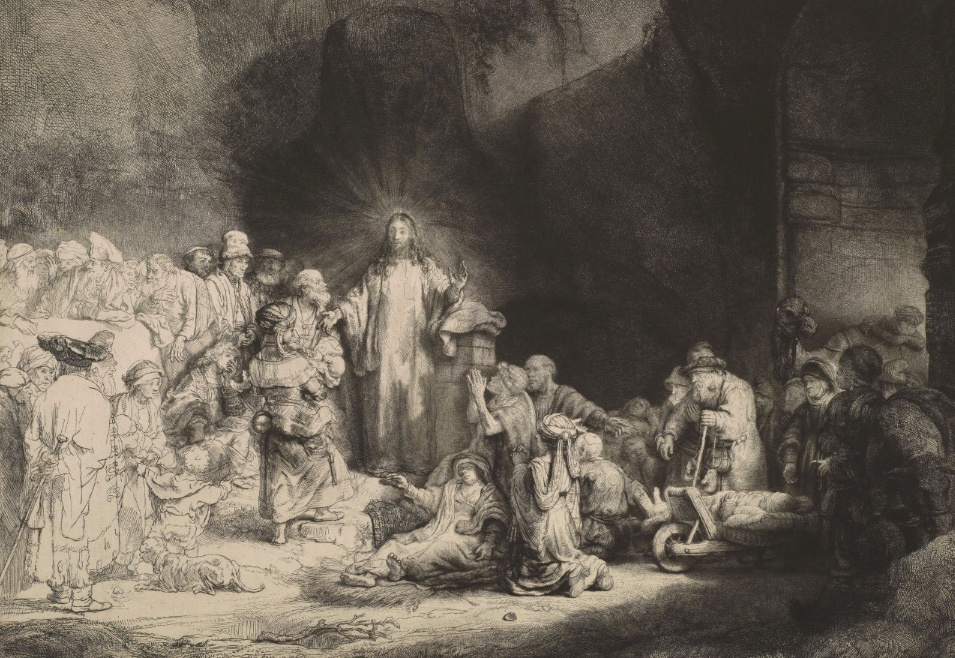
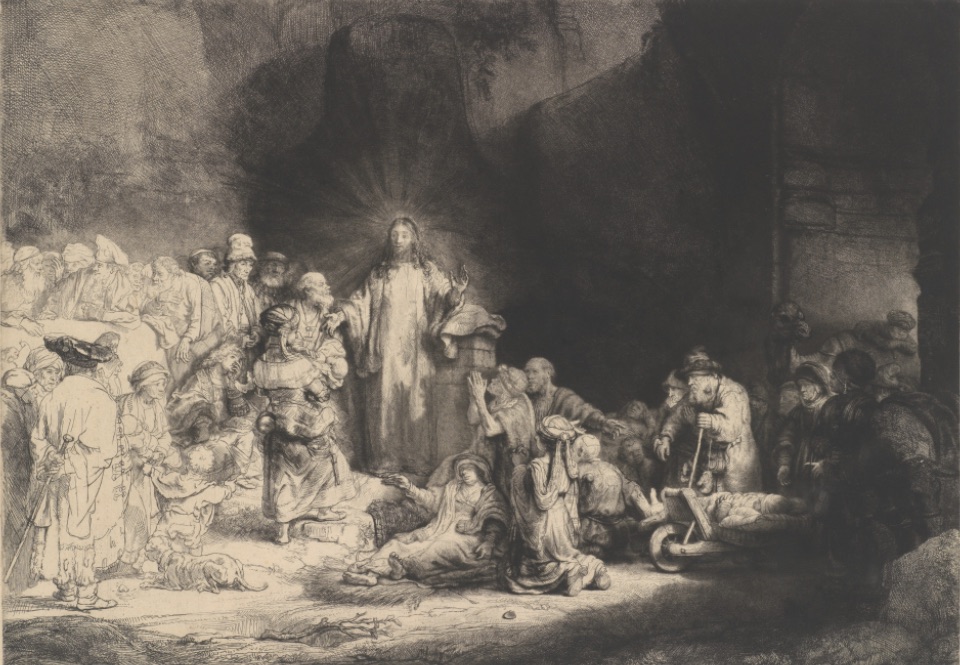
Matthew offers Mark’s stories in chapter 19 and 20 of his gospel. The artist Rembrandt drew a remarkable picture of the 19th and 20th chapter of Matthew called the Hundred Guilder Print.

Jesus stands at the center of Rembrandt’s work, bathed in light, his hands outstretched to the crowds before him.

Peter stands at Jesus right, close by. Other disciples, probably James and John, are next to him. Women and their children, whom the disciples told to go away, are next to them. The rich young man is also there in the crowd. Is he reconsidering?

Some of the enemies of Jesus who plotted against him and argued with him are also there, talking among themselves, but they’re still in the picture. Rembrandt even pictures the camel, back by the city gates.

Jesus sheds his light on them all. His arms are open to them all. Rembrandt has it right. Grace is more powerful than human weakness. It’s everywhere.

Monday: 1st Week of Advent

Readings:

Isaiah 2,1-5  All nations will come to this mountain

Matthew 8:5-11:  The Roman centurion at Capernaum.

In 8th century Jerusalem Isaiah makes glowing promises about the holy mountain, Jerusalem– all people will come there. At the same time,  Assyrian armies rumble into Palestine. “What are you talking about?” people say, “Can’t you see what’s at the door?”. But the prophet insists they will beat their swords into plowshares, their spears into pruning hooks and there will be no wars any more.

The prophet continues making outrageous promises. There will be a cloud by day and a fire by night over this holy mountain. The mountain’s moving, on an exodus of its own. Wonderful imagery for solid institutions, like churches and nations, that have been around for centuries. You’re still on the move, and God will guide you.

The Assyrians must have had the equivalent of the Roman centurions as the backbone of their armies. If you can get to them, you’ve got the army, military analysts would say. Powerful men, loyal soldiers. They could  tell their troops: “Lay down your swords and spears,” and it would be done.

The Roman centurion in today’s gospel comes humbly before Jesus. “Lord, I am not worthy that you come under my roof, but say the word and my servant will be healed.” He comes with a faith not found in Israel.

The Messiah will touch the proud and the strong. The centurion is one of them.


23rd Sunday a: Telling People They’re Wrong

For today’s homily, please play the video below:

The Hundred Guilder Print

Artists can be good interpreters of scripture. Rembrandt is one of the best. We’re in the second day of a Parish Mission–Revive, at St. Thomas of Canterbury Parish, Cornwall on Hudson, NY. I’ll be reflecting on some of the teachings of Jesus as he makes his way to Jerusalem from Galilee.

Rembrandt does that in his Hundred Guilder Print, a reflection on the 19th Chapter of Matthew’s Gospel. It’s an inspiring portrait of Jesus calling poor humanity to himself. He is our Savior.

The Kingdom of God is Coming, It’s Here: 25th Sunday

To listen to the audio for this week’s homily please select the audio slider below:

Matthew 20,1-19   25th Sunday A

The kingdom of God is coming, it’s here, Jesus says in the gospels. Often he describes the kingdom of God as a harvest, as he does in today’s gospel from Matthew. It’s an abundant harvest, bigger than you think. Pray that God’s kingdom come, he says to his disciples. Pray that it comes here on earth as in heaven. Don’t underestimate the kingdom, the harvest God sends.

It looks like the owner of the vineyard in our parable today has underestimated the size of his harvest. The first crew he sends out at 9 in the morning aren’t enough, so he calls more workers at noon, then 3 in the afternoon. At 5 in the afternoon he’s still adding to his workforce. Looks like he didn’t expect much.

That’s one of the first lessons to draw from the gospel. Don’t underestimate the power of God. Unfortunately, that’s what we do. We can expect too little from God. We forget that his kingdom will come on earth as it is in heaven. We think he has nothing or little to do with human affairs, or our world or the things here on earth.

The workers in the vineyard don’t seem to appreciate a big harvest either. They’re interested in something else– how much they’re getting paid and how much the other fellow is getting paid. The owner’s not fair, they say, because he pays the last workers the same as those who came first to work in the vineyard. They’re concerned with themselves, blinded as they are by envy and jealousy.

“Are you envious because I am generous,” the owner of the vineyard, who now seems to be a figure of God, says to them. Is this another lesson to draw from the parable? Envy and jealousy and measuring everything from our own perspective blinds us to God’s generosity. They blind us to the coming of God’s kingdom.

On his way through the towns of Galilee, Jesus announced the coming of the kingdom of God. He was bringing it to the world. It was an abundant harvest, yet even as he announced it, powerful voices were denying it was true. The scribes and Pharisees called him a false teacher, even his own disciples’ and his own family didn’t understand him. Still, he proclaimed God’s great kingdom. In the darkness of calvary he proclaimed it to a thief on a cross, and then he proclaimed it to his own disciples as he rose from the dead.

But let’s admit it, as we look at our world today we don’t see signs of a great harvest. Where is the harvest Jesus spoke of? Where is the kingdom of God. The kingdom of God seems far off, hardly here or ready to come. We’re living in a post-modern age, they say, when cynicism and questioning touch everything.

More than ever, we need to look at our world, not with our own eyes, but with the eyes of Jesus.

I like the story from John’s gospel describing Jesus meeting the Samaritan woman on his journey from Jerusalem to Galilee. It’s a hot afternoon; Jesus is tired and stops by a well to get a drink of water. It’s not a friendly place; the Samaritans don’t like the Jews and the Samaritan woman doesn’t like this Jew sitting at their well. But as they talk a new world appears, a light pierces the darkness and  the woman recognizes Jesus as the Messiah and calls the people of her town to see him.

“‘In four months the harvest will be here’”? Jesus says to his disciples, “ I tell you, look up and see the fields ripe for the harvest” He sees the kingdom of God coming in this small unexpected event. In the awakened faith of the woman before him, he sees the kingdom come.

That’s one of our greatest challenges today, to look up and see, in simple signs and in spite of everything, that the fields are ripe for the harvest. The kingdom of God has come.

An Abundant Harvest

Samaritan woman

As Jesus announces the coming of the kingdom of God, he often speaks of it as a harvest. It’s an “abundant” harvest, he says today in Matthew’s gospel– bigger than you think. That’s because it’s  God’s harvest. You need plenty of laborers to bring it in.

In one of his harvest parables, Jesus describes the owner of a vineyard calling workers into his vineyard. He’s obviously underestimated the size of the harvest. The first crew he sends  at 9 in the morning aren’t enough, so he calls more workers at noon, then 3 in the afternoon. At 5 in the afternoon he’s still adding to his workforce.

Though it’s not the main point of that parable, I think we can surmise that the vineyard owner didn’t grasp how big the harvest was. Neither do we grasp how “abundant” God’s harvest is, how great is the Kingdom that comes. We don’t see it.

Yet, the harvest is abundant, Jesus says as he goes through the towns and cities along the Sea of Galilee. Even as Pharisees and scribes oppose him, as he faces a lack of understanding from his disciples and his own family, as the towns where he ministers reject him, Jesus sees the coming of God’s kingdom.

He’s not looking at statistics; he doesn’t need a pollster or opinion polls to tell him the situation. He sees a harvest in the yearning for God, the desire for God, the workings of God in the people he meets.

According to John’s gospel, the woman he meets at Jacob’s well in the middle of the afternoon is enough for him to see God’s work. His disciples wonder why he’s talking to her,  a Samaritan woman. Jesus answers that he sees fields ripe for harvest in her.

Palm Sunday

Lent 1
(Please read further for Spanish and Swahili)
Readings
Matthew’s story of the passion of Jesus (Matthew 26-27) is the first of the four gospels read in Holy Week. Why four? Because this story can’t be expressed easily; each of the evangelists has something to say.
It’s a story that begins when Jesus rises from the dead.

Appearing to his disciples at Jerusalem that day “Jesus came and stood among them and said, ‘Peace be with you.’ When he had said this, he showed them his hands and his side.” ( John 20,19-21 ) To the disciples on the way to Emmaus that same day, Jesus said: “‘Was it not necessary that the Christ should suffer these things and enter into his glory?’ And beginning with Moses and all the prophets, he interpreted to them in all the scriptures the things concerning himself.” (Luke 24,26-27) The gospel narratives grew from these appearances of the Risen Christ and the scriptures he interpreted.

The Passion of Jesus is an Easter story that brings hope. He did not hide his wounds; he showed them to his disciples. He doesn’t dismiss his sufferings and death as an embarrassing setback; the power of God appeared in them. As Jesus revealed his experience, he made the hearts of his followers burn with rejoicing. As the story is told to us, we respond with a simple response of love.

“One loving word can keep your soul in prayer for a long time. For example, you are ready to meditate on Jesus Crucified and find yourself blank and unable. Make an act of love, like this: “O my Jesus Crucified, why are you on the cross?” Then, if you can go no further and your soul is a peace in the silence of love, lost in God, just continue that way. What a great prayer this is!”

May the Passion of Christ be always in our hearts!
Lent 1

Domingo de Ramos – Año A
Mateo 26, 14-75 y 27, 1-66

La historia de Mateo sobre la Pasión de Jesús (Mateo 26-27) es el primero de los cuatro Evangelios que se leen en la Semana Santa. ¿Por qué cuatro? Es que este relato no se puede expresar facilmente; cada uno de los evangelistas tiene algo que decir.

Este relato es contado inicialmente por Jesús Cristo después de resucitar de entre los muertos. Apareciendocele a sus discípulos en Jerusalén ese día, “Jesús entró y, poniéndose en medio de ellos les dijo, ‘Paz a ustedes.’ Cuando él había dicho esto, les mostró las manos y su costado.” (Juán 20,19-21) A los discípulos en el camino a Emaús ese mismo día Jesús les dijo, ” ‘¿A caso no tenía que sufrir el Mesías estas cosas antes de ser glorificado?’ Y comenzando con Moisés y todos los profetas él se puso a explicarles todos los pasajes de las escrituras que hablaban de él.” (Lucas 24,26-27) Estos narrativos del Evangelio provinieron de las apariciones del Cristo Resucitado y las escrituras que él interpretó para ellos.

La Pasión de Jesús es un relato de Pascua que trae esperanza. Él no escondió sus heridas; él se las enseñó a sus discípulos. Él no descarta sus sufrimientos y muerte como si solo hayan sido unas molestosas contrariedades; el poder de Diós se manifestó por ellas. Cuando Jesús revelaba su experiencia, él causaba que los corazones de sus seguidores ardieran con regocijo. Cuando nosotros escuchamos este relato, respondemos con la sencilla respuesta del amor.

San Pablo de la Cruz nos dice; ” Una palabra de amor puede mantener tu alma en oración por un largo rato. Por ejemplo, estás preparado para meditar sobre Jesús Crucificado y te encuentras incapaz, con la mente en blanco. Haz un acto de amor, como este: ‘O mi Jesús Crucificado, ¿por qué estás en esa cruz?’ Entonces, si no puedes proceder más allá y tu alma se siente en un estado de paz en el silencio del amor, perdido en Diós, pués continua de esa manera. Qué gran oración es esta! ”

Qué la Pasión de Cristo siga siempre en nuestros corazones!

Lent
Sikukuu Ya Matawi

Hadithi ya Matayo juu ya mateso ya Yesu ni ya kwanza kwenye injili nne

zinazosomwa wakati wa wiki takatifu. Kwa nini nne? Kwa sababu hii hadithi

haiwezi kuelezewa kwa urahisi; kila mwinjili ana jambo la kusema.

Ni hadithi iliyoanza baada ya Yesu kufufuka kutoka katika wafu.

Kuwatokea wanafunzi wake, siku ile kule Yerusalem “Yesu alikuja na kusimama

kati yao na kusema, ‘Amani iwe nanyi’. Baada ya kusema hayo, aliwaonyesha

mikono yake na ubavu (Yohana 20:19-20)”. Kwa wanafunzi wake waliokuwa

safarini kuelekea Emmaus siku ile ile, Yesu alisema: “ ‘Haikumpasa Kristo ateswe

mambo haya na kuingia katika utukufu wake?’ Aliwatafsiria maandiko matakatifu

na yale yote yaliyomhusu yeye mwenyewe, kuanzia kwa Musa na manabii. Luka

24:26-27.Simulizi la injili ya leo limekuwa kutoka katika kuonekana kwa Kristo

Mfufuka na maandiko matakatifu aliyoyaeleza/aliyoyafafanua.

Mataso ya Kristu ni hadithi ya pasaka yenye kuleta matumaini. Hakuficha vidonda

vyake; aliwaonyesha wanafunzi wake. Hatupilii mbali mateso na kifo chake

kwamba ni kitu cha aibu; nguvu ya mungu ilijionyesha ndani yao. Jinsi Yesu

alivyojifunua, alifanya mioyo ya wafuasi wake ichomwe kwa furaha. Nasi kadri

hadithi hii iliyvoelezwa kwetu, tunaitikia na mwitiko rahisi wa upendo.

Mtakatifu Paulo wa Msalaba

“Neno moja la upendo linaweza kuuweka moyo wako katika hali ya kusali kwa

mda mrefu. Kwa Mfano, uko tayari kutafakari juu ya kusulibiwa kwa Yesu na

unajikuta umetawanyika kimawazo na kushindwa kusali. Fanya tendo la upendo,

kama hili: “ O Yesu wangu uliyesulibiwa, kwa nini uko msalabani?” Alafu, kama

hauwezi kuendelea na moyo wako uko katika amani katika ukimya wa upendo,

umezama katika Mungu, basi endelea namna hii. Hii ni sala kubwa namna gani!”

Basi mateso ya Kristo na yawe daima ndani ya mioyo yetu.