“Christians live from feast to feast,” St. Athanasius said. The church’s feasts are linked to each other through the year, and every feast is linked to the great feast of the Resurrection of Jesus.
The feasts of Mary follow the pattern of the feasts of her Son, for she shares in his saving work. Following the feasts year by year, we learn the mysteries of God, little by little. Mary was blessed from her conception. ( Immaculate Conception, Dec. 8). We celebrate her birth 9 month later. (The Nativity of Mary, September 7). Her death and assumption into heaven are celebrated Augustus 15th.
The Feast of the Queenship of Mary, August 22, is part of the mystery of her assumption into heaven. Introduced into the liturgy of the Roman Catholic church in 1955, the feast celebrates the privileged place of Mary in heaven. She “was taken up body and soul into heavenly glory when her earthly life was over, and exalted by the Lord as Queen over all things.” (Second Vatican Council, Lumen Gentium 59)
Royal titles were commonly given to God and those anointed by God in the Old Testament; Christianity continued the pratice, giving royal titles to Jesus and Mary. She is called queen in traditional Christian prayers like the Hail Holy Queen (Salve regina) and Queen of Heaven (Regina Coeli):
“Hail, Holy Queen, Mother of mercy, our life, our sweetness and our hope. To you do we cry, poor banished children of Eve. To you do we send up our sighs, mourning and weeping in the valley of tears. Turn then, most gracious advocate, your eyes of mercy towards us, and after this our exile, show to us the blessed fruit of your womb, Jesus. O clement, O loving, O sweet Virgin Mary.
Pray for us, O holy Mother of God, that we may be made worthy of the promises of Christ.
Mary is a queen, but also a mother. She is the Mother of God, Mother of Jesus Christ, Mother of us all, the New Eve, given to us by her Son from the Cross through his disciple John.
Mary knows her greatness is from her Lord, as she acknowledges in her Magnificat:
“My soul proclaims the greatness of the Lord; my spirit rejoices in God, my Savior. He who is mighty has done great things to me; holy is his name.” ( Luke 1:46-55)
In the portrayal above, Fra Angelico captures Mary’s humility; she bows before her Son, her hands closed in prayer. The saints below her know that honors given to her are a reflection of the graces promised to humanity.
“Pray for us, O Holy Mother of God, that we may be made worthy of the promises of Christ.”
When I was a little boy, on August 15, the Feast of the Assumption of Mary into Heaven, my mother would tell me to go down to the Newark Bay, just a few blocks from my home in Bayonne, NJ, and go into the water. There’s a blessing in the water today, she told me.
I learned later where that custom came from. In medieval Europe the Feast of the Assumption was the day the fields were blessed. The middle of August was harvest time, and on this day herbs were gathered from the fields and brought to the church to be blessed with water. After they were blessed they were brought home to be medicines for the sick. We still get many if not most of our medicines today from herbs.
Customarily, a sprig was placed on the wall where children slept, asking God to keep them healthy and strong.
We will have herbs, a small olive tree, fruits of the earth and flowers before our altar for the feast on August 15 and then we will have a procession to our Mary Garden to bless them..
Many important feasts of our church occur in one of nature’s cycles. The birth of Jesus Christ, December 25, is celebrated as darkness gives way to light in the Western Hemisphere. Easter, the celebration of the death and resurrection of Jesus takes place during the Passover celebration, which occurrs at the spring harvest. Mary’s Assumption, August 15th, falls as the summer harvest begins.
You can see why Mary’s Assumption into heaven is a day to bless herbs and to bless the fields. It’s a feast of life. On this day Mary followed Jesus, her Son, into the mystery of his death and resurrection in a unique way. Mary’s body, her humanity, like the humanity Jesus assumed, like the humanity we all share, came from the earth.
We all come from dust, from creation, and to dust we shall return.“From dust you are, and to dust you shall return,” we are reminded on Ash Wednesday. But the promise we have from Jesus is that this dust will rise again to new life.
Mary witnesses to his promise in a unique was. Mary’s body, like the body of Jesus, never returned to the dust. She was assumed body and soul into heaven to become a sign of bodily resurrection. The promise of resurrection given to her is also given to us. Not only is it given to us, but to all God’s creation. Mary is the sign of a new creation, promised by God.
The first reading for her feast, from the Book of Revelation, describes Mary as a woman “ clothed with the sun, with the moon under her feet, and on her head a crown of twelve stars. She gave birth to a son, a male child, destined to rule all the nations.” After his resurrection, Jesus was enthroned in heaven and Mary was taken up to heaven to join him.
The Assumption of Mary is a time to rejoice in “the resurrection of the body and life everlasting”, the whole created world also rejoices in the promise of a new creation. Listen to Psalm 96:
O sing a new song to the Lord, sing to the Lord all the earth. O sing to the Lord, bless his name. Let the heavens rejoice and earth be glad, let the sea and all within it thunder praise, let the land and all it bears rejoice, all the trees of the wood shout for joy at the presence of the Lord for he comes, he comes to rule the earth.
The Feast of the Assumption of Mary into Heaven offers a future so different than the bleak picture of life we’re tempted to see today. She visits us today as she did her cousin Elizabeth long ago announcing a great mystery. We are called, like Mary, to a heavenly place with Jesus her Son. Our world, so battered with the storms and disease, so threatened by a changing climate, wars and poverty, also sees a glorious future in her assumption into heaven.
Pray for us, O Holy Mother of God, that we may be made worthy of the promises of Christ.
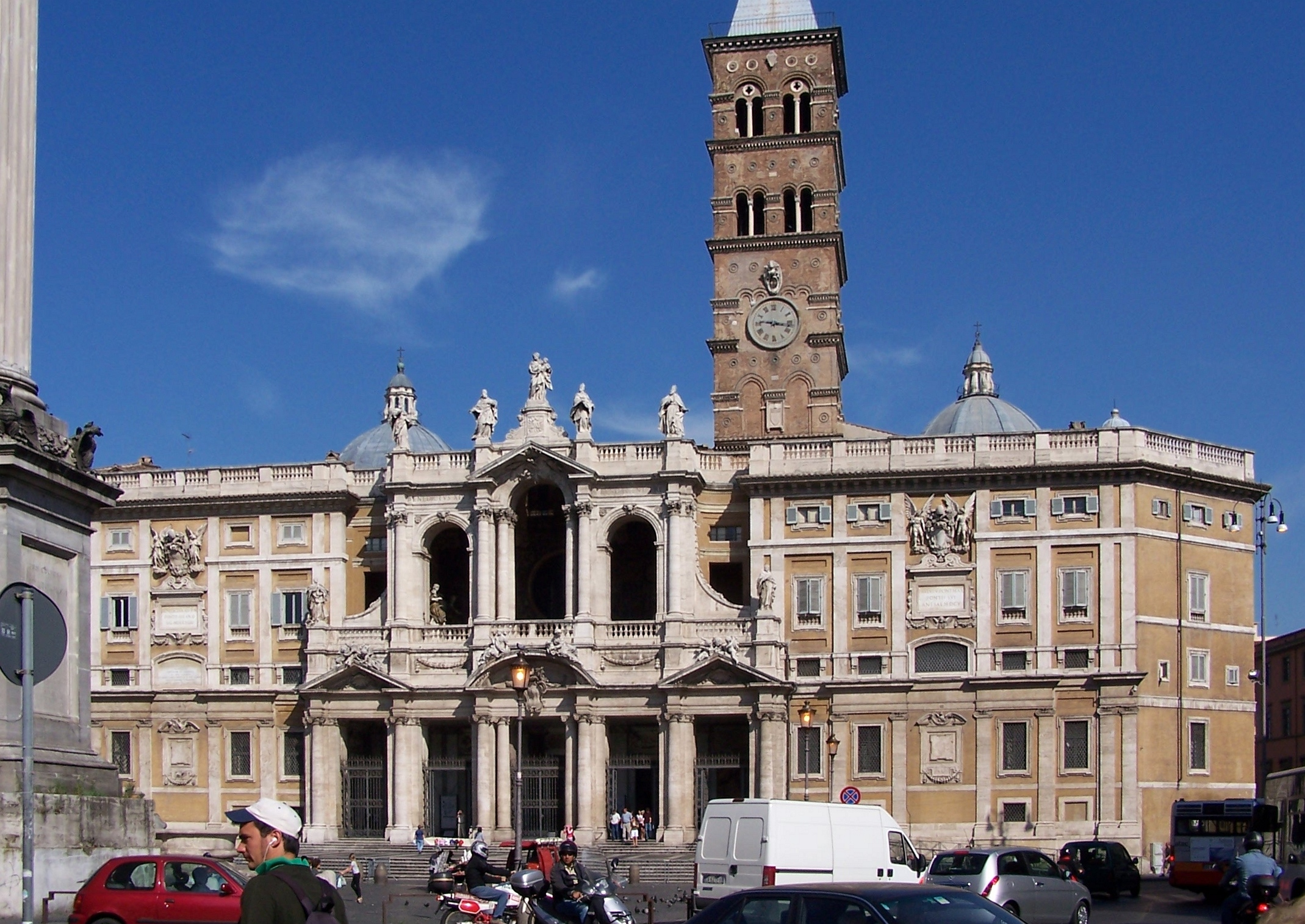
On the summit of the Esquiline Hill, a short distance from the Lateran Basilica, is the church of St. Mary Major, begun in the early 5th century and completed by Pope Sixtus III (432-440.)
Salus Populi Romani, c 5th century
Mary, the mother of Jesus, is honored here as the Mother of God. . In 431, the Council of Ephesus repudiated Nestorius, the patriarch of Constantinople, for refusing to call her “Mother of God.”
The title is important because it safeguards Christian belief in the mystery of the Incarnation: Jesus is God and man, the council said. For the Christian world Mary is the defender of Jesus, her son, who was both human and divine.
Devotion to Mary ran high in the Christian world after the Ephesus council, and churches dedicated to Mary arose everywhere. In the city of Constantinople alone, 250 churches and shrines in her honor were built before the 8th century. Pictures, icons of Mary holding her divine child multiplied, especially in churches of the East, where they became objects of special devotion.
Mary’s title, Mother of God, does not make her a goddess, otherwise how could she have given birth to Christ who is truly human? Yet, she can be called Mother of God, because Jesus who is truly her human son is truly Son of God from all eternity as well.
The 5th century, however, was hardly a good time to build a church in Rome. In 410, Alaric and his Goths shocked the Roman world by sacking a city all thought invincible. In 455 the Vandals under Genseric vandalized Rome. Twice more in the century other barbarian tribes invaded.
In far off Palestine St. Jerome cried out in disbelief at Rome’s misfortunes, which he saw heralding the end of the world. In Africa St. Augustine wrote “The City of God” in response to the followers of Rome’s traditional religions, who said Christian weakness caused the city’s devastation. Christians were not the cause of the city’s misfortunes, St. Augustine wrote; two loves are at work in the world building two cities. One love builds an evil city; Christianity builds the City of God, promoting love and justice.
The English historian Edward Gibbon called this period a time of decline and fall, the end of the Roman Empire. God’s plan does not lead to decline and fall, they say, but to triumph in Christ. God’s plan does not lead to decline and fall, they say, but to triumph in Christ. God’s plan does not lead to decline and fall, this church says. On the walls of St. Mary Major has stories from the Old and New Testaments calling for courage and hope.
In the church of St. Mary Major, Mary appears as Jesus’ mother and closest disciple. To use a phrase of St. Pope John Paul II, this church is “a school of Mary” who teaches mysteries she has learned. A noticeable number of women from the Old and New Testaments surround her: she represents those who seem powerless, but are empowered by God.
The great 13th century mosaic in the church’s apse of Mary crowned by Jesus Christ as heaven’s queen proclaims God’s triumph in her, but also his triumph in the church as well. She is taken up to heaven “to be the beginning and pattern of the church in its perfection, and a sign of hope and comfort for your people on their pilgrim way.” (Preface of the Assumption)
It shouldn’t surprise us that many of the mysteries in which Mary had a special role were first celebrated here as liturgical feasts. The Christmas liturgy, especially the midnight Mass on December 25th , began in this church in the 5th century and spread to other churches of the west.
A replica of the cave under the church of the Nativity at Bethlehem, the traditional site of Jesus’ birth, was constructed here early on.. After the Muslim conquest of the Holy Land in the 7th century, Christian refugees placed relics here purported to be from the crib that bore the Christ Child and relics of St.Matthew, an evangelist who told the story of Jesus birth.
Relics of the Crib from Bethlehem
Besides the Christmas liturgy, other great Marian feasts, such as her Immaculate Conception and Assumption, developed their liturgical forms in this church.
Built on a hill where all could see it, near Rome’s eastern walls so often threatened by barbarian armies, St. Mary Major affirms Christianity’s ultimate answer to its enemies. It is not military might, but the power of faith and love that triumphs in the end.
Visiting St.Mary Major
The church’s 18th century façade was built to enhance the appearance of this important church at a time when many visitors, especially from England and Germany, were traveling to Rome on the Grand Tour to visit its classical and religious sites.
The church’s interior, with its splendid 5th century mosaics along the upper part of the nave, retains its original form better than any other of the major basilicas of Rome.
The Sistine Chapel at the right hand side of the nave was built to house a silver reliquary with relics of the crib brought from the Holy Land in the 8th century. Two popes, Sixtus V and Pius V are buried there.
The Borghese Chapel at the left hand side of the nave honors the ancient icon of the Virgin and Child,”Salus populist Romani”, that Roman Christians have reverenced for centuries. A reproduction of the icon is a nice remembrance to bring home. Pope Francis has requested to be buried here.
The magnificent 13th century mosaic in the apse of the basilica presents the Coronation of Mary in heaven. It’s surrounded by 5th century mosaics depicting scenes from the birth of Jesus and the life of Mary.
We celebrate the Feast of Ann and Joachim today, parents of Mary, the Mother of Jesus. The New Testament says nothing about them, but an early 2nd century document called the Gospel of James tells their story,
Ann and Joachim lived in Jerusalem, the ancient source says, where Joachim, a descendant of David and a wealthy man, provided sheep and other offerings for the temple sacrifices. The two had ties to Bethlehem nearby and Nazareth in Galilee.
They were well off but for twenty years disappointment clouded their marriage: they had no child. Even after vowing to dedicate their child to God, no child came. And so, at a time when children were treasured, they were thought poor. Descendants of David, they were blamed also for failing to continue the line the Messiah would come from.
Stung by criticism, Joachim spent more time in the mountains, brooding among the shepherds and their flocks. As her husband distanced himself from her, Ann too grew sad. God seemed far away.
In the garden one day, noticing some sparrows building a nest in a laurel tree, Ann burst into tears: “Why was I born, Lord?” she said, “birds build nests for their young and I have no child of my own. The creatures of the earth, the fish of the sea are fruitful, and I have nothing. The land has a harvest, but I have no child in my arms.”
At that moment, an angel of the Lord came and said, “Ann, the Lord has heard your prayer. You shall conceive a child the whole world will praise. Hurry to the Golden Gate and meet your husband there.”
At the same time, In the mountains an angel in dazzling light spoke to Joachim, “Don’t be afraid, the Lord hears your prayers. God knows your goodness and your sorrow and will give your wife a child as he did Sara, Abraham’s wife, and Hannah, mother of Samuel. You will have a daughter and name her Mary. Give her to God, for she will be filled with the Holy Spirit from her mother’s womb. Go back to Jerusalem. You’ll meet your wife at the Golden Gate and your sorrow will turn into joy.”
Joachim and Ann met at the Golden Gate to the temple, the place of God’s presence. They embraced as they spoke of the angel’s promise. Returning home, Ann conceived and bore a daughter, and they called her “Mary.”
When she was three years old, Ann brought Mary to the temple to learn the scriptures, to pray and take part in the Jewish feasts. She watched her father bring lambs to be offered in sacrifice. She grew in wisdom and grace in God’s presence.
When Mary approached marriage age– then 15 or so–her parents arranged for her marriage as it was customary. They sought the high priest’s advice, tradition says, and Joseph of Nazareth was chosen as her husband. Nazareth was then their home.
The angel Gabriel appeared to Mary and announced that she was to be the Mother of Jesus. By the power of the Holy Spirit she conceived the Child.
After Jesus was born in Bethlehem, Mary and Joseph returned to Nazareth where Jesus grew up. He was raised in a large extended family that included his grandparents, Ann and Joachim, who cared for him as a child.
No one knows just when or where Ann and Joachim died, but Jesus must have treasured them in life and on their passage to God.
The 2nd century Protoevangelium of James repeats a fundamental theme of the Book of Genesis: God promises Adam and Eve many children who will enjoy the blessings of the earth. God repeats the promise to an aged, childless couple, Abraham and Sarah, and again to Hannah, who bemoans her childlessness to the priest Eli in the temple. In the same way, God gives a child to Ann and Joachim. Mary, their daughter, brings blessings to the nations through her son Jesus Christ, born of the Holy Spirit.
Giotto’s 14th century illustrations (above) from the Arena Chapel in Padua. helped popularize the story of the parents of Mary in Italy, Europe and the rest of the western world.
It’s an important story for grandmothers and grandfathers. Like Ann and Joachim they have a big role raising the next generation. More than they think.
A novena preparing for the Feast of Saints Ann and Joachim, the parents of Mary, the mother of Jesus, July 26 has begun, reminding us of the role parents and grandparents play in raising children. Some years ago I visited the ancient temple ruins in Jerusalem where Jewish women were fervently praying with their daughters before the temple’s western wall.
Ann and her daughter Mary must have prayed here too.
The picture above is a model of the temple from Jesus’ time at the Israel Museum. Tradition says Ann and Joachim were closely associated with the temple and may have lived nearby. An ancient church honoring St. Ann stands today near the Pool of Bethesda, near the temple. There, a paralyzed man was healed by Jesus. (John 5, 1-18) That’s the church in the ruins below.
Church of St. Ann, Jerusalem
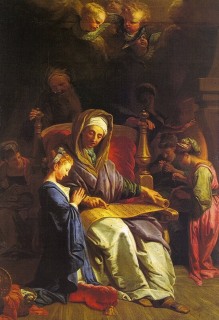
A statue of Ann and her daughter Mary is in the Jerusalem church. Ann is teaching her daughter at her side.
What is she teaching her? Some statues show her teaching Mary the scriptures, but I’ve seen a statue, like the one below, showing Ann teaching her the ABCs and numbers. That’s what parents and grandparents do, isn’t it? They teach children life’s basics: how to live and how to pray.
Cathedral, Tegucigalpa, Honduras
Still true today. We put the little statue below of the two of them under our chapel altar for the novena. Parents and grandparents, the next generation is at your side. Ann and Joachim pray for us; show us the way.
In my part of the world, novenas to Saint Ann have begun in churches and dioceses, like Scranton, PA. Where did the story of Saint Ann come from? From earliest times Christians wondered who the parents of Mary were and, as you would expect, that interest was particularly strong in Palestine. Ann and Joachim were first honored there as the mother and father of Mary, the mother of Jesus Christ.
Around the year 550, a church in her honor was built in Jerusalem on the site where her home was said to be, near the Pool of Bethesda, where Jesus cured the paralyzed man. Since then, many churches honoring Ann and Joachim have been built throughout the Christian world; The saints appear frequently in Christian art.
Feasts of St. Ann
Feasts honoring Mary’s birth (September 8) and her presentation in the temple (November 21) – inspired by the Protoevangelium– were introduced into the liturgies of the Eastern churches in the 6th century. Feasts in honor of St.Joachim and Ann (September 9), the conception of St Ann (December 9), and St.Ann alone (July 26) have been celebrated from the 7th century in the Greek and Russian churches.
The western church, adopting the eastern traditions, has celebrated the feast of St. Ann on July 26 since the 16th century. In 1969 her feast was joined with her husband Joachim to become the Feast of Saints Joachim and Ann.
Why was the story of Ann and Joachim so popular? Besides satisfying curiosity about the family background of Mary and Jesus, they supported traditional belief that Jesus is the Son of God, born of the Virgin Mary, a belief questioned by heretical elements in the church as well as outsiders of the faith from the beginning.
Ann and Joachim also offered inspiration to mothers and fathers, wives and husbands, grandmothers and grandfathers in their roles in family life.
Devotion to St. Ann in Europe
In the western church, devotion to St.Ann was fed by a popular belief that relics of her were brought to France by Mary Magdalen, Lazarus, Martha, and other friends of Jesus who crossed the stormy sea from Palestine to bring the Christian faith to the region around Marseilles.
Her relics were buried in a cave under the church of St.Mary in the city of Apt by its bishop, St. Auspice, the story goes. Barbarians invaded the area and the cave was filled with debris and almost forgotten, only to be unearthed 600 years later during the reign of Charlemagne. You can see why sailors and miners would be devoted to St. Ann.
Crusaders from Europe – many from France – went to the Holy Land in the 11th century, and they rebuilt the ancient church of St. Ann in Jerusalem. The date the crusader church was consecrated, July 26, is the day we celebrate the feast of Joachim and Ann in the western church today.
By the 14th century, devotion to St. Ann was on the rise throughout Europe as the Black Death struck the continent and raged everywhere for over 150 years, wiping out almost 30 percent of its population. Families bore the brunt of the catastrophe as they tended their sick and cared for the healthy.
They needed models like Mary and Joseph, Ann and Joachim, who supported their child and grandchild. Mothers and grandmothers were particularly important for raising children.
When the plague ended, Europe’s population expanded dramatically in the late 15th and 16th centuries; new towns and cities sprang up everywhere and families were uprooted from places and people familiar to them. Families needed help to stay together and survive.
Faith suggested Mary and Joseph, Ann and Joachim as models to be imitated. Images of the nursing Madonna and the caring grandparents became important sources of Christian inspiration.
Christians joined Confraternities of St. Ann, dedicated to caring for widows, orphans and families under stress. Images of Mary and Ann, nursing their children, playing with the Christ Child and/or John the Baptist were more than pious pictures; they had a social purpose as well.
One picture from this era, still popular today, portrays St. Ann teaching her little daughter how to read. Sometimes the words on the book are words of scripture; sometimes they’re basic numbers or letters of the alphabet: 1,2,3,4-A,B,C.
Playing with children, teaching them the ABC’s, passing on the mysteries of God to them are vital actions. Simple as they may seem, they’re holy actions and they can make those who do them saints.
To be a saint doesn’t mean you’re perfect, Pope Francis says in his exhortation “Gaudete et exsultate“, on holiness in today’s world. That’s good to remember when we consider St.Cyril of Alexandria, the 4th century bishop of Alexandria and doctor of the church, whose feast is today, June 26th.
If you read his online biography in Wikipedia–where many today look for information about saints – you’ll find that he was deeply involved in the messy partisan politics of his time, when Christians, Jews and pagans fought and schemed to control over Alexandria, the city then probably the most important city in the Roman empire. Some called him a “proud Pharaoh;” “ a monster” out to destroy the church, an impulsive, scheming bishop in a riotous city. The Wikipedia biography mainly sees him that way.
He was a saint, other biographies say. Why a saint? Well, Cyril was absorbed in understanding and defending the Incarnation of the Word of God. How did the Word of God come among us? Who was Jesus Christ? Pursuing that mystery defined Cyril during life. It was at the heart of things for him, and the voluminous collection of sermons, letters, commentaries and controversial essays he left bears out that interest.
He thought and wrote extensively about this mystery. The way he came to express it was used at the Council of Ephesus (431) and became the way we also express it in our prayers. Mary was the Mother of God. The One born of her was not simply another human being. Her Son was true God, who would be truly human and eventually die on the Cross. God “so loved the world” that he came among us as Mary’s Son.
What we see as “the totality” of Cyril’s life, his “life’s jouney”, the “overall meaning of his person”, to use the pope’s words, is not his involvement in the violent politics of his day. Yes, that was there. But his abiding quest was to know Jesus Christ.
“‘The Word was made flesh’ [John 1:14], can mean nothing else but that he became flesh and blood like ours; he made our body his own and came forth man from a woman, not casting off his existence as God, or his generation of God the Father, but in taking to himself flesh remaining what he was.
“This is the correct faith proclaimed everywhere. The holy teachers taught this and so they called the holy Virgin, the Mother of God, not as if the nature of the Word or his divinity began from the holy Virgin, but because that holy body with a rational soul, to which the Word, personally united, was born of her according to the flesh.”
— St. Cyril of Alexandria, First Letter to Nestorius
“When poisonous pride swells up in you, turn to the Eucharist; and that Bread, which is your God humbling and disguising himself, will teach you humility. When the fever of selfish greed rages in you, feed on this Bread; and you will learn generosity. When you feel the itch of intemperance, nourish yourself with the Flesh and Blood of Christ, who practiced heroic self-control during His earthly life, and you will become temperate. When you are lazy and sluggish about spiritual things, strengthen yourself with this heavenly Food; and you will grow fervent. Lastly, when you feel scorched by the fever of impurity, go to the banquet of the Angels; and the spotless Flesh of Christ will make you pure and chaste.”
Faith gives you life and calls you to a mission. That’s what it did for Mary, the mother of Jesus. Mary believed in the message of an angel at Nazareth. She welcomed the Son of God to be born of her, and he brought life to her and to the world.
He gave her a mission, Luke’s gospel says today. Mary set out “in haste” for the hill country of Judea to visit Elizabeth, the wife of Zechariah, who also was with child. Mary has a mission.
When Elizabeth heard Mary’s greeting, the infant leaped in her womb.” The infant who would be John the Baptist, leaped for joy, the gospel says.
Both of these women had exceptional faith. Mary, the younger woman, accepted what the angel asks, even as she questions how it will take place and the meaning of it all.
Elizabeth, the older woman, conceives with her husband, Zechariah. But she’s an old woman, pregnant with a child. However miraculous her pregnancy was, she must have felt fear and uncertainty for having a child in her old age. Like Mary, she must have asked, “How can this be?” “What does this all mean?”
Mary’s visit took those fears away from her. The child in Elizbeth’s womb leaped for joy. Elizabeth’s fears were turned into joy. Faith gives you life and sends you on a mission. Exceptional faith, in the case of Mary and Elizabeth led to exceptional missions.
In spite of what some people think, faith is not a burden that cripples you. Faith is a gift that empowers you. It takes you beyond your dreams and what you hope for.
“Blessed are you who believed,” Elizabeth says to Mary.
“You too, my people, are blessed,” comments St. Ambrose, “ you who have heard and who believe. Every soul that believes — that soul both conceives and gives birth to the Word of God and recognizes his works.
“Let the soul of Mary be in each one of you, to proclaim the greatness of the Lord. Let the spirit of Mary be in each one of you, to rejoice in God. According to the flesh only one woman can be the mother of Christ, but in the world of faith Christ is the fruit of all of us.”
As with Mary so with us, faith gives life and sends us on a mission..
The candles at Tenebrae lead to another reflection. The 15 candles stand for Jesus, his twelve apostles and the two disciples from Emmaus. As 14 candles are extinquished, we remember those who left him on Good Friday and fled.
Mary, the mother of Jesus, is not represented in the Tenebrae candles. She stood by his cross on Good Friday, but she is not among those our candles represent. Where did she go after his death and burial on Good Friday? Where was she on Holy Saturday?
She was among the women of Galilee who came up to the feast with Jesus. It’s likely they stayed in Bethany, the traditional place pilgrims from Galilee stayed. She must have been welcomed by the friends of Jesus, Mary, Martha and Lazarus. Did Lazarus, raised from the dead, offer her hope? Still, his death was so unlike that of her Son. He died of some sickness; Jesus was brutally put to death.
Would Mary have the same questions of God as Martha had of Jesus? Why? This was a day the piercing sword foretold by Simeon the temple struck most deeply into her heart. This was a day her faith was so fiercely tried.
In our calendars, Saturday is a day we remember Mary. We remember her today and ask her to pray that we may believe in the promises of Christ.
At the cross her station keeping, stood the mournful mother weeping, close to Jesus till the last.
Mark’s gospel today describes the arrival of Mary his mother and some of his relatives from Nazareth. (Mark 3: 32-35) They’re outside a house crowded with people gathered around Jesus, some looking to be cured, some to listen to what he has to say. Jesus and his disciples don’t even have time to eat, Mark says.
His family come because they want to take him home; some think he is out of his mind . (Mark 3:20-21) When people tell him ‘Your mother and your brothers and your sisters are outside asking for you.’ Jesus said to them in reply, ‘Who are my mother and my brothers?’ And looking around at those seated in the circle he said, ‘Here are my mother and my brothers. For whoever does the will of God is my brother and sister and mother.’” (Mark 3: 32-35)
Jesus sees people of faith as his family, his mother, brother and sister. He considers us who believe in him his family.
But we continue to ask: Why does his own family think he is out of his mind?
His mother Mary is with them. What does she think?
The gospels, Matthew 13:54-58, Mark 6: 1-6, Luke 4:16-30 all point to Nazareth as a place where Jesus is rejected. Luke’s gospel sees the rejection of Jesus at Nazareth in the harshest terms. They are ready to hurl him from the hill after the claims he makes in their synagogue. His visit to Nazareth is headed for violence, but a violence postponed, and no one takes his part. ( Luke 4:16-36 )
Mary lived there. What was it like for her? What was it like to be with family members who thought her son was mad? What was it like to be day after day with people who didn’t believe in her son? No one from Nazareth is among the 12 disciples Jesus chooses. The rejection of Jesus by the people of his own town, his own family and relatives, was a sword that pierced her heart.
We might say Mary’s faith was strong and kept her secure, but was it a faith that knew everything? Did it save her from questioning?
I wonder if we can see Mary’s appearance at Lourdes and Fatima in some way related to her own experience at Nazareth. She appears in places when the faith of ordinary people is severely challenged by a world increasingly hostile to belief.
She knows how to believe when everyone else does not. We welcome her today to be with us.






 The Victor's Place
