Tag Archives: Liturgy

After Thoughts: Liturgy of Seasons

Maurice de Vlaminck partie de campagne 1905

Maurice de Vlaminck, “La partie de campagne”, 1905

 .

Be still, and know that I am God.

—Psalm 46:11


.

Don’t move. If you do, you’ll burst into sweat.

This is when you know it’s hot. The slightest movement brings about spontaneous combustion.

God will have His way. If the cold wont get you to sit still in front of a fire, then the oppressive heat of summer will stop you in your tracks in the middle of an otherwise busy day.

That is until modern HVAC has its way.

So much progress. So much heating, ventilation and air-conditioning.

I wonder if we’d pay more attention to the Church calendar, more attention to prayer, more attention to God in general if we spent more time within His seasonal elements. I am fairly certain we’d spend a lot more time sitting still.

Yes, modern climate control may give us more time in many ways, but that certainly doesn’t imply that we spend that time well. For we are very weak, and most additional “freedom” most normally results in increased amounts of wasted, fruitless, and spiritually-empty activity.

Besides, voluntary sitting still is very different than forced stillness. Voluntary is certainly better—in terms of us using our freewill wisely, and in terms of us positioning ourselves to “know” God’s presence—but, on the other hand, when stillness is forced upon us, we actually might do it. We actually might stop, and we actually might be more concerned with “not moving” than just about anything else. That’s a funny consequence of truly compulsory conditions, when they come about through God’s perfectly ordained plan: The more we’re forced into something by factors greater and holier than ourselves, and the more we don’t resist but cooperate, the more we find ourselves desiring the consequences of the very conditions that were “forced upon us” in the first place.

When was the last time you had to sit still for any extended period of time in front of a fire in order to keep warm on a dangerously cold night, or sit extremely still in order to fend off the truly oppressive heat of a summer afternoon?

For that matter, forget the extreme cases, when was the last time you or I didn’t have a modern source of heating or cooling within a few steps on even moderately cool or warm days?

Most of us living within this culture and during this time are no longer very dependent upon “our sister Mother Earth” to force us into life changing ways. Yes, I know of course about the big storms and floods, the fires and earthquakes—the catastrophic natural events—but in terms of day-to-day living for the great majority of people in the Western world, daily climate is not something that cramps our modern, in-control-of-everything style. It is really quite ironic when we stop and think about it, for we hear so much about climate change, and yet most of us who may ponder that very question do so while comfortably residing within temperature-controlled homes, offices, and automobiles that make us almost oblivious to natural and seasonal weather changes.

Don’t get me wrong, I’m not suggesting that we should collectively trash our heating or a/c units and move back into the pre-HVAC age. I enjoy my heating, ventilation, and air-conditioning as much as my Middle-Eastern and Central-American neighbors living next door.

It’s just that I was forced into thinking about this. You see, my daughter is off from school and busy playing and making the “noises” that accompany such joy, and my wife is currently a busy little bee, walking in and out of each room, cleaning, straitening, and unpacking the laundry. I had little choice but to leave the house to get a few undisturbed moments of quiet. So here I am behind an urban two-family home, sitting within a somewhat screened-in gazeebo on a blacktopped driveway, trying not to move.

I thank God for allowing me to sweat. For reminding me of just how much I cannot control. For reminding me that exterior stillness and interior peace, although connected, are not one and the same. I also thank Him for allowing me to forget for the time being just how sensitive my feet, especially the first few toes of my left foot, are to the cold.

And now that I think about it, now that I have begun to give thanks, I’m realizing that it’s really not that bad. It’s not that hot. It’s kind of nice in fact. And I definitely notice that it has kept my writing in check. The word count of this piece has most surely been stunted, and I am very, very certain that that is for the best. I think I’ll leave it here then and wrap it up. And afterward, I’ll spend some time doing just about nothing, allowing the heat to box me in and keep me comfortably quiet.

I must admit though, I feel a bit guilty, knowing that it won’t be too long before I walk back into a climate controlled, air-conditioned environment—that is once the mosquitos begin to bite (thank God for screens!).

But maybe that’s just the point.

God’s will has its way.

His seasons, His entire world, always speaks to us.

His Liturgy never ends.

The Liturgy of Seasons cannot be stopped.


Happy Monday of the 15th week in Ordinary Time!

(Year: C(II). Psalter: Week 3. Liturgical Color: White. Memorial: St. Benedict.)

(Monday, July 11, 2016.)

(Hot. Humid. Partial Sunshine. Very Slight Chance of Thunderstorm.)

(Sunset 8:28 PM. Moon: Waxing Crescent, Illumination: 45%.)

.

.

—Howard Hain

.
Friday Thoughts: Walled Garden (2)

(Please note: This is part 2 of a piece entitled “Walled Garden”. To read part 1, simply click here: Friday Thoughts: Walled Garden (1))


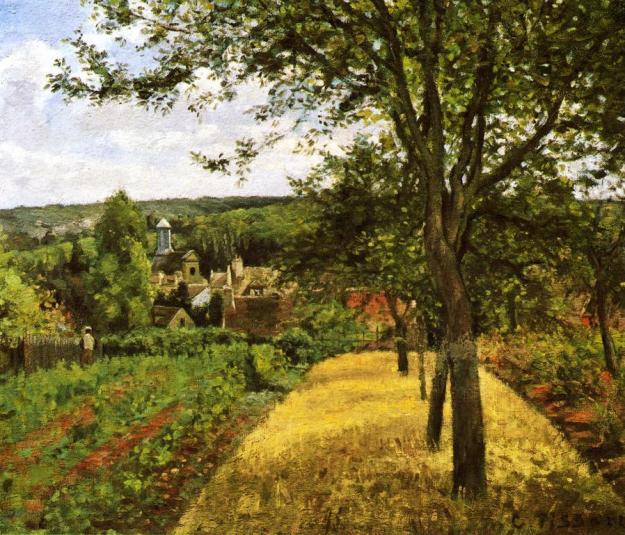
pissarro orchards at louveciennes 1872

Camille Pissarro, “Orchards at Louveciennes”, 1872

.

And from that hour the disciple took her into his home.

—John 19:27


.
On leaving the convent I came upon the friar I noticed on my way in. The little dog was no longer around. We approached each other as if we had met before. He was kind. He was middle-aged. He was simple. And then the strangest thing occurred. He took me by the arm, the way men stroll in Italy, arm-in-arm, during the evening passeggiata—the evening stroll.

But I had never met this man before.

Yes, it is certainly strange to have an unknown man approach you and link his arm in yours.

He led me toward a dirt path. We strolled. We spoke little. He didn’t speak English and my Italian was tiny. But it was nice. Peaceful. It didn’t feel strange. I only now use that word, for from a somewhat forced “objective” perspective, it seems that it had to be.

He was a man of God. And he saw I was too, before I had any idea God had undeservedly entrusted me with such a gift. The gift of loving God. The gift of wanting Him more than I could ever explain. The gift of being an outcast here in this world of time, a wanderer, a pilgrim, a crusading knight of Lady Poverty—of being—in yet again, some strange kind of way—a lady-in-waiting—patiently and painfully anticipating the exuberant arrival of the one and only eternal groom.


.

He brought me to what appeared to be an old foundation. I understood from what few words we exchanged that this was the remains of an abandoned orphanage. And then we began to head back toward whence we came. I remember offering him some bread that I had in my bag, purchased that morning in the city of Assisi up above. He lightly touched his stomach with one hand and shook his head “no”—a kind, polite, gracious, and utterly grateful, “no-thank-you” kind of “no”.

When we arrived at the door of the convent I understood from his gestures that he was inviting me to see something inside. It was clearly something that I had not yet seen. I motioned “yes” and we entered. We climbed a staircase and walked down a hallway. We were in an area not open to the public. The walls revealed its age. And we approached a door. A wooden door. And he unlocked it with an old large skeleton key. He opened the door and motioned for me to go inside, quietly informing me that this is Saint Clare’s cell. I entered and he remained outside. He gently pulled the door closed.

I wasn’t sure what to do. I was safe. I knew I wasn’t locked in. I was pleasantly confused. I looked around. It was small. It was literally a cell. Enclosed. All stone. A low tight arched ceiling. Bright. Dark. Cozy. Warm. Beautiful.

A tabernacle. A womb. A virgin’s womb.


At the end of the somewhat rectangular shaped room was a small alter-like shelf. I knelt before it. I have not the slightest recollection of what I prayed.  Of what I thought. Of anything spiritually taking place. I was just there. And I remained a few minutes. And then I left. I opened the door and I was all alone. No friar. I closed the door behind me and made my way back down from where I had come.

It seemed as if nothing extraordinary had happened. It was all so normal. So everyday. Yet it was nothing of the sort. It was extraordinary. It was an encounter. I think. Perhaps.


I think of little Mary. Alone in her room. I think of a gentle breeze and the sight of a bowing angel.

“Hail, full of grace…”

What a name, what a title to be given!

Gabriel holding the key that opens the door.

The young, chosen, highly-favored virgin agrees to hear his message, to walk arm-in-arm with him, to accompany him to she knows not where. She agrees to accept God’s invitation.

The Holy Spirit comes upon her simple life, her simple way, her simple manner.

The power of the Most High overshadows her daily existence.

Our Father confirms her trusting posture, her grace-filled instinct to utter the purest of prayers:

.

“Behold the handmaid of the Lord; be it done to me according to thy word.” (Luke 1:38)

.

Jesus entered a private, off-limits room. He made His home there.

And He never left.


.

“…when you pray, go to your inner room, close the door, and pray to your Father in secret…”

—Matthew 6:6


.

—Howard Hain

.

Morning Thoughts: A Simply Perfect Quilt

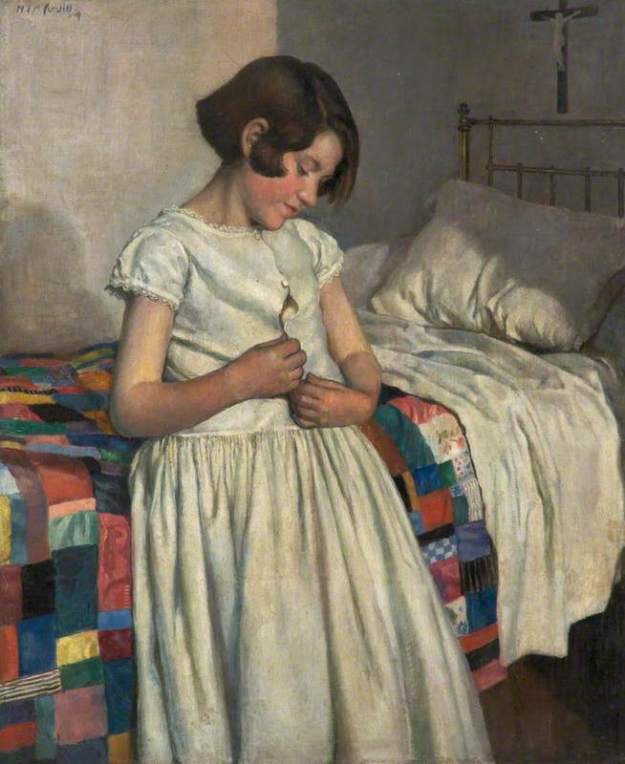
Cundell, Nora Lucy Mowbray, 1889-1948; The Patchwork Quilt

Nora Lucy Mowbray Cundell, “The Patchwork Quilt”, 1919

..

As nurslings, you shall be carried in her arms, and fondled in her lap; as a mother comforts her child, so will I comfort you; in Jerusalem you shall find your comfort.

—Isaiah 66:12-13.


.

I heard someone say the other day that Amish women leave their finished quilts imperfect, and that they do this purposely, so as not to commit blasphemy.

We hear lots of things. And like with most of what we hear, whether this or that is true or not, we quite often just don’t know—at least not in terms of earthly circumstance: what exactly was said, who exactly said it, or the exact context in which it was said. But also quite often, these factors simply don’t matter—at least not in terms of what we most need spiritually at that present moment.

To get caught up within the trivial details of who, what, where, and when is to lose a beautiful opportunity to receive correction, direction, encouragement, and inspiration. It is to miss a moment of grace.

God is always speaking to us. Always instructing. Always telling us what we need to hear. Even if His speech takes the form of a simple smile, or a simple piece of Amish lore. He is always right there with us, each one of us. One God. Three Persons. One clear, consistent, perfectly unified voice, continually encouraging us forward.

To me this is a beautiful case of the left hand knowing exactly what the right hand is doing. It is prophecy in real time. Moment by moment. Step by step. Stich by stich. Incremental inspiration. All toward a beautiful, comforting blanket composed entirely of grace. It is the Holy Spirit at work. It is Holy Spirit teaching.

———

We always get exactly what we need. But we must be willing to wear fleeces white as snow. For everywhere that Mary went, the lamb was sure to go.

Clean hands. Pure heart. Purity of intention.

Meekness. Humility. Docility to the Holy Spirit.

We must submit to Mother Church.

It is Simple. It is Holy. And Holy Simplicity simply results in simple, clear, straightforward answers.

And it gets simpler and simpler:

We simply hear what God says when we pray in the Holy Spirit and “worship in spirit and truth”. (John 4:24)

We simply become living, breathing manifestations of His glory when the Holy Spirit prays for and through us, when “the Spirit Himself intercedes for us with groans too deep for words“. (Romans 8:26)

And the Liturgy simply helps us to allow the Holy Spirit to do so.

———

For the Amish women don’t sew alone. God quilts too. His is simply perfect. Always. And to us it looks a lot like the Liturgy.

O the simple joy of being wrapped up tightly within it!

O the simple wonder of walking deeper into the Body of Christ each new day—into the greatest and most public prayer of the one, true, holy, catholic, and apostolic Church—The Holy Sacrifice of the Mass—with faith and hope and an ever-increasing expectation that we will “nurse“, “be satisfied” and “drink with delight” at the “abundant breasts” of Mother Church. (Isaiah 66:11)

We receive the comforting milk of Sacrament: of reconciliation, of sacrifice, of thanksgiving, of praise, of presence, of joy, of love…

We receive our physical nourishment, our spiritual inspiration, our mercy and forgiveness, our healing and peace, our much needed correction and instruction—and for breakfast and dessert—our daily share in The Cross.

We receive “our daily bread.”

And all are welcome.

The Church invites all, serves all, prays for all…

All of us—me, you, him, her, them, every single one of us—the entire patchwork of humanity—are always welcomed and always encouraged to turn more directly into the light of God’s face. The Face of Truth, of Mercy, of Justice, of Love…

All are always and truly welcome.

Welcome to walk in the clear, crisp, clean air of God’s ceaseless and abundant reality—a reality that never deceives, that never falsely promises imaginary pots of gold lying at the end of fanciful rainbows.

For rainbows are mere optical illusions. And all sin stems from and leads to delusion. Pure faith, on the other hand, rises above all images, whether they are real or those conjured up by Satan in his constant effort to pervert and deceive.

God’s promises are true. His kingdom is no illusion. Heaven is no empty pot of gold.

“…for on those you have rescued from slavery to sin you bestow eternal gladness.” (Collect, 14th Sunday in Ordinary Time, C)

All are welcome to truly come home.

Welcome to walk hand-in-hand with the Lord of the Garden:

“Wash, and be cleansed; remove the foulness of your actions from my sight.

Come, let us speak with one another, says the Lord.”

—Isaiah 1:16,18

———

Perhaps then our Amish lady friends have a good, sharp point. Maybe it is not that important to have things “just right”, exactly the way we will them to be. Maybe it is not about making everything “perfect” according to our own plans, nor about appeasing our every desire and inordinate appetite. Maybe, just maybe, happiness—true joy—resides in just the opposite.

Perhaps what makes a quilt simply “perfect” is that it is made with humble, patient, obedient hands. Grateful hands, quite aware of their own defects. Hands that need not be in constant control, nor constantly caressed.

And perhaps it is just those kinds of hands, the hands of poor humble handmaids, that simply remind us of the true purpose of a simple quilt—to keep us warm—warm enough to get us through—to get us through to the other side—to the other side of a long, dark, cold night.


.

She wrapped him in swaddling clothes and laid him in a manger, because there was no room for them in the inn. Now there were shepherds in that region living in the fields and keeping the night watch over their flock. The angel of the Lord appeared to them and the glory of the Lord shone around them, and they were struck with great fear.

—Luke 2:7-9


.

—Howard Hain

Friday Thoughts: Holding Christ’s Hand

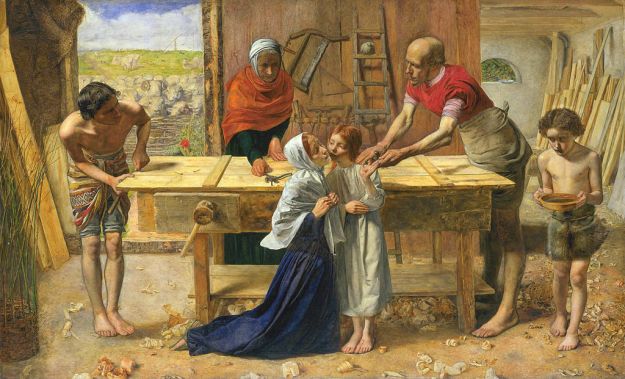
Christ in the House of His Parents by John Everett Millais 1849–50

John Everett Millais, “Christ in the House of His Parents”, 1849-50

.

“I am the way and the truth and the life. No one comes to the Father except through me.

—John 14:6


If we hold Christ’s hand we cannot get lost. For Christ is the way. It is not even possible to go astray.

If we cannot get lost, there can be no doubt. If no doubt, there can be no fear. If no fear—we are in the Kingdom of God. Right here. Right now.

Hold Christ’s Hand. Fear not. You are in the Kingdom of God.


—Howard Hain

.

Friday Thoughts: Walled Garden

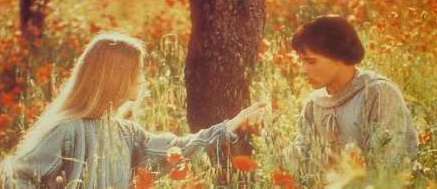
Francis and Clare from the movie Brother Sun, Sister Moon Franco Zeffirelli

Saint Francis and Saint Clare from the movie “Brother Sun, Sister Moon”, (Franco Zeffirelli) (1972)


.
A garden enclosed, my sister, my bride,
a garden enclosed, a fountain sealed!

—Song of Songs 4:12

.


.
From memory it is not easy to recall. I do have a clear image, but if it is accurate that remains to be seen. Here we go.

It was downhill. A sloping path. As I approached the stone church, a few people wandered around out front. There was somewhat of a courtyard, well not a courtyard, more like a little wall hugging into existence a welcoming space. This wall was about bench height, made also of stone, and extended outward from the building. It created what I would normally call an out-front patio space, but in Italian terms, perhaps it would be called a terrazza, or maybe even be considered a piazza, or perhaps most accurately, a piazzetta. Then again, maybe it is just a patio to Italians too.

Well, sitting on this low wall was a friar. And running around the open area was a small brown dog with a shaggy little beige beard.

I entered the church. It was small, almost cave like. A curved ceiling. Dark. Old. There was the cross, a crucifix. Not the actual one that spoke to Saint Francis—no, that one was moved up into the Basilica of Saint Clare located in the central part of the still small but no-longer medieval town of Assisi.

The reproduction spoke to me.

I’m an early companion of Francis.
.


.
I remained in the chapel for a while. I’m not sure if I was praying or not. I’m pretty sure I got on my knees. But from that day’s perspective, prayer was not known to me. So from that perspective, I wasn’t praying. But from today’s perspective, I most certainly was. For I was there. I was in Italy, in Assisi, in the Church of San Damiano. I was there intentionally. I was lost but I was found. I was looking, and I was obeying. Obeying what I didn’t know. I had no idea why, but I wanted to be there. And I felt something. It was heavy, literally. I remember feeling bent over. I remember thinking about all the prayer that must have taken place in that small space over the past thousand years. I remember thinking that all that collective belief must have an effect. It did. It does. It will. I was certain that I felt it. It bowed me down. It bent me over. And I remember liking it.

Faith is common.

I was a pilgrim and didn’t know it.
.


.

I don’t remember much about the convent itself. I do remember walking from room to room, the communal rooms where Saint Clare and her companions, her biological mother and two sisters among them, ate and prayed and cared for their sick. I remember the small warm inner garden, with it’s old well. And the spot marked as the place where Clare liked best to sit. I’ve always loved internal courtyards. The thought of being outdoors and yet enclosed. Architecturally, it best represents the beauty of true solitude. Open. Yet safe. Free. Yet sheltered. Alone. Yet surrounded by those who believe the same.

In that sense, solitude—when it’s truly interior, truly spiritual—is like love: you can never get enough of it, and once you have it, once you truly live within it, you’re never again alone.

Solitude is love. And love is never solitary.
.


.

Therefore the Lord himself shall give you a sign. Behold a virgin shall conceive, and bear a son, and his name shall be called Emmanuel.

—Isaiah 7:14

.

.

—Howard Hain

Morning Thoughts: The Clown of God

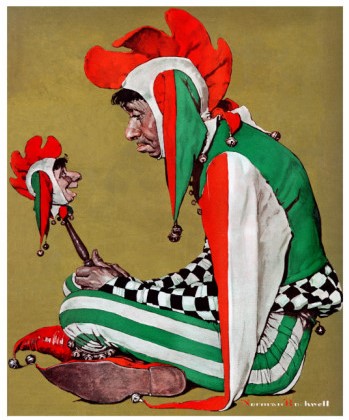
norman-rockwell-jester-february-11-1939

Norman Rockwell, “The Jester”, 1939

.

“Alas, poor Yorick! I knew him, Horatio, a fellow of infinite jest, of most excellent fancy.”

—William Shakespeare, Hamlet: Act 5, scene 1

.


.

Early this morning, Francesca and I had a good laugh.

The sun was up, we were not. We were out late a few days ago. On Saturday night we visited a friend’s home and didn’t get to bed until after 11. That’s pretty late for all of three of us, but for Francesca, from her six-year-old perspective, it was “almost the next day!”

So this morning, the Monday of a new week, we found the consequences of that shortened Saturday-night sleep still catching up with us.

Francesca had made her way from her bedroom to the couch I guess around five. I sat up just about half past, the sun fully making its presence known, and as I looked toward the couch I saw Francesca propped against some pillows, cuddled up in the corner, eyes open, but still quite in sleep mode. I walked toward the kitchen to hit the coffee button, and as I passed in front of the couch I broke into an overly-exaggerated stroll. As I disappeared into the kitchen I caught a peek of Francesca’s smile.

When I reentered her line of vision, just a handful of seconds after hitting the “on” button, she was sitting up straight, smiling broadly, and said quite adamantly: “Do it again.”

“Do what again?”, I smiled.

“Walk like that again!”, she immediately answered back, moving her little arms in a fashion somewhat like I hade moved mine.

“What are you talking about?”, I tried to say with a straight face as I walked the same way back across the room.

“Like that!”, she exclaimed, laughing and pointing at my arms.

And we were off and running, or should I say, “walking”. Over and over again, I would say: “What’s wrong with how I’m walking?”, and then she would point out what was “out-of-order” regarding my gait. Each time I would—with as much seriousness as I could muster— “correct” what she pointed out and then try again, this time adding yet another new “discrepancy”. One time I swung my arms wildly, another time I goose stepped, then I raised my knees too high, one round I walked “perfectly” but made funny noises with my mouth as I moved, and this went on and on, or I should say, we went on and on, and each and every time she was laughing more and more, getting more and more exasperated and adamant about what it was that I was not doing right.

“Just walk normal!”, she would laugh, and I would answer, “I am”, again and again. And then it got really funny. I could barely keep a straight face for even a few seconds. She herself began to illustrate how to properly walk, and seeing her trying to walk “normal”, which only resulted in her walking quite “un-normally”, only added to the Buster-Keaton type ridiculousness taking place in our tiny little living room. And all the while Laurie was just a few feet away still in bed, I wont say still asleep, because I have a hard time believing she could continue to snooze through all that ruckus.

But what really brought the house down was when I began to “really try” to walk right, listening intently to all her instructions, and painfully listing each one, and at the same time actually beginning to get confused. I had to think to myself for a second, “How is it that a person actually does just get up and walk?”. It is amazing what happens, what a mess we can make of things, when we try to understand and take control of what comes so naturally to us, of what comes so easily to almost all of mankind by the very nature of who we are, and seemingly without any effort or consciousness. But this little philosophical reflection didn’t stand a chance, Francesca was still on the scene and a child just wont permit, not even for a second, the antics of self-indulgent adult reflection to get in the way of a good time. She was focused on the action at hand, on the flow, from one act to the next, and she now had herself hysterical about the next and final slapstick scene in our not-so-silent film.

For you see, she discovered something in me that’s just priceless in her estimation. She loved the fact that I developed this little movement, quite unintentionally, as I “prepared” to try again to walk properly. I would kind of slightly waddle in place, lining up and squaring my feet, while at the same time slightly rotating my hips and shoulders, trying to position my feet, hips and shoulders just right. I guess I began to resemble a gymnast right before he launches the big run leading toward a long series of tumbles, or better yet, perhaps a diver in the Olympics right before leaping off the high board. Well, either way, this was more than Francesca could handle. She let out a true belly laugh, and then pointing wildly at my shoulders: “Daddy, do it again!”

At this, she jumped off the stool that she was now teetering upon, trying with all her might to mimic me. We both we’re beside ourselves with laughter. It was an absolute blast. It was creative chaos at its best. All heaven broke loose.

I hadn’t even had a sip of coffee yet. My morning prayers were still in a holding pattern. And then the thought came to me. A thought came to this continually under-occupied, perpetually unemployed forty-four-year-old man who just can’t seem to find his way in this world: “I should be a clown.”

I asked Francesca what she thought about my new career path. She loved the idea!

“Yes!!! Do it Daddy, do it!”

I decided to keep my prayers this morning to a few simple Our Fathers.

God was clearly praying for me since the moment I awoke.

The Spirit groans on our behalf, perhaps He laughs for us as well.

Prayer is prayer. This morning, Francesca’s laugh, and mine as well, was the peal of the morning bell—calling all the world to still attention—before the settling in of the business of another new day:

.

The Angel of the Lord declared unto Mary.

And she conceived by the Holy Spirit.

Hail Mary, full of grace…

.

.

—Howard Hain


Trinity Sunday


DSC00528

A story’s told that St. Augustine, the great philosopher and intellectual, was walking along the seashore one day when he saw a little boy playing in the sand, taking water from the sea in a small bucket and pouring it into a hole he had dug. Back the forth the boy went.

“What are you doing?” Augustine asked, “Do you think you can put the whole sea into that little hole?”

“No,” the little boy answered, “And neither can you put God into that small mind of yours no matter how smart you think you are.”

The story reminds us that our minds are limited before the mystery of God, even the smartest, most brilliant mind. God is beyond us. The Feast of the Holy Trinity is, first of all, a reminder of our limits before the mystery of God.

And yet, this feast also says that God invites us to know him, as Father, Son and Holy Spirit. As Father, God is the creator of heaven and earth. All creation ultimately comes from God’s hand. Creation itself is God’s gift;  through the created world we come to know God.

God has also invited us to known him in Jesus Christ, who was born of Mary over two thousand years ago, who walked this earth and died on a cross, who rose from the dead and remains with us.  We have his words, his actions, his promises. He’s our Savior and Redeemer, a sign of God’s love;  he’s promised us life eternal..

The Holy Spirit also is God with us, within us, guiding us and our world to our common destiny.

Yet, though God reveals himself, we’re still like the little boy on the seashore. We’re looking at an unmeasured sea that we approach with the little buckets of our minds. We can’t grasp it all. Even the most accessible person of the Trinity, Jesus Christ, remains a mystery to us.

Remember the story of the conversion of Paul the Apostle. Saui, the unbeliever, was on his way to the City of Damascus to persecute the followers of Jesus, when suddenly a blinding light throws him from his horse. “Who are you, Lord?” Paul cries out. “I am Jesus whom you persecute, “ the voice from the blinding light says.

Jesus Christ is like the blinding light of the sun. Yes, he is human like us, but he shares in the nature of God, who is brighter than sunlight. He blinds us when we try to see him. God dwells in light inaccessible, the scriptures say, and so even though we know much about Jesus, even though the scriptures and great saints and scholars describe him, he’s still beyond anything we can know.

Like the sun, Jesus is a blinding light, and yet, paradoxically, his light shines into the darkness of creation to give life and light.  St. John says: “No one has ever seen God. The only Son, God, who is at the Father’s side, has revealed him.” (John 1,18)

As people of faith we’re not like those who say you can’t know God at all or like those who say God doesn’t exist because my mind cannot grasp him. Yes, we have to admit that we are children of the Enlightenment, that movement in our western world that says there’s no need to pay much attention to God. Pay attention to the world at hand. Pay attention to yourself. That’s what’s important.

As people of faith we know God is important. God reveals himself to us little by little. God is the most important reality we can know and love.

The Feast of the Holy Trinity is a reminder of God’s invitation to know him, to serve him in this life, to pray to him and to be with him one day where we will know him much more. It’s an invitation God extends every day, all our lives. Father, Son and Holy Spirit.
.

Praying at Mass

IMG_1517

Catholics are not going to Mass as much as they did.  People are busy, of course. Some say they don’t get much out of it. Whatever the reasons, US Catholics aren’t going to Mass as they did before.

We have new texts for Mass, will they turn things around?  I don’t know. Better preaching? That would help. But there’s more. We need to look at the way we pray and participate at Mass.  The Mass is the central act of our faith, and we need to bring everything we have– our bodies, our minds, our memories, ourselves– to it.

We’re there to pray, from the moment we enter the church to the moment we leave. Only by praying at Mass will we appreciate it.

The way we pray at Mass is simple. It begins as we enter church and make the Sign of the Cross. It’s a key to a world of faith. Taking  holy water  we bless ourselves “In the Name of the Father and of the Son and of the Holy Spirit. Amen.” We are reminding ourselves  that we’re blessed by God with the gift of life and everything it means through Jesus Christ. Water is a sign of that life. 60% of the human body is made up of water, and so it’s a reminder we are being blessed by the God of life.

Water, like bread, is a sign of life.The signs of water and bread stand for the totality of blessings we receive , and we acknowledge our blessings and give thanks through them.

Jesus said “If anyone is thirsty come to me.” He also said “I am the bread of life.” As we make the Sign of the Cross,  we’re reminded we’re at the source of life now and of life everlasting, Jesus Christ. We’re blessed by his life, death and resurrection. We trace his sign on ourselves, on our foreheads, our hearts and our shoulders. We’re blessed in mind and heart and all our being.

So, as Mass begins, the priest leads us into this great  act of blessing and thanksgiving by inviting us to make the Sign of the Cross.

Notice we bless ourselves  a number of times at Mass besides its beginning.  We bless ourselves as the gospel is proclaimed, asking that our minds and hearts be blessed to hear God’s Word. We bless ourselves as we leave the church at the end of the Mass, because we carry God’s blessings to our world.

Besides the Sign of the Cross,  simple acclamations at Mass  draw us into this blessed mystery. So,  as the priest concludes a prayer or action, we often say “Amen” an ancient Hebrew word, which means “Yes” we agree. The “Amen” at Mass calls us into the blessing of God. Simple word like “Amen”  draw us to the prayer of the church.

“The Lord be with you.” “Lift up your hearts.” “Let us give thanks to the Lord our God.”

Listen carefully to those words and the readings, the songs and the music at Mass. Say them and mean them. Sing them when they’re sung, for“Someone who sings well prays twice.” So we join our voices in song. At Mass we pray together.

We pray with our eyes, too, as we see the actions and signs of Mass. Walking, kneeling, standing are prayers. Simple actions, like bowing and offering our hand to receive the Host are prayers. At Mass we pray with our whole being. Our walking, seeing, listening, speaking become acts of prayer that bring us into the presence of God.

Of course, we often come to Mass with a lot of things on our mind that distract us from this great mystery. So often we’re on overload. Our faith may not be the strongest. We have our doubts. We get sunk in the everydayness of our own lives.

But God’s grace is here in this great mystery and God will draw us–weak as we are–into this great mystery.  God will give us– all of us– the gift to pray and find blessings here. God draws us here to bless us.

Advent: The Season of Joy

https://www.youtube.com/watch?v=NbMImf0zo7s&feature=em-upload_owner%5B/embed%5D

Friday, First Week of Advent

  Readings:

Isaiah 29:17-24:  The deaf shall hear and the blind shall see.

Matthew 9:27-31:  Jesus gives two blind men sight.

Two blind men are among the many healed by Jesus in Matthew’s gospel. They’re healed together and they represent the blind who will see when the Messiah comes, Isaiah says.

Notice there are two of them, not one. Do the two blind men represent a collective blindness, a group blindness, perhaps a group prejudice against certain people, or a way of thinking that distorts how others are seen? Is it more than    physical blindness they share?  The cures Jesus worked touched more than the ills of body.

When John Newton, the former 18th century captain of an African slave ship, wrote the famous hymn “Amazing grace,” he said he “was blind, but now I see.” It wasn’t physical blindness he described. The tough seaman was converted on a voyage after reading Thomas a Kempis’ “The Imitation of Christ,” and gradually came to see the horrific evil of slavery as well as other vices he had fallen into.

In 1788 after years of debate over the issue in England, Prime Minister William Pitt formed a committee to investigate the slave trade which, until then, was largely seen by the nation as good for their country’s economic welfare. One of its star witnesses was John Newton who described in detail the slave trade and the horrendous practice it was.

This advent may Jesus bring light to our world, our nation, and our church. There are many things we don’t see.

What do you think they are?