Thanksgiving is a good time to remember our blessings, starting with Creation itself . I’m sure that was Noah’s prayer when God delivered him.
All-powerful God,
you are present in the whole universe
and in the smallest of your creatures.
You embrace with your tenderness all that is.
Pour out upon us the power of your love,
that we may protect life and beauty.
Fill us with peace, that we may live
as brothers and sisters, harming no one.
O God of the poor,
rescue the abandoned
and forgotten of this earth,
so precious in your eyes.
Bring healing to our lives,
that we may protect the world and not prey on it,
that we may sow beauty,
not pollution and destruction.
Touch the hearts
of those who look only for gain
at the expense of the poor and the earth.
Teach us to discover the worth of each thing,
We thank you for being with us each day.
Encourage us, we pray, as we struggle
for justice, love and peace.
Pooe Leo began an important conference in Rome October1 on the environment with that question posed by Pope Francis ten years ago in his letter Laudao si’.Looks like many of the countries of the world, especially the USA, are turning away from that question. We are absorbed in our wars and political fights.
“ Our Sister Earth cries out, pleading that we take another course. Never have we so hurt and mistreated our common home as we have in the last two hundred years. Yet we are called to be instruments of God our Father, so that our planet might be what he desired when he created it and correspond with his plan for peace, beauty and fullness.
The problem is that we still lack the culture needed to confront this crisis. We lack leadership capable of striking out on new paths and meeting the needs of the present with concern for all and without prejudice towards coming generations. The establishment of a legal framework which can set clear boundaries and ensure the protection of ecosystems has become indispensable; otherwise, the new power structures based on the techno-economic paradigm may overwhelm not only our politics but also freedom and justice.
It is remarkable how weak international political responses have been. The failure of global summits on the environment make it plain that our politics are subject to technology and finance. There are too many special interests, and economic interests easily end up trumping the common good and manipulating information so that their own plans will not be affected. Any genuine attempt by groups within society to introduce change is viewed as a nuisance based on romantic illusions or an obstacle to be circumvented.”
Pope Francis, Laudato SI 54-55
Today at the Vatican Gardens outside Rome evironmental leaders of the world gathered to answer that question: Are we caring for our common home?
One thing to notice about this conference, which involved artists,scientists, politicians, business people, ordinary people. Pope Leo sat among them, not before them, as if to signify their equal task in the care of the environment. They bring an equal wisdom to the challenge of caring for the earth. It’s not just the task of religious people, or a pope. It’s a common task for a common good.
We take for granted the ground we stand on. We live at 86-45 Edgerton Boulevard, Queens, Long Island, New York, USA, but the ground we stand on goes deeper than that.
The monastery we live in stands on the highest point of a spine of volcanic rock that goes back at least 400 million years, when the continent was being formed.
About 22,000 years ago the last glacier, the height of a skyscraper, came down from Canada and stopped here. Our monastery stands where the glacier stopped. As it receded and melted the glacier gave us the land we stand on now.
Southeast of us the glacier formed clay flatlands and sandy beaches facing the Atlantic Ocean. The winding depressions in our area, like Midland Parkway next to us, were streams from the glacier bringing sand and clay and rocks to the flatlands east of us.
North of us the last glacier left the waters that became Long Island Sound. The glaciers also left water in the aquifer that still provides drinking water for most of Long Island today.
About 12,000 years ago, the first humans arrived here. Small bands of Indians lived in settlements near streams and waterways where they fished and hunted for game.Then, we came here.
Pope Francis says in his encyclical Laudato Si that we need a long view of life for the days ahead, because we’re facing a world that will be radically transformed by climate change. To prepare, Pope Francis says, we need “an ecological conversion.”
That certainly means knowing more about the physical world we live in, so that we can understand it and care for it. Some say since the time of the Enlightenment in the 17th century we have concentrated too much on the human world and prioritized it too much. We’ve neglected creation and the ground we stand on.
That means also remembering that God created the heavens and the earth and God has a plan for the world. God must remain in the picture of the changing physical world, otherwise life becomes chaotic. We can’t depend on science alone.
Pope Francis, in Laudato Si, while accepting science and its findings, said that besides scientific knowledge, we should mine our own religious traditions for the wisdom and hope they give and he said to look at the Book of Genesis and our spiritual and sacramental traditions to face the future.
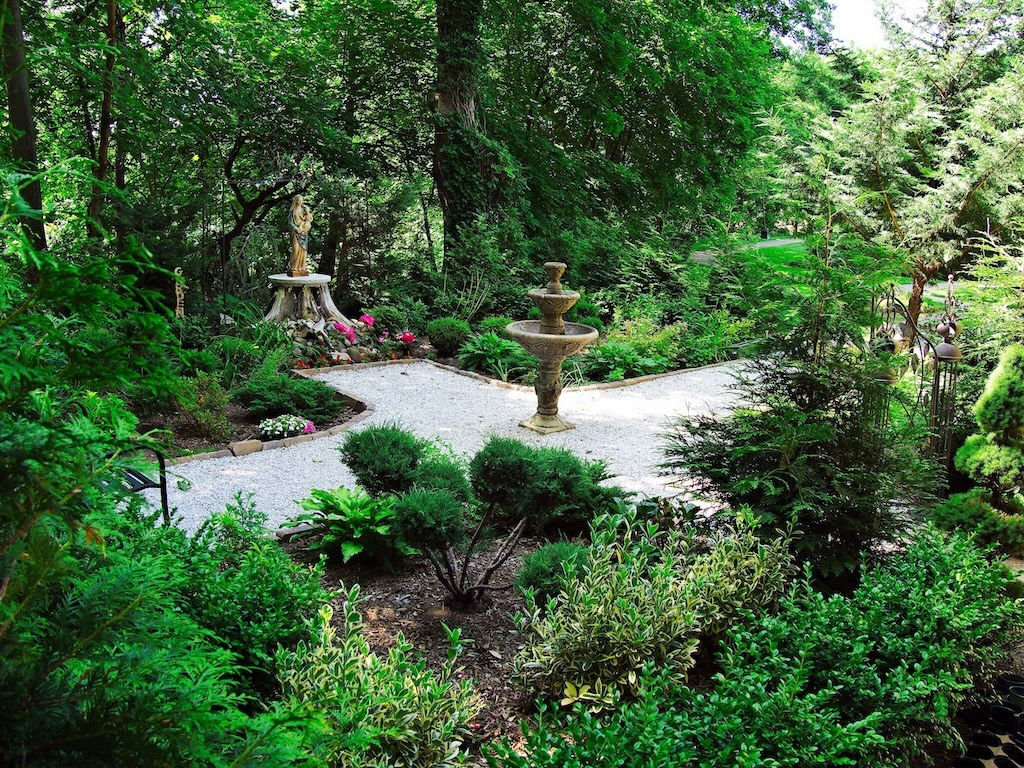
Our location here in Queens, particularly our garden, on the edge of a spine of volcanic rock, offers a valuable place for cosmic reflection. Our Mary Garden, based on the garden of Genesis, sees creation with eyes of faith and also with eyes of earthy experience. Water creates the garden, bringing life to everything else. Four rivers flow to the four corners of the earth. The plants in the four quadrants of the garden represent the staples of life– beauty, medicine and food.
Mary stands in our garden as the representative of redeemed humanity, holding in her arms Christ, the Redeemer. She rejoices in creation before her and presents the one, “through whom all things were made,” who blesses the world with hope. Mary also, as a witness to the resurrection of Jesus, knows he has promised a new heaven and a new earth. “Behold, I make all things new,”
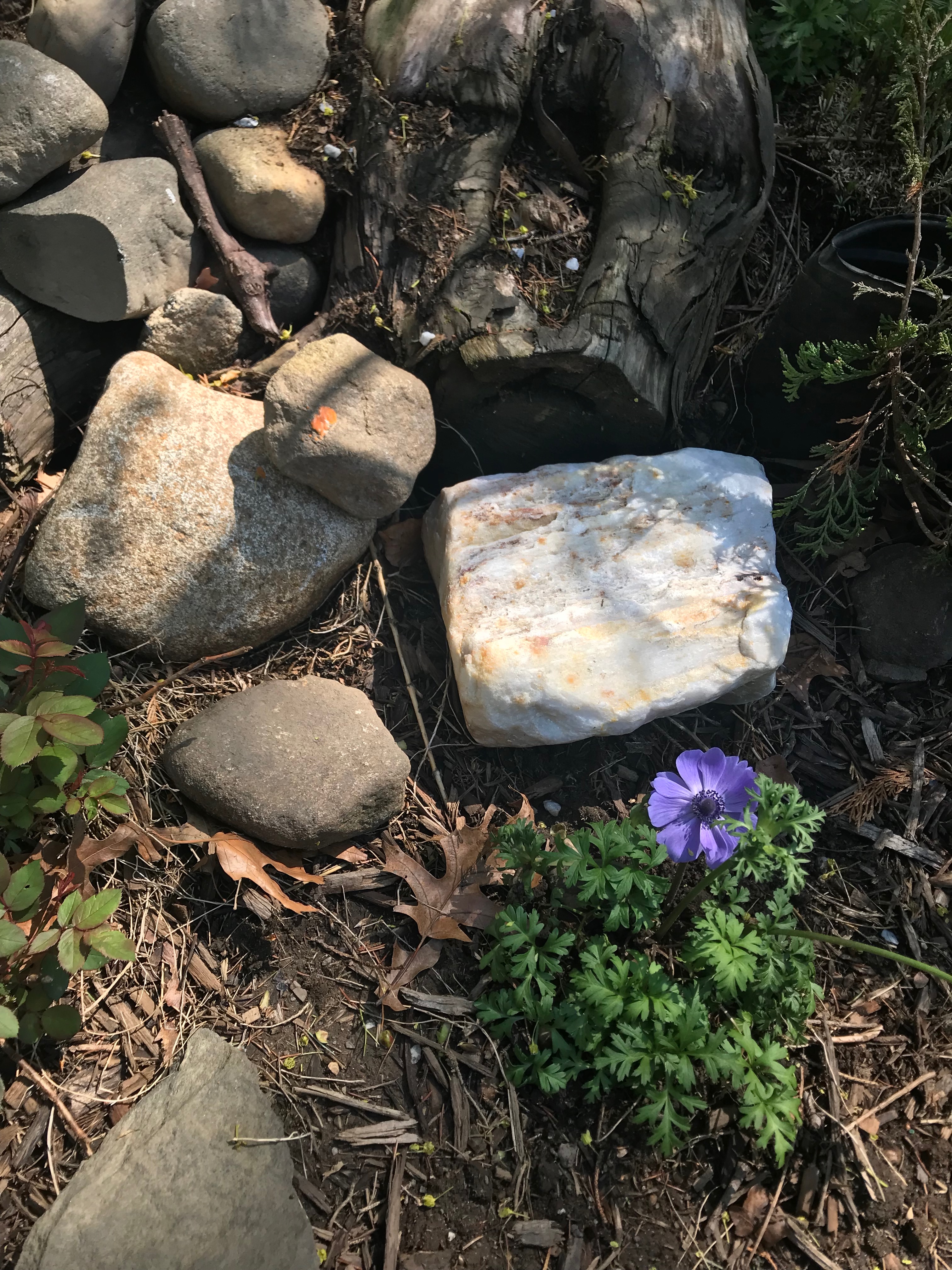
Mary’s statue stands on the stump of a large cedar tree, a tree whose roots reach deepest into the earth. At the base of the stump are rocks; most come from parts of our continent swept up by the ancient glacier and deposited here. We put some rocks from the Holy Land there, and a friend recently gave us a rock from Ireland to add to it.
The flowers in the Mary Garden bring the various colors and shapes of the world’s plant life here. Flowers are perhaps the most popular “immigrants” of the plant world, coming from everywhere, welcomed everywhere. Many of them, like the marigold, “Mary’s Gold”, are particularly associated with the Mother of Jesus.
Our Mary garden stands next to a grotto recalling Mary’s appearance at Lourdes in the 19th century when faith in France was eroding in an age of skepticism. Her appearances later at Fatima and the strong devotion to her that persists today remind us she is a permanent witness to Jesus Christ, who promised to remain with us “all days”, even days when the foundations of the earth are shaken. Mary’s a witness who comes when times are bad.
The concept of the Mary Garden developed in 13th century Europe when, during the “Black Death”, people believed a cursed earth caused millions to die. Today as the earth enters its own “passion” the Mary Garden offers a rich resource of Christian wisdom and hope for the days ahead.
Here’s a favorite picture of mine from the Staten Island Ferry. You say it’s a picture of the New York skyline? I say it’s a picture of water that gave birth to the city. True, isn’t it? The water was here first. The city came to be because water brought the world here, making the city a capitol of world trade and drawing millions of human beings to this place
Now look at it. The man who built the new World Trade Center claims it’s the tallest building in the country, challenging the heavens–like Babel.
Be careful, though, about challenging the heavens and forgetting about the earth. Be careful about the waters that brought you where you are. No fish or oysters here to eat now. Little space for the waters to go when they rise. And they will.
Don’t forget– the water was here first. It’s a “vision thing.” That’s what Pope Francis says in “Laudato si”.
This week’s readings from Genesis are good readings for improving our vision. In the weeks before we read from the Letter to the Hebrews, so you might say that from the heavens we’re now reflecting on the earth.
It’s good to reflect on creation, Genesis reminds us. God looks on what has been made and finds it good. Our account from Genesis today describes the creation of man (“man” here is a term for man and woman). Man is not immediately placed on the bare earth. No, he is placed in a garden where “various trees grow that were delightful to look at and good for food, with the tree of life in the middle of the garden and the tree of the knowledge of good and evil. “
Human beings, created by God, are called like God to find creation good. iThe Genesis account singles our the various trees that are delightful to look at and good for food, but all creation, from the sun and the stars to the simplest organisms, is to be looked at with delight.
We’ll read for two weeks in our lectionary from the Book of Genesis and then we’ll be reading from the Book of Sirach which continues the Genesis message. Learn the Lord’s wisdom from the sands on the seashore, from heaven’s heights and earth’s depths, Sirach teaches. Like the Book of Genesis, it tells us to learn from the world we live in.
The scriptures in our lectionary are not assigned arbitrarily. The compilers of our lectionary after Vatican II carefully planned the way our lectionary unfolds.
The land where Jesus lived spoke to him and inspired so many of his parables. The sea did too.
Jesus went out along the sea. All the crowd came to him and he taught them. As he passed by, he saw Levi, son of Alphaeus, sitting at the customs post. Jesus said to him, “Follow me.” And he got up and followed Jesus. (Mark 2:13)
From the Jordan where he heard his Father’s voice and the Spirit rested on him, Jesus went to Capernaum on the Sea of Galilee where he taught crowds and called disciples.
I remember looking quietly on the waters of the Sea of Galilee years ago on a visit.. At night a stillness centuries old takes over. The waters of the Jordan flow into it on their way to the Dead Sea. The river winds almost 200 miles from the Golan mountains in the north into the Sea of Galilee, then on to the Dead Sea in the south, a direct distance of about 60 miles. The river falls almost 3,000 feet on its way to the Dead Sea,.
.Jesus’ ministry began in the Jordan River. The waters spoke to him more strongly than they do to us today. The Jordan was sacred to the Jews from the time they miraculously crossed it on their way to the Promised Land. The great Jewish prophet Elijah came from a town near the river’s banks. Later he sought safety from his enemies there.
Elijah’s successor, the Prophet Elisha, also came from the Jordan. He told the Syrian general Namann to bathe in the river to be cured of his leprosy, and he was cured. Ancient hot springs near Tiberias on the Sea of Galilee still witness to the river’s curative powers.
At the time of Jesus, the river’s fresh flowing waters were the life-blood of the land, making the Sea of Galilee teem with fish and the plains along its banks fertile for agriculture. Pilgrims from Galilee followed the Jordan on their way to Jericho and then to Jerusalem and its temple. The river always spoke of life.
The Jordan Today
The river is still life to the region. It’s the primary source of its drinking water and crucial for its agriculture. Its water is a major point of controversy today between Israel and its Arab neighbors.
Nourishing Prophets
The Jordan nourished prophets. Somewhere near Jericho John the Baptist preached to and baptized pilgrims going to the Holy City. The place– hardly a desert as we may think of it– offered enough food for survival, like the “ grass-hoppers and wild honey” John ate. It was also an uncultivated place that taught you to depend on what God provided.
Jesus taught this too. “I tell you do not worry about your life, what you will eat, or drink, or about your body, what you will wear… Your heavenly Father knows that you need them all.” (Mt 6, 25 ff) The desert was a place for learning to put worry aside and trust in the goodness of God.
Water is a sign of life. When Jesus entered the waters of the Jordan, he acknowledged his heavenly Father as the ultimate Source of Life, the creator of all things. Like the prophets Elijah and John the Baptist, Jesus remained in this wilderness near the water for forty days before his divine mission. He also baptized and taught there with his first disciples. He readied himself there to depend on God for everything.
The Jordan after Jesus
Later, when the Roman empire accepted Christianity in the 4th century, Christians came to the Jordan River in great numbers on Easter and on the Feast of the Epiphany to remember the One baptized there. They bathed in the sacred waters, and many took some of it home in small containers.
Early Christian pilgrims like Egeria, a nun from Gaul who came to the Holy Land around the year 415 AD, left an account of her visit to the Jordan where Jesus was baptized. Monks who settled near the river knew a place called Salim, near Jericho. The town, associated with the priest Melchisedech, was surrounded by fertile land with a revered spring that flowed into the Jordan close by. Here’s Egeria’s description:
“We came to a very beautiful fruit orchard, in the center of which the priest showed us a spring of the very purest and best water, which gives rise to a real stream. In front of the spring there is a sort of pool where it seems that St. John the Baptist administered baptism. Then the saintly priest said to us: ‘To this day this garden is known as the garden of St. John.’ There are many other brothers, holy monks coming from various places, who come to wash in that spring.
“The saintly priest also told us that even today all those who are to be baptized in this village, that is in the church of Melchisedech, are always baptized in this very spring at Easter; they return very early by candlelight with the clergy and the monks, singing psalms and antiphons; and all who have been baptized are led back early from the spring to the church of Melchisedech.”
A 19th Century Pilgrim at the Jordan
Christians in great numbers visited the Jordan River. Towards the end of the 19th century, an English vicar, Cunningham Geikie, described Christian pilgrims following the venerable tradition of visiting its waters.
“Holy water is traditionally carried away by ship masters visiting the river as pilgrims to sprinkle their ships before a voyage; and we are told that all pilgrims alike went into the water wearing a linen garment, which they sacredly preserved as a winding sheet to be wrapped around them at their death.
“The scene of the yearly bathing of pilgrims now is near the ford, about two miles above the Dead Sea, each sect having its own particular spot, which it fondly believes to be exactly where our Savior was baptized…
“Each Easter Monday thousands of pilgrims start, in a great caravan, from Jerusalem, under the protection of the Turkish government; a white flag and loud music going before them, while Turkish soldiers, with the green standard of the prophet, close the long procession. On the Greek Easter Monday, the same spectacle is repeated, four or five thousand pilgrims joining in the second caravan. Formerly the numbers going to the Jordan each year was much greater, from fifteen to twenty thousand….”(Cunningham Geikie, The Holy Land and the Bible,Vol 2, New York, 1890 pp 404-405)
The Jordan and Christian Baptism
Today, every Catholic parish church has its baptistery where the mystery of the baptism of Jesus is celebrated for new believers. Some eastern Christian churches call their baptisteries simply “the Jordan.”
Today the site of Jesus’ Baptism, according to archeologists, is in Jordanian territory at el-Maghtas, where a large church and pilgrim center has been built following excavations begun in 1996 by Jordanian archeologists. It is probably the “Bethany beyond the Jordan” mentioned in the New Testament where Jesus was baptized and John the Baptist preached.
The Jordan River offers its own commentary on the mystery of death and resurrection of Jesus, expressed in his baptism. At one end of the river is the Sea of Galilee brimming with life, and at the other end is the Dead Sea a symbol of death. The river holds these two realities together, and if we reverse its course we can see the gift God gives us through Jesus Christ.
Like him, we pass through the waters of baptism from death to life.
“What is theology?” asked Professor Andrea Florendo to a group of young Catholic Scholars in the Passionist Monastery Chapel.
“The study of God,” responded a sophomore brightly in the front row.
“Yes, and where does theology begin?” Professor Florendo continued. Looking at each of the young faces, she exclaimed, “In a garden!” Following the creation account in Genesis, the story of God and humankind unfolds in the Garden of Eden. Flowers, trees, rocks, soil, animals, sun, moon, sky, water, humans—the whole natural world—declare the glory of God. Prayer and liturgy burst forth among flowering plants and birdsong in God’s garden of paradise.
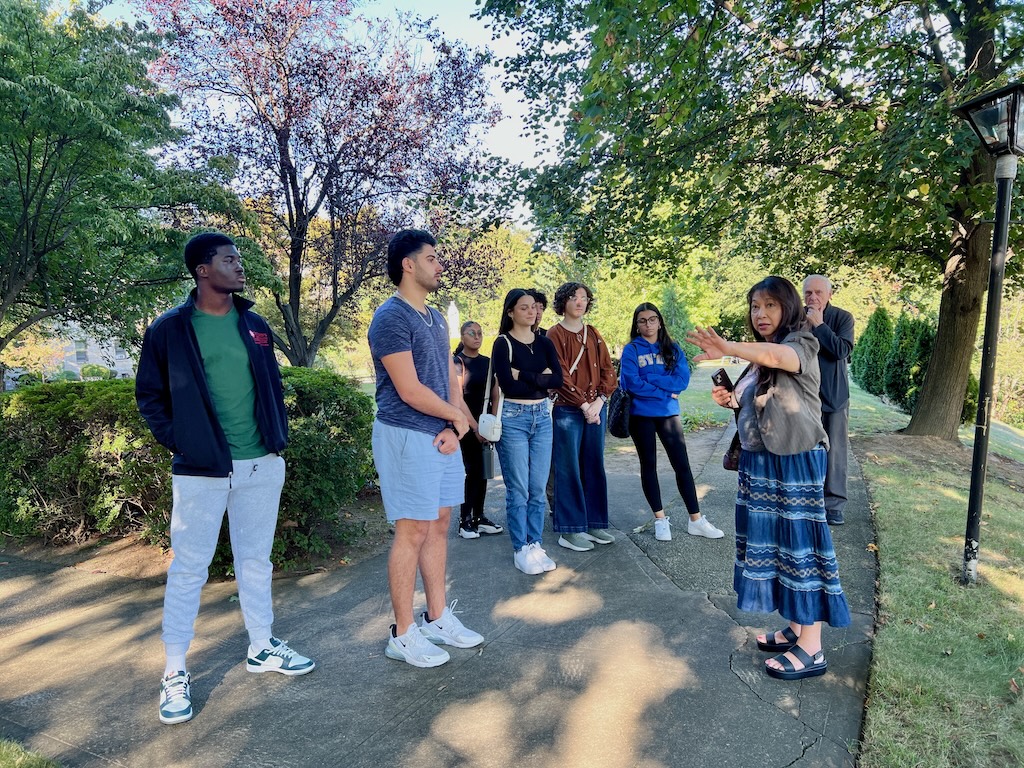
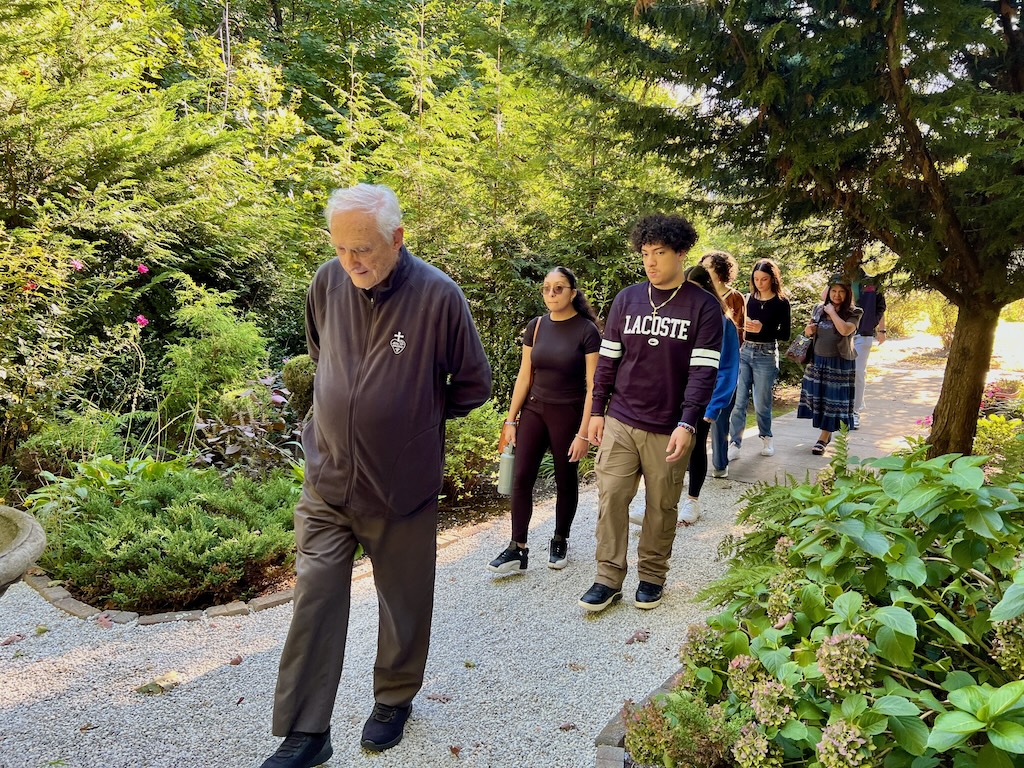
On Sunday, October 6, 2024, seven Catholic Scholars from St. John’s University visited the Mary Garden at the Passionist Monastery in Jamaica, NY. Fr. Victor Hoagland, C.P., Professor Andrea Florendo, and Gloria Chang, founders of the Mary Garden Guild at the Passionist Monastery, welcomed the students warmly.
Fr. Victor, who has traveled extensively throughout the world on pilgrimages and missions, shared the global Passionist charism with the Catholic Scholars, who are preparing for a life of faith-inspired leadership. The Passionists, who received their mission from St. Paul of the Cross to keep alive in the world the love of Jesus Crucified as seen in His Sacred Passion, have expanded their charism to include the care of creation as taught by Pope Francis in his encyclical Laudato Si. Inspired also by Fr. Thomas Berry, C.P. (1914-2009), a pioneer in ecology, the Passionists have redesigned their retreat center in Jamaica, NY, in his name.
Andrea Florendo, a retired theology professor at St. John’s University and designer of the Mary Garden, gave a tour, pointing out the significance of the enclosed garden as a symbol of Mary’s virginal womb, the fountain as Christ’s “fountain of living waters,” and the cross path as the four rivers in the Garden of Eden.
Our visit in the Mary Garden ended in praise and thanksgiving to God with prayers from Scripture and a reading from the Book of Genesis. May the Lord bless our Catholic Scholars abundantly with faith and grace as they continue their studies and formation at St. John’s University.
How great is your name, O Lord our God, through all the earth!
“Listen to the voice of creation” is the theme and invitation of this year’s Season of Creation. The ecumenical phase begins on 1 September with the World Day of Prayer for the Care of Creation, and concludes on 4 October with the feast of Saint Francis. It is a special time for all Christians to pray and work together to care for our common home. Originally inspired by the Ecumenical Patriarchate of Constantinople, this Season is an opportunity to cultivate our “ecological conversion”, a conversion encouraged by Saint John Paul II as a response to the “ecological catastrophe” predicted by Saint Paul VI back in 1970.
If we learn how to listen, we can hear in the voice of creation a kind of dissonance. On the one hand, we can hear a sweet song in praise of our beloved Creator; on the other, an anguished plea, lamenting our mistreatment of this our common home.
The sweet song of creation invites us to practise an “ecological spirituality” (Laudato Si’, 216), attentive to God’s presence in the natural world. It is a summons to base our spirituality on the “loving awareness that we are not disconnected from the rest of creatures, but joined in a splendid universal communion” (ibid., 220). For the followers of Christ in particular, this luminous experience reinforces our awareness that “all things came into being through him, and without him not one thing came into being” (Jn 1:3). In this Season of Creation, we pray once more in the great cathedral of creation, and revel in the “grandiose cosmic choir” made up of countless creatures, all singing the praises of God. Let us join Saint Francis of Assisi in singing: “Praise be to you, my Lord, for all your creatures” (cf. Canticle of Brother Sun). Let us join the psalmist in singing, “Let everything that breathes praise the Lord!” (Ps 150:6).
Tragically, that sweet song is accompanied by a cry of anguish. Or even better: a chorus of cries of anguish. In the first place, it is our sister, mother earth, who cries out. Prey to our consumerist excesses, she weeps and implores us to put an end to our abuses and to her destruction. Then too, there are all those different creatures who cry out. At the mercy of a “tyrannical anthropocentrism” (Laudato Si’, 68), completely at odds with Christ’s centrality in the work of creation, countless species are dying out and their hymns of praise silenced. There are also the poorest among us who are crying out. Exposed to the climate crisis, the poor feel even more gravely the impact of the drought, flooding, hurricanes and heat waves that are becoming ever more intense and frequent. Likewise, our brothers and sisters of the native peoples are crying out. As a result of predatory economic interests, their ancestral lands are being invaded and devastated on all sides, “provoking a cry that rises up to heaven” (Querida Amazonia, 9). Finally, there is the plea of our children. Feeling menaced by shortsighted and selfish actions, today’s young people are crying out, anxiously asking us adults to do everything possible to prevent, or at least limit, the collapse of our planet’s ecosystems.
Listening to these anguished cries, we must repent and modify our lifestyles and destructive systems. From its very first pages, the Gospel calls us to “repent, because the kingdom of heaven has come near” (Mt 3:2); it summons us to a new relationship with God, and also entails a different relationship with others and with creation. The present state of decay of our common home merits the same attention as other global challenges such as grave health crises and wars. “Living our vocation to be protectors of God’s handiwork is essential to a life of virtue; it is not an optional or a secondary aspect of our Christian experience” (Laudato Si’, 217).
As persons of faith, we feel ourselves even more responsible for acting each day in accordance with the summons to conversion. Nor is that summons simply individual: “the ecological conversion needed to bring about lasting change is also a community conversion” (ibid., 219). In this regard, commitment and action, in a spirit of maximum cooperation, is likewise demanded of the community of nations, especially in the meetings of the United Nations devoted to the environmental question.
The COP27 conference on climate change, to be held in Egypt in November 2022 represents the next opportunity for all to join in promoting the effective implementation of the Paris Agreement. For this reason too, I recently authorized the Holy See, in the name of and on behalf of the Vatican City State, to accede to the UN Framework Convention on Climate Change and the Paris Agreement, in the hope that the humanity of the 21st century “will be remembered for having generously shouldered its grave responsibilities” (ibid., 65). The effort to achieve the Paris goal of limiting temperature increase to 1.5°C is quite demanding; it calls for responsible cooperation between all nations in presenting climate plans or more ambitious nationally determined contributions in order to reduce to zero, as quickly as possible, net greenhouse gas emissions. This means “converting” models of consumption and production, as well as lifestyles, in a way more respectful of creation and the integral human development of all peoples, present and future, a development grounded in responsibility, prudence/precaution, solidarity, concern for the poor and for future generations. Underlying all this, there is need for a covenant between human beings and the environment, which, for us believers, is a mirror reflecting “the creative love of God, from whom we come and towards whom we are journeying”. The transition brought about by this conversion cannot neglect the demands of justice, especially for those workers who are most affected by the impact of climate change.
For its part, the COP15 summit on biodiversity, to be held in Canada in December, will offer to the goodwill of governments a significant opportunity to adopt a new multilateral agreement to halt the destruction of ecosystems and the extinction of species. According to the ancient wisdom of the Jubilee, we need to “remember, return, rest and restore”. In order to halt the further collapse of biodiversity, our God-given “network of life”, let us pray and urge nations to reach agreement on four key principles: 1. to construct a clear ethical basis for the changes needed to save biodiversity; 2. to combat the loss of biodiversity, to support conservation and cooperation, and to satisfy people’s needs in a sustainable way; 3. to promote global solidarity in light of the fact that biodiversity is a global common good demanding a shared commitment; and 4. to give priority to people in situations of vulnerability, including those most affected by the loss of biodiversity, such as indigenous peoples, the elderly and the young.
Let me repeat: “In the name of God, I ask the great extractive industries – mining, oil, forestry, real estate, agribusiness – to stop destroying forests, wetlands, and mountains, to stop polluting rivers and seas, to stop poisoning food and people”.
How can we fail to acknowledge the existence of an “ecological debt” (Laudato Si’, 51) incurred by the economically richer countries, who have polluted most in the last two centuries; this demands that they take more ambitious steps at COP27 and at COP15. In addition to determined action within their borders, this means keeping their promises of financial and technical support for the economically poorer nations, which are already experiencing most of the burden of the climate crisis. It would also be fitting to give urgent consideration to further financial support for the conservation of biodiversity. Even the economically less wealthy countries have significant albeit “diversified” responsibilities (cf. ibid., 52) in this regard; delay on the part of others can never justify our own failure to act. It is necessary for all of us to act decisively. For we are reaching “a breaking point” (cf. ibid., 61).
During this Season of Creation, let us pray that COP27 and COP15 can serve to unite the human family (cf. ibid., 13) in effectively confronting the double crisis of climate change and the reduction of biodiversity. Mindful of the exhortation of Saint Paul to rejoice with those who rejoice and to weep with those who weep (cf. Rom 12:15), let us weep with the anguished plea of creation. Let us hear that plea and respond to it with deeds, so that we and future generations can continue to rejoice in creation’s sweet song of life and hope.
Rome, Saint John Lateran, 16 July 2022, Memorial of Our Lady of Mount Carmel
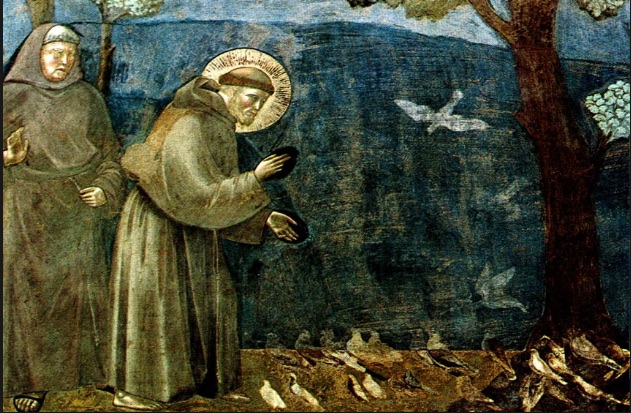
St. Francis is one of those super saints to keep in mind, even after his feast day. I mentioned in a previous blog the statue of Francis facing St. John Lateran and Pope Innocent’s dream of a young man who, like Francis, held up the church’s walls ready to fall. Francis helped renew the church.
In his encyclical Laudato Si, Pope Francis paints a verbal picture of Francis, holding his arms out to the created world, caring for our endangered planet:
“I believe that Saint Francis is the example par excellence of care for the vulnerable and of an integral ecology lived out joyfully and authentically. He is the patron saint of all who study and work in the area of ecology, and he is also much loved by non-Christians. He was particularly concerned for God’s creation and for the poor and outcast. He loved, and was deeply loved for his joy, his generous self-giving, his openheartedness. He was a mystic and a pilgrim who lived in simplicity and in wonderful harmony with God, with others, with nature and with himself. He shows us just how inseparable the bond is between concern for nature, justice for the poor, commitment to society, and interior peace.
“Francis helps us to see that an integral ecology calls for openness to categories which transcend the language of mathematics and biology, and take us to the heart of what it is to be human. Just as happens when we fall in love with someone, whenever he would gaze at the sun, the moon or the smallest of animals, he burst into song, drawing all other creatures into his praise. He communed with all creation, even preaching to the flowers, inviting them “to praise the Lord, just as if they were endowed with reason”.
“His response to the world around him was so much more than intellectual appreciation or economic calculus, for to him each and every creature was a sister united to him by bonds of affection. That is why he felt called to care for all that exists. His disciple Saint Bonaventure tells us that, “from a reflection on the primary source of all things, filled with even more abundant piety, he would call creatures, no matter how small, by the name of ‘brother’ or ‘sister’”. Such a conviction cannot be written off as naive romanticism, for it affects the choices which determine our behaviour.
“If we approach nature and the environment without this openness to awe and wonder, if we no longer speak the language of fraternity and beauty in our relationship with the world, our attitude will be that of masters, consumers, ruthless exploiters, unable to set limits on their immediate needs. By contrast, if we feel intimately united with all that exists, then sobriety and care will well up spontaneously. The poverty and austerity of Saint Francis were no mere veneer of asceticism, but something much more radical: a refusal to turn reality into an object simply to be used and controlled.
What is more, Saint Francis, faithful to Scripture, invites us to see nature as a magnificent book in which God speaks to us and grants us a glimpse of his infinite beauty and goodness. “Through the greatness and the beauty of creatures one comes to know by analogy their maker” (Wis 13:5); indeed, “his eternal power and divinity have been made known through his works since the creation of the world” (Rom 1:20). For this reason, Francis asked that part of the friary garden always be left untouched, so that wild flowers and herbs could grow there, and those who saw them could raise their minds to God, the Creator of such beauty. Rather than a problem to be solved, the world is a joyful mystery to be contemplated with gladness and praise.”
I like the pope’s words: “Rather than a problem to be solved, the world is a joyful mystery to be contemplated with gladness and praise.”
Thy will be done, on earth as it is in heaven. “This is not that God should do what he wills, but that we may be able to do what God wills,” St. Cyprian says in reflecting on this petition of the Our Father.
Weak as we are, we find it hard to know and to do God’s will, and so Jesus, “ showing the weakness of the humanity which he bore, said Father, if it is possible, let this cup pass from me, and showing his disciples an example, that they should do not their own will but God’s, he went on to say nevertheless, let it not be my will, but yours.”
Cyprian describes at length how we humans do God’s will: by dealing with others humbly, by holding steadily to our faith, by being just and merciful in what we do, by being moral in our lives.
But God’s will is to be done “on earth,’ we pray. Are only humans involved in doing God’s will, or is the earth itself involved in this petition?
The psalms call for the earth and all creation to “bless the Lord.” The earth itself is called to do God’s will. It has a place in God’s plan. Our responsibility is to discern what God’s will is for our earthly home and see that it is done.
Doing God’s will involves more than ourselves and human relationships. It extends to the earth as well. One of the points Pope Francis makes in Laudato sí.
We not preparing for the disasters brought by climate change, an article in USAToday by Rick Hampson says. “Will repeated exposures to vivid scenes of natural disaster–Western wildfires, a global heat wave, Hawaiian volcano eruptions, the 2017’s hurricane’s anniversary and a suddenly active 2018 season” prepare us to do something? “Experience counsels skepticism. So does human nature.”
“Experts say people aren’t really motivated by disaster until it come to, or through, their door.” Hampson writes.
We forget that “America, the Beautiful” is vulnerable to climate change as other parts of the world are, and our political system doesn’t help us face the change either. The earth doesn’t get to vote.
“Democracies are creatures of the present, because the public focuses on the here and now, not some future hypothetical problem… Our political system makes us vulnerable to distant crises, because we don’t try to anticipate or diffuse them.” (Robert J. Samuelson)
In a previous blog Pope Francis asks us to hear in the changing climate cries of “Our Sister, the earth” groaning from the abandonment and mistreatment received at our hands. Is Hurricane Florence a cry of creation?
“Save us, Lord, from becoming simply ‘creatures of the present.’ looking after ourselves. Let us hear our earth and sky and sea when they cry out from our abuse and lack of care. We ourselves are dust from the earth, we breathe her air and are refreshed by her waters. May we hear the cries of our Sister, the earth, and care for her.”









 The Victor's Place