Tag Archives: Job

World of Vapor

“World of Vapor”
A reflection on Ecclesiastes 1:1-11
©️2024 Gloria M. Chang

The words of the Preacher, the son of David, king in Jerusalem.
Vanity of vanities, says the Preacher,
vanity of vanities! All is vanity.

What does man gain by all the toil
at which he toils under the sun?

A generation goes, and a generation comes,
but the earth remains forever.

The sun rises, and the sun goes down,
and hastens to the place where it rises.

The wind blows to the south
and goes around to the north;
around and around goes the wind,
and on its circuits the wind returns.

All streams run to the sea,
but the sea is not full;
to the place where the streams flow,
there they flow again.

All things are full of weariness;
a man cannot utter it;
the eye is not satisfied with seeing,
nor the ear filled with hearing.

What has been is what will be,
and what has been done is what will be done,
and there is nothing new under the sun.

Is there a thing of which it is said,
“See, this is new”?
It has been already
in the ages before us.

There is no remembrance of former things,
nor will there be any remembrance
of later things yet to be
among those who come after.

Ecclesiastes 1:1-8 (ESV)

What is the Meaning of Life?

Qoheleth, the “Preacher,” writing in the name of Solomon, the son of David, wrestles with the absolute in the book of Ecclesiastes. The Hebrew word Qoheleth (from qahal, a root that means “assembly” or “congregation”) is Ekklesiastes in Greek, which names the book. Early traditions attribute the book’s authorship to Solomon, but philological evidence dates the book to no earlier than the mid-fifth century B.C., a half-millennium after Solomon’s reign. Thus, Qoheleth, a Hebrew sage, critiques the world through the eyes of King Solomon, the wisest, wealthiest, and most powerful man in the world. He investigates the patterns of nature and human striving, hoping to discover an ultimate purpose behind it all.  

World of Vapor

Qoheleth begins by lamenting that all is “vanity” (in Hebrew hebel, “vapor, breath”), which he pronounces five times in a single utterance (1:2). Finding no ultimate profit in the drudgery of human toil, he rhetorically asks, “What does man gain by all the toil at which he toils under the sun?”

Ephemeral phenomena and superficial impressions shift and slide incessantly “under the sun,” where nothing is constant. The rising and setting of the sun, and the circuitous currents of wind go “round and round” ceaselessly in a futile loop. The sea, too, like human ambition and appetite, never finds fulfillment despite continuous filling: “All streams run to the sea, but the sea is not full” (1:7). Jaded by familiarity, Qoheleth deplores the predictable motions of the earth.

“All things are full of weariness,” he despairs, “a man cannot utter it.” “The eye is not satisfied with seeing, nor the ear filled with hearing” (1:8). Ever restless, human desire insatiably consumes the panorama of sight and sound—representative of all sensory and intellectual stimuli. All impressions eventually evaporate like steam (hebel).

Nothing New Under the Sun

What has been is what will be,
and what has been done is what will be done,
and there is nothing new under the sun.

Is there a thing of which it is said,
“See, this is new”?
It has been already
in the ages before us.

Ecclesiastes 1:9-10 (ESV)

Ecclesiastes affirms the truism that “history repeats itself.” As civilizations rise and fall, human nature remains the same. War and peace, joy and sorrow, strength and weakness, freedom and slavery, profit and loss—the same old human affairs cycle round and round, generation after generation, world without end. A keen observer of human nature and historical recurrence, Qoheleth bleakly concludes, “There is nothing new under the sun.”

Puff of the Past

There is no remembrance of former things,
nor will there be any remembrance
of later things yet to be
among those who come after.

Ecclesiastes 1:11 (ESV)

As the sands of time fade away, so does human “remembrance of former things.” Stars and galaxies, fossils, and artifacts provide clues to the mystery of the 13.8 billion-year-old universe and human evolution. Yet billions of ancestors lie buried in the ground, forgotten by their descendants. Apart from cave paintings, oral traditions, scrolls, books, annals, chronicles, and even modern audiovisual media, which capture only fragments from limited perspectives, the past vanishes like vapor “under the sun.” Can fragmentary memories preserve an unbroken, unified recollection of the past? Can mortals achieve immortality in the minds of posterity? 

The Value of Struggle

Ecclesiastes challenges the assembly of wisdom seekers to find ultimate purpose and profit “under the sun.” Like Job, Qoheleth embraces disputation and wrestling with elemental questions. Sometimes described as “unorthodox,” these books goad the pious to “struggle with God,” the meaning of Israel’s name (Genesis 32:28). Questions do not threaten religion but expand its horizons. 

Without being an atheist, Qoheleth journeys to the edge of human striving to discover its peaks and valleys apart from God. His experiment confirms Paul’s observation that, on account of Adam’s departure from God’s will, “the creation was subjected to futility” (Romans 8:20; Genesis 3:17). The Greek word for futility, mataiotés (“vanity,” “emptiness”), translates the Hebrew word hebel (“vapor,” “breath”) in the Septuagint. Ecclesiastes allows every seeker of meaning to feel the emptiness of a life and vision that never rises above the sun. 

I have seen all things that are done under the sun, and behold, all is vanity and a chase after wind.

Ecclesiastes 1:14 (NABRE)

All is vanity, a chase after wind.
Series and cycles—these I examined.
Under the sun, seasons whirl like vapor.
What do humans gain by all their labor?


This content by Gloria M. Chang was originally published online at Shalom Snail: Journey to Wholeness.
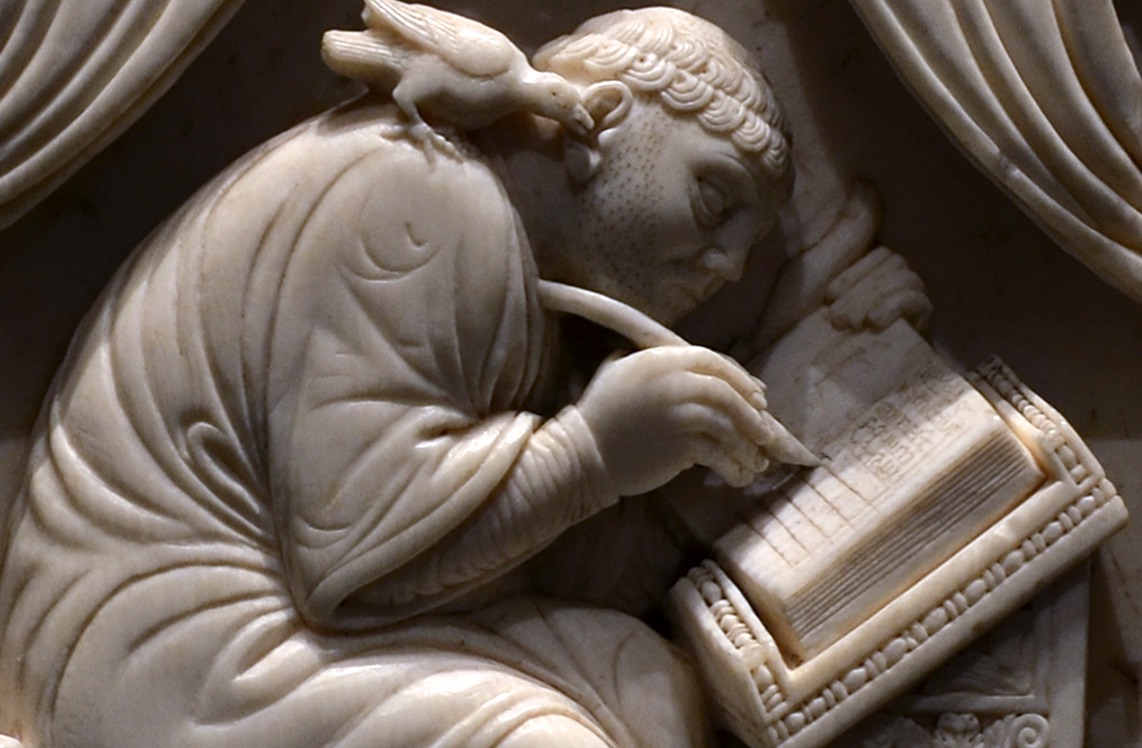
St. Gregory the Great, September 3


Gregory the Great

September 3rd is  the feast of St. Gregory the Great, many say the greatest of the popes. I’m sure he never thought of himself as great, he was too absorbed in the troubled times he lived in. Usually saints are recalled on the day of their death or martyrdom, but Gregory’s remembered the day he became pope, September 3, 590. That was a day of martyrdom for him.

Years ago, I lived across the street from Gregory’s home on the Celian Hill in Rome. On my way to school, I would peek through the ancient doors of the library of Pope Agapitus, a relative of Gregory’s, where archeologists were trying to learn about what was once the largest Christian library in Rome. Barbarian tribes later plundered the place on their regular sweeps through the city.

Those were bad times. Gregory was called from his monastery here on the Celian to become pope, but also to take charge of  a city under siege. He never was a healthy man and he never had much support. Most of Rome’s leading families fled to safer parts; the imperial government relocated in Milan. The burden of the city and the church fell on him.

Called to a job he didn’t want, Gregory drew wisdom and strength from the scriptures, especially from figures like Job and Paul the Apostle, who taught him that strength can come to weak “earthen vessels” like himself.

In his Commentary on Ezechiel, which we read in the Office of Readings, Gregory describes what he went through. Like Ezechiel, he was appointed a watchmen in the city, supposed to go up to the heights and see what’s coming, but “I’m not doing this very well, ” Gregory said.

“I do not preach as well as I should nor does my life follow the principles I preach so inadequately.
“I don’t deny my guilt, I get tired and negligent. Maybe by recognizing my failure I’ll win pardon from a sympathetic judge. When I lived in the monastery I was able to keep my tongue from idle topics and give my mind almost continually to prayer, but since taking on my shoulders the burden of pastoral care, I’m unable to keep recollected, with my mind on so many things.

“I have to consider questions affecting churches and monasteries and often I have to judge the lives and actions of individuals; I’m forced to take part in certain civil affairs, then I have to worry about barbarians attacking and wolves menacing the flock in my care; I have to do my political duty to support those who uphold the law; I have to put up patiently with thieves and then I have to confront them, in all charity.

“My mind is torn by all the things I have to think about. Then I have to put my mind on preaching. How can I do justice to this sacred ministry?

“Because of who I am I have to associate with all kinds of people and sometimes I say too much. But if I don’t talk to them the weaker kind of people wont come near me, and then we wont have them when we need them. So I have to listen to a lot of aimless chatter.

“But I’m also weak myself and I can get drawn into gossiping and then find myself saying the same things I didn’t care to listen to before.

“Who am I — what kind of watchman am I? I’m not standing on the heights, I’m in the depths of weakness. And yet the creator and redeemer of all can give me, unworthy though I am, the grace to see life as it is and power to speak effectively of it. It’s for love of him that I do not spare myself in preaching him.”

We have to admire Gregory, don’t we? He feels weak, but he’s a watchman looking out for his city and his church. Weakness doesn’t prevent him from serving or being far-sighted. From the Celian Hill Gregory sent monks to England, to the ends of the world, to found the church there. On his tomb in the Vatican is the simple inscription that describes him so well. “Servant of the servants of God.”

Today, Mother Theresa’s community lives on the land where Gregory’s home once was, on the Celian Hill, next to the ancient church of Saints John and Paul. They say Gregory took in 12 poor people for a meal almost every day. The poor are still taken care of where he once lived.

I hope to visit there in a few weeks.

The Patience of Job

I think the greatest of popes was Gregory the Great, who held the church together during Rome’s free fall into poverty in the 6th century. He kept his balance by reflecting on the scriptures, and one of his favorite books to reflect on was the Book of Job.  Here he is drawing on Job’s wisdom:

“Paul saw the riches of wisdom within himself though he himself was outwardly a corruptible body, which is why he says ‘We have this treasure in earthen vessels’. In Job, then, the earthenware vessel felt  gaping sores externally; while an interior treasure remained unchanged. The gaping outward wounds did not stop the treasure of wisdom within from welling up and uttering these holy and instructive words: ‘If we have received good at the hand of the Lord, shall we not receive evil?’ By the good he means the good things given by God, both temporal and eternal; by evil he means the blows he is suffering from in the present.”

Gregory quotes from Isaiah:

“‘I am the Lord, unrivalled,

I form the light and create the dark.

I make good fortune and create calamity,

it is I, the Lord, who do all this.’

“I form the light, and create the dark, because when the darkness of pain is created by blows from without, the light of the mind is kindled by instruction within.

‘I make good fortune and create calamity…’ Notice Job’s skill as he meets the arguments of his wife.If we have received good at the hand of the Lord, shall we not receive evil?’

 “It’s consoling, when we suffer afflictions, to remember our Maker’s gifts to us. Painful things will not depress us if we quickly remember also the gifts that we have been given. As Scripture says, ‘In the day of prosperity do not forget affliction, and in the day of affliction, do not forget prosperity.’”