Tag Archives: Jesus

The Kingdom of God is Coming, It’s Here: 25th Sunday

To listen to the audio for this week’s homily please select the audio slider below:

Matthew 20,1-19   25th Sunday A

The kingdom of God is coming, it’s here, Jesus says in the gospels. Often he describes the kingdom of God as a harvest, as he does in today’s gospel from Matthew. It’s an abundant harvest, bigger than you think. Pray that God’s kingdom come, he says to his disciples. Pray that it comes here on earth as in heaven. Don’t underestimate the kingdom, the harvest God sends.

It looks like the owner of the vineyard in our parable today has underestimated the size of his harvest. The first crew he sends out at 9 in the morning aren’t enough, so he calls more workers at noon, then 3 in the afternoon. At 5 in the afternoon he’s still adding to his workforce. Looks like he didn’t expect much.

That’s one of the first lessons to draw from the gospel. Don’t underestimate the power of God. Unfortunately, that’s what we do. We can expect too little from God. We forget that his kingdom will come on earth as it is in heaven. We think he has nothing or little to do with human affairs, or our world or the things here on earth.

The workers in the vineyard don’t seem to appreciate a big harvest either. They’re interested in something else– how much they’re getting paid and how much the other fellow is getting paid. The owner’s not fair, they say, because he pays the last workers the same as those who came first to work in the vineyard. They’re concerned with themselves, blinded as they are by envy and jealousy.

“Are you envious because I am generous,” the owner of the vineyard, who now seems to be a figure of God, says to them. Is this another lesson to draw from the parable? Envy and jealousy and measuring everything from our own perspective blinds us to God’s generosity. They blind us to the coming of God’s kingdom.

On his way through the towns of Galilee, Jesus announced the coming of the kingdom of God. He was bringing it to the world. It was an abundant harvest, yet even as he announced it, powerful voices were denying it was true. The scribes and Pharisees called him a false teacher, even his own disciples’ and his own family didn’t understand him. Still, he proclaimed God’s great kingdom. In the darkness of calvary he proclaimed it to a thief on a cross, and then he proclaimed it to his own disciples as he rose from the dead.

But let’s admit it, as we look at our world today we don’t see signs of a great harvest. Where is the harvest Jesus spoke of? Where is the kingdom of God. The kingdom of God seems far off, hardly here or ready to come. We’re living in a post-modern age, they say, when cynicism and questioning touch everything.

More than ever, we need to look at our world, not with our own eyes, but with the eyes of Jesus.

I like the story from John’s gospel describing Jesus meeting the Samaritan woman on his journey from Jerusalem to Galilee. It’s a hot afternoon; Jesus is tired and stops by a well to get a drink of water. It’s not a friendly place; the Samaritans don’t like the Jews and the Samaritan woman doesn’t like this Jew sitting at their well. But as they talk a new world appears, a light pierces the darkness and  the woman recognizes Jesus as the Messiah and calls the people of her town to see him.

“‘In four months the harvest will be here’”? Jesus says to his disciples, “ I tell you, look up and see the fields ripe for the harvest” He sees the kingdom of God coming in this small unexpected event. In the awakened faith of the woman before him, he sees the kingdom come.

That’s one of our greatest challenges today, to look up and see, in simple signs and in spite of everything, that the fields are ripe for the harvest. The kingdom of God has come.

20th Sunday A: Scraps from the Table

 For an audio of the homily:

My mother (God rest her) used to sneak food under the table regularly to her beloved cocker spaniel, Buffy. Sometimes, when I visited home after becoming a priest I’d say to her–in a losing attempt to keep Buffy’s weight down– “Mom, you shouldn’t feed that dog scraps from the table.”

She’d reply, “You don’t live here. Besides, I’m not feeding him scraps from the table. He’s eating the same food we eat.”

I could never understand the logic of her answer, but I gradually gave up trying to stop her. And I remember her every time I hear this gospel,

Jews and gentiles didn’t mix in Jesus’ time and as an observant Jew from Nazareth, Jesus usually avoided eating with them and entering their homes. After his baptism in the Jordan he saw himself sent first “to the lost sheep of the house of Israel.” But then, gentiles like the Roman centurion from Capernaum and this Canaanite woman from Tyre and Sidon came to him.

Matthew’s gospel says the woman was “calling out” to him from a distance, asking him to cure her daughter, but Jesus doesn’t answer. She keeps calling out in spite of his silence. “Send her away,” his disciples say, but the woman persists and even draws nearer.

“It’s not right to take the food of children and throw it to the dogs,” Jesus finally says. But the woman’s answer has a logic of its own. “Please Lord, even the dogs eat the scraps that come from their master’s table.” “ Let it be done for you as you wish,” he says and God fed her from the table.

Jesus’ answer to the woman sounds hard, doesn’t it? But sometimes doesn’t the silence of God seem just like that? A daughter’s sick, a wife is dying of cancer, a child is taken away so young. Is the woman calling out to Jesus an example that persistent prayer is always heard, even if God seems silent, even when God seems not to care?

Zacchaeus, Come Down

Zachaeus
We celebrate two days at the beginning of November that look beyond this world to the world to come: the Feast of All Saints and All Souls Day, November 1st and 2nd. The Feast of All Saints is not just a feast of canonized saints, like Mary the Mother of Jesus, Peter and Paul, Mother Teresa. It celebrates our belief that a great number– beyond counting according to St. John– are with God now. Each of us knows some good and faithful people who must be among them.

What about All Souls Day? I wonder if on that day we recognize there’s human weakness, as well as human goodness, in those God calls for judgment. They need God’s purifying mercy for their sins, their misuse of God’s gifts, their meanness, their lack of faith and hope and love. We know people like that too, maybe we can see ourselves in them.

The more important of these two November days is the Feast of All Saints, which proclaims the God’s mercy to be stronger than our sinfulness. It’s beyond what we expect. We hope and pray for it.

Our readings for this Sunday are about God’s mercy, a mercy that pursues us through this life and into the next. (Wisdom 11, 22-12,20) Our gospel story about the call of Zacchaeus is a special lesson in God’s mercy. Zacchaeus, the chief tax-collector in Jericho, is a wealthy man whom Jesus called down from a tree and then stayed in his house on his way to Jerusalem. (Luke 19, 1-10)

As Jericho’s chief-tax collector, Zacchaeus was an agent for Herod Antipas, the ruler of Galilee and Perea in Jesus’ day. Archeologists are still uncovering ruins of a good many of Herod’s building projects in Galilee and elsewhere. He built on a grand scale and he built lavishly, to impress his allies, the Romans.

Of course, you need money for his kind of building, and that’s where tax-collectors come in. There was no dialogue or voting on government spending then. Herod told his army of tax-collectors, “Here’s how much I need; you go out and get it. Go to the fishermen along the Sea of Galilee and the farmers near Nazareth and get what I need; I don’t care how you squeeze it out of them.” And the tax collectors went out and got him the money, and kept some for themselves.

You needed to be tough and relentless for the job. It had to leave you hard headed and hard hearted. People bitterly resented the tax collectors. Zacchaeus, chief tax collector in Jericho, led them all, and he was the one whom Jesus called down from a tree and stayed with on his way to Jerusalem.

The only words Jesus said to Zacchaeus, according to the gospel, are these: “Today salvation has come to this house because this man too is a descendant of Abraham. For the Son of Man has come to seek and to save what was lost.” No thunderous warnings or stern corrections. Jesus declares that salvation has come and they sit down for a feast. In this story you can hear echoes of the Parable of the Prodigal Son, also from Luke’s gospel.

Zacchaeus encountered the goodness and mercy of God in Jesus and it changed him. Goodness and mercy changes people. When we encounter the goodness and mercy of God we’re changed too.

We have to ask: Is God’s mercy a thing of the past, or limited only to this life? Will it also pursue us in death? Jesus will judge us at that moment. Will his judgment of us be like his judgment of Zacchaeus? When he calls us home, will he be merciful as he was to the tax-collector?

We see now in signs; we hear promises. Then we will see him face to face, and his goodness will change us, the sight of him will purify us.

God’s mercy pursues us, now in signs, then face to face. As we look upon the Bread come down from heaven at Mass we hear, “Behold, the Lamb of God, behold him who takes away the sins of the world. Happy are those who are called to his supper.” God’s mercy is proclaimed, as it was for Zacchaeus, at a supper.

Follow Me

Galilee shore

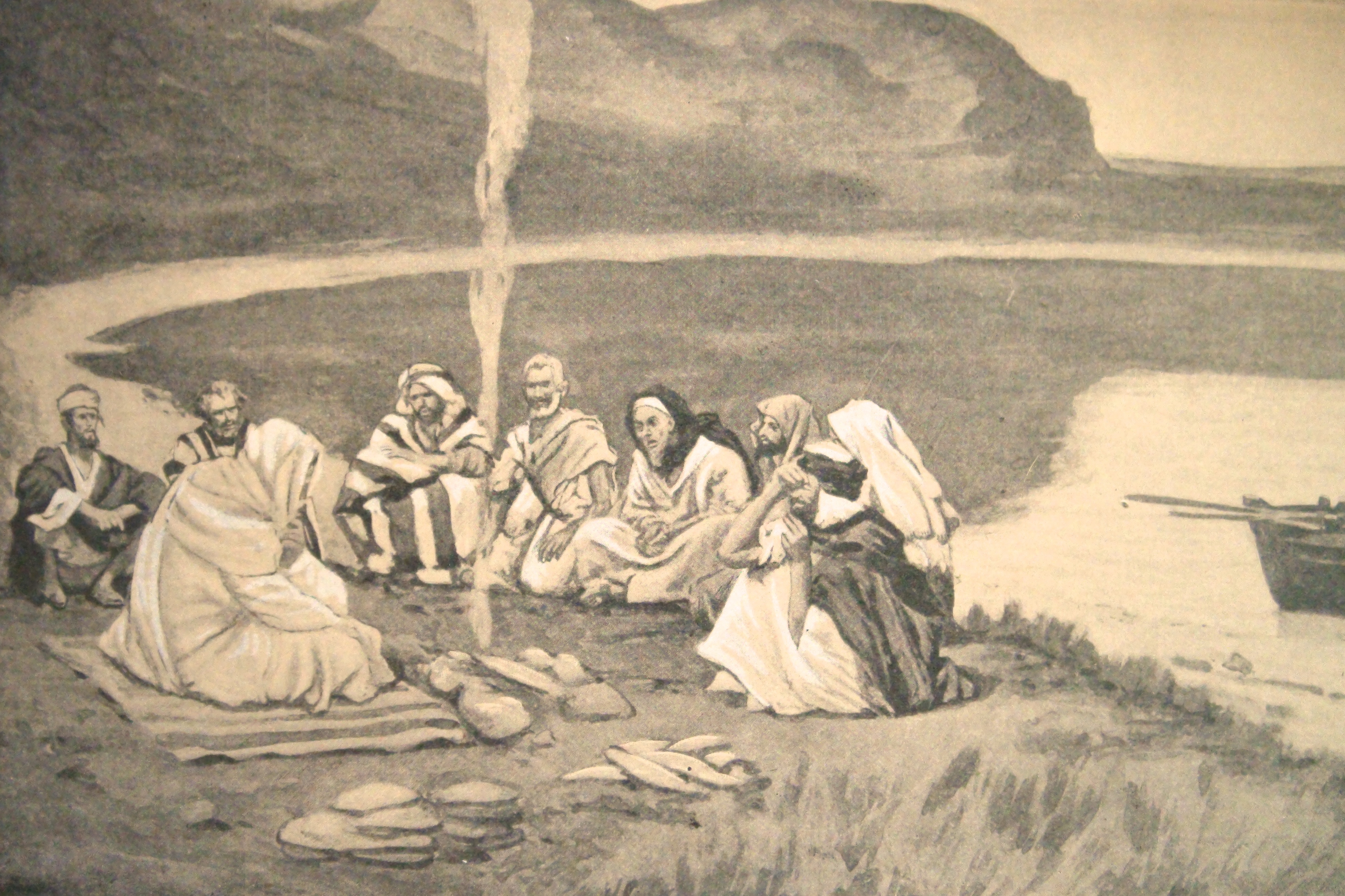
The gospel of John is read at Mass these last days before the Feast of Pentecost. We’re brought to the Sea of Galilee where the Lord first called Peter and John and others to follow him. Now, from the shore the Risen Jesus calls them again. They’ve fished all night and caught nothing. Not only are their boats empty; some days earlier in Jerusalem they deserted the One they promised to follow forever. Their spirits are empty.

From the shore Jesus tells them to cast their nets into the sea again and an abundant catch of fish pours into their boats. Calling them ashore, Jesus feeds them some loaves and fish. As he did in the supper room the night before he died, Jesus offers them his life-giving love.

Taking Peter aside, he asks the disciple who denied him three times “Do you love me?” “Yes, Lord, you know I love you,” Peter answers three times. “Feed my sheep,” Jesus tells him.

Then, renewing the invitation he made at this same shore at the beginning of his ministry, Jesus says to his disciple, “Follow me.”

The Feast of Pentecost is a feast for a church that has failed, for disciples facing their weakness and broken promises, for those who work and have nothing to show for it. The Holy Spirit, whom Jesus breathed upon the disciples after his resurrection, comes to our world as he promised, to renew the face of the earth. “Come follow me,” the life-giving Spirit says.

The Paralyzed Man

Let’s compare the paralyzed man at the pool at Bethesda, whom we hear about in today’s gospel, with the official in our previous story from John’s gospel. The official came to Jesus in Cana in Galilee looking for a cure for his son. Obviously, he was important. He knew how to get things done and came to get Jesus to do something for him. He’s a resourceful man.

The paralytic at Bethesda, on the other hand, seems utterly resourceless. For 38 years he’s come to a healing pool– archeologists identify its location near the present church of St. Anne in Jerusalem– and he can’t find a way into the water when it’s stirring. Paralyzed, too slow, he can’t even get anybody to help him. He doesn’t approach Jesus; Jesus approaches him, asking: “Do you want to be well?”

Instead of lowering him into the water, Jesus cures the paralyzed man directly and tells him to take up the mat he was lying on and walk. The man has no idea who cured him until Jesus tells him later in the temple area. He’s slow in more ways than one.

“God chose what is weak in the world to shame the strong; God chose what is low and despised in this world, things that are not, to reduce to nothing things that are, so that no one might boast in the presence of God,” St. Paul tells the Corinthians.
Here’s one of the weak, the lowly, the nobodies God chooses, and he wont be the only one. But are we far from him?

Lord Jesus,
like the paralytic I wait for you,
not knowing when or how you will come.
But I wait, O Lord,
however long you may be.

The Weather of God’s Blessings

sower

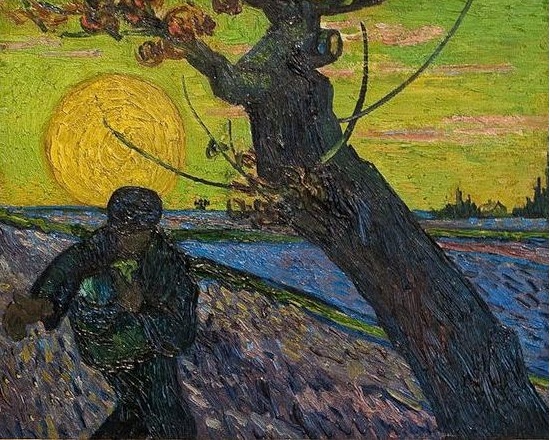
The first reading from today’s Lenten Mass describes God’s blessings in terms of the weather.

“Just as from the heavens

the rain and snow come down, and do not return there

till they have watered the earth,

making it fertile and fruitful,

Giving seed to the one who sows

and bread to the one who eats,

So shall my word be

that goes forth from my mouth;

It shall not return to me void,

but shall do my will,

achieving the end for which I sent it. (Isaiah 55,10)

Can this reading help us understand how God blesses us?  Like rain or snow God’s blessings come, making our lives fruitful. Yes, they will surely come, but how about the times we have to wait, when no rain or snow comes at all?

God’s blessings are like the weather.

Or think of God’s blessings through the Sign of the Cross. We say “we bless ourselves” when we make this sign. Sometimes God’s blessing comes through the cross of glory and we receive blessings never imagined through his tender mercy.

Sometimes his blessings takes another form of his cross; disappointment, suffering, failure, sickness, death. There God’s blessings are mostly hidden and hard to see.

In Matthew’s gospel today Jesus offers us a way of praying. Does this blessing also follow the weather. Prayer is a gift, but it’s a gift like the rain and snow. It’s one of God’s greatest gifts to us, yet sometimes we find it hard to pray while at other times it wells up within us.

The blessings of God are like the weather.

My Thoughts are not Your Thoughts

Last Sunday religion played a part in the tenth anniversary of 9/11, though some wanted to be silent about it. At the anniversary ceremonies, we heard words of belief among the questions and the tears.

Religion always has a role when something tragic like 9/11 happens. That’s because a tragedy like that– and it was tragic on a grand scale– is something we can’t measure or understand, and so we look for meaning and support in a power and a wisdom beyond our own.

People from many religious traditions died in that tragedy, and many turned to their own religious traditions for support. Of course, some had nothing to turn to.

As Christians we believe that God’s not silent in tragedy. God speaks to us through Jesus Christ, his Son. Yet, even so,  God’s wisdom is not so easy to understand.

“For my thoughts are not your thoughts,

nor are your ways my ways, says the LORD.

As high as the heavens are above the earth,

so high are my ways above your ways

and my thoughts above your thoughts.”  Isaiah 55, 8-9

In situations as simple as that described in today’s gospel, the parable of the workers in the vineyard, God’s ways are not our ways.  They’re higher and deeper.

At the heart of the tragedy of 9/11 is the mystery of death,  a reality common to all that lives.  Nature in our part of the world is now  experiencing a kind of dying as leaves turn and fall. We human beings die too, but death for us is different than it is for the rest of the natural world. We have a strong unique desire for life within us, for our lives to continue, and that makes us different.

Death happens to us in many ways. Some of us will die from natural causes, like sickness or old age. Some may die in accidents, earthquakes, floods. And then, some die because other human beings cause their death. That’s what happened at 9/11. That’s what makes that event so tragic; an evil injustice caused them to die.

Over the ages, there’s been a lot of reflection about death. Of course, today we don’t like to talk much about it. It’s become a taboo in our society.

But for Christians, death is important. The heart of our faith is about death and resurrection, which we see in the death and resurrection of Jesus Christ. We hear about  it over and over in our liturgy. And we reflect on it.

Some theologians, reflecting on sources like  St. Paul’s Letter to the Romans (Chapters 4-5), speculate that in the beginning God planned death of another kind for the human race, before sin intervened. If human sin had not entered the world, they suggest , maybe human beings like us would reach a climactic moment in the normal course of our lives when God would invite us to another higher life. It would be an invitation we’d welcome, we’d freely choose it, sure that a new and better existence waits for us with our Creator.

But it was human sin that darkened that moment in the beginning and made it the death we know now. So, instead of an experience of joy and adventure and new beginnings,  death became for the human family a moment of fear and suffering.

We believe Jesus came as our Savior and Redeemer to enter that dark, fearful moment and change it to a moment of salvation. “Dying, you destroyed our death; Rising, you restored our life,” we say in our liturgy.

To save and redeem us, Jesus truly experienced death in all its ferocity. The gospels clearly say he did.  Jesus faced a death,  not from old age or from sickness, not from some act of nature, but from sinners. He was put to death by evil injustice. It was death at its worst that he faced.  But when he died, he conquered death and evil and gave us hope by rising again. He “destroyed our death” we say.

He gives us now the power to face death, to go through the moment of death, even at its worst, and to know resurrection. He’s there at the moment of our death; he’s there with all who die; he’s there as our Savior and Redeemer. None of us dies alone.

After the tragedy of 9/11 you may remember they found a cross of twisted steel from the   wreckage of the World Trade Center and placed in the ruins. I think that cross hangs now outside St.Peter’s Church a few blocks away. For religious reasons, of course, it probably will remain there.

But the wisdom of that Cross, hard as it is for us to understand, speaks to that tragic place. His ways are not our ways, his thoughts not our thoughts, but God is not silent, God speaks  in the death and resurrection of his Son.

Following Jesus, our Teacher

Jesus Christ is the teacher of the ages. His Sermon on the Mount offers a lasting wisdom,  and so he speaks to us as well as to the people of his time. It’s up to us to listen to him and keep our eyes on him, even as others vie for our attention with their wisdom and their wishes. Like sheep, our eyes and our attention are on the next step we take; we have to listen for the Shepherd’s voice and turn to see where he is leading us;

Here’s a selection from St. Gregory of Nyssa in the Office of Readings for today:


“We shall be blessed with clear vision if we keep our eyes fixed on Christ, for he, as Paul teaches, is our head, and there is in him no shadow of evil. Saint Paul himself and all who have reached the same heights of sanctity had their eyes fixed on Christ, and so have all who live and move and have their being in him.

As no darkness can be seen by anyone surrounded by light, so no trivialities can capture the attention of anyone who has his eyes on Christ. The one who keeps his eyes upon the head and origin of the whole universe has them on virtue in all its perfection; he has them on truth, on justice, on immortality and on everything else that is good, for Christ is goodness itself.

The wise, then, turn their eyes toward the One who is their head, but the fool gropes in darkness. No one who puts his lamp under a bed instead of on a lamp-stand will receive any light from it. People are often considered blind and useless when they make the supreme Good their aim and give themselves up to the contemplation of God, but Paul made a boast of this and proclaimed himself a fool for Christ’s sake. The reason he said, We are fools for Christ’s sake was that his mind was free from all earthly preoccupations. It was as though he said, ‘We are blind to the life here below because our eyes are raised toward the One who is our head.’”


Called by God’s Word

Yesterday’s gospel for the feast of St. Andrew the Apostle says that Jesus called the two fisherman, Peter and Andrew, from their boat on the Sea of Galilee to follow him as his disciples. We easily picture the scene–the sea, the fishing boat, the smell of the nets, two men in a boat facing another on the shore.

Not so easily pictured is the mystery enveloping the scene. Who calls the two ordinary men from the shore?  Why are they called? They’re not just to accompany him for a few days, or a few years. Who is he?

“The very Son of God, older than the ages, the invisible, the incomprehensible, the incorporeal, the beginning of beginning, the light of light, the fountain of life and immortality, the image of the archetype, the immovable seal, the perfect likeness, the definition and word of the Father: he it is who comes to his own image and takes our nature for the good of our nature, and unites himself to an intelligent soul for the good of my soul, to purify like by like.

He who makes rich is made poor; he takes on the poverty of my flesh, that I may gain the riches of his divinity. He who is full is made empty; he is emptied for a brief space of his glory, that I may share in his fullness. What is this wealth of goodness? What is this mystery that surrounds me? I received the likeness of God, but failed to keep it. He takes on my flesh, to bring salvation to the image, immortality to the flesh. He enters into a second union with us, a union far more wonderful than the first.”  (St. Gregory Nazianzen)

The Transfiguration of Jesus

Feasts like the Transfiguration of Jesus on the mountain, which we celebrate today, are gifts from God, helping us to recall who we are and what we’re meant to be. We so easily forget.

Here’s a short excerpt from a sermon byAnastatius of Sinai from today’s Office of Readings.

“Let us run with confidence and joy to enter into the cloud like Moses and Elijah, or like James and John. Let us be caught up like Peter to behold the divine vision and to be transfigured by that glorious transfiguration. Let us retire from the world, stand aloof from the earth, rise above the body, detach ourselves from creatures and turn to the creator, to whom Peter in ecstasy exclaimed: Lord, it is good for us to be here.

It is indeed good to be here, as you have said, Peter. It is good to be with Jesus and to remain here for ever. What greater happiness or higher honour could we have than to be with God, to be made like him and to live in his light?

Therefore, since each of us possesses God in his heart and is being transformed into his divine image, we also should cry out with joy: It is good for us to be here – here where all things shine with divine radiance, where there is joy and gladness and exultation; where there is nothing in our hearts but peace, serenity and stillness; where God is seen.

For here, in our hearts, Christ takes up his abode together with the Father, saying as he enters: Today salvation has come to this house. With Christ, our hearts receive all the wealth of his eternal blessings, and there where they are stored up for us in him, we see reflected as in a mirror both the first fruits and the whole of the world to come.”