Tag Archives: Jesus Christ

How fast today?

“The disciples of John approached Jesus and said,

“Why do we and the Pharisees fast much,

but your disciples do not fast?”

Jesus answered them, “Can the wedding guests mourn

as long as the bridegroom is with them?

The days will come when the bridegroom is taken away from them,

and then they will fast.”

For a brief moment in time, Jesus Christ, the Word of God, appeared in the flesh. Then, he rose from the dead and his appearances in the flesh ended.

Now his disciples have to fast, according to today’s lenten reading from Matthew 9, 14-15. What kind of fasting should they do? Certainly a little fasting from food, drink, entertainment would help, for sure.

But how about turning  from that “expressive individualism” that Charles Taylor calls the trademark of our western world. A more subtle kind of fasting.

There’s a commercial on television calling us to go to the Florida Keys, where  you’re free to express yourself and do what you like, where freedom reaches its highest expression. Sounds like that “far off country” that beckoned the Prodigal Son.

Does our fasting means fasting from  too much attention to ourselves, which leads us to turn our backs on our own? Do we need to pay more attention to helping the poor, where Christ can always be found?

At the Name of Jesus

A shelf of scripture commentaries and theology books wont bring me wisdom of themselves, St. Bonaventure says in his Breviloquium, otherwise only scholars would enter the kingdom of heaven.

“The stream of holy Scripture flows not from human research but from revelation by God. It springs from the Father of lights, from whom all fatherhood in heaven and on earth takes its name. From him, through his Son Jesus Christ, the Holy Spirit flows into us; and through the Holy Spirit, giving, at will, different gifts to different people, comes the gift of faith, and through faith Jesus Christ has his dwelling in our hearts. This is the knowledge of Jesus Christ which is the ultimate basis of the solidity and wisdom of the whole of holy Scripture…

If we are to follow the direct path of Scripture and come straight to the final destination, then right from the beginning – when simple faith starts to draw us towards the light of the Father – our hearts should kneel down and ask the Father to give us, through his Son and the Holy Spirit, true knowledge of Jesus and of his love. Once we know him and love him like this, we shall be made firm in faith and deeply rooted in love, and we can know the breadth, length, depth and height of holy Scripture.”

It’s the tradition of my community to begin prayer with a short reminder of our dependence on God’s revelation in Jesus Christ. “At the name of Jesus, every knee shall bend, in the heavens, on earth and under the earth, and every tongue proclaim to the glory of God the Father–Jesus Christ is Lord.”

Nazareth again

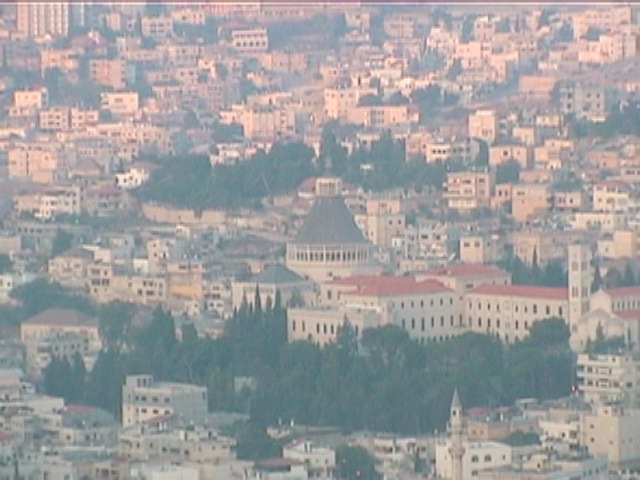
Nazareth: 1843

The gospel readings for the last two Sundays, and then today’s reading, make you wonder about Nazareth, where Jesus spent most of his life. He was rejected there, the gospels say, even by his own family. Why? Because they knew him too well, or at least they thought they did?

What happened at Nazareth afterwards? Did the rejection continue?

Archeologists and historians piece together some facts about the place where the Word made flesh dwelt. John Meier’s, A Marginal Jew: Rethinking the Historical Jesus, Vol 1, New York,1991, offers a lengthy assessment of what the gospels and other early sources say about his parents, his family status, the language he spoke, his education, his own place in society.

In his book, Meier criticizes the popular over-reliance on apocryphal literature like the Gospel of Thomas–which colors so many media presentations about Jesus today–  and asks why more attention isn’t given instead to the more reliable New Testament and patristic writers of the “great church.’

For the gospel writers, especially Mark,  leaving your own town and place was part of a prophet’s mission, Meier says, and so they have little to say about any connections Jesus had with his hometown during his ministry. Besides the story of his rejection there, Mark records some unpleasant visits from his family to Capernaum. (Mark 3, 21; 3,31-35) That explains somewhat the silence about Jesus’ hometown.

John’s gospel, though, mentions that after the wedding at Cana in Galilee, Jesus “went down to Capernaum with his mother, his brothers, and his disciples and remained there for a few days.” (John 2,12)

So there wasn’t a radical break.

Later, some from Nazareth took up his cause. Though they didn’t take part in his public ministry,  people from Nazareth were there when he died. In John’s gospel,  Mary, his mother, his mother’s sister, Mary the wife of Clophas–all presumably from Nazareth– stand beneath his cross with one of his disciples, and Jesus gives his mother into the disciple’s care.

The Acts of the Apostles say that Mary, his mother, along with “certain women’ and “his brothers” join in prayer with the eleven disciples after Jesus ascends into heaven. (Acts 1,14)

James, called the Just, likely one of those brothers mentioned in Acts, became a leader of the Jerusalem church. Paul met him a number of times, beginning shortly after his conversion . “Then after three years I went up to Jerusalem to confer with Cephas and remained with him for fifteen days. But I did not see any other of the apostles, only James the brother of the Lord.” (Galatians 1,18-19)

Paul notes too that Jesus appeared to James after his resurrection. “…He appeared to Cephas, and then to the Twelve. After that, he appeared to more than five hundred of the brothers and sisters at the same time, most of whom are still living, though some have fallen asleep. Then he appeared to James, then to all the apostles”

James continued to be a highly respected leader of the Jewish Christians in Jerusalem and probably met his death there in 62 AD, for resisting the pressure of the Jewish authorities to limit the growth of that faith in the city.

He’s the author of the Epistle of James, a hard-hitting appeal for social justice. “If a brother or sister is naked and lacks daily food, and one of you says to them, ‘Go in peace; keep warm and eat your fill,’ and you do not supply their bodily needs, what is the good of that. So faith by itself, if it has no works, is dead.” ( James 2,15-17)

Besides James, a number of relatives of Jesus became leaders in the new Christian movement. We wonder about Joseph, but the silence of early sources seems to indicate that he died before Jesus began his ministry.

Still, others from Nazareth must have found Jesus “too much for them.” Early sources speak of the Ebionites, Jewish Christians who thought that Jesus of Nazareth was indeed the messiah, but not the Son of God born of a virgin. There must have been some too from his native place who considered him a fraud. Jesus of Nazareth cast a dividing fire on the earth. “From now on five in one house will be divided, three against two and two against three…” (Luke 12,52)

But what about the Nazareth itself? The town  was certainly affected by the destruction of Jerusalem in 70 AD, which reduced the presence of Jewish Christianity and Judaism  throughout that land.  When Jerusalem was rebuilt, gentile Christians became leaders of the Christian church there. Some relatives of Jesus still lived as farmers in Nazareth and kept memories of him alive, but their relationship meant less and less as time went by.

Hegesippus, a Jewish Christian writer of the 2nd century, says that at the end of the 1st century, Zocer and James, descendants of Jude, a relative of Jesus, were called to Rome for questioning by the Emperor Domitian, because of suspicions that as descendants of David  they might lay claim to his throne.

The emperor’s fears vanished when he saw the poor bedraggled farmers with callused hands standing before him, and he immediately sent them home.

In the 3rd century, another relative of Jesus, Conon, was arrested and stated that he was from Nazareth and was related to Christ. He was put to death; a shrine to him was built in the town and remains can still be seen.

Today Nazareth is a sprawling new city, the regional capital of Galilee, with over 60,000 people, the majority of whom are Moslem. Ancient and modern Christian shrines have been built over the old town. and remnants of the houses like the one where Jesus and his family once lived have been unearthed.

As with other great places of the past–Rome, Athens, Constantinople–the right kind of eye lets you see great things in this ancient town.

I hope to go there next November.

A Rejected Prophet

Usually celebrities are welcomed to their hometowns by proud family members and neighbors,  but when Jesus returns to his native place, a rising star in Galilee, he’s driven out of the synagogue and almost killed by the people of Nazareth. He claims to be anointed by the Spirit of God and he’s been acclaimed elsewhere, but they see him only as the son of Joseph, the carpenter, and reject him. (Luke 4,21-30)

They stay unconvinced, it seems, because some of his family appear later at Capernaum, the base for most of his ministry, and want to take him home because he’s out of his mind,they say.

Why are they against his extraordinary claim? Is it because they know him too well? Or really, not enough? They’ve watched him grow; he’s worked on their homes and in their fields. He built some of the tables they’ve used for their meals. They know his father, his mother, his relatives. An unassuming young man whom they’ve known since infancy.

Where does he get all this?

We have to be careful that, like them, we get used to Jesus Christ, whom we may have known from our infancy. They took him for granted. His silence through the years made them blind to his power and they did not believe in him.

We know his silence too in faith and sacraments. He may act somewhere else, we may think, but not in us. We can mistake his silence for powerlessness too.

Give us faith in you, Lord.

(4th Sunday of the Year)

Preaching in the World Marketplace

Today,  24 January 2010, Feast of Saint Francis de Sales and World Communications Day, Pope Benedict XIV urged priests, as he previously urged others in the church, to discover new possibilities in the “new media” for carrying out their ministry of preaching the Word of God. “Church communities have always used the modern media for fostering communication, engagement with society, and, increasingly, for encouraging dialogue at a wider level. Yet the recent, explosive growth and greater social impact of these media make them all the more important for a fruitful priestly ministry. “

For the pope, the new media is an important way of preaching the gospel, especially to the younger generation and to the world beyond the church and he calls on priests “to proclaim the Gospel by employing the latest generation of audiovisual resources (images, videos, animated features, blogs, websites) which, alongside traditional means, can open up broad new vistas for dialogue, evangelization and catechesis.”

There’s a new “agora,” a world marketplace, where Christ must be proclaimed. Get out there.

Bravo.

Sharing His Life

As “the true light, which enlightens everyone ” come into the world, Jesus came not only that we might see his glory but also that we might share in it. “From his fullness we have all received, grace for grace.” (John 1,16) His baptism in the Jordan and his presence at the marriage feast of Cana in Galilee – two themes from John’s gospel still closely connected with the Feast of the Epiphany– portray Jesus revealed as God’s Son who unites humanity to himself.

From earliest times the Feast of the Epiphany, like Easter, was a day for baptizing those who believed in his name. To them, “he gave power to become children of God.” (John 1, 12) The story of the Magi, from Matthew’s gospel, says that all people are called by God to share in the grace of Jesus Christ. “The Gentiles are fellow heirs, members of the same body, and partakers of the promise in Jesus Christ through the gospel.” (Ephesians 3, 5-6)

Some historians see the Feast of the Epiphany originating from early Jewish-Christian celebrations of the Jewish Feast of Tabernacles, which celebrated God’s glory in covenant, light and water. In John’s gospel it’s during this same Jewish feast that the question is asked: Who is Jesus Christ? (cf John 7-10) He is God’s divine Son, the gospel says.

In some places the Feast of the Epiphany is also called the Feast of the Holy Kings or Three King’s Day. Gifts are given in memory of the Magi’s gifts of gold, frankincense and myrrh. Homes are blessed with holy water, in remembrance of that blessed home where the Magi found the Child and his mother.

In the western church, the feast of the Baptism of Jesus follows the celebration of the Epiphany as a separate feast, but it should be seen as  part of that celebration.

“For on this day land and sea share between them the grace of the Saviour, and the whole world is filled with joy. Today’s feast of the Epiphany manifests even more wonders than the feast of Christmas.”  (St. Proclus of Constantinople)

Following the Word

Hippolytus, an early Roman theologian reflects on the mystery of the Word made flesh:

“ We know that Christ’s humanity was of the same clay as our own; if this were not so, he would hardly have been a teacher who could expect to be imitated. If he were of a different substance from me, he would surely not have ordered me to do as he did, when by my very nature I am so weak. Such a demand could not be reconciled with his goodness and justice.

No. He wanted us to consider him as no different from ourselves, and so he worked, he was hungry and thirsty, he slept. Without protest he endured his passion, he submitted to death and revealed his resurrection. In all these ways he offered his own humanity as the first fruits of our race to keep us from losing heart when suffering comes our way, and to make us look forward to receiving the same reward as he did, since we know that we possess the same humanity.”

The Word became flesh. What does his early life tell us? In one sense, his birth and early life show us the helpless Word, carried along and cared for by others, part of an extended family that nourishes and instructs him, one of the nameless crowd swept along by the strong currents of his time.

Isn’t that what happens to all of us?

On to Nazareth

This year we go quickly, too quickly I think, from Bethlehem to Nazareth for the Feast of the Holy Family on Sunday.

According to a story from CNN this week, Israeli archeologists announced that they had uncovered the remains of a house in Nazareth from the time of Jesus. It’s near the Church of the Annunciation, the large Franciscan church that’s built over the center of the ancient town.

The house has two small rooms, a courtyard with a cistern for gathering rainwater and a pit the archeologists speculate was dug as a hiding place at the time the Roman army invaded Israel in the mid 60s. It may not be the actual house where Jesus lived, but it would be like it.

They say that Nazareth probably had about 50 of these modest dwellings, clustered together, where families or groups of families lived. They tended small farms on the outskirts of the town.

This was where Jesus Christ was brought up and spent most of his life. Hardly a showcase for someone Christians call “the Light of the World,” But it was the place God’s Son chose to live among us. Another mystery to wonder about.

CNN also carried a story called Passions Over the Prosperity Gospel: Was Jesus Weathy? The “prosperity preachers,” evangelists who tell you to believe and you’ll get rich, should take a trip to the digs at Nazareth where  Jesus spent most of his days. Probably a little different than where they live.


2nd Sunday of Advent

In last week’s reading, Jeremiah looked out at the bleak landscape of Jerusalem, destroyed by the Babylonians, its people mostly in exile, and pointing to a shoot, a little sliver of life, told us to hope. This Sunday, his scribe Baruch describes a glorious restoration when God leads his people home.

The holy city clothed in glory will rise in splendor to welcome her returning children. “Led away on foot by their enemies they left you: but God will bring them back to you borne aloft in glory as on royal thrones.”

They have been “remembered by God, ” who levels mountains and valleys for their joyful journey, beneath fragrant trees, “with God’s mercy and justice for company.”

How unrealistic, many listening to the prophet’s vision must have thought!

How unrealistic the gospel reading also seems, as John the Baptist turns towards the desert to welcome “all flesh” to Jerusalem, still in the firm grip of the Romans, Herod’s dynasty and the priestly caste from Jerusalem.

Yet, the prophets speak the truth, even though we see only ruins and what is.  Remember us, O Lord.

The Call to All

We weren’t called on the shore of the Sea of Galilee as Peter and Andrew were, but St. Bernard says in today’s reading Jesus calls us as well. He speaks of the three comings of Christ.

“In his first coming the Lord was seen on earth and lived among men, who saw him and hated him. At his last coming All flesh shall see the salvation of our God, and They shall look on him whom they have pierced. In the middle, the hidden coming, only the chosen see him, and they see him within themselves; and so their souls are saved. The first coming was in flesh and weakness, the middle coming is in spirit and power, and the final coming will be in glory and majesty.”

Jesus said, “ If anyone loves me, he will keep my words, and the Father will love him, and we shall come to him,” and so as surely as he dwelt with his apostles who followed him from the boat will he dwell in the hearts of those who welcome him

Yet, Bernard speaks to a Christian community baptized into the Christian faith. What of those who do not welcome Christ, perhaps because they do not know him or misunderstand him? What of those nominal Christians who have all but forgotten their call? Bernard doesn’t say, but wouldn’t the Father still come to them and dwell with them until he chooses to reveal his Son?

There is a universal call to intimacy with God.