Tag Archives: Eucharist

Friday Thoughts: Pray the Mass

Paul Cézanne Bathers (Les Grandes Baigneuses) 1895-1905

Paul Cezanne, “Bathers” (Les Grandes Baigneuses), 1895-1905 

.

“Rejoice always. Pray without ceasing. In all circumstances give thanks, for this is the will of God for you in Christ Jesus.”

—1 Thessalonians 5:17


.
Come with me. I love to go. I so love to go. The Mass in its abundant overflow.
 .
“For God so loved the world, that he gave his only begotten Son…” (John 3:16)
.

Come with me. It doesn’t matter what language you speak, nor what color skin your flesh happens to wear. Come. Be one with the Lord.

Pray the great prayer of the Church. Pray with sinners like me. Pray with all God’s Angels and Saints.

Pray the Mass. O, how God loves for us to share, to participate in Christ’s salvation of the world!

Living sacrifices. Gifts of bread and wine.

Come. Come. He is so very real. So much love. His Liturgy kisses each individual brow.

Begin your day by adjusting your ear…

If today you hear his voice, harden not your hearts.” (Psalm 95)

Pray the Mass. Live it at home. Hour by hour. Minute by minute. Work through the Mass as you work through your day—knowing that the Holy Sacrifice of the Mass is being celebrated at every moment throughout the entire world.

———
 .
“The Lord be with you. And with your spirit.”
.

Antiphon to Antiphon. Introductory to Concluding Rites. Let the Mass order your day.

The Sign of the Cross upon opening your eyes.

“Kyrie, eleison…”, as you rise from bed.

A morning shower beneath God’s infinite reign of mercy: “Wash me, O Lord, from my iniquity and cleanse me from my sin.”

Read. Confess. Sing. Proclaim.

Wash the dishes. Run to the store.

Always praise. Yes, always praise: “Glory to God in the highest, and on earth peace to people of good will.”

Head to work. Attend a meeting. Go for a run.

“Alleluia, alleluia”:  The Gospel Acclamation.

It’s almost high noon. Enjoy the Sun. The light of God’s face. Hear the Holy Spirit’s instruction and inspiration for the day. Hold up your wounds, pray in union with God’s Crucified Child…

Offer the Universal Prayer while waiting for the bus…

Intercede for the entire world: the salvation of souls, the conversion of sinners, a unified church, the remembered and forgotten souls in purgatorial fire…

…for the sick, the persecuted, the poor, the imprisoned, the hungry, the thirsty…for every single soul for whom God wills us to pray…

For all the intentions of Jesus’ Most Sacred Heart.

———

“I believe in one God…”

Time for lunch.

Prepare the table. Acknowledge God’s goodness. Accept His gifts:

“By the mystery of this water and wine may we come to share in the divinity of Christ…”

Live. Breathe. Be free and at ease.

Let the Eucharistic Prayer flow into the core of your being:

“Lift up your hearts. We lift them up to the Lord…”

“…Holy, Holy, Holy Lord God of hosts…”

Watch as angels ascend and descend…your gifts borne “by the hands of God’s holy Angel to His altar on high…”

A priest at this very moment lifts the hands of Christ:

“Through him, and with him, and in him…”

———

Afternoon arrives:

“Behold the Lamb of God.”

Ask Jesus to come into your soul. Properly position yourself at the foot of the table:

“Lord, I am not worthy…but only say the word and my soul shall be healed.”

Jesus thirsts to enter. Learn to open wide. Beg God on bended knee. Beg Him for the grace to generously give and graciously receive:

“The Body of Christ.

The Blood of Christ.”

“Amen.

Amen.”

———

Sitting in traffic. Waiting on a call. Wanting to get home.

“Period of silence or song of praise.”

Rest beneath the external chaos, enter the internal peace of the Kingdom that resides deep within. Remember that Jesus—Body, Blood, Soul, Divinity—continues to transform your entire being.

Stop and go. Almost home. Evening approaches.

The prayers the priest says quietly at the altar—pray them too—ceaselessly in the silence of your consecrated heart.

“Lord Jesus Christ…free me by this, your most holy Body and Blood…

…keep me always faithful…never let me be parted from you.”

Park the car. Say hello to a man who’s homeless. Briefly visit a confused elderly neighbor. Prepare to sit peacefully around your kitchen table. Practice patience. Hug and kiss the kids. Allow the joy of Christ to radiate outward from the eternal spring within.

At the close of supper, give great thanks, and call to mind an after-communion prayer:

“What has passed our lips as food, O Lord, may we possess in purity of heart, that what has been given to us in time may be our healing for eternity.”

———

Now circle around and approach the end of this blessed day much like the way you began—for somewhere out there—Mass is just about to begin:

“The Lord be with you. And with your spirit.”

Brush your teeth. Prepare to sleep the sleep of a most blessed mystical death. Ask Mother Mary to help you dress for the flight.

“May almighty God bless you, the Father, and the Son, and the Holy Spirit. Amen.”

———

Kiss your wife goodnight.

Turn off the lamp.

Close your eyes in God’s perfect peace. The Mass at your right hand. Its liturgical rhythm steadily beating within your sacred heart.

Darkness descends.

“Go forth, the Mass is ended.”

The best is yet to come.

Faith. Hope. Love.

Eternal Life.

And as always: “Thanks be to God.”


.

“For God so loved the world, that he gave his only begotten Son…”

—John 3:16


—Howard Hain
.
.
(Note: All italicized quotations are from The Order of Mass, unless otherwise indicated.)
.

Friday Thoughts: Walled Garden (2)

(Please note: This is part 2 of a piece entitled “Walled Garden”. To read part 1, simply click here: Friday Thoughts: Walled Garden (1))


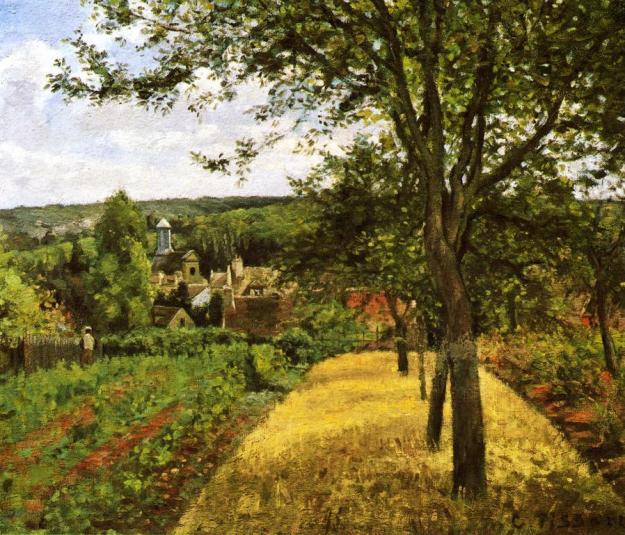
pissarro orchards at louveciennes 1872

Camille Pissarro, “Orchards at Louveciennes”, 1872

.

And from that hour the disciple took her into his home.

—John 19:27


.
On leaving the convent I came upon the friar I noticed on my way in. The little dog was no longer around. We approached each other as if we had met before. He was kind. He was middle-aged. He was simple. And then the strangest thing occurred. He took me by the arm, the way men stroll in Italy, arm-in-arm, during the evening passeggiata—the evening stroll.

But I had never met this man before.

Yes, it is certainly strange to have an unknown man approach you and link his arm in yours.

He led me toward a dirt path. We strolled. We spoke little. He didn’t speak English and my Italian was tiny. But it was nice. Peaceful. It didn’t feel strange. I only now use that word, for from a somewhat forced “objective” perspective, it seems that it had to be.

He was a man of God. And he saw I was too, before I had any idea God had undeservedly entrusted me with such a gift. The gift of loving God. The gift of wanting Him more than I could ever explain. The gift of being an outcast here in this world of time, a wanderer, a pilgrim, a crusading knight of Lady Poverty—of being—in yet again, some strange kind of way—a lady-in-waiting—patiently and painfully anticipating the exuberant arrival of the one and only eternal groom.


.

He brought me to what appeared to be an old foundation. I understood from what few words we exchanged that this was the remains of an abandoned orphanage. And then we began to head back toward whence we came. I remember offering him some bread that I had in my bag, purchased that morning in the city of Assisi up above. He lightly touched his stomach with one hand and shook his head “no”—a kind, polite, gracious, and utterly grateful, “no-thank-you” kind of “no”.

When we arrived at the door of the convent I understood from his gestures that he was inviting me to see something inside. It was clearly something that I had not yet seen. I motioned “yes” and we entered. We climbed a staircase and walked down a hallway. We were in an area not open to the public. The walls revealed its age. And we approached a door. A wooden door. And he unlocked it with an old large skeleton key. He opened the door and motioned for me to go inside, quietly informing me that this is Saint Clare’s cell. I entered and he remained outside. He gently pulled the door closed.

I wasn’t sure what to do. I was safe. I knew I wasn’t locked in. I was pleasantly confused. I looked around. It was small. It was literally a cell. Enclosed. All stone. A low tight arched ceiling. Bright. Dark. Cozy. Warm. Beautiful.

A tabernacle. A womb. A virgin’s womb.


At the end of the somewhat rectangular shaped room was a small alter-like shelf. I knelt before it. I have not the slightest recollection of what I prayed.  Of what I thought. Of anything spiritually taking place. I was just there. And I remained a few minutes. And then I left. I opened the door and I was all alone. No friar. I closed the door behind me and made my way back down from where I had come.

It seemed as if nothing extraordinary had happened. It was all so normal. So everyday. Yet it was nothing of the sort. It was extraordinary. It was an encounter. I think. Perhaps.


I think of little Mary. Alone in her room. I think of a gentle breeze and the sight of a bowing angel.

“Hail, full of grace…”

What a name, what a title to be given!

Gabriel holding the key that opens the door.

The young, chosen, highly-favored virgin agrees to hear his message, to walk arm-in-arm with him, to accompany him to she knows not where. She agrees to accept God’s invitation.

The Holy Spirit comes upon her simple life, her simple way, her simple manner.

The power of the Most High overshadows her daily existence.

Our Father confirms her trusting posture, her grace-filled instinct to utter the purest of prayers:

.

“Behold the handmaid of the Lord; be it done to me according to thy word.” (Luke 1:38)

.

Jesus entered a private, off-limits room. He made His home there.

And He never left.


.

“…when you pray, go to your inner room, close the door, and pray to your Father in secret…”

—Matthew 6:6


.

—Howard Hain

.

Friday Thoughts: Holding Christ’s Hand

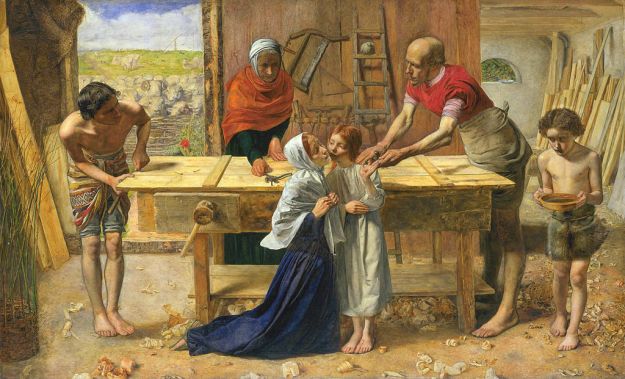
Christ in the House of His Parents by John Everett Millais 1849–50

John Everett Millais, “Christ in the House of His Parents”, 1849-50

.

“I am the way and the truth and the life. No one comes to the Father except through me.

—John 14:6


If we hold Christ’s hand we cannot get lost. For Christ is the way. It is not even possible to go astray.

If we cannot get lost, there can be no doubt. If no doubt, there can be no fear. If no fear—we are in the Kingdom of God. Right here. Right now.

Hold Christ’s Hand. Fear not. You are in the Kingdom of God.


—Howard Hain

.

Friday Thoughts: You Dirty Rat

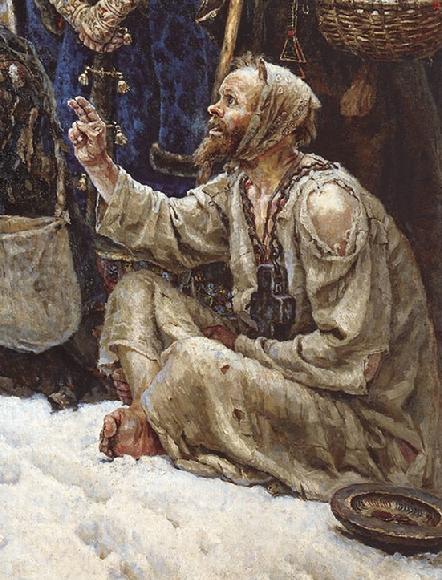
The Boyarina Morozova, Vasilij Surikov, 1887, detail 2

Vasilij Surikov, “The Boyarynya Morozova”, 1887 (detail)

 .
I am starving to death by not preaching. I search the garbage bins and pick out of dumpsters, ever eying with hungry eyes trash thrown by the wayside.

I am so wonderfully fed by Christ!

Yet I thirst a thirst of love. I long for more painful encounters that heal me so. I am a lover of the beach who roams the Sahara. Below the height of the mounting sun, among the singing dunes, I bellow with them the universal hum.

The sand is all about me. An oasis resides within my heart. I am surrounded by mirages of men whom long ago have forgotten to start.

I starve to preach. To sing of our Lord. I starve to fly high with no might of my own. Tapping toes and rocking forth, slightly bending knees, ready to spring forth from well to well.

I love our God. I love Him so. I love Him and Him alone. He tells me to love others as myself. I love Him despite myself. I love Him in others, and others because of Him. I love for I have been brought low. I love for I have learned to soar high. He is my all. My everything. Of Him, and Him alone, do I sing.

I sing of socks, and of sneakers, of old clothes and new sandals, and of wedding rings. I sing of mice, and of men, I sing of the difference that resides only in the length of whiskers. I sing of dogs and of cats, and o yes, of rats—o those ugly creatures that challenge me so.

I ask myself, are they not created by God as well?

Isn’t that dirty filthy stinkin’ rat also beautiful and also real?

Does not God shine the sun and shower the rain on disturbing rats as well?

O, if I could only love rates, then I would truly sing! Mend this heart, this rock of mine, hardened by selfish sight and by wanting what isn’t mine. Yes, boil me down, so I may drown in what the residue of life leaves to those who truly suffer.

I sing to you, O Glorious Rat. Creature of God!

I sing to you that you too shall sing with me. I see that I no longer need to sing alone. Come, accept my embrace. I forgive you. Now perhaps I too may be forgiven.

I see and smell and hear the truth. You the rat, object of everyone’s scorn. You too were once so young, before you crawled into the bin, before you journeyed down the darkened tunnel—you too—little infant rat—were brought forth from the mother’s womb.

Come young, come old! Come from your abandoned buildings, and vacant storage yards, from old ball fields well over grown. Come one, come all!

The pious pied piper now plays a gospel tune. The garbage begins to gather, the desolation takes on an evening glow. The sand all about me recedes from the stormy cloud. It slowly begins to lay low.

The desert creeps up upon a vast body of water.

I pass between walls of a held back sea, my feet tread cross a red clay bottom.

You too, brother rat, are a gift from our mighty God above. You too were loved into existence by the Lord of all.

God of all who share residence upon the earth.

God of all who sigh and sing.

God of all who snort and smile.

God of all who bellow and breathe, both fresh and soiled city air alike.

Come, then, last call, leave your dens, leave your hobbies, leave you daily work behind. Leave you rats, friends of mine, leave the muck and sewers of this world, climb the hills, and charge the mountain, dip yourselves in Carmel air, for even you reflect the glory of Zion from a peak so high.

Come and join the birds who listened so intently, who still this day patiently hear lonely troubadours sing. Yes, join us, for there is always plenty of room, room for even you, object of everyone’s scorn.

Enough for even you, you dirty rat.

A sight for sore eyes to this poor lonely thirsty preacher.

For through you I give our magnificent God mighty humble joy-felt praise.

———

.
—Howard Hain

Friday Thoughts: Walled Garden

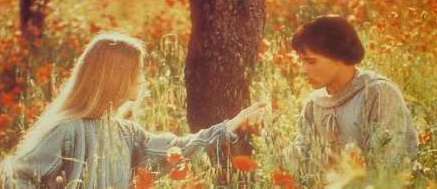
Francis and Clare from the movie Brother Sun, Sister Moon Franco Zeffirelli

Saint Francis and Saint Clare from the movie “Brother Sun, Sister Moon”, (Franco Zeffirelli) (1972)


.
A garden enclosed, my sister, my bride,
a garden enclosed, a fountain sealed!

—Song of Songs 4:12

.


.
From memory it is not easy to recall. I do have a clear image, but if it is accurate that remains to be seen. Here we go.

It was downhill. A sloping path. As I approached the stone church, a few people wandered around out front. There was somewhat of a courtyard, well not a courtyard, more like a little wall hugging into existence a welcoming space. This wall was about bench height, made also of stone, and extended outward from the building. It created what I would normally call an out-front patio space, but in Italian terms, perhaps it would be called a terrazza, or maybe even be considered a piazza, or perhaps most accurately, a piazzetta. Then again, maybe it is just a patio to Italians too.

Well, sitting on this low wall was a friar. And running around the open area was a small brown dog with a shaggy little beige beard.

I entered the church. It was small, almost cave like. A curved ceiling. Dark. Old. There was the cross, a crucifix. Not the actual one that spoke to Saint Francis—no, that one was moved up into the Basilica of Saint Clare located in the central part of the still small but no-longer medieval town of Assisi.

The reproduction spoke to me.

I’m an early companion of Francis.
.


.
I remained in the chapel for a while. I’m not sure if I was praying or not. I’m pretty sure I got on my knees. But from that day’s perspective, prayer was not known to me. So from that perspective, I wasn’t praying. But from today’s perspective, I most certainly was. For I was there. I was in Italy, in Assisi, in the Church of San Damiano. I was there intentionally. I was lost but I was found. I was looking, and I was obeying. Obeying what I didn’t know. I had no idea why, but I wanted to be there. And I felt something. It was heavy, literally. I remember feeling bent over. I remember thinking about all the prayer that must have taken place in that small space over the past thousand years. I remember thinking that all that collective belief must have an effect. It did. It does. It will. I was certain that I felt it. It bowed me down. It bent me over. And I remember liking it.

Faith is common.

I was a pilgrim and didn’t know it.
.


.

I don’t remember much about the convent itself. I do remember walking from room to room, the communal rooms where Saint Clare and her companions, her biological mother and two sisters among them, ate and prayed and cared for their sick. I remember the small warm inner garden, with it’s old well. And the spot marked as the place where Clare liked best to sit. I’ve always loved internal courtyards. The thought of being outdoors and yet enclosed. Architecturally, it best represents the beauty of true solitude. Open. Yet safe. Free. Yet sheltered. Alone. Yet surrounded by those who believe the same.

In that sense, solitude—when it’s truly interior, truly spiritual—is like love: you can never get enough of it, and once you have it, once you truly live within it, you’re never again alone.

Solitude is love. And love is never solitary.
.


.

Therefore the Lord himself shall give you a sign. Behold a virgin shall conceive, and bear a son, and his name shall be called Emmanuel.

—Isaiah 7:14

.

.

—Howard Hain

Morning Thoughts: The Clown of God

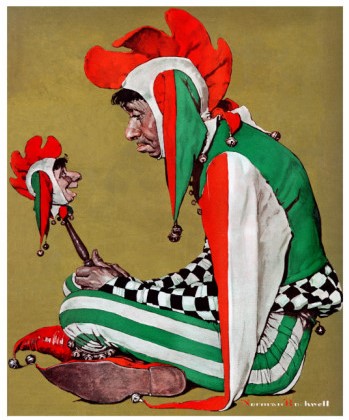
norman-rockwell-jester-february-11-1939

Norman Rockwell, “The Jester”, 1939

.

“Alas, poor Yorick! I knew him, Horatio, a fellow of infinite jest, of most excellent fancy.”

—William Shakespeare, Hamlet: Act 5, scene 1

.


.

Early this morning, Francesca and I had a good laugh.

The sun was up, we were not. We were out late a few days ago. On Saturday night we visited a friend’s home and didn’t get to bed until after 11. That’s pretty late for all of three of us, but for Francesca, from her six-year-old perspective, it was “almost the next day!”

So this morning, the Monday of a new week, we found the consequences of that shortened Saturday-night sleep still catching up with us.

Francesca had made her way from her bedroom to the couch I guess around five. I sat up just about half past, the sun fully making its presence known, and as I looked toward the couch I saw Francesca propped against some pillows, cuddled up in the corner, eyes open, but still quite in sleep mode. I walked toward the kitchen to hit the coffee button, and as I passed in front of the couch I broke into an overly-exaggerated stroll. As I disappeared into the kitchen I caught a peek of Francesca’s smile.

When I reentered her line of vision, just a handful of seconds after hitting the “on” button, she was sitting up straight, smiling broadly, and said quite adamantly: “Do it again.”

“Do what again?”, I smiled.

“Walk like that again!”, she immediately answered back, moving her little arms in a fashion somewhat like I hade moved mine.

“What are you talking about?”, I tried to say with a straight face as I walked the same way back across the room.

“Like that!”, she exclaimed, laughing and pointing at my arms.

And we were off and running, or should I say, “walking”. Over and over again, I would say: “What’s wrong with how I’m walking?”, and then she would point out what was “out-of-order” regarding my gait. Each time I would—with as much seriousness as I could muster— “correct” what she pointed out and then try again, this time adding yet another new “discrepancy”. One time I swung my arms wildly, another time I goose stepped, then I raised my knees too high, one round I walked “perfectly” but made funny noises with my mouth as I moved, and this went on and on, or I should say, we went on and on, and each and every time she was laughing more and more, getting more and more exasperated and adamant about what it was that I was not doing right.

“Just walk normal!”, she would laugh, and I would answer, “I am”, again and again. And then it got really funny. I could barely keep a straight face for even a few seconds. She herself began to illustrate how to properly walk, and seeing her trying to walk “normal”, which only resulted in her walking quite “un-normally”, only added to the Buster-Keaton type ridiculousness taking place in our tiny little living room. And all the while Laurie was just a few feet away still in bed, I wont say still asleep, because I have a hard time believing she could continue to snooze through all that ruckus.

But what really brought the house down was when I began to “really try” to walk right, listening intently to all her instructions, and painfully listing each one, and at the same time actually beginning to get confused. I had to think to myself for a second, “How is it that a person actually does just get up and walk?”. It is amazing what happens, what a mess we can make of things, when we try to understand and take control of what comes so naturally to us, of what comes so easily to almost all of mankind by the very nature of who we are, and seemingly without any effort or consciousness. But this little philosophical reflection didn’t stand a chance, Francesca was still on the scene and a child just wont permit, not even for a second, the antics of self-indulgent adult reflection to get in the way of a good time. She was focused on the action at hand, on the flow, from one act to the next, and she now had herself hysterical about the next and final slapstick scene in our not-so-silent film.

For you see, she discovered something in me that’s just priceless in her estimation. She loved the fact that I developed this little movement, quite unintentionally, as I “prepared” to try again to walk properly. I would kind of slightly waddle in place, lining up and squaring my feet, while at the same time slightly rotating my hips and shoulders, trying to position my feet, hips and shoulders just right. I guess I began to resemble a gymnast right before he launches the big run leading toward a long series of tumbles, or better yet, perhaps a diver in the Olympics right before leaping off the high board. Well, either way, this was more than Francesca could handle. She let out a true belly laugh, and then pointing wildly at my shoulders: “Daddy, do it again!”

At this, she jumped off the stool that she was now teetering upon, trying with all her might to mimic me. We both we’re beside ourselves with laughter. It was an absolute blast. It was creative chaos at its best. All heaven broke loose.

I hadn’t even had a sip of coffee yet. My morning prayers were still in a holding pattern. And then the thought came to me. A thought came to this continually under-occupied, perpetually unemployed forty-four-year-old man who just can’t seem to find his way in this world: “I should be a clown.”

I asked Francesca what she thought about my new career path. She loved the idea!

“Yes!!! Do it Daddy, do it!”

I decided to keep my prayers this morning to a few simple Our Fathers.

God was clearly praying for me since the moment I awoke.

The Spirit groans on our behalf, perhaps He laughs for us as well.

Prayer is prayer. This morning, Francesca’s laugh, and mine as well, was the peal of the morning bell—calling all the world to still attention—before the settling in of the business of another new day:

.

The Angel of the Lord declared unto Mary.

And she conceived by the Holy Spirit.

Hail Mary, full of grace…

.

.

—Howard Hain


Feast of Corpus Christi

To listen to today’s homily, please select the audio file below:

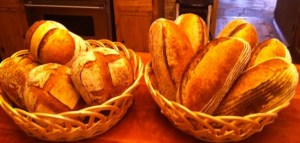
A man I know built himself an oven and bakes bread “the old way,” he told me. He goes about the process meticulously: the flour’s carefully chosen, the right amount of water is used, the fire that bakes the bread is just the right temperature. It takes time, but what a feast results!

Bread

I mentioned to him how so many homilies on the Eucharist from the days when they baked bread “the old way” see profound spiritual mysteries in this same process. The flour represents creation itself; the water and the fire represent the work of the Holy Spirit whom we invoke in this sacrament. “The Sacraments are a privileged way in which nature is taken up by God to become a means of mediating supernatural life.”(Laudato Si 235.) Simple created realities like water, oil, bread and wine speak for all creation.

In our prayer over the bread at Mass we say: “Blessed are you, Lord God of all creation, for through your goodness we received the bread we offer you, fruit of the earth and work of human hands, it will become for us the bread of life.”

The bread we offer, the wine we offer are signs of creation and the human efforts involved in creation. They’re signs of everything that the “God of all creation” gives us and of everything that comes from our hands. “The word bread stands for everything,” Augustine said in one of his commentaries on the Lord’s Prayer. (Epistle to Proba) No wonder Jesus chose these two precious signs to give himself to us.

The bread and wine stand for everything. Think what that means. Scientists say that our universe came into existence about 15 billion years ago. The bread and wine stand for the 15 billion years our universe has been in existence. About 3.5 billion years ago life began on our planet. The bread and wine represent that 3.5 billion years of life on our planet. When they’re brought to the altar the whole universe is brought here. About 200,000 years ago human life emerged on our planet. 200,000 years of human life are represented in the bread and wine. Our lives are part of the human story represented in the bread and wine .

We believe that when Jesus sat down with his disciples at the Last Supper and took bread and wine into his hands he took all creation, all life, all human life into his hands.. “This is my body.” “This is my blood,” he said. He is God in human flesh giving himself to us and to everything that God made. In love poured out, he renews the covenant God makes with us and with creation.

Pope Francis in his letter “Laudato Si.” emphasizes the cosmic dimension of the Eucharist. Our created world is there with the dignity and purpose bestowed on it. As he takes bread and wine into his hands, Jesus takes the whole universe to himself. “ Joined to the incarnate Son, present in the Eucharist, the whole cosmos gives thanks to God. Indeed the Eucharist is itself an act of cosmic love: Yes, cosmic! Because even when it is celebrated on the humble altar of a country church, the Eucha¬rist is always in some way celebrated on the altar of the world. The Eucharist joins heaven and earth; it embraces and penetrates all creation. The world which came forth from God’s hands returns to him in blessed and undivided adoration: in the bread of the Eucharist creation is projected towards divinization, towards the holy wedding feast, towards the unification with the Creator himself.” (LS, 236)

We celebrate this great mystery on the “humble altar” of our church. The created universe as it was, as it is and as it will be is before us. A marvelous sacrament, so simple in appearance and so tremendous in reality.

The Vine

I visited  Laurita Winery in New Egypt, New Jersey, some years ago. Some of us wanted to see how wine was made.  Ray Shea, one of the owners, and Nicholaas Opdam, the Oenologist or Vineyard Manager, gave us a tour.

“ I am the vine, you are the branches” Jesus says in today’s  gospel. He saw  the vineyard as an image of the play between  heaven and earth. Growing grapes is as challenging as sowing seed, which can fall by the wayside, or on hard ground, or among thorns, and the birds of the air can eat it up.

Vines are similar. At the very least, the vine needs pruning. But there’s more.They depend on the right climate, they need the right amount of water, the soil in which they’re planted needs feeding and watchful adjusting. Blackbirds can swoop down on the ripening grapes. Better than protecting nets is a circling red-tailed hawk, the vineyard keepers say.

“We need good weather and other things beyond our control,” they told us.  Twice a year the vineyard is blessed, in the cold of January and during the harvest in October.

They’re using the latest technology and the wisdom of wine-makers from all over the world at this vineyard. Solar panels circling the fields harvest the energy of the sun and a man made lake collects vital water. Yet it’s no sure thing. It’s a risky business.

“I am the vine; you are the branches.” I must admit, I hardly thought of the patience, the risk, the dimensions behind this image, which is so richly incarnational.  A loaf of bread or a bottle of wine came to the table from nowhere, I thought.

Not so.

At the Eucharist, bread and wine just come to the table, from nowhere. Not so.

20th Sunday B: Taste and See

I stopped for something to eat the other day along the seashore at Montauk, Long Island, a place I stopped by chance. “We have a nice fish chowder, everything fresh from near here,” the waitress said, so I ordered the fish chowder. Couldn’t have been better, better than anything I expected.

Our first reading today for Sunday Mass is about a meal that’s even better, better than we could expect or plan for. Someone wise provides it. It’s not a meal for just one or two; we’re all invited to the table. Amazingly, it’s free; we don’t have to pay for it.

Listen again to the Book of Wisdom: “Whoever is simple turn in here; to the one who lacks understanding, she says, Come eat my food and drink of the wine I have mixed.”

“Whoever is simple turn in here.” I suppose that means whoever is hungry, whoever is weary, whoever is burdened, come and eat. Aren’t those the ones Jesus felt compassion for. “Come to me, and I will refresh you,” he said. Don’t we qualify for an invitation like this? His refreshment is beyond what earthy food or drink can bring.

Where can we find this meal, except in the Eucharist, where “we taste and see the goodness of the Lord.” A goodness beyond our expectations.

“Take and eat, this is my body.” “Take and eat, this is my blood.” The people in today’s gospel (John 6,51-58) are repulsed by Jesus when he says “unless you eat the flesh of the Son of Man and drink of his blood you cannot have life in you. Whoever eats my flesh and drinks my blood has eternal life and I will raise him on the last day.”

“How can he give us his flesh to eat and his blood to drink?” They take his words in too narrow a way. Who tells us to do this? Who’s the One who offers us his body and blood? The Lord of all, who made all things. He contains all the treasures of wisdom and knowledge. He’s the Lord of life who gives life. He promises resurrection, while knowing the reality of our death.

No other meal can compare to this. No other food can satisfy us; no other drink can quench our thirst .

17th Sunday of the Year: B – The Bread of Life


Audio homily below:

The next five Sundays at Mass we’ll read from the 6th chapter of St. John’s gospel, which centers around the miracle of the loaves and the fish. All four gospels recall this miracle of Jesus; Mark and Matthew recall it twice. It’s one of Jesus’ most important miracles. It’s a miracle that will define him more than others miracles do.

John’s gospel expands on the miracle more than the other gospels. John’s gospel likes to point out signs. This miracle as an important
sign of Jesus’ mission in this world. He’s “the Bread of Life,” who answers the hunger that’s in our world.

John’s gospel notes the time and place the miracle occurs. It’s the time of Passover, on a mountain near the Sea of Galilee. When we hear it’s the Feast of Passover, we know that was when God led the Israelites out of Egypt. It was a mighty action of God. Now God will do a further act of saving his people through Jesus, his Son.

Jesus goes up a mountain. That’s an important detail too: Moses spoke to the people from a mountain on the desert journey. Now we’ll hear a greater voice from the mountain by the Sea of Galilee.

Look at the picture we have in John’s gospel: Jesus on the mountain sees a multitude of people coming toward him. In the other gospel accounts of this miracle, the disciples notice the crowds coming and nervously tells Jesus to send them away. In John’s gospel, though, Jesus sees the crowds approaching and, as if to remind his disciples of the inability of human resources to deal with them, he asks his disciple Philip, “Where could we buy enough food for them to eat?” Of course, there are no places to buy food and even if there were they wouldn’t have enough money. There are only 5 loaves and two fish.

Then, look how the miracle takes place in John’s gospel. Jesus doesn’t have the people line up, as if in a breadline for a piece of bread to tide them over on their way home. No, he settles them all on the green grass as if he were seating them at a banquet table. Then, taking the loaves and giving thanks, “he distributed them to those who were reclining , and also as much of the fish as they wanted.”

And it’s not only enough for them to eat; there’s a lot left over, which they collect in baskets. “More than they could eat.”

What does the miracle say to us? Let’s go back to the beginning. Jesus seeing the crowd is God seeing us all, the whole human family in fact. He sees the hunger of the crowd that can’t be met by human resources alone. The miracle isn’t an answer to a temporary crisis; it’s a sign that points to something deeper, something lasting. God will be with us on our human journey. God will always be with us; God will give us what we need, and even more than we expect.

You see the promise we have in this miracle. It’s not something done long ago and then over. It’s a sign that goes on and on.

This miracle says there’s a hunger in human beings that only God can satisfy. We may hardly be aware of it; just as the crowds who came to Jesus that day may not have been aware of it. But he was.

It’s not just a hunger for food either; it’s a hunger for wisdom and knowledge that only God can give. “You have made us for yourself, O Lord, and our hearts are restless until they rest in you.”( Augustine) There’s something unsatisfied, something restless in us that can only be met by God. Our human hunger wont be satisfied by money, by success, by popularity, by things, by a healthy, perfect body. We can have all of these, but the question rises, “What then?” “What then?”

The miracle of the loaves and fish also points to the mystery of the Holy Eucharist, that beautiful sign so small and insignificant. Yet we sat it’s a banquet, God’s banquet. It’s the place where Jesus looks at us and see our hunger and offers food. He is our Bread of Life.