Tag Archives: Environment

Young Mother Sewing

by Howard Hain

DP139632

Mary Cassatte, “Young Mother Sewing” 1900, (The Met)


A living faith works. It is always active, especially when we are docile to the Spirit.

When we walk by faith we see, we hear, we speak what God intends, especially when we are blind to the cares and anxieties of the world.

Small children are wonderfully active, superbly passive, and at times they seem completely blind, fantastically blind. They are alive. They see. They hear. They speak. They watch. They feel.

Mother Church calls all of us home, even when she is silent. She is always at work. She watches us even when her eyes are busy with the business of the day.

She sews. We just need to obey. To trust. To allow ourselves the freedom to lay across her lap.

In the short description upon the little museum card hanging beneath the painting shown above, God has planted great instruction. The work is by American impressionist Mary Cassatt.

According to the card, about the year 1890 “Cassatt redirected her art toward women caring for children and children alone—themes that reflected her affection for her nieces and nephews and the prevailing cultural interest in child rearing.” And then, after informing us that for this particular painting Cassatt “enlisted two unrelated models to enact the roles of mother and child”, the card completes its little catechesis by blessing us with a precious little anecdote and quote:

Louisine Havemeyer, who purchased it in 1901, remarked on its truthfulness: “Look at that little child that has just thrown herself against her mother’s knee, regardless of the result and oblivious to the fact that she could disturb ‘her mamma.’ And she is quite right, she does not disturb her mother. Mamma simply draws back a bit and continues to sew.”

God are we blessed. So blessed to have such a mother. All of us. Maybe give her a call today. Better yet, perhaps even stop by. She’d love that. She’d love to see your face. You’re always on her mind and in her heart. She lives in the closest church you can find, any building that truly houses her Son.

If she seems a little occupied with the “cooking and cleaning”, with all “the business of life”, don’t let that stop you or cut your visit short. No, throw yourself against your “mother’s knee regardless of the result and oblivious to the fact” that you could disturb your “mamma.”

It most certainly does not.

“Mamma simply draws back a bit and continues to sew.”


Howard Hain is a contemplative layman, husband, and father. He blogs at http://www.howardhain.com

Follow Howard on Twitter @HowardDHain

www.twitter.com/HowardDHain

If you enjoyed this post, please consider “liking” it, adding a comment, becoming an email subscriber, or passing it along via the social-media links below. Your support is greatly appreciated. Step by step. All for God’s glory.


Web Link: The Met Museum. Mary Cassatt, “Young Mother Sewing”, 1900


Change and Automation


17. Theological and philosophical reflections on the situation of humanity and the world can sound tiresome and abstract, unless they are grounded in a fresh analysis of our present situation, which is in many ways unprecedented in the history of humanity. So, before considering how faith brings new incentives and requirements with regard to the world of which we are a part, I will briefly turn to what is happening to our common home.

18. The continued acceleration of changes affecting humanity and the planet is coupled today with a more intensified pace of life and work which might be called “rapidification”. Although change is part of the working of complex systems, the speed with which human activity has developed contrasts with the naturally slow pace of biological evolution. Moreover, the goals of this rapid and constant change are not necessarily geared to the common good or to integral and sustainable human development. Change is something desirable, yet it becomes a source of anxiety when it causes harm to the world and to the quality of life of much of humanity.

19. Following a period of irrational confidence in progress and human abilities, some sectors of society are now adopting a more critical approach. We see increasing sensitivity to the environment and the need to protect nature, along with a growing concern, both genuine and distressing, for what is happening to our planet.
Pope Francis, Laudato SI, 17-19

Avoiding an “irrational confidence in progress and human abilities”, we need to make “a fresh analysis of our present situation,” the pope says. He speaks of the “rapidification” of life– a fast changing world that cares little for nature or sustainable human development.

Like automation, smart cars, or whatever else puts people out of work and removes them from involvement in society or having a hand in the progress of our created world?

Revelation

    In this Wednesday’s Gospel ( MT 16: 13-18 ) Jesus asks His disciples:

            ” ‘ Who do people say that the Son of Man is?’ They replied, ‘ Some say John the Baptist, others Elijah, still others Jeremiah or one of the prophets.’ He said to them, ‘But who do you say that I am?’ Then Simon Peter said in reply,’ You are the Christ, the Son of the Living God. ‘  Jesus said to him in reply,’Blessed are you, Simon son of Jonah. For flesh and blood has not revealed this to you, but my heavenly Father. And so I say to you, you are Peter, and upon this rock I will build my church, and the gates of the netherworld shall not prevail against it.'”

    Over the last week I have allowed myself to be angered and distressed by the news on TV. Out of so many things, what I found most disturbing was the underreported story that the Congress is quietly crafting nearly 100 “riders” that take away or degrade all types of environmental laws, from energy conservation, to the Endangered Species Act, to the protection of the oceans, rivers , lakes, groundwater, and air. There seems to be no way to stop these new laws from being enacted.

    I feel helpless. I even feel embarrassed to ask my Lord Jesus, in prayer, “Why?” . In the darkness I feel Him asking me, ” Who do you say that I am? Am I just a nice priest or prophet to be remembered and venerated? Do you believe that I am the Son of the Living God? Don’t you trust that I am the Savior of the world? Do you have faith that I AM in charge? Don’t you know how much I love my creation?”

    His soothing presence reminds me that only by loving can I begin to do anything about these problems. So I surrender myself, in hope and confidence, to His Will. Like Peter, I confess His kingship. I will be His instrument. He will show me the way.

    And I am not alone. I am part of a great community of love, His Church, where I meet so many good people who want to do good for this world. We also have Peter’s successor, Pope Francis. He is a compassionate man, a rock of righteousness, a strong voice in our world, strong enough to reach the ears of the powerful. His message advocates for the poor, the oppressed, the dispossessed, and also reminds us of our urgent need to protect God’s Creation.

    So, Beloved Heavenly Father, never mind my thoughts and the thoughts of men. You have given me confidence in You, and I thank You for Your Revelation: Christ lives, and loves, and cares for us . We are not floundering alone in a wild, threatening sea. We are standing on firm rock.

Orlando Hernández

Fidel

fidel

Dear Lord,

     The death of Fidel Castro, Cuban dictator, brought joy to many and sadness to others. In Miami there were celebrations in the streets of Little Havana. In Cuba there were nine days of mourning. Many of my friends ask how I feel about the death of Fidel. I’m neither happy nor sad. As a Christian I don’t rejoice in someone’s death. What I do is put them in Your capable hands, my Lord. I’m no one to judge!

     I’ve been praying for Fidel’s soul. Unfortunately I can’t forget that because of his political views and cruel policies generations lost their country and way of life. Torture, executions, imprisonment, all took place if you dared to disagree with any of his policies. Freedom no longer existed. Indoctrination began! Your churches, Lord, were closed. Prayer and religion were no longer necessary, we now had Fidel.

     My mother decided that she needed to leave Cuba for my sake and her own. In 1962 we became refugees. Thanks to the U.S., which opened its arms to us, we began a new life. It wasn’t easy, my God. Here we were penniless in a new land facing a new language and new obstacles. But with the help of family, the U.S. government, and the Catholic Church hope began to spring up and we survived.

     We left Cuba, my God, afraid and without much hope. We left Cuba because one man lost his way and the need for power overwhelmed his ideals. Fidel did have wonderful ideals, but the dark side won, in his case.

     I’ve been in the U.S. now for over fifty years. I’m in love with You, my Lord Jesus and I have to admit that happened here in the U.S.. Good things happened to most Cuban refugees. Most of us survived. We progressed. We lived full lives. But we never will know what could have been. The Cuba of today is nothing like the Cuba of yesterday. For some it’s very sad, for others it’s life. For me it is Your will, my God! May You, our Lord and Savior have the mercy on Fidel that he neglected to have for many of his people.

Berta Alvarez-Hernández

Feast of Corpus Christi

To listen to today’s homily, please select the audio file below:

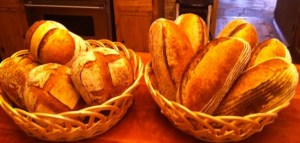
A man I know built himself an oven and bakes bread “the old way,” he told me. He goes about the process meticulously: the flour’s carefully chosen, the right amount of water is used, the fire that bakes the bread is just the right temperature. It takes time, but what a feast results!

Bread

I mentioned to him how so many homilies on the Eucharist from the days when they baked bread “the old way” see profound spiritual mysteries in this same process. The flour represents creation itself; the water and the fire represent the work of the Holy Spirit whom we invoke in this sacrament. “The Sacraments are a privileged way in which nature is taken up by God to become a means of mediating supernatural life.”(Laudato Si 235.) Simple created realities like water, oil, bread and wine speak for all creation.

In our prayer over the bread at Mass we say: “Blessed are you, Lord God of all creation, for through your goodness we received the bread we offer you, fruit of the earth and work of human hands, it will become for us the bread of life.”

The bread we offer, the wine we offer are signs of creation and the human efforts involved in creation. They’re signs of everything that the “God of all creation” gives us and of everything that comes from our hands. “The word bread stands for everything,” Augustine said in one of his commentaries on the Lord’s Prayer. (Epistle to Proba) No wonder Jesus chose these two precious signs to give himself to us.

The bread and wine stand for everything. Think what that means. Scientists say that our universe came into existence about 15 billion years ago. The bread and wine stand for the 15 billion years our universe has been in existence. About 3.5 billion years ago life began on our planet. The bread and wine represent that 3.5 billion years of life on our planet. When they’re brought to the altar the whole universe is brought here. About 200,000 years ago human life emerged on our planet. 200,000 years of human life are represented in the bread and wine. Our lives are part of the human story represented in the bread and wine .

We believe that when Jesus sat down with his disciples at the Last Supper and took bread and wine into his hands he took all creation, all life, all human life into his hands.. “This is my body.” “This is my blood,” he said. He is God in human flesh giving himself to us and to everything that God made. In love poured out, he renews the covenant God makes with us and with creation.

Pope Francis in his letter “Laudato Si.” emphasizes the cosmic dimension of the Eucharist. Our created world is there with the dignity and purpose bestowed on it. As he takes bread and wine into his hands, Jesus takes the whole universe to himself. “ Joined to the incarnate Son, present in the Eucharist, the whole cosmos gives thanks to God. Indeed the Eucharist is itself an act of cosmic love: Yes, cosmic! Because even when it is celebrated on the humble altar of a country church, the Eucha¬rist is always in some way celebrated on the altar of the world. The Eucharist joins heaven and earth; it embraces and penetrates all creation. The world which came forth from God’s hands returns to him in blessed and undivided adoration: in the bread of the Eucharist creation is projected towards divinization, towards the holy wedding feast, towards the unification with the Creator himself.” (LS, 236)

We celebrate this great mystery on the “humble altar” of our church. The created universe as it was, as it is and as it will be is before us. A marvelous sacrament, so simple in appearance and so tremendous in reality.

Ecological Conversion

IMG_0943
Today, September 1st, Pope Francis asks Catholics and all people to pray for the care of creation, the subject of his recent encyclical “Laudato Si.” We may need to pray, if recent surveys are right that claim that American Catholics aren’t much interested in the pope’s recent encyclical. That might be true of Catholics elsewhere as well.

There’s an ecological crisis, the pope says in his letter, and we have to do something about it. Some may deny the crisis exists; some may claim it’s exaggerated; some may just throw up their hands thinking it’s too big to deal with. Some may think it can be easily fixed by the eventual play of “market forces.”

For the pope and many today the ecological crisis is real, it endangers the world and it has to be dealt with now. To meet it Francis recently urged Christians to “first rediscover in our own rich spiritual patrimony the deepest motivations for our concern for the care of creation.”

That’s important advice. The first step is not to immerse ourselves in conclusions of science, although the pope in his encyclical obviously respects scientific conclusions. The ecological crisis is not going to be taken care of with a few quick moves, like changing a couple of light bulbs at home. The first step, the pope says, is to undergo an “ecological conversion” guided by our spiritual patrimony.

Caring for creation isn’t going to be an easy task. People of faith are needed who, in the pope’s words, understand that “living our vocation to be protectors of God’s handiwork is essential to a life of virtue; it is not an optional or a secondary aspect of our Christian experience” (Laudato Si, 217).

In his encyclical the pope looks to the scriptures, from Genesis to the books of the New Testament, to provide wisdom for our steps. He looks to the sacraments, especially the Eucharist, as signs that creation itself figures in God’s plan.

An interesting feature in “Laudato Si” is the way Francis turns to the Eastern Church for guidance to ecological conversion, almost as if he recognizes the weakness of western theology and spirituality. A prayer suggested by the Vatican for today’s prayer service is inspired by the prayers of the Eastern Church:

We praise and bless you, O Lord,
for you are the King of all ages,
and through Christ your Son you have made all that is.
In the beginning of the beginning,
you breathed upon the waters of creation,
and filled the earth with life through your vibrant Spirit.
The heavens declare your glory, O Lord,
and the stars of the sky bring light to our darkness.
You spoke, and the earth burst forth in life,
you saw that it was good.
You called forth creation, and enlivened every creature on land and sea.
You made human beings in your image,
and set us over the whole world in all of its wonders.
You gave us share in your dominion,
and called us “to till and to keep” this garden, the work of your hands.
As day gives way to evening, we praise you for your manifold gifts.
May our adoration this night give glory to your name,
so that we may serve you with faithfulness and love.
May our daily care for your creation show reverence for your name,
and reveal your saving power in every creature under heaven.
We make this prayer in the name of Christ your Son,
in the unity of the Holy Spirit, One God forever and ever. Amen.

Laudato Si

Sower

Be awhile before I get through Pope Francis’ encyclical, Laudato Si, filled as it is with thought provoking words. He says in this encyclical that we need to slow down, our world is too fast paced. This is a work to go through slowly.

He quotes from many sources, religious and secular. I found a little gem in a quotation Francis takes from a Sufi mystic: We need to regain and develop a mystical appreciation of the earth”

[159] The spiritual writer Ali al-Khawas stresses from his own experience the need not to put too much distance between the creatures of the world and the interior experience of God. As he puts it: “Prejudice should not have us criticize those who seek ecstasy in music or poetry. There is a subtle mystery in each of the movements and sounds of this world. The initiate will capture what is being said when the wind blows, the trees sway, water flows, flies buzz, doors creak, birds sing, or in the sound of strings or flutes, the sighs of the sick, the groans of the afflicted…” (EVA DE VITRAY-MEYEROVITCH [ed.], Anthologie du soufisme, Paris 1978, 200).

Francis urges us to feel the pain of our earth and those society ignores, like the unseen immigrants searching for a home somewhere. The Passion of the earth is a theme the Passionists have been addressing recently, influenced by the work of Fr. Thomas Berry, CP, who must be smiling from above at the pope’s efforts.

There’s something for everyone here.

11th Sunday in Ordinary Time: the Environment


Within a week or so we’re expecting the encyclical of Pope Francis on the Environment. An encyclical is a letter that the pope sends to the church throughout the world about a matter of Christian belief or morality or a major concern, like the environment, that’s important for living our lives in this world. As we know, the condition of our natural world is not only a concern of Catholics, it concerns everyone in our world today; it’s also a concern for the world of tomorrow. Many, in fact, are waiting to see what the pope says.

Some people say the environment is really a concern of scientists and politicians and the pope should keep away from the subject and stick to religious questions . But the popes have spoken out strongly on social issues throughout history and particularly in recent times.

At the end of the 19th century, for example, Pope Leo XIII spoke out against the awful conditions of workers in the western world because of the Industrial Revolution. Pope Leo wrote that workers had a right to a just wage and a right to unionize to promote their just interests. The bad conditions in which people were working affected families and their children. The pope was a voice speaking for social justice. (Rerum novarum)

Today, in speaking out on the environment and climate control, Pope Francis is following what recent popes like Pope John Paul and Pope Benedict have already said about the issue. He’s looking are at the world prudently, which is not the same as looking at the world personally, or scientifically, or politically, or economically, or even spiritually.

Let me explain:

Looking at the world prudently is to have a larger vision of a question. Let me give you an example. Suppose today the weather people announced that another hurricane like Sandy was going to hit the Jersey shore in a few days and I lived on the Jersey shore. Suppose they announced that 97% of weather people said it was going to hit. Suppose I said that’s not 100% sure and I decided to say a little prayer and stay in my house.

I would be personally imprudent, don’t you think? We can’t think of an issue as large as the environment only as an individual, a scientist, a politician or an economist. We need scientific, political, economic wisdom, to be sure, but we need a larger vision, a prudential vision that incorporates all of these.

We need prudence today. Unfortunately, we can misunderstand this important virtue. We think prudence is being overly cautious, afraid to act or to change. Prudence is not that at all. Prudence is a virtue that’s not afraid to look at things as they are and react reasonably according to what we know. That’s what the pope will be urging us to do in his encyclical.

We’re living in an age of “expressive individualism,” the philosopher Charles Taylor says. We tend to see the world as a stage to express ourselves. We find it hard to think of and to act in a world bigger than ourselves.

Because of “expressive individualism” we can lose our connection to natural world that supports us with life. One of our most important spiritual tasks today to regain our respect for the earth that God has given us. Because of “expressive individualism” we can lose our connection with the rest of the human family, especially with the poor. I’m sure we will hear all those themes in Pope Francis’ encyclical.

Creation Redeemed


creation
Pope Francis is soon to issue an important encyclical on the environment. Some say that’s none of the church’s business, but creation is the church’s business, In his great treatise “On the Incarnation of the Word ” St. Athanasius says Jesus Christ came to save it.

“The Word of God, incorporeal, incorruptible and immaterial, entered our world. Yet it was not as if he had been remote from it up to that time. For there is no part of the world that was ever without his presence; together with his Father, he continually filled all things and places.

“ Out of his loving-kindness for us he came to us, and we see this in the way he revealed himself openly to us. Taking pity on our weakness, and moved by our corruption, he could not stand aside and see death have the mastery over us; he did not want creation to perish and his Father’s work in fashioning humanity to be in vain. He therefore took to himself a body, no different from our own, for he did not wish simply to be in a body or only to be seen.

“ If he had wanted simply to be seen, he could indeed have taken another, and nobler, body. Instead, he took our body in its reality.”

Jesus Christ, the Word of God, entered into the world of real time and place, Athanasius says.  The world was not a stage he used, to be dismantled and thrown away.  it was a reality he embraced and redeemed. “He is the Word through whom you made the universe; the Savior you sent to  redeem us.” “He became flesh and dwelt among us.”

God’s plan of salvation, then, was not restricted to human beings: “he did not want creation to perish and his Father’s work of fashioning humanity to be in vain.”

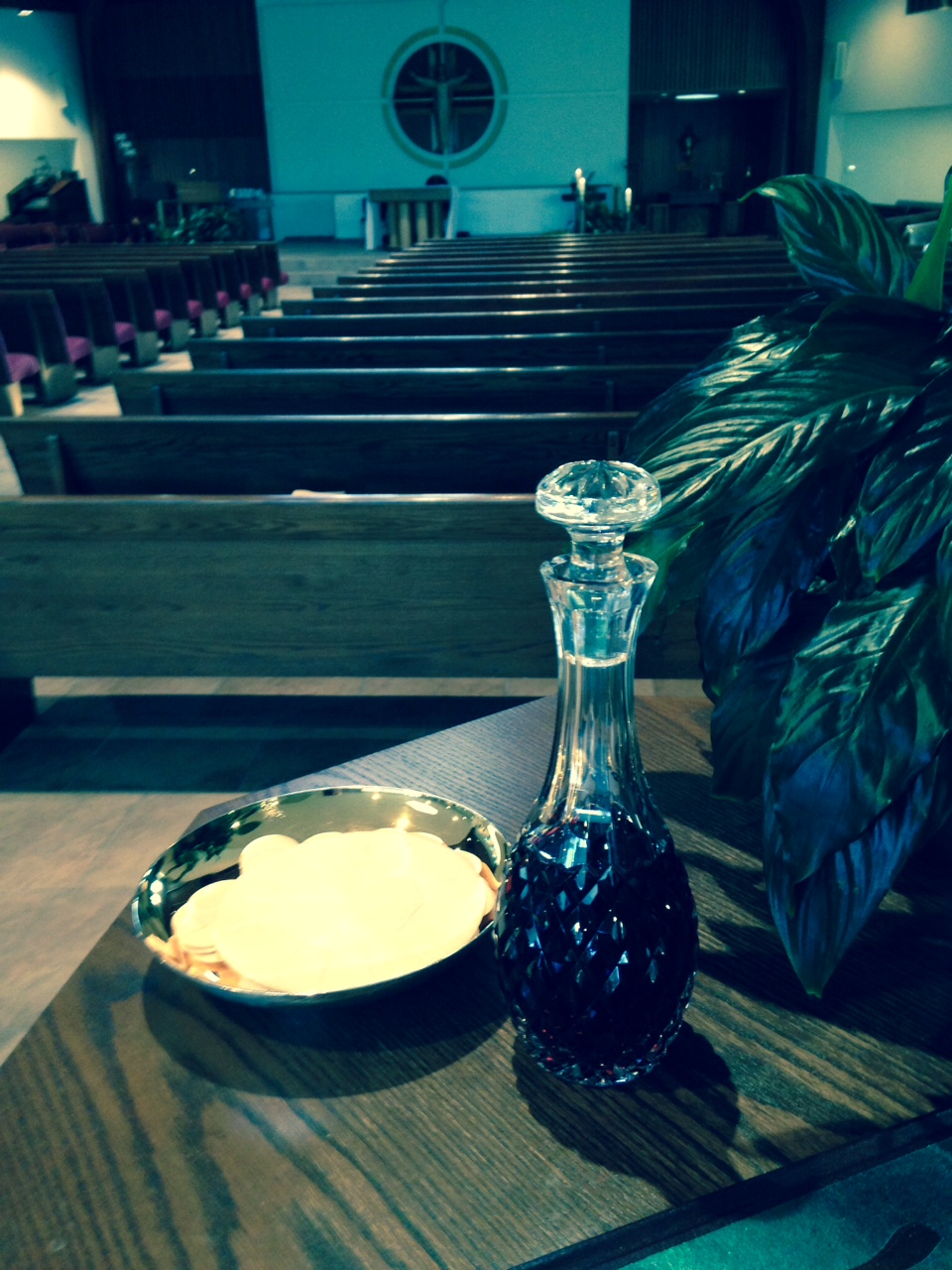
Bread and Wine

photo

The German theologian Romano Guardini years ago recommended in a little book “Sacred Signs” that we let the signs and the words of the liturgy guide our prayer. He was a key figure in initiating recent liturgical reforms in the Catholic Church, which made the signs and prayers of the liturgy better able to communicate the mysteries we celebrate.

I suspect, though, that in our liturgical prayer today the words of the liturgy–the scripture readings and the homily–get more of our attention than the signs.

Maybe we need to pay more attention to signs like bread and wine. They’re sacred signs we can take for granted.

In our prayer over the bread at Mass we say: “Blessed are you, Lord God of all creation, for through your goodness we received the bread we offer you, fruit of the earth and work of human hands, it will become for us the bread of life.” The bread we offer is the fruit of the earth and work of human hands. It’s a sign of all creation, of everything that the “God of all creation” gives us, of everything our hands have fashioned.

“The word bread stands for everything,” Augustine said in one of his commentaries on the Lord’s Prayer. (Epistle to Proba) Early commentators like Tertullian, Cyprian and Origen wrestled with that petition, “Give us this day our daily bread.” Does it mean just the food we eat, or does it mean the wisdom we need? Is Jesus Christ our daily bread? I like Augustine’s explanation because it’s so open-ended.

Scientists say that our universe came into existence about 15 billion years ago. About 3.5 billion years ago life began on our planet. Bread and wine represent that universe; they’re brought to the altar to tell its story.

About 200,000 years ago human life emerged on our planet. 200,000 years of human life are represented in the bread and wine, and our lives are part of the human story represented in bread and wine.

We believe that God created our world and it’s good, according to the Book of Genesis. There’s a plan for this universe, a plan conceived in God’s wisdom and love. In its opening chapters, Genesis poetically describes the beginning of our universe, but then turns quickly to the journey of the human family from its beginnings .

God’s plan, however, involves, not just the human family, but also the universe itself. All creation is waiting for the kingdom of God to be revealed. The bread and wine are signs of it.

Certainly human beings have an important role in the coming of God’s kingdom, as the incarnation of Jesus Christ makes clear. We’re not slaves, cogs in the wheel, as life grinds on. We represent God here in the universe and have to exercise a godlike care of this world. Each of us has a part to play that God’s kingdom come. We share in the promise.

We know too that the mystery of evil is at work in our world, a mystery also represented in the bread and wine. When Jesus took bread into his hands at the Last Supper, he saw a sinful world ready to put him to death, but he still took the bread in his hands. His blood would be poured out, but he still took the chalice to drink from it.

How magnificent is his response. He takes all created reality, all human existence, the goodness and evil of life in his hands, embracing them all with God’s love and care. From his hands he gives them to us, blessed by his presence.

“This is my body.” “This is my blood.” Incarnate in this great universe he gives life to it and to us.

In communion, Jesus gives himself to us in bread and wine, the signs of the world in which we live. We’re to live in that great world and have a role in it to fulfill. The Word made flesh is our bread of life, our food and drink, who gives wisdom and power to us.

Father Thomas Berry, a Passionist priest who taught me long ago, had a passionate love of the universe and a concern that the universe story enrich our way of looking at life. In one of his writings he saw the universe story enriching our understanding of the sacraments. It does.