In one of his poems, “Putting in the Seed,” Robert Frost describes a farmer’s love affair with the earth. It’s getting dark and someone from the house tries fetching him to come in. Supper’s on the table, yet he’s a
“Slave to a springtime passion for the earth. How Love burns through the Putting in the Seed On through the watching for that early birth When, just as the soil tarnishes with weed, The sturdy seedling with arched body comes Shouldering its way and shedding the earth crumbs.”
Can’t you see that farmer zestfully casting seed on the waiting earth, eagerly watching it to grow? Jesus sees the Sower as an image of God, casting saving grace onto the world in season and out, because he loves it so much.
If you have ever been to Galilee and seen the lake and the surrounding lands abundant with crops, you know this is a blessed place. It was in Jesus’ time too. Here, the sower scatters his seed with abandon, hardly caring where it goes: on rocky ground, or amid thorns, or on the soil that gives a good return.
God the Sower sows blessed seed, no matter how badly our human world appears, or how badly it receives. In his parables Jesus acknowledges rejection as well as acceptance, but the sower still sows. Grace is never withheld, and that makes us hope.
And is it just the human world God loves? Doesn’t his love extend to all the earth God calls “good” in the Book of Genesis? We worry about our planet earth, and with reason. How fragile it has become, what damage we careless humans do! We are concerned rightly for its future.
The nature parables we are reading in Mark’s gospel tell us to hope for our earth too. Though it is not immune from the threat of destruction and degradation, God loves it still. He’s a Sower at work. Blessed be the Lord God of all creation, may you sow your blessings on all.
Thanksgiving is a good time to remember our blessings, starting with Creation itself . I’m sure that was Noah’s prayer when God delivered him.
All-powerful God,
you are present in the whole universe
and in the smallest of your creatures.
You embrace with your tenderness all that is.
Pour out upon us the power of your love,
that we may protect life and beauty.
Fill us with peace, that we may live
as brothers and sisters, harming no one.
O God of the poor,
rescue the abandoned
and forgotten of this earth,
so precious in your eyes.
Bring healing to our lives,
that we may protect the world and not prey on it,
that we may sow beauty,
not pollution and destruction.
Touch the hearts
of those who look only for gain
at the expense of the poor and the earth.
Teach us to discover the worth of each thing,
We thank you for being with us each day.
Encourage us, we pray, as we struggle
for justice, love and peace.
We celebrated the feast of Christ the King last Sunday. It’s hard to think of Christ as king in a world where kings are few, at least in our western world. Royal families, where they exist, have mainly ceremonial roles.
Yet, Jesus Christ is king, and what’s more we share in his kingly role. (Catholic Catechism 1546) We’re all priests, prophets and kings by our baptism. “We’re a “chosen race, a royal priesthood, a people set apart,” (1 Peter 2,5)
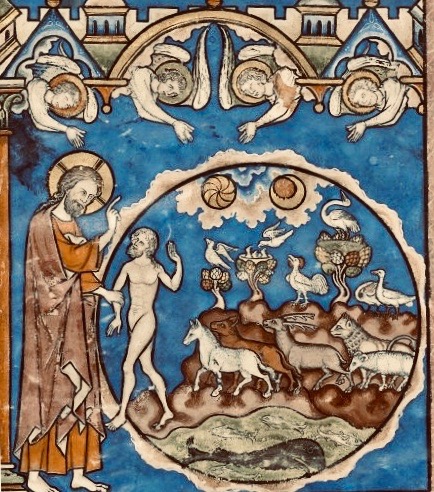
How are we kings? The illustration of Adam, from the Book of Genesis, may tell us. Adam is given kingly powers by God in the garden, the symbol of the created world. He names the animals and is caretaker of God’s creation.
Psalms, like Psalm 8 (Saturday Morning, week 2), remind us that’s our role: When I see the heavens, the work of your hands, The moon and the stars that you arranged, What are we that you keep us in mind,, Mortal as we are that you care for us.
Yet you have made us little less than gods, With glory and honor you crown us, You have give us power over the works of your hand, Put all things under our feet.”
This week’s readings from Daniel and Luke’s Gospel (Friday) seem to predict a world torn apart and discarded when God’s kingdom comes. But that’s not so. Creation itself awaits the promise of resurrection. Jesus Christ is our Savior and we are part of his saving work.
We have been given kingly care over creation. Let’s not forget it. We’re not here just to save ourselves nor is our purpose in life to escape from this world. We’re to care for creation and make it ready for God’s kingdom.
Pooe Leo began an important conference in Rome October1 on the environment with that question posed by Pope Francis ten years ago in his letter Laudao si’.Looks like many of the countries of the world, especially the USA, are turning away from that question. We are absorbed in our wars and political fights.
“ Our Sister Earth cries out, pleading that we take another course. Never have we so hurt and mistreated our common home as we have in the last two hundred years. Yet we are called to be instruments of God our Father, so that our planet might be what he desired when he created it and correspond with his plan for peace, beauty and fullness.
The problem is that we still lack the culture needed to confront this crisis. We lack leadership capable of striking out on new paths and meeting the needs of the present with concern for all and without prejudice towards coming generations. The establishment of a legal framework which can set clear boundaries and ensure the protection of ecosystems has become indispensable; otherwise, the new power structures based on the techno-economic paradigm may overwhelm not only our politics but also freedom and justice.
It is remarkable how weak international political responses have been. The failure of global summits on the environment make it plain that our politics are subject to technology and finance. There are too many special interests, and economic interests easily end up trumping the common good and manipulating information so that their own plans will not be affected. Any genuine attempt by groups within society to introduce change is viewed as a nuisance based on romantic illusions or an obstacle to be circumvented.”
Pope Francis, Laudato SI 54-55
Today at the Vatican Gardens outside Rome evironmental leaders of the world gathered to answer that question: Are we caring for our common home?
One thing to notice about this conference, which involved artists,scientists, politicians, business people, ordinary people. Pope Leo sat among them, not before them, as if to signify their equal task in the care of the environment. They bring an equal wisdom to the challenge of caring for the earth. It’s not just the task of religious people, or a pope. It’s a common task for a common good.
When I was a little boy, on August 15, the Feast of the Assumption of Mary into Heaven, my mother would tell me to go down to the Newark Bay, just a few blocks from my home in Bayonne, NJ, and go into the water. There’s a blessing in the water today, she told me.
I learned later where that custom came from. In medieval Europe the Feast of the Assumption was the day the fields were blessed. The middle of August was harvest time, and on this day herbs were gathered from the fields and brought to the church to be blessed with water. After they were blessed they were brought home to be medicines for the sick. We still get many if not most of our medicines today from herbs.
Customarily, a sprig was placed on the wall where children slept, asking God to keep them healthy and strong.
We will have herbs, a small olive tree, fruits of the earth and flowers before our altar for the feast on August 15 and then we will have a procession to our Mary Garden to bless them..
Many important feasts of our church occur in one of nature’s cycles. The birth of Jesus Christ, December 25, is celebrated as darkness gives way to light in the Western Hemisphere. Easter, the celebration of the death and resurrection of Jesus takes place during the Passover celebration, which occurrs at the spring harvest. Mary’s Assumption, August 15th, falls as the summer harvest begins.
You can see why Mary’s Assumption into heaven is a day to bless herbs and to bless the fields. It’s a feast of life. On this day Mary followed Jesus, her Son, into the mystery of his death and resurrection in a unique way. Mary’s body, her humanity, like the humanity Jesus assumed, like the humanity we all share, came from the earth.
We all come from dust, from creation, and to dust we shall return.“From dust you are, and to dust you shall return,” we are reminded on Ash Wednesday. But the promise we have from Jesus is that this dust will rise again to new life.
Mary witnesses to his promise in a unique was. Mary’s body, like the body of Jesus, never returned to the dust. She was assumed body and soul into heaven to become a sign of bodily resurrection. The promise of resurrection given to her is also given to us. Not only is it given to us, but to all God’s creation. Mary is the sign of a new creation, promised by God.
The first reading for her feast, from the Book of Revelation, describes Mary as a woman “ clothed with the sun, with the moon under her feet, and on her head a crown of twelve stars. She gave birth to a son, a male child, destined to rule all the nations.” After his resurrection, Jesus was enthroned in heaven and Mary was taken up to heaven to join him.
The Assumption of Mary is a time to rejoice in “the resurrection of the body and life everlasting”, the whole created world also rejoices in the promise of a new creation. Listen to Psalm 96:
O sing a new song to the Lord, sing to the Lord all the earth. O sing to the Lord, bless his name. Let the heavens rejoice and earth be glad, let the sea and all within it thunder praise, let the land and all it bears rejoice, all the trees of the wood shout for joy at the presence of the Lord for he comes, he comes to rule the earth.
The Feast of the Assumption of Mary into Heaven offers a future so different than the bleak picture of life we’re tempted to see today. She visits us today as she did her cousin Elizabeth long ago announcing a great mystery. We are called, like Mary, to a heavenly place with Jesus her Son. Our world, so battered with the storms and disease, so threatened by a changing climate, wars and poverty, also sees a glorious future in her assumption into heaven.
Pray for us, O Holy Mother of God, that we may be made worthy of the promises of Christ.
July 4th we celebrate our Independence Day in the USA. Parades, fireworks, speeches, hot dogs. What else? How about the meaning of it all? Today many wonder about the direction our country is taking.
Then there’s this beautiful prayer for the day.
Father of all nations and ages, we recall the day when our country claimed its place among the family of nations; for what has been achieved we give you thanks, for the work that still remains we ask your help, and as you have called us from many peoples to be one nation, grant that, under your providence, our country may share your blessings with all the peoples of the earth. Through our Lord Jesus Christ, your Son, who lives and reigns with you in the unity of the Holy Spirit, one God, for ever and ever.
Tower of Babel. Pieter Bruegel the Elder. 16th century
After the deluge, God renews a covenant with creation, and the descendants of Noah begin to fulfill God’s command “to increase and multiply and fill the earth.”
But then something else happens: human beings want to be together, so they build a city. A common origin and language draws them together, not just as families or clans, but in a larger society. They look for human flourishing in a city. (Genesis 11,1-9)
Unfortunately, they overreach. They want to get their heads into the heavens and so they plan a tower into the sky. Like Adam and Eve reaching for the Tree of the Knowledge of Good and Evil, they want to be like gods, “presuming to do whatever they want,” Their tower becomes a Tower of Babel. It collapses and they’re scattered over the world, leaving their city unfinished.
It’s important to recognize that the Genesis story does not claim God’s against human beings building a city. The bible, in fact, often sees the city as a place favoring human flourishing. In the Book of Jonah, God values the great city of Nineveh. Jesus sees Jerusalem, the Holy City, cherished by the Lord, the place where he dwells. The Spirit descends on his church in the city. The Genesis story sees the city as good, but it can be destroyed by sin and human pride..
The picture at the beginning of this blog is a painting of the Tower of Babel by the 16th century Dutch artist, Pieter Bruegel the Elder. It’s situates Babel in Antwerp, one of the key seaports of the time. Its shaky structure suggests it’s too ambitiously built. Still incomplete, it may not last. So the painter offers a warning against ambition and not caring for people, especially the needy.
It’s interesting to note that Pope Francis encourages mayors from cities to plan well. Commentators say the pope, conscious of a rising isolationism that’s affecting nations and international bodies today, sees cities to be agents for unifying peoples. They’re important places for humans to flourish. The United Nations also sees cities as key resources in the challenge that comes with climate change.
The picture at the end? You don’t have to be told. A great city. Still, its greatness will be judged, not by its big buildings or businesses, but how it encourages human flourishing.
The LORD God said: “It is not good for the man to be alone. I will make a suitable partner for him.” (Genesis 2,18)
We usually rush on when we hear these words to the creation of Eve, who becomes “bone of my bone, flesh of my flesh” for Adam, and the human story begins.
But the Genesis account we read today and the medieval artist above remind us that God first “formed out the ground various wild animals and various birds of the air, and he brought them to the man… but none proved to be the suitable partner for the man.” (Genesis 2,19 ff)
Adam signals to God these new creatures are not enough, but does he dismiss them altogether for Eve?
Whether we realize it or not, we are not meant to be isolated individuals on this planet. We look for human companionship and friendship. But are human beings our only relationship. Besides caring for each other, we have destiny to care for all the creatures Adam names. They’re our partners too and we share this common home with them.
The land where Jesus lived spoke to him and inspired so many of his parables. The sea did too.
Jesus went out along the sea. All the crowd came to him and he taught them. As he passed by, he saw Levi, son of Alphaeus, sitting at the customs post. Jesus said to him, “Follow me.” And he got up and followed Jesus. (Mark 2:13)
From the Jordan where he heard his Father’s voice and the Spirit rested on him, Jesus went to Capernaum on the Sea of Galilee where he taught crowds and called disciples.
I remember looking quietly on the waters of the Sea of Galilee years ago on a visit.. At night a stillness centuries old takes over. The waters of the Jordan flow into it on their way to the Dead Sea. The river winds almost 200 miles from the Golan mountains in the north into the Sea of Galilee, then on to the Dead Sea in the south, a direct distance of about 60 miles. The river falls almost 3,000 feet on its way to the Dead Sea,.
.Jesus’ ministry began in the Jordan River. The waters spoke to him more strongly than they do to us today. The Jordan was sacred to the Jews from the time they miraculously crossed it on their way to the Promised Land. The great Jewish prophet Elijah came from a town near the river’s banks. Later he sought safety from his enemies there.
Elijah’s successor, the Prophet Elisha, also came from the Jordan. He told the Syrian general Namann to bathe in the river to be cured of his leprosy, and he was cured. Ancient hot springs near Tiberias on the Sea of Galilee still witness to the river’s curative powers.
At the time of Jesus, the river’s fresh flowing waters were the life-blood of the land, making the Sea of Galilee teem with fish and the plains along its banks fertile for agriculture. Pilgrims from Galilee followed the Jordan on their way to Jericho and then to Jerusalem and its temple. The river always spoke of life.
The Jordan Today
The river is still life to the region. It’s the primary source of its drinking water and crucial for its agriculture. Its water is a major point of controversy today between Israel and its Arab neighbors.
Nourishing Prophets
The Jordan nourished prophets. Somewhere near Jericho John the Baptist preached to and baptized pilgrims going to the Holy City. The place– hardly a desert as we may think of it– offered enough food for survival, like the “ grass-hoppers and wild honey” John ate. It was also an uncultivated place that taught you to depend on what God provided.
Jesus taught this too. “I tell you do not worry about your life, what you will eat, or drink, or about your body, what you will wear… Your heavenly Father knows that you need them all.” (Mt 6, 25 ff) The desert was a place for learning to put worry aside and trust in the goodness of God.
Water is a sign of life. When Jesus entered the waters of the Jordan, he acknowledged his heavenly Father as the ultimate Source of Life, the creator of all things. Like the prophets Elijah and John the Baptist, Jesus remained in this wilderness near the water for forty days before his divine mission. He also baptized and taught there with his first disciples. He readied himself there to depend on God for everything.
The Jordan after Jesus
Later, when the Roman empire accepted Christianity in the 4th century, Christians came to the Jordan River in great numbers on Easter and on the Feast of the Epiphany to remember the One baptized there. They bathed in the sacred waters, and many took some of it home in small containers.
Early Christian pilgrims like Egeria, a nun from Gaul who came to the Holy Land around the year 415 AD, left an account of her visit to the Jordan where Jesus was baptized. Monks who settled near the river knew a place called Salim, near Jericho. The town, associated with the priest Melchisedech, was surrounded by fertile land with a revered spring that flowed into the Jordan close by. Here’s Egeria’s description:
“We came to a very beautiful fruit orchard, in the center of which the priest showed us a spring of the very purest and best water, which gives rise to a real stream. In front of the spring there is a sort of pool where it seems that St. John the Baptist administered baptism. Then the saintly priest said to us: ‘To this day this garden is known as the garden of St. John.’ There are many other brothers, holy monks coming from various places, who come to wash in that spring.
“The saintly priest also told us that even today all those who are to be baptized in this village, that is in the church of Melchisedech, are always baptized in this very spring at Easter; they return very early by candlelight with the clergy and the monks, singing psalms and antiphons; and all who have been baptized are led back early from the spring to the church of Melchisedech.”
A 19th Century Pilgrim at the Jordan
Christians in great numbers visited the Jordan River. Towards the end of the 19th century, an English vicar, Cunningham Geikie, described Christian pilgrims following the venerable tradition of visiting its waters.
“Holy water is traditionally carried away by ship masters visiting the river as pilgrims to sprinkle their ships before a voyage; and we are told that all pilgrims alike went into the water wearing a linen garment, which they sacredly preserved as a winding sheet to be wrapped around them at their death.
“The scene of the yearly bathing of pilgrims now is near the ford, about two miles above the Dead Sea, each sect having its own particular spot, which it fondly believes to be exactly where our Savior was baptized…
“Each Easter Monday thousands of pilgrims start, in a great caravan, from Jerusalem, under the protection of the Turkish government; a white flag and loud music going before them, while Turkish soldiers, with the green standard of the prophet, close the long procession. On the Greek Easter Monday, the same spectacle is repeated, four or five thousand pilgrims joining in the second caravan. Formerly the numbers going to the Jordan each year was much greater, from fifteen to twenty thousand….”(Cunningham Geikie, The Holy Land and the Bible,Vol 2, New York, 1890 pp 404-405)
The Jordan and Christian Baptism
Today, every Catholic parish church has its baptistery where the mystery of the baptism of Jesus is celebrated for new believers. Some eastern Christian churches call their baptisteries simply “the Jordan.”
Today the site of Jesus’ Baptism, according to archeologists, is in Jordanian territory at el-Maghtas, where a large church and pilgrim center has been built following excavations begun in 1996 by Jordanian archeologists. It is probably the “Bethany beyond the Jordan” mentioned in the New Testament where Jesus was baptized and John the Baptist preached.
The Jordan River offers its own commentary on the mystery of death and resurrection of Jesus, expressed in his baptism. At one end of the river is the Sea of Galilee brimming with life, and at the other end is the Dead Sea a symbol of death. The river holds these two realities together, and if we reverse its course we can see the gift God gives us through Jesus Christ.
Like him, we pass through the waters of baptism from death to life.
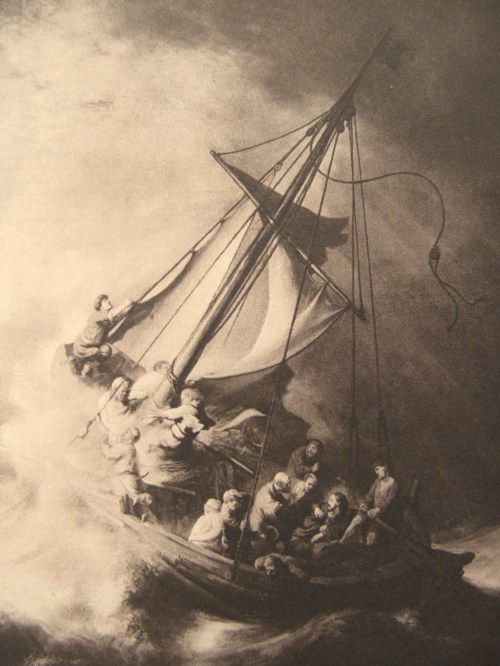
The giant waves on the Sea of Galilee in Rembrandt painting would be hard to survive, let alone walk on, but that’s what Jesus did, Matthew’s gospel today tells us. Jesus walked on the waters and tamed them. Only God does that, the psalms say.
“You uphold the mountains with your strength. You are girded with power. You still the roaring of the seas And the roaring of their waves, And the tumult of the peoples. “ Psalm 65
We usually read the stories of the disciples in the storm at sea as stories of rescue, and they are. God saves us from the storms we face on our life journey. But first, the stories testify to Jesus’ mastery over creation. On the shore his power touched human beings, like the leper, the deaf and those who could not speak; on the sea he rules creation. “Truly, you are the Son of God,” his disciples say after he gets into the boat and the wind dies down. (Matthew 14,22-36)
In his encyclical on the environment “Laudato Si” Pope Francis emphasizes the power of God over creation. As creator and savior, God gives all things their dignity and purpose. Human beings are not lords of this world, God alone is.
The story of Peter in our gospel takes on new interest in that perspective. Jesus invites him to walk on the water, giving him a share in God’s power. But Peter’s fear and lack of faith overcomes him. He begins to sink.
In our unfolding environmental crisis (storms, winds, floods) are we like Peter, called to share God’s power but turning away from our responsibility to calm the waters? Too big for us to take on. If that’s so, we sink.





 The Victor's Place