Tag Archives: Cross

Friday Thoughts: A Cross-Shaped Shadow

But Jesus cried out again in a loud voice, and gave up his spirit. And behold, the veil of the sanctuary was torn in two from top to bottom. The earth quaked, rocks were split, tombs were opened, and the bodies of many saints who had fallen asleep were raised.

—Matthew 27:50-52

.

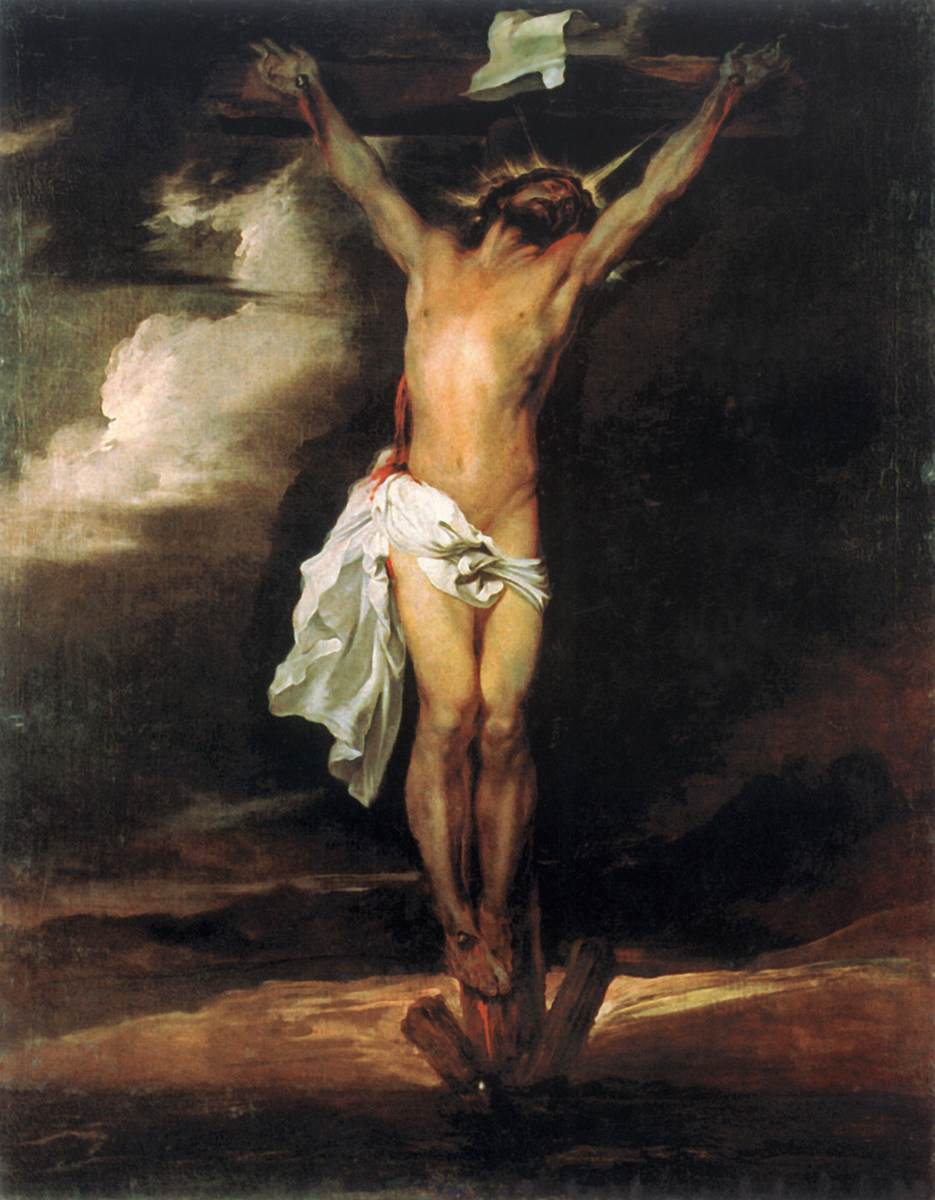
Van Dyck, “Crucifixion” (1622)

.

Get close to the Cross, so close that you stand in its shadow.

It is then that you feel the earth quake and your faith deepen.

It is then that you witness salvation pouring forth from His wounds.

.

.“Clearly this man was the son of God!”

—Mark 15:39


..

—Howard Hain

.

Mission: St. Joseph, Keyport, NJ

IMG_1100

I’m leading a 3 day mission at St. Joseph Parish in snowy Keyport, New Jersey, ending Ash Wednesday. The theme of the mission is: Following Jesus Christ. Last night, we remembered how Jesus called others to follow him into the world. Parishioners read from the call of the disciples from St. John’s gospel and I spoke about the way Jesus in Mark’s gospel led his disciples into the town of Capernaum, into its synagogue, the house of Peter and then on the road where they met a leper.

Today Jesus calls us to go with him into our world, into our towns and cities, our churches, our homes and along the road where we meet the poor, the lepers of today. He’s leading us there.

In the catechesis I suggested we look again at the simple ways we were taught to pray, like the Sign of the Cross and the Our Father. In prayer we come know Jesus Christ. For our closing rite we held lighted candles, symbols of our baptismal call. We listened to a wonderful testimony from a couple who returned to church recently; the choir provided inspirational music. Afterwards there were refreshments in the parish hall.

Praching (2)

Tonight we turn to the Passion story of Mark. In our catechesis I suggested reading the bible during Lent, because we can know Jesus Christ through the bible. In recent times our understanding of the bible has grown as archeologists, historians and other studies enlarge what we know of the world Jesus lived in and the early writings that tell of him. The New American Bible Revised Edition is a good choice to read because it contains the same translations read in the liturgy and its notes are up to date and well written.

Knowing more about the books of the bible can help us understand them better. For example, the Gospel of Mark, generally considered the earliest gospel, was probably written in Rome for Christians who had been shaken by a fierce, unexpected persecution under the Emperor Nero. The persecutions caused Roman Christians to question their faith in the light of this absurd injustice.

Mark’s gospel doesn’t answer their questions. Instead, it presents the innocent Jesus as he faces suffering and death holding on to a belief he is in his Father’s care. From death, he will rise again.

Tonight we read from the story of the Passion of Jesus in Mark and reflect on its meaning. We’ll also hear a testimony from one of our young parishioners here at St Joseph’s and be given a small cross as a reminder of Jesus’ words, “Take up your cross and follow me.”

Mother of Sorrows

Mary sorrow

We remember the sorrows of Mary on September 15th, the day after the church celebrates the Feast of the Exaltation of the Cross. In John’s Gospel Mary stands bravely close to Jesus while others flee the dark happenings on Calvary. Standing beneath the cross of her dying Son was certainly her greatest sorrow.

Her sorrows were not confined to Calvary, however. They began earlier.  Early in Luke’s gospel, the priest Simeon in the temple, taking the Child Jesus in his arms tells Mary this child will cause a sword to pierce her heart. His words were etched in her mind as she left the temple holding her endangered Child. Fleeing to Egypt, she protected him in her arms. Later, she sought him anxiously when he was lost on a Jerusalem pilgrimage.

These were hardly all the sorrows she faced, though. What of her long waiting in Nazareth, not knowing all to expect? What of the years her Son ministered in Galilee, when he faced rejection even from his own family? What of the ominous journey to Jerusalem? Those years brought, not physical sufferings, but sufferings of another kind.

Mary’s sorrows were the sorrows of her Son. Mary’s cross was a daily one she bore day by day.  “O Lady Mary, thy bright crown is no mere crown of majesty. With the reflect of his own resplendent thorns, Christ circled thee.” (Francis Thompson)

Mary teaches us  that our sorrows, whatever they may be, reflect the Cross of Jesus. They will not crush us or beat us down; they lift us up to glory.

An Electrifying Image

photo

Last Wednesday in St. Peter’s Square, the Pope embraced and kissed a man suffering from a rare disease called neurofibromatosis, which causes his skin to be covered with awful tumors and sores. Most people would find it hard to look at him; much harder to embrace him.

A writer in the New Yorker Magazine said “The image was electrifying, in a way that mercy can be.”

That phrase is also true of the image at the center of our faith.

Tell Us

We have had names for you:

The Thunderer, the Almighty

Hunter, Lord of the snowflake

and the sabre-toothed tiger.

One name we have held back

unable to reconcile it

with the mosquito, the tidal wave,

the black hole into which

time will fall. You have answered

us with the image of yourself

on a hewn tree, suffering

injustice, pardoning it;

pointing as though in either

direction; horrifying us

with the possibility of dislocation.

Ah, love, with your arms out

wide, tell us how much more

they must still be stretched

to embrace a universe drawing

away from us at the speed of light.

R.S.THOMAS, from: The SPCK Book of Christian Prayer, London, 1995

Good Friday

We solemnly celebrate the death and Resurrection of our Lord on Holy Thursday, Good Friday, and Holy Saturday, using the simplest of signs.

On Holy Thursday Jesus knelt before his disciples and washed their feet. At table he gave them in bread and wine his own body and blood as signs of his love for them and for all humanity.

On Good Friday we take another symbol, the cross, a powerful sign of death, which first struck fear into the hearts of Jesus’ disciples, but then as they recalled the Lord’s journey from the garden to Calvary, as they saw the empty tomb, as they were taught by the Risen Jesus himself, they began to see that God can conquer even death itself.

On this day, we read the memories of John, the Lord’s disciple, who followed him from the Sea of Galilee, to Jerusalem, its temple and its feasts, to Calvary where he stood with the women and watched the Lord die. Like the others, he recoiled before it all, but then saw signs of victory even in the garden, in the judgment hall, before Pilate, and finally in the cross itself.

On this darkest of days, Christ’s victory is proclaimed in John’s Gospel.

“ Go into my opened side,

Opened by the spear,

Go within and there abide

For my love is here” (St. Paul of the Cross, Letter, September 5, 1740).

My Thoughts are not Your Thoughts

Last Sunday religion played a part in the tenth anniversary of 9/11, though some wanted to be silent about it. At the anniversary ceremonies, we heard words of belief among the questions and the tears.

Religion always has a role when something tragic like 9/11 happens. That’s because a tragedy like that– and it was tragic on a grand scale– is something we can’t measure or understand, and so we look for meaning and support in a power and a wisdom beyond our own.

People from many religious traditions died in that tragedy, and many turned to their own religious traditions for support. Of course, some had nothing to turn to.

As Christians we believe that God’s not silent in tragedy. God speaks to us through Jesus Christ, his Son. Yet, even so,  God’s wisdom is not so easy to understand.

“For my thoughts are not your thoughts,

nor are your ways my ways, says the LORD.

As high as the heavens are above the earth,

so high are my ways above your ways

and my thoughts above your thoughts.”  Isaiah 55, 8-9

In situations as simple as that described in today’s gospel, the parable of the workers in the vineyard, God’s ways are not our ways.  They’re higher and deeper.

At the heart of the tragedy of 9/11 is the mystery of death,  a reality common to all that lives.  Nature in our part of the world is now  experiencing a kind of dying as leaves turn and fall. We human beings die too, but death for us is different than it is for the rest of the natural world. We have a strong unique desire for life within us, for our lives to continue, and that makes us different.

Death happens to us in many ways. Some of us will die from natural causes, like sickness or old age. Some may die in accidents, earthquakes, floods. And then, some die because other human beings cause their death. That’s what happened at 9/11. That’s what makes that event so tragic; an evil injustice caused them to die.

Over the ages, there’s been a lot of reflection about death. Of course, today we don’t like to talk much about it. It’s become a taboo in our society.

But for Christians, death is important. The heart of our faith is about death and resurrection, which we see in the death and resurrection of Jesus Christ. We hear about  it over and over in our liturgy. And we reflect on it.

Some theologians, reflecting on sources like  St. Paul’s Letter to the Romans (Chapters 4-5), speculate that in the beginning God planned death of another kind for the human race, before sin intervened. If human sin had not entered the world, they suggest , maybe human beings like us would reach a climactic moment in the normal course of our lives when God would invite us to another higher life. It would be an invitation we’d welcome, we’d freely choose it, sure that a new and better existence waits for us with our Creator.

But it was human sin that darkened that moment in the beginning and made it the death we know now. So, instead of an experience of joy and adventure and new beginnings,  death became for the human family a moment of fear and suffering.

We believe Jesus came as our Savior and Redeemer to enter that dark, fearful moment and change it to a moment of salvation. “Dying, you destroyed our death; Rising, you restored our life,” we say in our liturgy.

To save and redeem us, Jesus truly experienced death in all its ferocity. The gospels clearly say he did.  Jesus faced a death,  not from old age or from sickness, not from some act of nature, but from sinners. He was put to death by evil injustice. It was death at its worst that he faced.  But when he died, he conquered death and evil and gave us hope by rising again. He “destroyed our death” we say.

He gives us now the power to face death, to go through the moment of death, even at its worst, and to know resurrection. He’s there at the moment of our death; he’s there with all who die; he’s there as our Savior and Redeemer. None of us dies alone.

After the tragedy of 9/11 you may remember they found a cross of twisted steel from the   wreckage of the World Trade Center and placed in the ruins. I think that cross hangs now outside St.Peter’s Church a few blocks away. For religious reasons, of course, it probably will remain there.

But the wisdom of that Cross, hard as it is for us to understand, speaks to that tragic place. His ways are not our ways, his thoughts not our thoughts, but God is not silent, God speaks  in the death and resurrection of his Son.
The World Trade Cross

I’m not sure what they’ll do with the Cross at St. Peter’s Church on Barclay Street,  salvaged from the ruins of the World Trade site after September 11, 2001, but it would be sad to lose the wisdom that mystery offers. We need it.

After Jesus Christ crossed over to the Garden of Gethsemane that Thursday evening centuries ago, he began his hard journey to death by praying in the garden.  Jesus faced  “the primordial experience of fear, quaking in the face of the power of death, in terror before the abyss of nothingness that makes him tremble to the point that, in Luke’s account, ‘his sweat falls to the ground like drops of blood.’ (Luke 22,44)”

He faced an unnatural death that caused a “ particular horror felt by him who is Life itself before the abyss of the full power of destruction, evil, and enmity with God that is now unleashed upon him, that he now takes directly upon himself, or rather into himself, to the point that he is ‘made to be sin’ ( 2 Cor 5.21)… Because he is the Son, he sees with total clarity the whole foul flood of evil, all the power of lies and pride, all the wiles and cruelty of the evil that masks itself as life yet constantly serves to destroy, debase, and crush life.” (Jesus of Nazareth, Part 2, Benedict XVI)

The World Trade Center Tragedy wasn’t caused by an earthquake, a hurricane, some natural cause. Human beings caused it, just as human beings were responsible for the passion and death of Jesus.

Jesus disciples took up their swords when his enemies came to arrest him in the garden, but he told them, “Put your sword into its place. Those who take up the sword will perish by the sword.” After ten years of wars, in Iraq and Afghanistan and Pakistan, it might be time to put up our swords too.

You can’t fight evil by violence.

We live in a time that has largely forgotten the Passion of Jesus, but it’s still the wisdom and power of God. We shouldn’t put the Cross aside.

His Own Received Him Not

Lk 4:24-30

Jesus said to the people in the synagogue at Nazareth:
“Amen, I say to you,
no prophet is accepted in his own native place.
Indeed, I tell you, there were many widows in Israel
in the days of Elijah
when the sky was closed for three and a half years
and a severe famine spread over the entire land.
It was to none of these that Elijah was sent,
but only to a widow in Zarephath in the land of Sidon.
Again, there were many lepers in Israel
during the time of Elisha the prophet;
yet not one of them was cleansed, but only Naaman the Syrian.”
When the people in the synagogue heard this,
they were all filled with fury.
They rose up, drove him out of the town,
and led him to the brow of the hill
on which their town had been built,
to hurl him down headlong.
But he passed through the midst of them and went away.

Monday, 3rd week of Lent

The gospel from Luke brings us back to Nazareth, where Jesus lived most of his life among “his own.” Yet when he began his ministry in the synagogue at Nazareth, his own strongly reject him.  It’s hard to see how Jesus would not carry the hurt of that rejection with him;  how could he forget it?

According to Matthew’s gospel, the crowds that welcome him to Jerusalem on Palm Sunday call him “the prophet Jesus from Nazareth in Galilee.”  But  few disciples from Nazareth follow him into Jerusalem; a couple of women from there will stand by his cross as he dies. From what we know of Nazareth and its subsequent history, Jesus did not find much acceptance there. “He came to his own and his own received him not.”

To prepare us to enter the great mystery of Jesus’ death and resurrection, the lenten gospels  help us understand the one who took on himself our sorrows. They also help us see what our own participation in that mystery will be like. Can rejection by our own be one of them?

Ash Wednesday and Mystical Death

An excerpt from a letter of St. Paul of the Cross about mystical death may help us celebrate Ash Wednesday.

“Life for true servants and friends of God means dying every day: ‘We die daily; for you are dead and your life is hidden with Christ in God.’ This is the mystical death I want you to undergo.

I’m confident that you will be reborn to a new life in the sacred mysteries of Jesus Christ, as you die mystically in Christ more and more each day, in the depths of the Divinity. Let your life be hidden with Christ in God…

Think about mystical death. Dying mystically means thinking only of living a divine life, desiring only God, accepting all that God sends and not worrying about it. It means ignoring everything else so that God can work in your soul, in the sanctuary of your soul, where no creature, angelic or human, can go. There you experience God working and being born as you mystically die.

But I’m in a hurry, and this note is getting too mystical, so listen to it with a grain of salt, because we don’t get it.”    (Letter, Dec 28, 1758)

On Ash Wednesday, ashes are placed on our foreheads in the form of a cross and some simple words are said: “Remember you are dust and to dust you shall return.”

A reminder we will die. Yet, so much more is said in this brief symbolic act. A daily mystical death is also taking place within us. Our physical life will end, the ashes tell us;  the day and hour are unknown. But ashes in the form of a cross tell us Jesus Christ changes death. “Dying, you destroyed our death. Rising, you restored our life.” Jesus Christ has made his risen life ours. Though his gift is hidden, we will experience it when we enter his glory.

Meanwhile, the mystery of his death and resurrection is at work in us now. Share this mystery mystically,  St. Paul of the Cross says in the letter quoted above. Daily, deliberately, attentively turn to God working within you. A new life is being born in you, though you may not see it.  Desire it, accept it in whatever God sends, without worry. God is working within through the mystery of the Lord’s cross.

Yet the saint, like the rest of us, has to hurry off to something else. He’s going somewhere, or has something to do, or someone to see, and he tells his correspondent that you can’t think about deep things too long. It’s a mystery beyond us.

And so, we only glimpse this mystery as ashes are placed on us. Still, may we hear the Lord’s voice in the day’s readings and in the signs of the liturgy. Ash Wednesday is an ambassador sent by God reminding us of his work for us; he will send his graces through the days of Lent and Easter. Yes, through all the days of our life.

Let us embrace his cross each day and die mystically and be born anew.

If you’re interested in more on Ash Wednesday and Lent, go here.