Tag Archives: Christmas

The Holy Family


Luke 2,41-52

For most people, Christmas is over– the music’s stopped; Santa Claus is gone from the malls. The decorations are down and put away. It’s over.

But in church Christmas isn’t over. We’re still singing  carols and continue to celebrate as we think  about what it means when we say “our God was made visible.”

Today’s the feast of the Holy Family. The Word was made flesh, and as the child of Mary and Joseph Jesus was part of a family in the small town of Nazareth in  hills of  Galilee.

For one thing, families then were extended families or clans, living close together and working side by side. Archeological excavations in Nazareth and Capernaum (pictures below) make that clear. Families worked together in the fields or in  business, they ate together and moved together, as they still do in parts of the Middle East and elsewhere today.

holy familyCapernaumruinsDSC00062

It’s safe to say that nuclear families didn’t exist then. A nuclear family– mother, father and children– is a modern form of family life. Mary, Joseph and the Child Jesus were not all by themselves in a small house in Nazareth. Rather, Jesus was raised in an extended family where  grandfathers and grandmothers, uncles, aunts and cousins lived together and were involved in bringing him up.

That doesn’t take away the part Mary and Joseph played in his upbringing, of course. They weren’t props, standing by while angels brought him up. Some of the apocryphal gospels – early stories about Jesus which the church rejected  – seem to say that.  One  story describes the Child Jesus forming  the figure of a bird from clay, then breathing on it, and instantly it becomes a living bird and flies away. Stories like that presented him exercising  miraculous powers as a child.

The church rejected those stories because they gave a  false picture of Jesus growing up. He “was subject” to Mary and Joseph, the gospel of Luke says. He grew up in their care as an ordinary child would.

Like mothers and fathers everywhere, they saw to his needs, they held him in their arms,  fed him, clothed him,  stayed up at night when he was sick. They taught him his first words,  guided his first steps,  nudged him along this way and that.

They  brought him to church–the synagogue, the temple–as we see in today’s gospel from Luke. They instructed him in his tradition. They taught him to pray,  interpreted events for him,  listened to his questions,  encouraged him over and over. They had their misunderstandings, as today’s gospel  indicates. In fact, they  influenced his life.

Yes, angels were there, but at a distance.  Mary and Joseph and that larger family and village around him raised the Child.

Today’s  feast of the Holy Family takes in the years of Jesus’ childhood and early adult life called his “Hidden Life.” His  years in that nondescript town among those ordinary people were truly hidden, yet were they less important than his Public Life, the few years he taught and did great miracles,  suffered and died and rose from the dead? In those hidden years “he humbled himself.”  A hidden life is important; it’s what mostly characterizes life in a family.

We need to think about family life today, because it’s in trouble.  For one thing, the nuclear family– father, mother, children– is  in trouble. I read some disturbing statistics recently. In every state in our country, families where children have two parents have declined significantly in the last 10 years. One of three children live in a home without a father. Almost 5 million children live in a home without a mother. A single mother may have an income of $24,000. Two parents are likely to have an income significantly greater.

What can we do? How can we help? Feasts  like the Holy Family focus our attention on important things.  They remind us what’s important in God’s eyes. The feast of the Holy Family focuses on the family. It’s important, it says.  At the same time, it tells us God’s grace will be ours when we work to make families go and when we support them all we can.  God points to family life today. It’s vitally important in our world.
Morning Thoughts: Wise as Doves

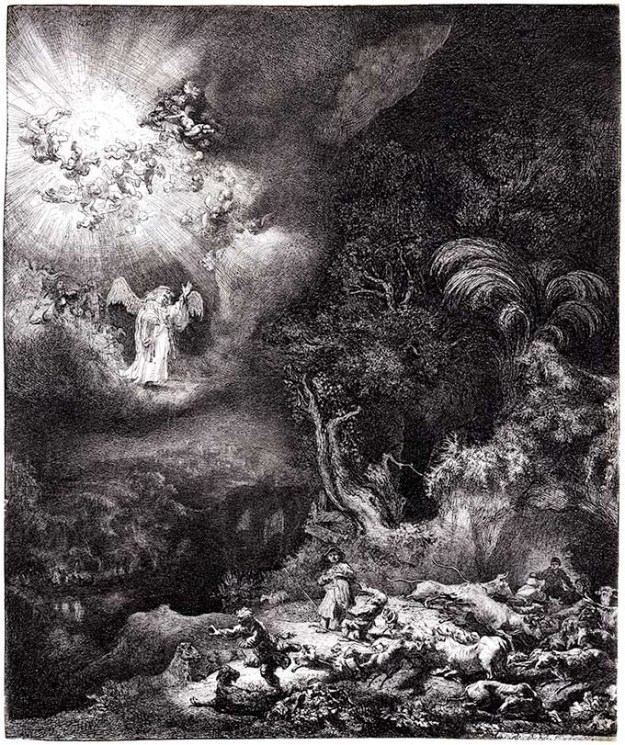
rembrandt-angel-appearing-to-the-shepherds-1634

Rembrandt, “The Angel Appearing to the Shepherds”, 1634

 .

Now there were shepherds in that region living in the fields and keeping the night watch over their flock. The angel of the Lord appeared to them and the glory of the Lord shone around them, and they were struck with great fear.

—Luke 2:8-9


.

Perhaps the scariest thing to those of us who cling tightly to the things of the world is to accept the job that the Lord assigns us.

Oh, how so many of us are so quick to long for greater adventure!

Yet, when it comes to those humble, little shepherds to whom the angel of the Lord appeared, we are perhaps even quicker to long to be one of them—sitting quietly upon a gentle hillside, effortlessly tending to a passive flock, while the always-full moon provides a soft, ever-so-appropriate illumination from above.

But we are liars. For there’s nothing less romantic in each one of our daily lives, or more mundane. We simply have to be honest, or at least consistent. It all depends on how we look at it. If we see the shepherds in such a delicate light then we also need to see ourselves in the same. For before the angel appears, the shepherds were hardly posing for picturesque landscapes. Perhaps it is for this very reason—their realness, their authenticity, their holy simplicity—that the Lord chose them to be present when He revealed His glory.

It is exciting. We have a wonderful choice, then. Either our “boring” lives make us just the kind of people to whom God prefers to reveal Himself, or our lives are a lot more “exciting” than we ever imagined. Either way, what is vital to making such a decision is true sincerity and genuine gratitude. We need to thank God for who He has made us, for where He has placed us, and for what type of task He has assigned us.

A faithful, humble heart dreams and believes and sees great things among the most ordinary circumstances. Just look at the young virgin and the upright carpenter to whom the shepherds “went in haste” to find in a stable, adoring a child born within the company of the “lowest” of men.

If we spend our time dreaming of being someone else, living somewhere else, and doing something else, we miss the opportunity of being exactly who God intends us to be—and when that happens—we are always in the wrong place, at the wrong time, and most tragically, doing that which matters very little.

For to be the first on the scene, the first to “lay hold”, the first to adore the New Born King, is as good as it gets—even for those whose “normal existence” isn’t standing around all alone—day after day in the scorching sun or biting cold, while picking fleas from matted-down fleece or scaring off hungry wolves.


.

The angel said to them, “Do not be afraid; for behold, I proclaim to you good news of great joy that will be for all the people…”

So they went in haste and found Mary and Joseph, and the infant lying in the manger. When they saw this, they made known the message that had been told them about this child. All who heard it were amazed by what had been told them by the shepherds.

Then the shepherds returned, glorifying and praising God for all they had heard and seen, just as it had been told to them.

—Luke, Chapter 2:10,16-18,20


.

—Howard Hain

.

The Wonder of Christmas

To listen to today’s homily, please select the audio file below:

“I wonder as I wander out under the sky,

why Jesus, our Savior, was born for to die,

for poor, orn’ry people like you and like I

I wonder as I wander out under the sky.”

Wonder is a Christmas word;  we hear it in the carols we sing and in the words we hear and in the prayers we say.  Wonder is our reaction to something  beyond what we expect, beyond our experience and our understanding,  so big it leaves us lost for words.

We need wonder these days to lift up our minds and hearts.

Listen to the gospel story from St. Luke:

‘In those days a decree went out from Caesar Augustus that the whole world should be enrolled.” Caesar Augustus, the ruler of the world gives an order. “Quirinius was governor of Syria.” Quirinius , Caesar’s enforcer for Palestine, orders his jurisdiction to be counted. The mighty and the powerful of this world have spoken.

But the high and mighty, the politicians, the generals, the money people don’t impress Luke. Rather, his eyes are drawn to a couple in the multitude being enrolled,  a couple from an insignificant town in Galilee called Nazareth– Joseph and  his betrothed wife Mary, who was with child. They’re  on their way to Bethlehem.

“While they were there, the time came for her to have her child, and she gave birth to her firstborn son. She wrapped him in swaddling clothes and laid him in a manger,because there was no room for them in the inn.”

Luke goes on in his gospel to tell about this child born in Bethlehem, who grows up in Nazareth, who begins to preach and work marvels in Galilee, who gathers excited followers and then goes up to Jerusalem where he’s arrested, sentenced to death, crucified, then  raised from the dead. Luke goes on to describe the followers of Jesus who take his message to the ends of the earth and to us today.

That marvelous story begins in Bethlehem,  where a Child in swaddling clothes is laid in a manger, because there’s no room in the inn. That marvelous story goes on. It changes the way we look at ourselves and the world in which we live. God is quietly at work in our world, unnoticed, unacknowledges, God is with us.

There’s wonder in this story, a wondrous love’s behind it. This Child is God become like us, like “poor, orn’ry creatures like you and like I.” So unexpected, so beyond our experience and understanding, beyond words.

Today’s a day that calls us to wonder. Let’s not lose that gift that takes us beyond where we are. Begin with the world in which we live, the world around us as we “wander out under the sky.”  However difficult and dark this world can be, there’s a wonder to it. We’ve been gifted with the wonderful gift of life, which we carry in the flesh and blood that is ours, the gift of life we have in our families and our friends and all of those around us. Let’s not take them for granted.

Then, there’s the gift of God we remember today, a God not distant but close, a God not removed from our experience but sharing it, a God who loves us so much that he wishes to become one with us, a God who would die for us and bring us the promise of life that never ends. Let’s not take God for granted.

“I wonder as I wander out under the sky, why Jesus our Savior was born for to  die, for poor orn’ry people like you and like I. I wonder as I wander out under the sky.”

Morning Thoughts: Home Sick

.

I wonder. Did God ever catch a cold?

Did Mary look at Him while He slept, watching carefully His chest rise and fall?

Did Joseph pace around their small home, looking upward, his right hand touching his brow?

I wonder. Did they wince in sync when Jesus coughed from the bottom of His soul?

Was there a day, a single hour, from the moment Jesus was conceived that Joseph and Mary weren’t concerned?

Concerning all this there’s not much to wonder.

Jesus is human.

Of course He experienced “cold” in all its forms.

Of course Joseph and Mary felt they’d rather die than see their child in pain.

And Jesus is divine.

Of course He was homesick.

Of course He longed to return.

Between Mary’s womb and heaven the desert is awfully dry.

He climbed up high, seeking out mountain views.

He returned to the sea, seeking out salt air.

He stopped to hang out with the little ones, seeking out angels.

Jesus is just like you and me.

Only He allows Himself to be loved.

And that led Him to love to the utter extreme.

All flowed from and toward a family reunion.

His pain, His grief, His hope, His love were perfectly ordered.

Even when He coughed or sneezed or tossed and turned, Jesus did so while in the company of a promise.

And He’s extremely contagious.

Joseph and Mary became homesick too.

There’s only one place they could want to be.

With their only child.

Clinging to Him, to their God with all their might.


.

—Howard Hain

.

Friday Thoughts: The Yet Empty Stable

.

There’s a little stable not too far from here.

It sits in a church that has seen better days.

The parish is poor and the people seem to disappear.

But a few persistent peasants wont stay away.

I love it there.

The priest is wonderfully uncertain.

He is afraid of God.

He instinctively bows his head at the mention of the name.

He knows how little he is in front of the great star.

I imagine he was involved in setting the stable.

It is a good size, on the relative little-stable scale.

It is surrounded by ever-green branches.

Probably snipped from the few Douglas Firs placed around the altar and yet to be trimmed.

The stable itself is composed of wood.

A little wooden railing crosses half the front.

A single string of clear lights threads through the branches laid upon the miniature roof.

They are yet to be lit.

I love it there.

I kneel before the empty scene.

For as of yet, not a creature or prop is present.

Not an ox or a goat, not a piece of hay or plank of fencing.

Not even a feeding trough that is to be turned into a crib.

No visible sign of Joseph and Mary, nor a distant “hee-haw” of a very tired donkey.

I wonder if I could get involved.

Perhaps I could slip into the scene.

There’s a darkened corner on the lower left.

In the back, against the wall.

I could hide myself within the stable.

Before anyone else arrives.

I don’t think they would mind.

I’d only be there to adore.

To pay homage to the new born king.

I might even help keep the animals in line.

Yes, a stagehand, that’s what I can be!

I know there’s no curtain to pull.

That’s to be torn in a much later scene.

But to watch the Incarnation unfold from within!

That’s what I dream.

To see each player take his and her place.

To see the great light locate the babe.

To watch the kings and shepherds stumble onto the scene.

Hark! To hear the herald angels sing!

O the joy of being a simple farmhand.

Of being in the right place at always the right time.

Of course though I wouldn’t be alone.

In that darkened corner, also awaiting the entire affair, there are many others.

Most I don’t know by name.

Too many in fact to even count.

But a few I know for sure.

For certain, present are those few persistent peasants who wont stay away.

And of course there’s that wonderful anonymous parish priest.

The one who helped set into place this yet empty but very expectant stable.

The one whose fear of God is so clearly the beginning of wisdom.


.

—Howard Hain

.

Morning Thoughts: Mary’s Mother


durer

Albrecht Durer, “Virgin and Child with Saint Anne”, ca. 1519 (The Met)


Christmas is a time for grandmothers.

They bake and cook and decorate. Their homes become mini North Poles, diplomatic outposts of Santa’s Castle.

At its core, Christmas is of course all about Jesus. All about Jesus, Mary, and Joseph. All about the Holy Family.

The Holy Family is an extended family though. And it doesn’t stop at grandmothers and grandfathers, aunts and uncles, or even cousins and distant cousins.

Just ask Saints Joachim and Anne, Zechariah and Elizabeth, or John the Baptist—not to mention all the unknown relatives whom the child Jesus surely encountered throughout His Galilean days. Ask any one of them about the far-reaching ripple effects of family grace.

Those touched by Jesus have a tendency to appear bigger than life.

Look at Santa Claus.

Most of us are aware that he is really Saint Nick.

But do we stop to wonder who Mrs. Claus really is?

I think she’s Saint Anne.

After all, Mrs. Claus is seen as everyone’s grandmother, especially when it comes to holiday cheer. But when it comes to truly celebrating the birth of Jesus, it is through Saint Anne that we approach the gates of Christ’s Nativity.

Mary’s Mother holds a special key. She is first among grandmas, first among those who pinch chubby cheeks, who pass along one more extra sugary treat.

———

Saint Anne help us. Speak to us. Show us how to be grand parents to all those around us, especially the little ones. Stir up the spirit of Advent. Bake away the holiday blues. Cook up a dish of Christmas love that only your hearth can serve.

———

Come one, come all, to the home of Saint Anne. Come with me to Grandma’s house for a holiday visit. Taste and see. Enter her kitchen, where the hot chocolate can always fit a little more whipped cream, where you hear the constant refrain: “eat…eat…eat…”

At Grandma’s your plate is never empty.

Her table is continually set.

She always sees Jesus as having just been born.

She is always wrapping Him up tightly in swaddling clothes.

It is simply grand.

To Grandma, Jesus is always an innocent child.

And she can’t help but see Him deep within both you and me.


.

—Howard Hain

.

http://www.metmuseum.org/art/collection/search/436244

.

Morning Thoughts: A Simply Perfect Quilt

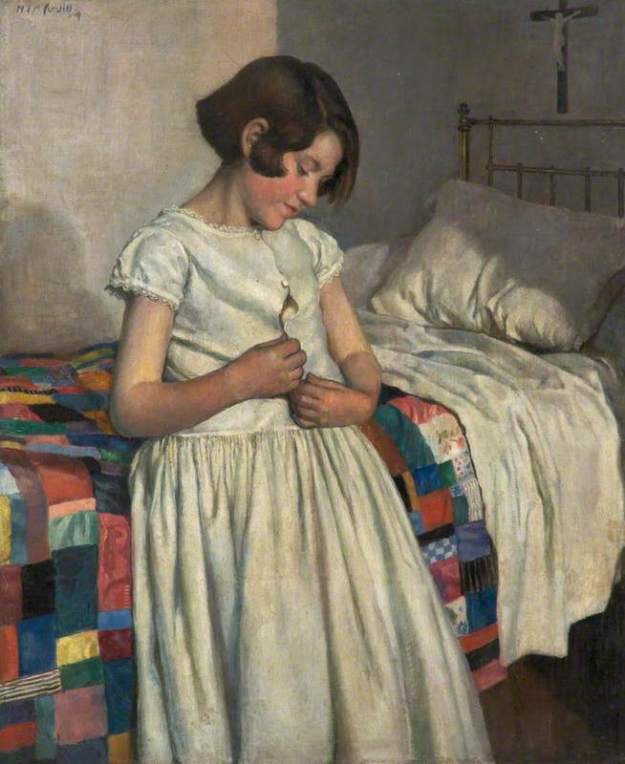
Cundell, Nora Lucy Mowbray, 1889-1948; The Patchwork Quilt

Nora Lucy Mowbray Cundell, “The Patchwork Quilt”, 1919

..

As nurslings, you shall be carried in her arms, and fondled in her lap; as a mother comforts her child, so will I comfort you; in Jerusalem you shall find your comfort.

—Isaiah 66:12-13.


.

I heard someone say the other day that Amish women leave their finished quilts imperfect, and that they do this purposely, so as not to commit blasphemy.

We hear lots of things. And like with most of what we hear, whether this or that is true or not, we quite often just don’t know—at least not in terms of earthly circumstance: what exactly was said, who exactly said it, or the exact context in which it was said. But also quite often, these factors simply don’t matter—at least not in terms of what we most need spiritually at that present moment.

To get caught up within the trivial details of who, what, where, and when is to lose a beautiful opportunity to receive correction, direction, encouragement, and inspiration. It is to miss a moment of grace.

God is always speaking to us. Always instructing. Always telling us what we need to hear. Even if His speech takes the form of a simple smile, or a simple piece of Amish lore. He is always right there with us, each one of us. One God. Three Persons. One clear, consistent, perfectly unified voice, continually encouraging us forward.

To me this is a beautiful case of the left hand knowing exactly what the right hand is doing. It is prophecy in real time. Moment by moment. Step by step. Stich by stich. Incremental inspiration. All toward a beautiful, comforting blanket composed entirely of grace. It is the Holy Spirit at work. It is Holy Spirit teaching.

———

We always get exactly what we need. But we must be willing to wear fleeces white as snow. For everywhere that Mary went, the lamb was sure to go.

Clean hands. Pure heart. Purity of intention.

Meekness. Humility. Docility to the Holy Spirit.

We must submit to Mother Church.

It is Simple. It is Holy. And Holy Simplicity simply results in simple, clear, straightforward answers.

And it gets simpler and simpler:

We simply hear what God says when we pray in the Holy Spirit and “worship in spirit and truth”. (John 4:24)

We simply become living, breathing manifestations of His glory when the Holy Spirit prays for and through us, when “the Spirit Himself intercedes for us with groans too deep for words“. (Romans 8:26)

And the Liturgy simply helps us to allow the Holy Spirit to do so.

———

For the Amish women don’t sew alone. God quilts too. His is simply perfect. Always. And to us it looks a lot like the Liturgy.

O the simple joy of being wrapped up tightly within it!

O the simple wonder of walking deeper into the Body of Christ each new day—into the greatest and most public prayer of the one, true, holy, catholic, and apostolic Church—The Holy Sacrifice of the Mass—with faith and hope and an ever-increasing expectation that we will “nurse“, “be satisfied” and “drink with delight” at the “abundant breasts” of Mother Church. (Isaiah 66:11)

We receive the comforting milk of Sacrament: of reconciliation, of sacrifice, of thanksgiving, of praise, of presence, of joy, of love…

We receive our physical nourishment, our spiritual inspiration, our mercy and forgiveness, our healing and peace, our much needed correction and instruction—and for breakfast and dessert—our daily share in The Cross.

We receive “our daily bread.”

And all are welcome.

The Church invites all, serves all, prays for all…

All of us—me, you, him, her, them, every single one of us—the entire patchwork of humanity—are always welcomed and always encouraged to turn more directly into the light of God’s face. The Face of Truth, of Mercy, of Justice, of Love…

All are always and truly welcome.

Welcome to walk in the clear, crisp, clean air of God’s ceaseless and abundant reality—a reality that never deceives, that never falsely promises imaginary pots of gold lying at the end of fanciful rainbows.

For rainbows are mere optical illusions. And all sin stems from and leads to delusion. Pure faith, on the other hand, rises above all images, whether they are real or those conjured up by Satan in his constant effort to pervert and deceive.

God’s promises are true. His kingdom is no illusion. Heaven is no empty pot of gold.

“…for on those you have rescued from slavery to sin you bestow eternal gladness.” (Collect, 14th Sunday in Ordinary Time, C)

All are welcome to truly come home.

Welcome to walk hand-in-hand with the Lord of the Garden:

“Wash, and be cleansed; remove the foulness of your actions from my sight.

Come, let us speak with one another, says the Lord.”

—Isaiah 1:16,18

———

Perhaps then our Amish lady friends have a good, sharp point. Maybe it is not that important to have things “just right”, exactly the way we will them to be. Maybe it is not about making everything “perfect” according to our own plans, nor about appeasing our every desire and inordinate appetite. Maybe, just maybe, happiness—true joy—resides in just the opposite.

Perhaps what makes a quilt simply “perfect” is that it is made with humble, patient, obedient hands. Grateful hands, quite aware of their own defects. Hands that need not be in constant control, nor constantly caressed.

And perhaps it is just those kinds of hands, the hands of poor humble handmaids, that simply remind us of the true purpose of a simple quilt—to keep us warm—warm enough to get us through—to get us through to the other side—to the other side of a long, dark, cold night.


.

She wrapped him in swaddling clothes and laid him in a manger, because there was no room for them in the inn. Now there were shepherds in that region living in the fields and keeping the night watch over their flock. The angel of the Lord appeared to them and the glory of the Lord shone around them, and they were struck with great fear.

—Luke 2:7-9


.

—Howard Hain

Advent: The Season of Joy

https://www.youtube.com/watch?v=NbMImf0zo7s&feature=em-upload_owner%5B/embed%5D

I Wonder As I Wander

Nativity

 “I Wonder As I Wander.” The American folklorist John Jacob Niles wrote that haunting Christmas carol. You may remember the words:


I wonder as I wander out under the sky

How Jesus the Saviour did come for to die

For poor on’ry people like you and like I;

I wonder as I wander out under the sky

When Mary birthed Jesus ’twas in a cow’s stall

With wise men and farmers and shepherds and all

But high from God’s heaven, a star’s light did fall

And the promise of ages it then did recall.

If Jesus had wanted for any wee thing

A star in the sky or a bird on the wing

Or all of God’s Angels in heaven to sing

He surely could have it, ’cause he was the King

I wonder as I wander out under the sky

How Jesus the Saviour did come for to die

For poor on’ry people like you and like I;

                                                                                                                     I wonder as I wander out under the sky


Niles heard a young girl sing a fragment of that song in a little town in North Carolina in 1933. “Her clothes were unbelievably dirty and ragged, and she too, was unwashed,” he wrote in his autobiography, “but she was beautiful, and in her untutored way, she could sing. She smiled as she sang, smiled rather sadly, and sang only a single line of the song.”

I wonder. Like so many great Christmas carols this song calls us to reflection, to wonder about the deepest questions of life, questions you only think about as you wander out under the sky. Big questions.

So where do we come from? And where are we going? And what does it all mean? Does God who is beyond our sight, see us? Is Jesus our Savior God’s Son?  Has he really come among us?

I wonder how he came. He could have had anything, our song says, “a star in the sky, or a bird on the wing”…he could have had anything, “cause he was a King.” But he came “for to die.”

I wonder about this fallen world of ours. Why does death still seem so strong?  Why were those innocent children slaughtered by Herod at his birth? And why do innocent children still die, I wonder today? And why in the end did he die such a death?

“When Mary birthed Jesus, twas in a cow stall.” Wise men and ordinary people came to a manger, his first throne on earth. I wonder how God should dwell in so simple a place, where animals were fed. Is it in  simple places like this, in bread and wine, in the simple ways we love each other, that God still feeds us, who wander out under the sky, “poor on’ry people like you and like I?”

What Does Christmas Mean?

DSC00339
I was just reading again a piece Pope Benedict XVI did for the Financial Times of London last Christmas, which I think shows the continuity of the church’s teaching from one recent pope to another. Pope Francis’ style may be different, but the message is the same.

“The birth of Christ challenges us to reassess our priorities, our values, our very way of life. While Christmas is undoubtedly a time of great joy, it is also an occasion for deep reflection, even an examination of conscience. At the end of a year that has meant economic hardship for many, what can we learn from the humility, the poverty, the simplicity of the crib scene?

“Christmas can be the time in which we learn to read the Gospel, to get to know Jesus not only as the Child in the manger, but as the one in whom we recognize God made Man. It is in the Gospel that Christians find inspiration for their daily lives and their involvement in worldly affairs – be it in the Houses of Parliament or the Stock Exchange. Christians shouldn’t shun the world; they should engage with it. But their involvement in politics and economics should transcend every form of ideology.

“Christians fight poverty out of a recognition of the supreme dignity of every human being, created in God’s image and destined for eternal life. Christians work for more equitable sharing of the earth’s resources out of a belief that, as stewards of God’s creation, we have a duty to care for the weakest and most vulnerable.

“Christians oppose greed and exploitation out of a conviction that generosity and selfless love, as taught and lived by Jesus of Nazareth, are the way that leads to fullness of life.

“Christian belief in the transcendent destiny of every human being gives urgency to the task of promoting peace and justice for all.

“Because these goals are shared by so many, much fruitful cooperation is possible between Christians and others.

“Yet Christians render to Caesar only what belongs to Caesar, not what belongs to God. Christians have at times throughout history been unable to comply with demands made by Caesar.

“In Italy, many crib scenes feature the ruins of ancient Roman buildings in the background. This shows that the birth of the child Jesus marks the end of the old order, the pagan world, in which Caesar’s claims went virtually unchallenged.

“Now there is a new king, who relies not on the force of arms, but on the power of love. He brings hope to all those who, like himself, live on the margins of society. He brings hope to all who are vulnerable to the changing fortunes of a precarious world. From the manger, Christ calls us to live as citizens of his heavenly kingdom, a kingdom that all people of good will can help to build here on earth.”