Tag Archives: Baptism

Sprinkle Them With Water

water sprinkled

At the Masses I celebrated on Easter Sunday following the homily I cast holy water on the congregation after we renewed our baptismal promises. We renounced Satan and said we believe in God, the Father Almighty, creator of heaven and earth, and in Jesus Christ, his son, and in the Holy Spirit, the giver of life. Yes, we believe in God’s church, the communion of saints, the forgiveness of sins, the resurrection of the body and life everlasting.

Then, I went through the congregation sprinkling them with water, the sign of life, the sign poured out on us at our baptism. I tried not to leave anyone out.

Of course the church was more full on Easter. Some I knew smiled when I sprinkled them generously with the water. Many I didn’t recognize, and I wondered what they thought of it all. The kids squinted when the water hit their faces. Some devoutly made the sign of the cross, some seemed a little uncomfortable.

Easter’s more than hearing something; it’s believing what we hear. Does the water fall on rock and hard ground as well as on good soil I wondered? God promises to “pour out water” on his people, the scriptures say. It’s a generous gesture God makes. Water, too, makes its way we know. It’s everywhere in God’s creation. We hardly realize how present it is in us; it’s there in every tissue of our bodies. God is there in us all, seen and unseen.

So the rite of the church says: Sprinkle them all with water, and this I did.

Saint John Lateran

To listen to the audio of today’s homily please select file below:

Some years ago I went to Rome to visit churches. One was the Church of Saint John Lateran.

Churches have stories, which is especially true of  St. John Lateran. It’s the first of the great Christian churches built by the Emperor Constantine after coming to power early in the 4th century. He gave Christians freedom to practice their religion throughout the Roman empire. He also built them churches and St. John Lateran was the first of the many he built.  At its entrance is an inscription, “The mother of churches”; it’s been there for 1500 years.

The church, holding 10,000 people, was dedicated around  320 AD. Rome’s Christians must have been thrilled as they entered it.. Many were persecuted or has seen relatives, friends or other believers jailed or put to death during the reign of Diocletian, before Constantine.

Now, a new emperor honored them by building a church, a great Christian church, that everyone in Rome could see. He built it on property belonging to enemies of his, the Laterani family, which is why it’s called St. John Lateran. It’s situated on the southeastern edge of the city, away from the Roman Forum,  because Constantine didn’t want to antagonize followers of the  traditional religions. Still,  the Lateran church was a sign that Christianity had arrived.

Before this, throughout the Roman empire, Christians had no churches but met  in ordinary homes or small buildings. In Rome itself there were about 25 homes  where they met and worshipped.

That in itself made people wonder about them. Why didn’t Christians  participate in public rites and religious sacrifices conducted for the good of the empire, as good Romans did? What kind of religion was this anyway, people said? They’re godless, atheists. The 2nd century pagan writer Celsus saw them plotting rebellion, these “ people who cut themselves off and isolate themselves from others.” (Origen, Contra Celsum,8,2)

So, the building of the church of St. John Lateran was a signal of changing times. After centuries meeting apart in homes and small community settings, Christians now gathered as one great family.

That’s what churches do; they bring people together as one body, one family, one people. That’s how Paul described the church in his Letter to the Romans: “As in one body we have many members, and all the members do not have the same function, so we, though many, are one body in Christ, and individually members one of another.” (Romans12, 4-5)

An important part of the church of Saint John Lateran is its baptistery,  a large building connected to the church itself,  worn and patched, as you would expect from a building over 1500 years old. You can still see bricks from Constantine’s time. This is where for centuries Romans have been baptized. Conveniently, it’s built over a Roman bath, for a good supply of water for baptism. The church is called St. John Lateran because St. John the Baptist is one of its patrons, along with St. John the Evangelist. A beautiful Latin inscription is over the big baptismal basin and fount.

Those bound for heaven are born here,

born from holy seed by the Spirit moving on these waters.

Sinners enter this sacred stream and receive new life.

No differences among those born here,

they’re one, sharing one Spirit and one faith.

The Spirit gives children to our Mother, the Church, in these waters.

So be washed from your own sins and those of your ancestors.

Christ’s wounds are a life-giving fountain washing the whole world.

The kingdom of heaven is coming, eternal life is coming.

Don’t be afraid to come and be born a Christian.

One last thing about St. John Lateran, which many people don’t know. It’s the pope’s church. From the time of Constantine till the 15th century, the popes as leaders of the Church of Rome resided next to this church. Then, they moved to the Vatican, where they live today.

Celebrating the dedication of a church, as we are doing today, reminds us  how important church buildings are for teaching us our faith. God speaks to us in our churches, God comes to us in our churches.

“Do you not know that you are the temple of God,

and that the Spirit of God dwells in you?” St. Paul says.

“If anyone destroys God’s temple,

God will destroy that person;

for the temple of God, which you are, is holy.”

Friday Thoughts: Holding Christ’s Hand

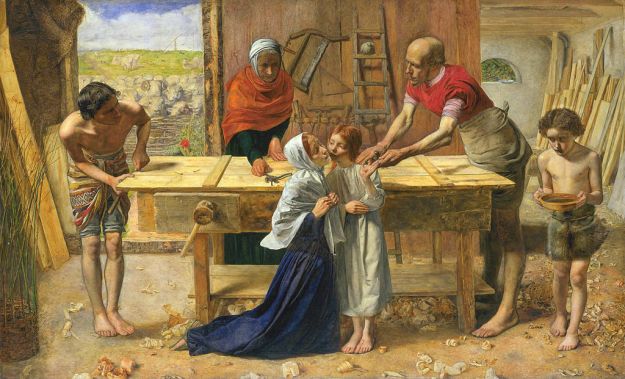
Christ in the House of His Parents by John Everett Millais 1849–50

John Everett Millais, “Christ in the House of His Parents”, 1849-50

.

“I am the way and the truth and the life. No one comes to the Father except through me.

—John 14:6


If we hold Christ’s hand we cannot get lost. For Christ is the way. It is not even possible to go astray.

If we cannot get lost, there can be no doubt. If no doubt, there can be no fear. If no fear—we are in the Kingdom of God. Right here. Right now.

Hold Christ’s Hand. Fear not. You are in the Kingdom of God.


—Howard Hain

.

Friday Thoughts: You Dirty Rat

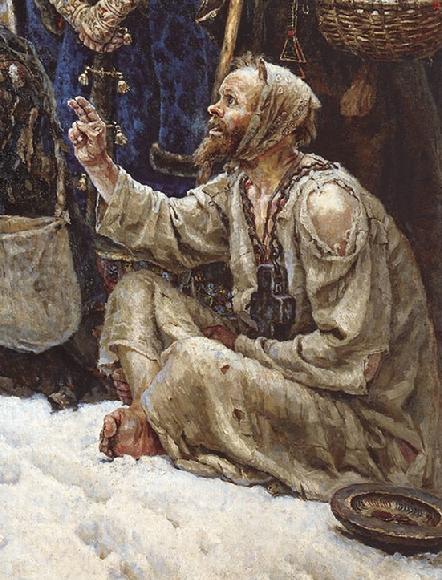
The Boyarina Morozova, Vasilij Surikov, 1887, detail 2

Vasilij Surikov, “The Boyarynya Morozova”, 1887 (detail)

 .
I am starving to death by not preaching. I search the garbage bins and pick out of dumpsters, ever eying with hungry eyes trash thrown by the wayside.

I am so wonderfully fed by Christ!

Yet I thirst a thirst of love. I long for more painful encounters that heal me so. I am a lover of the beach who roams the Sahara. Below the height of the mounting sun, among the singing dunes, I bellow with them the universal hum.

The sand is all about me. An oasis resides within my heart. I am surrounded by mirages of men whom long ago have forgotten to start.

I starve to preach. To sing of our Lord. I starve to fly high with no might of my own. Tapping toes and rocking forth, slightly bending knees, ready to spring forth from well to well.

I love our God. I love Him so. I love Him and Him alone. He tells me to love others as myself. I love Him despite myself. I love Him in others, and others because of Him. I love for I have been brought low. I love for I have learned to soar high. He is my all. My everything. Of Him, and Him alone, do I sing.

I sing of socks, and of sneakers, of old clothes and new sandals, and of wedding rings. I sing of mice, and of men, I sing of the difference that resides only in the length of whiskers. I sing of dogs and of cats, and o yes, of rats—o those ugly creatures that challenge me so.

I ask myself, are they not created by God as well?

Isn’t that dirty filthy stinkin’ rat also beautiful and also real?

Does not God shine the sun and shower the rain on disturbing rats as well?

O, if I could only love rates, then I would truly sing! Mend this heart, this rock of mine, hardened by selfish sight and by wanting what isn’t mine. Yes, boil me down, so I may drown in what the residue of life leaves to those who truly suffer.

I sing to you, O Glorious Rat. Creature of God!

I sing to you that you too shall sing with me. I see that I no longer need to sing alone. Come, accept my embrace. I forgive you. Now perhaps I too may be forgiven.

I see and smell and hear the truth. You the rat, object of everyone’s scorn. You too were once so young, before you crawled into the bin, before you journeyed down the darkened tunnel—you too—little infant rat—were brought forth from the mother’s womb.

Come young, come old! Come from your abandoned buildings, and vacant storage yards, from old ball fields well over grown. Come one, come all!

The pious pied piper now plays a gospel tune. The garbage begins to gather, the desolation takes on an evening glow. The sand all about me recedes from the stormy cloud. It slowly begins to lay low.

The desert creeps up upon a vast body of water.

I pass between walls of a held back sea, my feet tread cross a red clay bottom.

You too, brother rat, are a gift from our mighty God above. You too were loved into existence by the Lord of all.

God of all who share residence upon the earth.

God of all who sigh and sing.

God of all who snort and smile.

God of all who bellow and breathe, both fresh and soiled city air alike.

Come, then, last call, leave your dens, leave your hobbies, leave you daily work behind. Leave you rats, friends of mine, leave the muck and sewers of this world, climb the hills, and charge the mountain, dip yourselves in Carmel air, for even you reflect the glory of Zion from a peak so high.

Come and join the birds who listened so intently, who still this day patiently hear lonely troubadours sing. Yes, join us, for there is always plenty of room, room for even you, object of everyone’s scorn.

Enough for even you, you dirty rat.

A sight for sore eyes to this poor lonely thirsty preacher.

For through you I give our magnificent God mighty humble joy-felt praise.

———

.
—Howard Hain

Friday Thoughts: Running with the Lord

cezanne bather-with-outstreched-arms 1878

Paul Cezanne, “Bather With Outstretched Arms”, 1878

.

“…into your hands I commend my spirit”

and when he had said this he breathed his last.

—Luke 23:46

.


.

Years ago when I was living in San Francisco, a group of us used to go hiking out in Marin County, just across the giant red expanse of the Golden Gate Bridge. We went often. A group of both men and women, mostly single, mostly without a care in the world. I think every one of us was under thirty, or thereabouts.

My favorite part was running down. Don’t get me wrong, the hike upward was terrific too, that’s when we discussed ideas and dreams and laughed almost all the while, breaking up into smaller groups of two or three or maybe even four, and then drifting back together—like a herd of elk, for they too have not a care in the world—only to once again drift apart, this time usually paired up with a different companion or combination thereof. None of it was planned or had any real intention of course, it just happened: laughter, ideas, silence, stops, gazes outward, waiting, speeding up, sipping water, laughter, drifting apart….it was divine.

 Like the elk, it all seemed to be instinct.

But something special happened when we reached the top. After we reached the top. After we caught our breath, removed our backpacks, and viewed the scape. After we had eaten a little snack or a small sandwich, something light, usually along with an apple or granola bar, maybe even a small handful of assorted nuts and a few of those purple chips that all San Franciscans seem to love. It was time to descend.

My friends used to laugh and say that it was because I’m an Indian. They would go on and on about my “Cherokee” blood, and the fact that the first three letters of my first name spelled “how” only served as additional fodder. But there was some truth in it. Not only because I actually do have some American Indian blood, but more so because at that time I was very much a native. Primitive. Raw. Free.

That’s why I would run down.

I loved it. I would run as fast as I could go. Cutting back and forth, hopping over logs, propelling myself around turns by pivoting hard on the corner tree. I loved it. I loved the way I felt. I loved that my weight added to the speed, that what normally would slow me down, would normally make me huff and puff, now drove me forward, propelled me toward from whence I came.

It was wonderful. I was free. I was free. I was free. It was the closest this man ever came to flying.

This morning, almost twenty years later, in urban New Jersey—just across the Hudson River from Manhattan—I went for a jog. They just opened a new circular path around the old reservoir resting slightly higher than its surrounding cities of Weehawken and Union City. It is very pleasant.

I wasn’t sure how far I’d be able to make it. And after a very short distance I thought to myself, “Oh boy, I’m gonna have to stop already.” But I didn’t. I thought about posture. I thought about positioning of hands. I thought about breath. I quickly realized that the Lord has taught me much.

The posture of prayer is important. How we position ourselves is powerful. And breathing is everything.

I made it around three times. I smiled almost all the way. My pace was pretty good. I did alright, not bad for a man I thought just a few minutes before was getting old. I think even the newly-minted goslings admired my gait. And even if they didn’t, it was nice to be in a place to think that maybe they did.

I walked a lap and then began to make my way back toward my home, my one bedroom apartment that I share with my most recent and till-death-do-us-part hiking companions: my beautiful, delicately strong bride of twelve years, and my precious little girl, who at six-and-a-half runs and laughs like the wind.

I was a few streets away, coming down 18th and crossing Summit, when it happened. I never really noticed it before. The next two blocks were a steady, fairly steep decline. I began to run.

I loved it. I ran as fast as I could go. Cutting back and forth, hopping over the cracks in the sidewalks, propelling myself around the turn by pivoting hard on the corner stop sign. I loved it. I loved the way I felt. I loved that my weight added to the speed, that what normally would slow me down, would normally make me huff and puff, now drove me forward, propelled me toward from whence I came.

It was wonderful. I was free. I was free. I was free. It was the closest this man ever came to flying.

For a moment I thought I was on the outskirts of San Francisco.


.

And with that he breathed on them and said, “Receive the Holy Spirit…”

—John 20:22

.

.

—Howard Hain

Sharing the Resurrection of Jesus

I like the richness and simplicity of the 5th century Catecheses of Cyril of Jerusalem, which he preached in the Church of the Holy Sepulcher after Easter.

“When we were baptised into Christ and clothed ourselves in him, we were transformed into the likeness of the Son of God. Having destined us to be his adopted sons, God gave us a likeness to Christ in his glory, and living as we do in communion with Christ, God’s anointed, we ourselves are rightly called “the anointed ones.” When he said: Do not touch my anointed ones, God was speaking of us.

“We became “the anointed ones” when we received the sign of the Holy Spirit. Indeed, everything took place in us by means of images, because we ourselves are images of Christ. Christ bathed in the river Jordan, imparting to its waters the fragrance of his divinity, and when he came up from them the Holy Spirit descended upon him, like resting upon like. So we also, after coming up from the sacred waters of baptism, were anointed with chrism, which signifies the Holy Spirit, by whom Christ was anointed and of whom blessed Isaiah prophesied in the name of the Lord: The Spirit of the Lord is upon me, because he has anointed me. He has sent me to preach good news to the poor.

“Christ’s anointing was not by human hands, nor was it with ordinary oil. On the contrary, having destined him to be the Saviour of the whole world, the Father himself anointed him with the Holy Spirit. The words of Peter bear witness to this: Jesus of Nazareth, whom God anointed with the Holy Spirit. And David the prophet proclaimed: Your throne, O God, shall endure for ever; your royal sceptre is a sceptre of justice. You have loved righteousness and hated iniquity; therefore God, your God, has anointed you with the oil of gladness above all your fellows.

“The oil of gladness with which Christ was anointed was a spiritual oil; it was in fact the Holy Spirit himself, who is called the oil of gladness because he is the source of spiritual joy. But we too have been anointed with oil, and by this anointing we have entered into fellowship with Christ and have received a share in his life. Beware of thinking that this holy oil is simply ordinary oil and nothing else. After the invocation of the Spirit it is no longer ordinary oil but the gift of Christ, and by the presence of his divinity it becomes the instrument through which we receive the Holy Spirit. While symbolically, on our foreheads and senses, our bodies are anointed with this oil that we see, our souls are sanctified by the holy and life-giving Spirit.”

And so, we are not just observers of Christ’s resurrection, St. Cyril says. We are transformed into the likeness of the Son of God, becoming like him in his glory.  Our outward appearance may resemble the appearance of the Risen Christ, as the  gospels describe him. We may look like the humble gardener Mary Magdalen saw, or the  stranger walking with the disciples towards Emmaus, or the figure at dawn on the shore of Galilee, or one with wounds in our hands and feet.

But if the Holy Spirit anointed us with chrism after our baptism, we have been empowered to bring good news to the poor; we have been anointed with the oil of gladness. We have been given a spiritual joy and a share in the life of Christ.

Memories of a Baptism

I was celebrant at the funeral Mass for Jack Olsen last Saturday morning in Sacred Heart Church in Bay Head, NJ.

My memories of Jack go way back to when the Olsens lived in the house on the corner of Lord Avenue and 3rd Street in Bayonne, NJ. My mother was a friend of Jack’s mother and when we were young she took my sister and me regularly to see the Olsens. We played with their 9 kids. Just down the street from their house was a football field where some of the best local teams played. During the 2nd World War Italian prisoners of war were held in barracks there and many Bayonne Italians went down to talk to them and pass them food. It put a human face to war.

Just beyond the Olsen’s house was the Kill Van Kull, the busy three mile waterway between Bayonne and Staten Island. Bill Olsen, Jack’s father, was a tugboat captain. As a kid, I couldn’t think of a better job in all the world than pushing and pulling big ships and barges around New York harbor.

My mother told me she met my father when she was washing the dishes after a baptism at the Olsens–maybe it was Jack’s baptism, or Fr. Tom’s, or Rita’s. My father was a friend of Jack’s uncle, Dinny, who probably invited him to the baptismal celebration that day.

“What’s your name?” my father said to her. “Rose O’Donnell,” she replied. “I’m Victor Hoagland,” he said. So my sister and I are here 80 or so years later. How connected our lives are by small things, like washing dishes or going to a baptism.

I mentioned at Jack’s funeral some of the small things that took place at his baptism 86 years ago. He was brought to church and signed with the sign of the Cross. That simple sign meant that he was blessed by the mystery of the death and resurrection of Jesus, who would bless him through the course of his life, even the hard months that marked his final sickness.

At his baptism, the priest poured water, the source of life, on his forehead and said (in Latin then) “John, I baptize you in the name of the Father, and of the Son, and of the Holy Spirit.” Life was God’s gift to him, a life that begins at conception and continues beyond the years here on earth.

Jack was a strong believer in God, the Creator, who gives life and Jesus, our Redeemer, who saw life so precious that he gave his life that we might live. He was a firm believer in the Right to Life.

Baptism is a sacrament of family life, which means, first of all, that we’re members of the family we belong to in this world. Jack, a bachelor, played a big part in his large family of brothers and sisters, nieces and nephews and all their wives and husbands, never missing celebrations, births, deaths and holidays. He was proud of his family and loyal to his own.

Baptism calls us into other families too– the family that’s our neighborhood, our city, our country. Jack was a good neighbor who loved the place where he lived and the people who lived there.

Baptism also calls us into the family of the church. Jack was a true believer; he loved the church. No doubt about his loyalty; the church was his home. He belonged to its societies, like the Holy Name and the Knights of Columbus. He made retreats with the Passionists. The Mass and the sacraments were not formalities, they were real for him. He loved his church in good times and bad.

At Jack’s funeral the other day, it seemed right to remember his baptism. The sacrament is at the heart of our funeral rites, when you think about it. We blessed him with water, the sign of life and made the sign of the cross over him again as his remains were carried into the church and then carried out. A white cloth, a reminder of the white garment he received long ago, was placed over him. The great words of faith were proclaimed: “The souls of the just are in the hands of God.” We heard the account of Jesus’ death and the message of the angel, “He is risen.” We celebrated the mystery of the Bread and Wine, which Jesus said are the food of eternal life.

“Life is changed, not ended,” our prayer said. Rest in peace.

Feast of the Dedication of the Church of St. John Lateran

Today, is the feast of the Dedication of Church of St. John Lateran in Rome. It seems to me you can see much of the history of the Roman Catholic Church here in this building, one of the great pilgrim churches of Rome.I wrote about this ancient 4th century church, the “mother of all churches” elsewhere.

In a homily for this feast, St. Caesarius of Arles says that this church, like all churches, reminds us we’re temples of God. “And if we think more carefully about the meaning of our salvation, we shall realize that we are indeed living and true temples of God. God does not dwell only in things made by human hands, nor in homes of wood and stone, but rather he dwells principally in the soul made according to his own image and fashioned by his own hand. Therefore, the apostle Paul says: The temple of God is holy, and you are that temple.”

The ancient baptistery at the Lateran church, pictured above, is an entrance to this church. Through baptism we belong to the great church whose Lord, Jesus Christ, shares his life with us.

The beauty of a church reminds us of the beauty of our souls, Caesarius says: “Whenever we come to church, we must prepare our hearts to be as beautiful as we expect this church to be… Just as you enter this church building, so God wishes to enter into your soul, for he promised: I shall live in them, I shall walk through their hearts.”

First Holy Communion

In our parish children are receiving their First Holy Communion these Sundays of the Easter season. They will come into the church together, each one with her or his name printed on their clothes and we will greet each one of them by name at the altar. Their families and relatives will be here.

Later, we will call them to stand around the altar at the Eucharistic prayer and they will be the first to receive Communion. Afterwards, they’ll be joining their families to celebrate this important step in their life of faith.

We call them by name. In baptism, that’s the first thing we ask parents who bring their children to the baptized: “What’s his/her name?” and later we baptize them “in the name of the Father, and of the Son and of the Holy Spirit.”

God calls us by name. It’s my name and it stands for me. In baptism we are called by God, who takes us into his hands forever. We are baptized with water, with life, in the name of the Father, and of the Son and the Holy Spirit. We know God’s name: Father, Son and Holy Spirit.

Baptized as infants, we didn’t speak for ourselves; our parents spoke for us, and they were entrusted to bring us up in this belief: that we are God’s children, God who is Father, Son and Holy Spirit.

At first Holy Communion we speak for ourselves; no one holds us in their arms or speaks for us as they did in baptism. When we receive Jesus in the bread we say “Amen.” I believe he comes to me; I know who he is; He is my Lord and my God who loves me. He gave his life for me and he calls me to eternal life.

Our First Communion should be the beginning of many communions. Jesus wants us to know his name and to know us. That’s what the word “communion” means.

3rd Sunday of Advent

Readings are here.

Knowing who you are is one of the most important tasks we have in this life.

Here’s a homily on John the Baptist  by St. Augustine. He had to distinguish himself from Jesus, the Messiah.

John is the voice, but the Lord is the Word who was in the beginning. John is the voice that lasts for a time; from the beginning Christ is the Word who lives for ever…

Because it is hard to distinguish word from voice, even John himself was thought to be the Christ. The voice was thought to be the word. But the voice acknowledged what it was, anxious not to give offence to the word.

I am not the Christ, he said, nor Elijah, nor the prophet. And the question came: Who are you, then? He replied: I am the voice of one crying in the wilderness: Prepare the way for the Lord.

The voice of one crying in the wilderness is the voice of one breaking the silence. Prepare the way for the Lord, he says, as though he were saying: “I speak out in order to lead him into your hearts, but he does not choose to come where I lead him unless you prepare the way for him.”

What does prepare the way mean, if not “pray well”? What does prepare the way mean, if not “be humble in your thoughts”? We should take our lesson from John the Baptist. He is thought to be the Christ; he declares he is not what they think. He does not take advantage of their mistake to further his own glory.

If he had said, “I am the Christ,” you can imagine how readily he would have been believed, since they believed he was the Christ even before he spoke. But he did not say it; he acknowledged what he was. He pointed out clearly who he was; he humbled himself.

He saw where his salvation lay. He understood that he was a lamp, and his fear was that it might be blown out by the wind of pride.