Tag Archives: Abraham

December 17: The Tree of Jesse

From December 17th until Christmas, we read from the infancy narratives  of Matthew and Luke to prepare for the  Christmas feast.

  Matthew’s genealogy of Jesus Christ traces his ancestry as “the son of David and the son of Abraham.” Descended from Abraham Jesus fulfilled the promise God made to the patriarch: “in your descendants all nations would be blessed.” Matthew ends his genealogy with “Joseph, the husband of Mary. Of her was born Jesus who is called the Messiah. ” In our portrayal above Mary points to Joseph as the one who can explain it to us all.

Matthew’s genealogy offers a Messiah whom Jew and Gentile can claim for their Savior. His ancestors reach beyond Palestine; his roots are worldwide. He’s not just a Jewish Messiah in Matthew’s listing either. His bloodline includes women like Tamar, Ruth and Bathsheba– foreigners and even women with questionable backgrounds.

 In his humanity,  Jesus didn’t come from perfect ancestors or untainted Jewish royalty ; he’s rooted in all humanity. His bloodline includes saints and sinners; he comes from a line of sinners and some saints. He shares our human DNA.

Matthew obviously wants us to look at Jesus’ family tree and see it as our own. We’re at home there. The Tree of Jesse, based on Matthew’s genealogy  was a favorite subject for medieval artists working on illuminated manuscripts or creating stained glass windows for churches. A great way to see the humanity of Jesus Christ.

Luke’s genealogy goes further and brings Jesus beyond Abraham to Adam. He becomes the new Adam. We are born from his side, we share his blood; he is the first born of many like us. So we pray:

“O God, Creator and Redeemer of human nature…your Only Begotten Son, having taken to himself our humanity, may you be pleased to grant us a share in his divinity.” (Collect)

O Wisdom of our God Most High,
guiding creation with power and love:
come to teach us the path of knowledge!

Jacob Wrestling with God

Jacob wrestling

( Genesis 23, 33-43)

Our lectionary leaves out a number of the stories about Jacob and his wife Rachel, her brother Laban and his sons, that are far from edifying. They are hardly honest. They strike deals and, by hook or by crook, try to get the best deal they can. They’re not people you want for neighbors or do business with.

Yet, God promises Jacob what he promised Abraham:

“I, the LORD, am the God of your forefather Abraham and the God of Isaac; the land on which you are lying I will give to you and your descendants. These shall be as plentiful as the dust of the earth, and through them you shall spread out east and west, north and south. In you and your descendants all the nations of the earth shall find blessing. Know that I am with you; I will protect you wherever you go, and bring you back to this land. I will never leave you until I have done what I promised you.” (Genesis 22,1 8-28)

Even with those sublime words ringing in his ears, Jacob never seems to abandon his wheeling and dealing. It’s as if the most important thing in the world is the extra sheep he’s going to wheedle out of his father in law.

The Old Testament certainly portrays real life. The early Christian scholar Marcion wanted to throw out the Old Testament altogether, because he claimed it wasn’t spiritual enough. God wouldn’t promise such great things to people like Abraham, Isaac and Jacob and their wives and relations and slaves.

I suppose that’s one reason for us to keep reading the Old Testament:  God works in real life. “God is a Potter; he works in mud,” the Greek writer Nikos Kazantzakis entitled a chapter in one of his books.

Two things commentators note about the stories of Jacob. First, he doesn’t recognize the presence of God until afterwards. “When Jacob awoke from his sleep, he exclaimed, ‘Truly, the LORD is in this spot, although I did not know it!’” That’s an interesting discovery we all can make. God was there and we didn’t know he was there.–except afterwards.

Second, the commentator for the New American Bible says this about the story of Jacob wrestling in the dark at the river edge with the unknown figure: “The point of the tale seems to be that the ever-striving, ever-grasping Jacob must eventually strive with God to attain full possession of the blessing.”

God engages us and wrestles with us, “ever striving, ever grasping”, whether we like it or not, and we will have scars to prove it.

St. Thomas: Going to God through Questions

Thomas

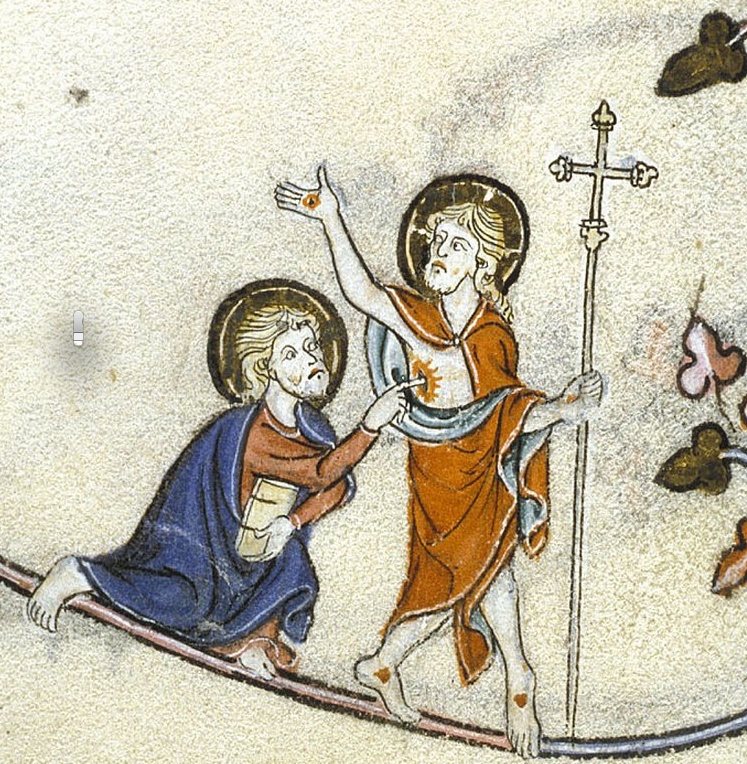
Today, July 3rd, we remember Thomas the apostle. We’re tempted to think that belief does away with troublesome questions and shelters us from unbelief, making our way to God smooth and undisturbed. Not so, Thomas reminds us; he found faith through his questions and by placing his finger into the wounds of Christ.

Gregory the Great reminds us today of the importance of Thomas the Apostle.

“In a marvellous way God’s mercy arranged that the disbelieving disciple, in touching the wounds of his master’s body, should heal our wounds of disbelief. The disbelief of Thomas has done more for our faith than the faith of the other disciples. As he touches Christ and is won over to belief, every doubt is cast aside and our faith is strengthened. So the disciple who doubted, then felt Christ’s wounds, becomes a witness to the reality of the resurrection.”

That’s an interesting statement, isn’t it? “The disbelief of Thomas has done more for our faith than the faith of the other disciples.” Is an unbelieving world strengthening our faith now?

We go to God through questions, and some troubles too. We’re healed by touching the wounds of Christ. How do we touch the wounds of Christ? Is it by touching those who are wounded like him?

Grant, Almighty God,
that we may glory in the Feast of the blessed apostle Thomas, so that we may always be sustained by his intercession
and, believing, may have life
in the name of Jesus Christ your son,
whom Thomas acknowledged as the Lord.
Who lives and reigns with you in the unity of the Holy Spirit, one God, for ever and ever.

Genesis: 11-50

We might call our first readings at Mass this week the Jewish part of the Book of Genesis. (Gen 11–50) The origins of the world and the beginnings of the human race are described in first 10 chapters of Genesis. Chapter 11 begins with the call of Abram and recounts the beginnings of the Jewish people.

For Jews living in exile, when the Jewish scriptures were finally assembled, Abraham was someone to look to as they made their way in uncertain times, when the road ahead was unclear.

The road ahead doesn’t seem clear for us either, does it?

The Commentary from the New American Bible describes these chapters from Genesis as a book exiles can learn from:

Genesis 1150. One Jewish tradition suggests that God, having been rebuffed in the attempt to forge a relationship with the nations, decided to concentrate on one nation in the hope that it would eventually bring in all the nations. The migration of Abraham’s family (11:2631) is part of the general movement of the human race to take possession of their lands (see 10:3211:9). Abraham, however, must come into possession of his land in a manner different from the nations, for he will not immediately possess it nor will he have descendants in the manner of the nations, for he is old and his wife is childless (12:19). Abraham and Sarah have to live with their God in trust and obedience until at last Isaac is born to them and they manage to buy a sliver of the land (the burial cave at Machpelah, chap. 23). Abraham’s humanity and faith offer a wonderful example to the exilic generation.”

I like Jesssica Power’s poem on the great patriarch:

“I love Abraham, that old weather-beaten
unwavering nomad; when God called to him
no tender hand wedged time into his stay.
His faith erupted him into a way
far-off and strange. How many miles are there
from Ur to Haran? Where does Canaan lie,
or slow mysterious Egypt sit and wait?
How could he think his ancient thigh would bear
nations, or how consent that Isaac die,
with never an outcry nor an anguished prayer?

I think, alas, how I manipulate

dates and decisions, pull apart the dark

dally with doubts here and with counsel there,

take out old maps and stare.

Was there a call after all, my fears remark.

I cry out: Abraham, old nomad you,

are you my father? Come to me in pity.

Mine is a far and lonely journey, too.

The Faith of Abraham

Abraham and Isaac
Roman catacombs, 3rd century

What does it mean to believe? Abraham is “our father in faith.” We read his story from the Book of Genesis at the Easter Vigil, where it appears as a key reading, and in odd years from Monday of the 12th week of the year to Thursday of the 13th week of the year.

First, faith is a gift by which God invites us to a life far beyond what we have now. “The Lord said to Abram: ‘Go forth from the land of your kinsfolk and from your father’s house to a land I will show you.’” It’s not a land we discover, but a land God shows us. We must leave a land we know and enter a land unknown.

Faith’s a gift, but also a challenge. Genesis 22,1-19 begins: “God put Abraham to the test.” There would be no greater test for Abraham than to take his son, Isaac, “your only one, whom you love,” and go up a high mountain and “offer him up as a burnt offering.”

Intimations of the Passion of Jesus are here: “the high mountain… the only son, whom you love.” Approaching the mountain, Abraham takes “the wood for the burnt offering and laid it on his son Isaac’s shoulders.” “God will provide the sheep.” Abraham tells Isaac. He builds an altar and arranges the wood. “Next he ties up his son Isaac, and put him on top of the wood on the altar.” All suggesting the Passion of Jesus.

But when Abraham takes his knife, God stops him. “I know how devoted you are. You did not withhold from me your beloved son.” And God blesses him. “I will bless you abundantly and make your descendants as the stars of the sky and the sands of the sea.”

The Letter to the Hebrews says, “By faith Abraham, when put to the test, offered up Isaac, and he who had received the promises was ready to offer his only son of whom it was said, ‘Through Isaac descendants shall bear your name.’ He reasoned that God was able to raise even from the dead and he received Isaac back as a symbol.” (Hebrews 11,18-19)

“He reasoned that God was able to raise even from the dead.” He faces sadness and cruelty. He’s not a dumb executioner, immune to what he was to do, but “he reasoned,” he believed deep within that God was a God of life. Like Jesus, Abraham faced an absurd death like this, and he believed in a God of love and promise. Like Jesus, his answer was “Not my will, but yours be done.”

The commentator in the New American Bible describes Abraham’s test. “… after the successful completion of the test, he has only to buy a burial site for Sarah and find a wife for Isaac. The story is widely recognized as a literary masterpiece, depicting in a few lines God as the absolute Lord, inscrutable yet ultimately gracious, and Abraham, acting in moral grandeur as the great ancestor of Israel. Abraham speaks simply, with none of the wordy evasions of chapters 12 and 21.  The style is laconic; motivations and thoughts are not explained, and the reader cannot but wonder at the scene.

We ask for Abraham’s faith.

Abraham’s sacrifice is portrayed frequently in the Christian catacombs of Rome, where believers also faced the mystery of death. (above)

A medieval book for artists, “Speculum humanae salvationis,” the prime resource medieval artists used for comparing New Testament stories with the Old Testament, pairs the story of Abraham bringing Isaac to be sacrificed with the story of Jesus carrying his cross to Calvary, as shown in the example below:

abraham Passion

Abraham, The Unwavering Nomad

We reading the story of Abraham in our lectionary this week. He is called “Our father in faith” in our 1st Eucharistic Prayer. That’s because Abraham believed when God called him to leave his own land and go to a land he did not know. He believed in God’s call.

A pastoral nomad who settled down and then moving on. Abraham moved on to a permanent home. That’s us too. Abraham trusted in God rather than in himself. As an old man, he believed God who said he would have a child. His wife Sarah was old too.

The great patriarch was tested. Faith grows through testing. Abraham’s greatest test came when God asked him to sacrifice his only son Isaac.

My favorite reflection on Abraham is Jessica Power’s beautiful poem:

“I love Abraham, that old weather-beaten
unwavering nomad; when God called to him
no tender hand wedged time into his stay.
His faith erupted him into a way
far-off and strange. How many miles are there
from Ur to Haran? Where does Canaan lie,
or slow mysterious Egypt sit and wait?
How could he think his ancient thigh would bear
nations, or how consent that Isaac die,
with never an outcry nor an anguished prayer?

I think, alas, how I manipulate
dates and decisions, pull apart the dark
dally with doubts here and with counsel there,
take out old maps and stare.
Was there a call after all, my fears remark.
I cry out: Abraham, old nomad you,
are you my father? Come to me in pity.
Mine is a far and lonely journey, too.

19th Sunday C: Prayer and Violence

To listen to today’s homily, please select the audio file below:

When tragedies occur like the recent violent attacks in Nice and Orlando or the murder of the priest in France, they’re usually followed by demonstrations of concern. People place flowers or notes or lighted candles near where the attacks occurred. A Mass was celebrated for the priest. Muslims as well as Christians came.

We need to pay attention to things like this. As Christians we say we need to pray.

I notice recently, though, that some question the response of prayer. They want action instead of prayer. “Don’t say you’re going to pray, do something,” they say, as if prayer were a waste of time and did nothing.

Now, let’s admit sometimes that accusation is true. Sometimes we promise to pray and it’s just a gesture meaning nothing at all. Prayer, though, is more than a gesture. It’s a way of getting through life and knowing what to do.

Our second reading today from the Letter to the Hebrews describes the faith of Abraham, but it also describes his prayer, because prayer along with works are expressions of faith. We can learn about prayer from the great Jewish patriarch. Abraham’s prayer is a constant prayer, a faithful prayer, a daily prayer.

God called Abraham to “ go out to a place that he was to receive as an inheritance; and he went out, not knowing where he was to go. “ Not knowing where he’s going from day to day, he lives in tents. Abraham prays as he goes; he prays each day, because God must show him the way, day by day.

We’re like him, aren’t we? On our way each day, and each day’s different. We need God to show us the way. We’re people who live in tents. “Give us this day our daily bread.”

Abraham also has to deal with things he doesn’t understand, the Letter to the Hebrews says. God originally promises him and Sarah his wife a child as they begin their journey, but they don’t have a child until their old age when having a child seems impossible. Listen to the way it’s described:

By faith Abraham received power to generate, even though he was past the normal age—and Sarah herself was sterile—for he thought that the one who had made the promise was trustworthy.  So it was that there came forth from one man,himself as good as dead,descendants as numerous as the stars in the sky and as countless as the sands on the seashore.

There are a lot of things we don’t understand, especially the promises of God. They come in God’s time and not ours. We question the trustworthiness of God. Prayer is a way of accepting God’s time. “Your will be done.”

Finally, God commands Abraham to take his son Isaac up upon a mountain and sacrifice him. What a disturbing example of violence, like the violence we saw at Nice and Orlando and the murder of the priest as he ended Mass.

Why did God permit it, we ask? Things like that make life itself seem absurd and meaningless. They make us lose hope in the world in which we live.

And so we look at the mountain where God sacrificed his Son. Why did God do it, we ask? “He rose again on the third day and will come to judge the living and dead.” We need to pray before the Cross of Jesus, who tells us suffering and death are not the final word. God’s final word for us and our world is life.

“ Abraham reasoned that God was able to raise even from the dead,and he received Isaac back as a symbol.”


17th Sunday C: Are Prayers Answered?

Audio version of homily here:

Two wonderful readings in today’s Mass for the 17th Sunday of the Year. (Genesis 18,20-32,Luke 11, 1–13)

The Genesis story says that God came down to stand with Abraham before two notorious cities, Sodom and Gomorrah, that stood near the Dead Sea. Should these places be destroyed? God comes down and looks at these evil cities with Abraham at his side.

Not a pretty picture, the two cities where corruption and evil of every kind have taken hold. We might imagine seeing the same picture in some places we know today.

But Abraham speaks up for them, and how familiarly he speaks to God! “Suppose there were fifty innocent people in the city; would you wipe out the place, rather than spare it for the sake of the fifty innocent people within it? Far be it from you to do such a thing, to make the innocent die with the guilty so that the innocent and the guilty would be treated alike! Should not the judge of all the world act with justice?”

How simply they talk together. “How about 45 people? How about 30, 20, 10,” Abraham asks? “I would save the city for 10,” God says at the end.

We’re told something about God here. God certainly doesn’t want the world destroyed, even if evil seems so bold and prevalent. God who made heaven and earth stands with us as we look regularly at our world, seeing what we see and even more. God wants to save what God has made.

We’re also told something about how we as human beings should face evil in our society as we listen to Abraham, our father in faith. He stays hopeful about the world he lived in, even at its worse. He wants to save it too. Shouldn’t we follow him?

Notice Luke’s version of the Our Father in the gospel for today. Unlike Matthew, Luke omits the phrase “who art in heaven.” Does the evangelist want us to know that God is not a distant God, far away and unavailable–in heaven? God is the Father standing at our side, looking on the same reality we do. A Father who gives us daily bread and nourishment, who opens the door we think is closed. A constant watchful parent, ever present, never far away.

These readings invite us to pray to God in a familiar way when we face evil in our world. That advice might not be a popular today. Recent surveys of religious belief say that many Americans believe in God, but does that mean they believe in a familiar God, like the God revealed in our two readings today? Or is God simply unknowable, maybe possible, uncertain, or someone for an emergency? Is God someone we can talk to as we face hard days, and does God answer our prayers?

In facing the violence and hard times of today, we often hear calls for prayer, but today you also hear some say: “Forget about prayer, let’s do something about it.”

If we hear our first reading for today, Abraham’s prayer was doing something about it. His prayer came from his concern and love for people and cities dsperately in need. And God was not unconcerned either, if we understand our reading right. God hears.

Prayer is not something we should forget about. It’s the most important step to take when we need to be delivered from evil.

Immigration, Now and Then

Immigration is a hot political topic today. It’s not just an issue here in America; it’s a world issue. Millions of people all over the world are on the move today because of wars, violence and because they can’t make a living on lands affected by climate change.

Our first reading today at Mass is about Abraham, the “wandering Aramean” whom God blessed as he went from place to place. May God bless those wandering from place to place today.

Today also is St. Patrick’s day. This was a big day in the place where I was born and raised, Bayonne, NJ, a city of immigrants, many from Ireland. The Irish went to church today to thank God for the faith brought to them by St. Patrick and for being able to live in a country where they could make a living and bring up their families, hoping for a better life.

Years ago, I visited the place where some of my relatives came from in Donegal, in northern Ireland. I saw the little abandoned farm house, with no roof, where some of them lived. An old man in the neighborhood remembered the day they left for America, three young people carrying away their simple belongings. It was all they had. There was no work for them there anymore.

When they came to America they took whatever jobs they could get. It had to be hard for them making their way in a new land and another way of living. But they helped one another, and that’s one of the things I remember about that immigrant generation. They helped one another.

I took a picture of that abandoned house in Donegal and gave it to my relatives. I see it’s still hung proudly in their house when I visit. We have to remember where we come from. We’re children of Abraham, on our way to a place that’s still before us. We have to stick together.

Putting Stormy Times in Place

The scriptures are meant for stormy times, and they put stormy times in their place.

Last Sunday’s gospel was about the storm at sea from Mark’s gospel. Night’s coming, the wind rises, the waves sweep over the boat. Looks like the end, and Jesus is asleep.

I was thinking about the storm created by Pope Francis’ encyclical “Laudato Si.” Take a look at Twitter, #popefrancis, and you will see what I mean. What is he getting us into?

Today we began to read at Mass about the call of Abraham from the Book of Genesis. Brother Angelo read it slowly, as he usually does, dwelling on phrases you could miss.

“The LORD said to Abram:
‘Go forth from the land of your kinsfolk
and from your father’s house to a land that I will show you.’”

“…a land I will show you,” God says. Not a land you will show me.

“You will be a blessing…all the communities of the earth will find blessings in you.”
Not your land and it’s not about you, but it’s a blessing for all nations.

“Abraham was seventy-five years old when he left Haran.”
Seventy-five? How old is Pope Francis? How old are we?

“Abraham took his wife, Sarai, his brother’s son Lot, all the possessions they had and the persons they acquired in Haran.”
Too many people, too complicated to go anywhere with such baggage.

So Abraham built an altar near the Terebinth at Mamre.
The early Christian commentators say the terebinth tree at Mamre is a symbol of the cross.

“Then Abraham journeyed on in stages to the Negeb.”
“Are we there yet?” Not there yet, only “in stages.”