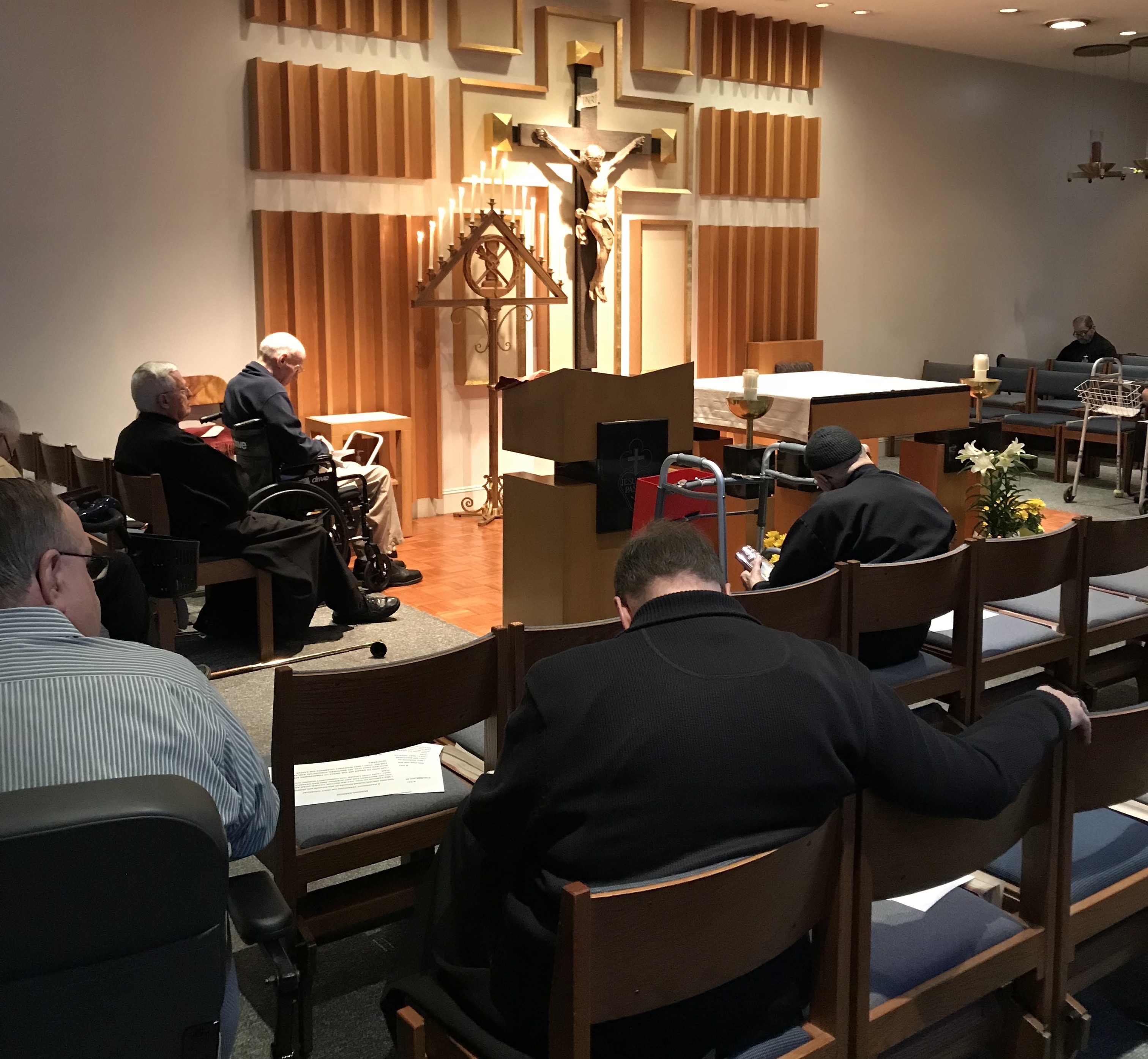
3rd Sunday of Easter: the Emmaus Disciples

For this week’s homily please watch the video below.

During the easter season, we read accounts of the resurrection of Jesus from all four gospels, Matthew, Mark, Luke and John. On the 3rd Sunday, St. Luke’s account is read. All the gospels tell the same story of Jesus resurrection, but each gospel writer has his own way of telling the story. 

The women who followed Jesus from Galilee to Jerusalem for the Feast of Passover are important in Luke’s story as well as the two disciples on their way to Emmaus. They had heard Jesus preach and saw him work wonders in Galilee. In Jerusalem they witnessed his death and then went with those who took his body down from the cross, carrying it wrapped in a linen cloth to the tomb close by where they placed it. 

After the Feast of Passover, early in the morning, some of the women from Galilee – Luke mentions Mary Magdalene, Joanna, and Mary, the mother of James, among them–returned to the tomb with spices and ointments to complete the traditional Jewish anointing of his body. (Luke 24: 1-12)

They were puzzled when they found the stone enclosing the tomb rolled back and the tomb itself empty. 

Then, two heavenly messengers “in dazzling garments appeared to them. They were terrified and bowed their faces to the ground.

They said  ‘He is not here, he has been raised…Remember what he said to you in Galilee, that the Son of Man must be handed over to sinners and be crucified, and rise on the third day.’ 

“And they remembered his words. They returned from the tomb and announced all these things to the eleven and to all the others. but their story seemed like nonsense and they did not believe them.(Luke 25)

Luke continues his resurrection account  with the story of two other followers of Jesus, the disciples on their way to Emmaus. They are also told to remember what Jesus had said about his death and resurrection, and also to recognize him in the breaking of the bread. Will the women from Galilee also meet the Risen Christ in the scriptures and the bread? 

Many churches have stained glass windows of Jesus’ life, death and resurrection. A window of Jesus’ rising from the tomb, shining in great glory while the soldiers guarding the tomb are blinded by the light is a popular one. But the gospels depict Jesus’ resurrection appearances quite differently. 

In the gospel accounts the tomb is not the usual place where Jesus shows himself risen. He appears to the women on their way from the tomb carrying the fearful news he’s been raised from the dead, in Matthew’s gospel. He appears in the city in a locked room Easter Sunday evening where his disciples are hiding in fear. He appears to disciples who have gone back to Galilee, who are probably still trying to make sense of all that has happened.

In Luke’s gospel today, Jesus appears far from the tomb,  to two disciples leaving Jerusalem and going home after the terrible crucifixion. Again, he doesn’t appear in glory, they haven’t the slightest idea who he is when he first joins them on their way. He seems like someone else leaving Jerusalem after an awful experience. 

How does Jesus make himself known to them? He describes the Messiah in simple words from the prophets and the psalms. “As they approached the village to which they were going, he gave the impression that he was going on farther. But they urged him, “Stay with us, for it is nearly evening and the day is almost over.” So he went in to stay with them.And it happened that, while he was with them at table, he took bread, said the blessing, broke it, and gave it to them.With that their eyes were opened and they recognized him, but he vanished from their sight.

Is that the way Jesus appears to us now? In the readings we read, in the bread we have? He appeared to women on their way fearful and confused, to his disciples hiding in a locked room, to these disciples disappointed and losing hope, ready to give up. Is that the way it is with us now?

Is Jesus speaking to us in the words of scripture we’re listening to now, in the bread we eat now, in the fears, hopes and disappointments we have now? The Risen Jesus is not gone and far away. He is here, with us now.

“The Lord be with you,” we hear as our gospel is announced.  Yes, he is. 
The Bread of Life

DSC00076

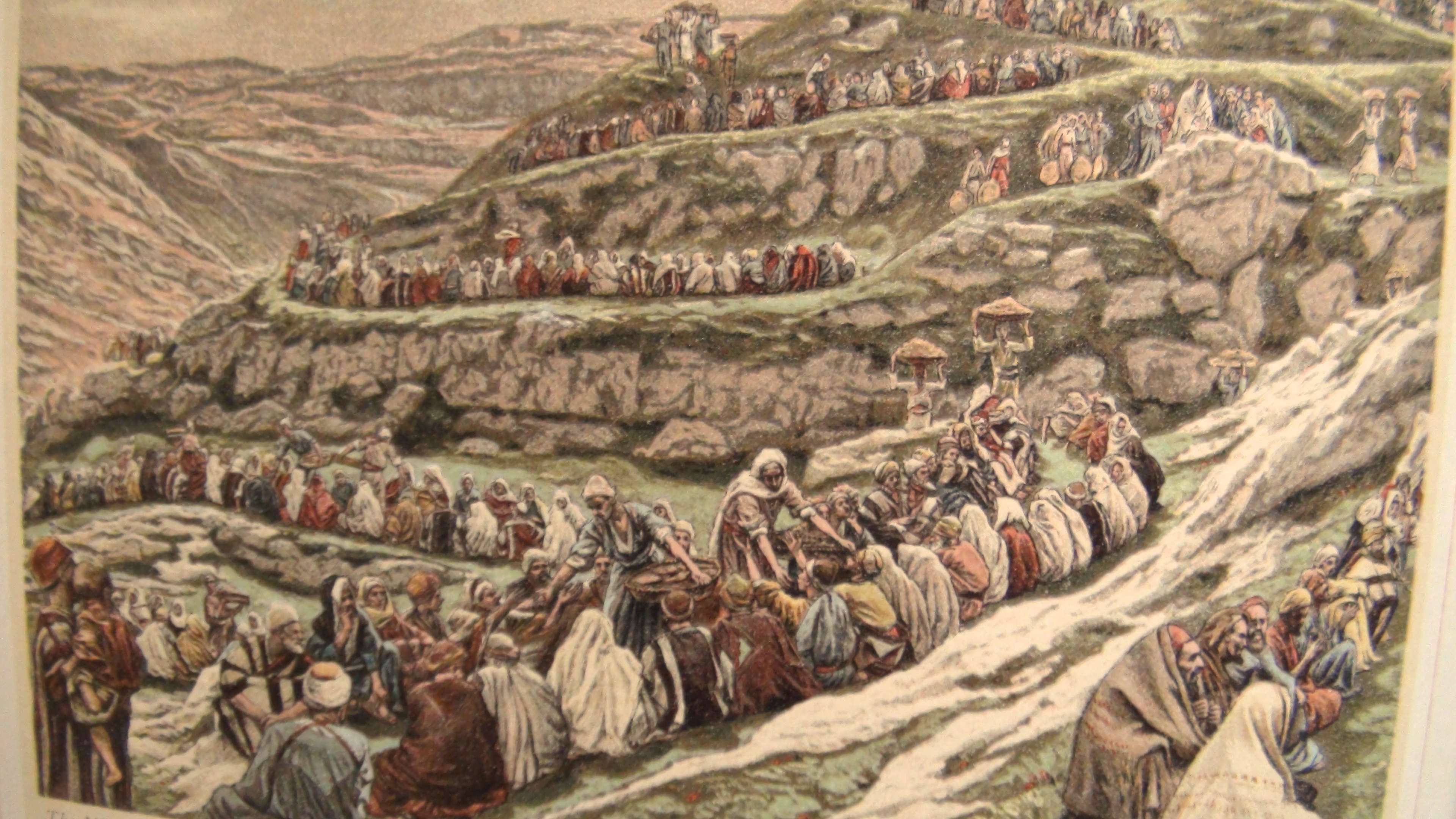
All four gospels say that Jesus fed a great crowd near the Sea of Galilee by multiplying a few loaves of bread and some fish. It’s an important miracle.

John’s account (John 6), read at Mass on weekdays from the Friday of the 2nd week of Easter until Saturday of the 3rd week of Easter, indicates the miracle takes place during the feast of Passover. Like the Passover feast, the miracle and the teaching that follows occur over a number of days.

The Passover feast commemorated the Manna God sent from heaven to sustain the Jews on their journey to the promised land. Jesus claims to be the “true bread,” the “living bread” that comes down from heaven.

Jesus is a commanding presence during the miracle and the days that follow in John’s account. “Where can we buy enough food for them to eat?” he asks Philip as crowds come to him. He then directs the crowd to sit down, feeds them with the bread and fish, and says what should be done with the fragments left over. Unlike the other gospel accounts that give the disciples a active role in the miracle John’s account gives them a small role. Philip and the other disciples are tested during the miracle and the teaching that follows it.

As they embark on the Sea of Galilee to return to Capernaum after the miracle, a sudden storm occurs and Jesus’ rebukes the wind and the sea, the forces of nature, so that the disciples reach the other shore. All four gospels have some version of Jesus’s power over the sea and therefore the natural world. He has divine power.

The crowds to whom Jesus speaks at Capernaum after the miracle are also tested as well as his disciples. They want to make him king after a plentiful meal and only look for a steady hand out instead of “the true bread come down from heaven.” Their faith is limited and imperfect after the miracle. They miss the meaning of the sign.

The disciples also are tested; some walk with him no more.

The miracle of the loaves and the fish remind us that Jesus is Lord and we are people of limited faith. We only see so far. The Risen Lord leads us to the other shore. He is the Bread of Life. “Master, to whom shall we go? You have the words of everlasting life,” Peter says to Jesus at the end of John’s account. And so do we.

This is the Day

cross mono

cross, 4th Century Sarcophagus, Rome

Easter’s over for many people, but it isn’t over. We celebrate Easter for 50 days, from the Easter vigil till the feast of Pentecost. It’s a long day. Over and over we say: “This is the day the Lord has made.”

The reason we celebrate the long day of Easter is because the Lord’s plan takes time to understand.  Jesus spent many days with his disciples, who were  “slow to understand.” So are we.

Cardinal Newman spoke of this long day:

“Let us rejoice in the Day that He has made… the Day of His Power. This is Easter Day. Let us say this again and again to ourselves with fear and great joy. As children say to themselves, ‘This is the spring,’ or ‘This is the sea,’ trying to grasp the thought, and not let it go; as travellers in a foreign land say, ‘This is that great city,’ or ‘This is that famous building,’ knowing it has a long history through centuries, and vexed with themselves that they know so little about it; so let us say, This is the Day of Days, the Royal Day, the Lord’s Day.

“This is the Day on which Christ arose from the dead; the Day which brought us salvation. It is a Day which has made us greater than we know. It is our Day of rest, the true Sabbath. Christ entered into His rest, and so do we. It brings us, in figure, through the grave and gate of death to our season of refreshment in Abraham’s bosom. We have had enough of weariness, and dreariness, and listlessness…

“May we grow in grace, and in the knowledge of our Lord and Saviour, season after season, year after year, till He takes to Himself, first one, then another, in the order He thinks fit, to be separated from each other for a little while, to be united together for ever, in the kingdom of His Father and our Father, His God and our God.”
John Henry Newman, “Difficulty of Realizing Sacred Privileges,”

The Community of Believers

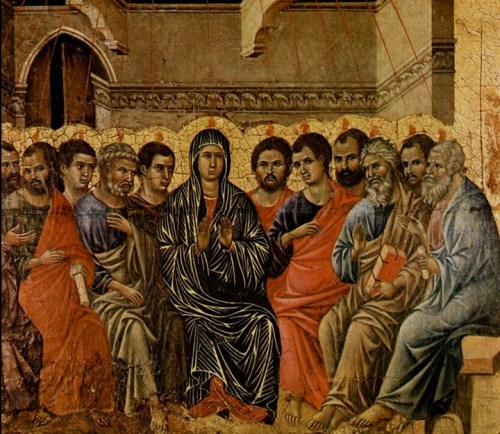
Pentecost

Today’s first reading at Mass describes the early Christian community in glowing terms: “The community of believers was of one heart and mind, and no one claimed that any of his possessions was his own but they had everything in common. With great power the Apostles bore witness to the resurrection of the Lord Jesus, and great favor was accorded them all. There was no needy person among them, for those who owned property or houses would sell them, bring the proceeds of the sale, and put them at the feet of the Apostles, and they were distributed to each according to need. (Acts 4, 32-37)

The community described here and in Acts 2, 33-47  is an important model  for the church. It has influenced Catholic social teaching over the centuries. What would our world be like if the world community, individual nations, the church, the parish, the family could be like this? In a society like ours where excessive individualism is so strong, where so much wealth and power are concentrated in the hands of so few, this ideal is surely appealing. 

A note in the New American Bible, however, cautions that Luke is painting a “somewhat idyllic” picture of the early Christian community. Idyllic means idealized, even unsustainable. In other words, given human nature, the early Christian community never measured up altogether to the picture Luke paints.

The commentator Luke Timothy Johnson suggests Luke’s glowing picture might be influenced by the Hellenistic writers of his time– like Plato–who describes the early days of Athens as a time when “none of its members possessed any private property but they regarded all they had as the common possession of all.” Early writers also put great stock in friendship; people of “one heart and mind become builders of community. ” (The Acts of the Apostles. Sacra Pagina, Collegeville, Min 1992 p. 62)

Reading Luke’s description of the Christian community, then, we need to avoid the temptation to look for utopias. We can’t expect perfect communities anywhere. They don’t exist here on earth. Nor should we think they existed in the past and all has gone downhill since. That’s  “Golden Age” thinking. Our readings from Acts of the Apostles in the Easter season describe an enthusiastic, dedicated group of Jesus’ followers. The gospels describe more skeptical followers, like Thomas and Nicodemus.  We have to keep both groups in mind; they make up our church too.

At the same time, though, we can’t give up on the ideal Luke presents and think it unreal. It’s an ideal to be aimed at, a norm to measure ourselves and the communities we belong to. Not to strive for Luke’s ideal is to lose faith in the mystery of the resurrection. Jesus taught us to pray, “Your kingdom come on earth as it is in heaven.” We have to pray for and work for God’s kingdom to come now, here and now.

Readings and Feasts:  2nd Week of Easter

17 Mon Easter Weekday Acts 4:23-31/Jn 3:1-8

18 Tue Easter Weekday Acts 4:32-37/Jn 3:7b-15

19 Wed Easter Weekday Acts 5:17-26/Jn 3:16-21)

20 Thu Easter Weekday Acts 5:27-33/Jn 3:31-36

21 Fri Glorious Wounds of Christ Zec 12;10-17/Jn 20:24-29

Easter Weekday [Saint Anselm, Bishop and Doctor of the Church]

Acts 5:34-42/Jn 6:1-15

22 Sat Easter Weekday Acts 6:1-7/Jn 6:16-21

23 SUN THIRD SUNDAY OF EASTER Acts 2:14, 22-33/1 Pt 1:17-21/Lk 24:13-35

The church grows gradually after the resurrection. The followers of Jesus meet him, but they’re slow to believe. The ApostleThomas exemplifies their skepticism. The week’s gospel readings from John introduce us to another group slow to believe– people like Nicodemus, who comes to Jesus by night. Nicodemus, supposedly a well-informed religious person, only understands Jesus Christ slowly. 

Our readings from the Acts of the Apostles describes a later time when the apostles witness bravely in the temple after the Holy Spirit comes upon them at Pentecost. “Uneducated, ordinary men,”  the temple leaders call them, but they proclaim boldly God’s mighty works in Jesus Christ. Told to end their witness, they cannot. “It is impossible for us not to speak about what we have seen and heard.” They’re persecuted, imprisoned, yet the number of believers grows.

The healing of the crippled man which we read about last Wednesday is only the beginning of the healing miracles that accompany the preaching of the resurrection of Jesus. Signs must accompany preaching. Signs not only prove the credibility of the witnesses; they point out that God is creatively restoring humanity and the earth itself.

The Acts of the Apostles for Saturday points to a new development of the Christian community. ( Acts 6:1-7) Seven men are chosen to provide for the needs of Greek-speaking followers of Jesus, Stephen and Philip among them. This leads to Christians breaking away from Jerusalem, its temple and its laws, for a new center in Antioch in Syria.  

On Friday the Passionists celebrate the “Glorious Wounds of Christ.” We also begin reading about the miracle of the loaves from the 6th chapter of John’s gospel, an important reading for the Easter season. Bread is a sign that the Risen Jesus remains with us. Bread, “which earth has given and human hands have made,” is also a sign that creation itself shares in the mystery of the Lord’s resurrection.  We will continue to read from John’s gospel into next week: the mystery of the Eucharist has a major place in the Easter season. 

Easter Friday

Since the Easter Vigil we’ve been reading the resurrection accounts from the four gospels.

Today John’s Gospel takes us to Galilee with Peter and the other disciples. It’s the third time Jesus appeared to them, John’s Gospel says, a week after Good Friday. Tradition says it took place at Tabgha, a stretch of wooded land just south of Capernaum, the center of Jesus’ ministry in Galilee. Fresh water from seven springs flow into the lake there.

It was an obvious place for fishermen to come for water or to eat after a night’s fishing. Peter and the others returned to Galilee after that first Easter and went fishing, John’s gospel says. ( John 21) An ancient church marks the spot at Tabgha; it’s a likely place.

They caught nothing through the night, but at dawn they heard a call from the shore to cast out their nets again.“… Jesus was standing on the shore; but the disciples did not realize that it was Jesus.

Then, they caught a large catch of fish. Jesus called from the shore to come eat some fish at a fire he had started; he gave them bread and some fish to eat and revealed himself to them.

Peter has a big role in this story. After they ate, Jesus took him aside and asks him three times “Do you love me?”

Three times the apostle who cursed and swore he did not know him, three times he answers “Yes, I do. I love you.” And Jesus tells him “Feed my lambs. Feed my sheep.”

Peter isn’t alone here. The other disciples and all of us receive that same gift of mercy.

There’s a statue at Tabgha in memory of that beautiful meeting of mercy between Peter and Jesus. No scolding words,. No “I told you so.” No warning, “You do that again and …” No demotion.

Rather, Jesus gives Peter new responsibility.“Feed my lambs” he says. God’s mercy does not take away, but gives more. The disciples  look again at what happened in Galilee and see more than they saw before. They look again at what Jesus did, what he said and promised. They will proclaim it to others, to all nations, as they are told by Jesus to do.

A reading in our liturgy from the Acts of the Apostles accompanies this reading from John’s Gospel, offering an example of Peter’s address to the people in Jerusalem after Pentecost, fearlessly proclaiming the good news he has heard. We can hear in his words something of what he learned personally on the shore of the Sea of Galilee. He echoes God’s forgiving love spoken to him. Now he proclaims God ’s forgiveness to others.

I’ll leave you with some pictures of the beautiful place recalled today on the Friday of Easter. The previous Friday Jesus promised the thief at his side forgiveness and a place in his kingdom. Today, the Risen Jesus brings Peter, the disciples, and us, the promise of mercy and a call to follow him.

Readings here

Why Weren’t You Here?

On Holy Saturday the psalms and readings of Tenebrae dwell on the mystery of death. Psalm 6 offers that great promise  “My soul is glad, even my body shall rest in safety, for you will not leave my soul among the dead, or let your beloved know decay.”(Psalm 6)

The promise extends to creation itself, as we hear especially in the homily for Holy Saturday. Jesus goes down to the realms of death and brings redemption. Jesus does not rise alone, but humanity and creation rise with him.

The candles at Tenebrae lead to another reflection. The 15 candles stand for Jesus, his twelve apostles and the two disciples from Emmaus. As 14 candles are extinquished, we remember those who left him on Good Friday and fled. 

Mary, the mother of Jesus, is not represented in the Tenebrae candles. She was there on Good Friday, but she is not among those our candles represent. Where did she go after his death and burial on Good Friday?  Where was she on Holy Saturday?

It’s likely she went back to Bethany, the place where Jesus and his followers stayed during the feasts, among friends, the gospels seem to indicate. Martha, Mary and Lazarus were there.

It’s also likely Lazarus, raised from the dead offered her hope. But his death was so unlike that of her Son. Lazarus died of some sickness. Jesus was brutally put to death.  

Would Mary have the same questions of God that Martha had of Jesus? Why weren’t you here? This was a day the piercing sword foretold by Simeon the temple struck most deeply into her heart. This was a day her faith was fiercely tried.

In our calendars, Saturday is a day we remember Mary. We remember her today. She asked the great questions of life. “How can this be?” She asked the angel who announced the coming of Jesus to her. “How can this be” she must have asked at his death.

And so we pray to her  and ask her to “pray for us sinners now and at the hour of our death. “

“How can I describe you, to what can I compare you, virgin daughter of Sion?Huge as the sea is your aflliction, who can take it away? ” (Lamentations)

Through her heart his sorrow sharing 
all his bitter anguish bearing           
Now at length the sword has passed.
Can the human heart refrain.       
From partaking of her pain.              
 In that Mother’s pain untold?
Holy Mother, pierce me through, 
in my heart each wound renew 
of my Savior crucified.

Tenebrae

Tenebrae is an ancient Holy Week service celebrated on Holy Thursday, Good Friday and Holy Saturday. Tenebrae, a latin word, means darkness, but the 15 lighted candles at the heart of this service say that darkness never has its way. The 15 candles stand for Jesus, his twelve disciples and the two disciples who leave Jerusalem for Emmaus after Jesus’ death, having lost all hope.

In the Tenebrae service, the candles are extinguished one by one, as the scriptures are read. His disciples leave him, one betrays him. Jesus goes to death alone, but his light remains burning.

Psalm 69 is read at Tenebrae on Holy Thursday:

“I have become an outcast to my brothers,
a stranger to my mother’s sons,
because zeal for your house consumes me,
and the insults of those who blaspheme you fall upon me.”

On Holy Thursday Jesus leaves Bethany with his disciples to celebrate the Passover feast in the evening in an upper room in Jerusalem near the temple. At the table he tells them their faith will be shaken and they will leave him.

The Tenebrae readings tell us  Jesus is our great high priest whose love never fails:

“We have a great high priest who has passed through the heavens, Jesus, the Son of God, let us hold fast to our confession. For we do not have a high priest who is unable to sympathize with our weaknesses, but one who has similarly been tested in every way, yet without sin. So let us confidently approach the throne of grace to receive mercy and to find grace for timely help.”
(Hebrews 4, 14-16)

These days of Holy Week we approach “the throne of grace to receive mercy and find grace for timely help.”

A final reading on Holy Thursday from an Easter homily by St. Melito of Sardis reminds us: “He is the one who brought us out of darkness into light, out of slavery into freedom, out of death into life, and made us a people chosen to be his own. He is the Passover which is our salvation.”

We celebrated Tenebrae  Holy Thursday, Good Friday and Holy Saturday at Immaculate Conception Monastery in Jamaica, New York.

I haven’t found much on the history of Tenebrae, except indications that the prayer began in monastic circles early on. My guess is that it developed from a pastoral need. During the days of Holy Week more people must have come to monasteries to pray as  work was somewhat lessened–unlike our time when we work, feast days or not. Did the monks decide to make some accomodation to their daily office for their visitors?  

The celebration has candles, extinguished as the psalms and other scriptures are read. Everyone understands candles. The psalms are favored sources for understanding the mystery of the passion and resurrection of Jesus in monastic prayer, but they’re not easily appreciated. 

The psalm prayers and captions from St. Augustine and other saints in the church’s morning and evening prayer today are meant to help people appreciate their Christian meaning. 

So can Tenebrae still be a creative prayer form during Holy Week?  I think so. 

Palm Sunday

For this week’s homily please watch the video below.

I like the way Andrew of Crete describes Jesus’ entrance into Jerusalem today as his enters the “dark regions” of our fallen world where so much evil dwells, especially sin and death. “Let our souls take the place of the welcoming branches” strewn before the Lord, the saint tells us, and humbly take part in his journey, with the children who cried out: “Blessed is he who comes in the name of the Lord.” (Office of Readings, Palm Sunday)

Why not take the palm blessed in church today and put it on a cross in your homes as your symbolic welcome of this great mystery.

We’re not spectators in this story. Instead, we are invited into it. Our involvement is more than just listening or going  to church services. Our involvement should change us.

Think of those who were changed that day by their experience of the passion of Christ. There was Simon of Cyrene, who came from work in the fields hardly expecting to be caught up in a stranger’s tragedy. Yet, he saw God in the suffering man whose cross he helped bear. Can we, who often enough ignore the sufferings of others, become more aware of what others are going through and walk at their side? If we do, we heard this story.

There was the thief crucified with Jesus. He’s called a “revolutionary” in one of a translations today. How about a “terrorist,” or any term that describes the lowlife of society. He cried out in the dark for forgiveness and was heard. Can we believe in a God so merciful that he can forgive us, that he can forgive anybody, caught in a life of failure and sin? 

This is a story meant to give hope to those who don’t believe they are any good at all. If we can believe in mercy so great, then we have heard this story. 

There was Joseph of Aramithea who bravely goes to the powerful Roman Procurator Pontius Pilate to ask for the body of Jesus to bury it. Before this he seems a wishy-washy religious leader. If we find ourselves less cowardly in speaking up to the powerful of our own world, then we have heard this story. 

“My God, My God, why have you forsaken me?” How easily we fall into believing our world forsaken, that God is nowhere near us! If we can believe God’s care never fails, not matter what, then we have heard this story.

Mary, his mother, and the holy women, the disciple John, and yes, Peter and others who deserted him were there that day. What they experienced then, they never forgot. They remembered the raw suffering, the cruel death, the unmeasured sadness. But they saw God’s love in the One who was arrested and condemned, who was crucified under Pontius Pilate and who rose again on the third day. 

If we too are touched by the overwhelming love of God we see here, then we have heard this story.

Finally, this story does not end in a tomb. Death itself, the mystery we all face, is conquered when Jesus rises from the dead. When we hope we will live in him who died and rose again, we have heard this story.

Listen to this story this holy week. The Lord speaks  “with a well-trained tongue, a word to the weary that will rouse them.”

This week God speaks. Let’s listen.