BLESSINGS


The recent papal declaration, Fiducia supplicans,  explains Pope Francis’ permission for priests blessing same sex couples and explores the meaning of blessings. The issue goes beyond priests and same sex marriage, the declaration points out. To understand it we need to understand the God of Blessing.

“The great blessing of God is Jesus Christ. He is the great gift of God, his own Son. He is a blessing for all humanity, a blessing that has saved us all. He is the Eternal Word, with whom the Father blessed us ‘while we were still sinners’ (Rom. 5:8), as St. Paul says. He is the Word made flesh, offered for us on the cross.” (Pope Francis)

In the light of God who blesses, the declaration asks us to broaden and enrich our understanding of blessing. 

We bless in our liturgy, a “blessing  that requires what is blessed be conformed to God’s will, as expressed in the teachings of the Church… For this reason, since the Church has always considered only those sexual relations that are lived out within marriage to be morally licit, the Church does not have the power to confer its liturgical blessing when that would somehow offer a form of moral legitimacy to a union that presumes to be a marriage or to an extra-marital sexual practice.”

Yet blessings go beyond liturgy and the moral conditions required for receiving  sacraments. Limiting blessings to the liturgy limits the  unconditional power of God’s love at the heart of blessing, according to the pope. We should not “lose pastoral charity, which should permeate all our decisions and attitudes” and avoid being “judges who only deny, reject, and exclude.” (12,13)

The papal declaration explores the variety of blessings in the Old and New Testament. In the Old Testament God blesses and people respond: “ Melchizedek, King of Salem, blesses Abram (cf. Gen. 14:19); Rebekah is blessed by family members just before she becomes the bride of Isaac (cf. Gen. 24:60), who, in turn, blesses his son, Jacob (cf. Gen. 27:27). Jacob blesses Pharaoh (cf. Gen. 47:10), his own grandsons, Ephraim and Manasseh (cf. Gen. 48:20), and his twelve sons (cf. Gen. 49:28). Moses and Aaron bless the community (cf. Ex. 39:43; Lev. 9:22). The heads of households bless their children at weddings, before embarking on a journey, and in the imminence of death. These blessings, accordingly, appear to be a superabundant and unconditional gift.”

In the New Testament “Jesus blessed children: And he took them in his arms and blessed them, laying his hands upon them” (Mk. 10:16). And Jesus’ earthly journey will end precisely with a final blessing reserved for the Eleven, shortly before he ascends to the Father: “And lifting up his hands he blessed them. While he blessed them, he parted from them and was carried up into heaven” (Lk. 24:50-51). The last image of  Jesus on earth is that of his hands raised in the act of blessing.”

The papal declaration looks to the blessings described in the scriptures offered to all without requiring anything. “It is God who blesses. From the first pages of the Bible, there is a continual repetition of blessings. God blesses, but humans also give blessings, and soon it turns out that the blessing possesses a special power, which accompanies those who receive it throughout their lives, and disposes man’s heart to be changed by God.

So we are more important to God than all the sins we can commit because he is father, he is mother, he is pure love, he has blessed us forever. And he will never stop blessing us.

It is a powerful experience to read these biblical texts of blessing in a prison or in a rehabilitation group. To make those people feel that they are still blessed, notwithstanding their serious mistakes, that their heavenly Father continues to will their good and to hope that they will ultimately open themselves to the good. Even if their closest relatives have abandoned them, because they now judge them to be irredeemable, God always sees them as his children.”

The papal declaration offers priests the opportunity to bless same sex unions with a devotional, not liturgical blessing. But they are not the only ones who bless. The whole church is called to bless the world. The declaration calls for all of us to recover our role as children of God who blesses. 

We might start with the simple words from everyday life and everyday prayers. “In the name of the Father and of the Son and of the Holy Spirit.”  We bless ourselves as individuals. Saint or sinner, we personally look to God for the blessing that comes from the Cross of Christ. “Good bye,” is an old phrase for “God be with you,” a blessing also found in words like “Good night”, “Good day”.  “Bless the Lord, all you works of the Lord, glory and praise him forever.”  We bless the world before us, human beings like ourselves and all the creatures of the earth. 

Everyday phrases, everyday prayers express a God who blesses.
The Bird of Good Hope

I found this Christmas story called “Aidan of the Cows” in an old book.

A young woman named Aidan had a herd of  choice cows producing the best milk and cheese anywhere in the village of St.Koatsven in a distant land near the shore of a distant sea.

Unfortunately, Aidan fell on bad times because the young man she loved spent her fortune and all her cows had to be sold  to moneylenders.

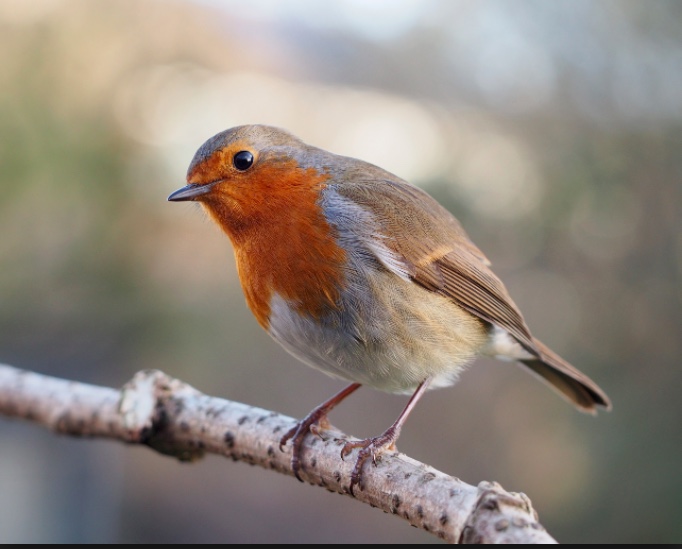
Christmas morning Aidan wandered sadly down a meadow near the sea and  heard a robin singing:

She listened with amazement, with fear and trembling,  with a fearful joy, because the bird sang in human speech.
“I am Robin Redbreast,” he sang, ” the Bird of Good Hope, much admired among birds. For in ancient times when He was toiling up the heavy hill bearing the bitter Cross, I was moved by Heaven to alight on His head, and I plucked from out His bleeding brow one thorn from the cruel crown that bound His temples. One drop of His blood bedewed my throat as I stooped to the blessed task and dyed my breast in a hue of glorious beauty for ever.”

Aidan listened with all the ears of her heart.
“In remembrance of what I did, a blessing was given me—that once  every year, on Christmas-eve, I can give a good gift to the first maiden, good but unhappy, who should put her foot upon the herb Marie, as you, Aidan, have done.”

The girl looked down. Her foot was lightly- pressing the pretty little yellow trefoil plantret, an herb called Marie. “As you have done, Aidan of the Cows,” the robin repeated with a confident chirrup.

Of course, Aidan got her cows back and even got her repentant young man, whom she married, and they live happily ever after. All this took place in a Distant Land where things like this take place.

May the Bird of Good Hope speak to you today.

Unfortunately, we’ve lost this wonderful imaginative tradition that sees divine mysteries allied to the ordinary plants and creatures of creation. Science has taken over our Christian imagination. May we get it back some day; maybe the Christmas mystery so closely allied to a simple stable and donkeys and cattle and camels and straw may help us.

Visits and Gifts

Visits, gifts, greeting cards ( now by email) are a good part of the holiday experience.  How can we love everyone all at once? I don’t know.

But Luke’s gospel makes visiting a part of the Christmas mystery. Mary goes into the hill country to visit her cousin Elisabeth after she hears the angel’s message. They meet, not just to trade family news and pass the time together, but they share faith.

They’re two believers who reveal to each other the mystery hidden within them in their unborn children. And they rejoice in their common gift.

We gather with others at Christmas time; people of faith, believers in a mystery we do not see. At Christmas, believers meet, even believers to a degree.

More than we know, we’re signs to each other, like the bread and wine, sometimes hardly evident. In his commentary today on the gospel of the visitation, St. Ambrose says we’re like Mary and Elizabeth; “Every soul that believes–that soul both conceives and gives birth to the Word of God and recognizes his works.”

So we visit and give our gift.

The Christmas Crib

Pope Francis explained the origins of our Christmas crib:

“Let us go back to the origins of the Christmas crèche so familiar to us. We need to imagine ourselves in the little Italian town of Greccio, near Rieti. Saint Francis stopped there, most likely on his way back from Rome where on 29 November 1223 he had received the confirmation of his Rule from Pope Honorius III. Francis had earlier visited the Holy Land, and the caves in Greccio reminded him of the countryside of Bethlehem. It may also be that the “Poor Man of Assisi” had been struck by the mosaics in the Roman Basilica of Saint Mary Major depicting the birth of Jesus, close to the place where, according to an ancient tradition, the wooden panels of the manger are preserved.

The Franciscan Sources describe in detail what then took place in Greccio. Fifteen days before Christmas, Francis asked a local man named John to help him realize his desire “to bring to life the memory of that babe born in Bethlehem, to see as much as possible with my own bodily eyes the discomfort of his infant needs, how he lay in a manger, and how, with an ox and an ass standing by, he was laid upon a bed of hay”.[1] At this, his faithful friend went immediately to prepare all that the Saint had asked. On 25 December, friars came to Greccio from various parts, together with people from the farmsteads in the area, who brought flowers and torches to light up that holy night. When Francis arrived, he found a manger full of hay, an ox and a donkey. All those present experienced a new and indescribable joy in the presence of the Christmas scene. The priest then solemnly celebrated the Eucharist over the manger, showing the bond between the Incarnation of the Son of God and the Eucharist. At Greccio there were no statues; the nativity scene was enacted and experienced by all who were present.[2]

This is how our tradition began: with everyone gathered in joy around the cave, with no distance between the original event and those sharing in its mystery.

Thomas of Celano, the first biographer of Saint Francis, notes that this simple and moving scene was accompanied by the gift of a marvellous vision: one of those present saw the Baby Jesus himself lying in the manger. From the nativity scene of that Christmas in 1223, “everyone went home with joy”.[3]

With the simplicity of that sign, Saint Francis carried out a great work of evangelization. His teaching touched the hearts of Christians and continues today to offer a simple yet authentic means of portraying the beauty of our faith. Indeed, the place where this first nativity scene was enacted expresses and evokes these sentiments. Greccio has become a refuge for the soul, a mountain fastness wrapped in silence.

Why does the Christmas crèche arouse such wonder and move us so deeply? First, because it shows God’s tender love: the Creator of the universe lowered himself to take up our littleness. The gift of life, in all its mystery, becomes all the more wondrous as we realize that the Son of Mary is the source and sustenance of all life. In Jesus, the Father has given us a brother who comes to seek us out whenever we are confused or lost, a loyal friend ever at our side. He gave us his Son who forgives us and frees us from our sins.

Setting up the Christmas crèche in our homes helps us to relive the history of what took place in Bethlehem. Naturally, the Gospels remain our source for understanding and reflecting on that event. At the same time, its portrayal in the crèche helps us to imagine the scene. It touches our hearts and makes us enter into salvation history as contemporaries of an event that is living and real in a broad gamut of historical and cultural contexts.”

The whole world awaits Mary’s reply

You have heard, O Virgin, that you will conceive and bear a son; you have heard that it will not be by man but by the Holy Spirit. The angel awaits an answer; it is time for him to return to God who sent him. We too are waiting, O Lady, for your word of compassion; the sentence of condemnation weighs heavily upon us.

  The price of our salvation is offered to you. We shall be set free at once if you consent. In the eternal Word of God we all came to be, and behold, we die. In your brief response we are to be remade in order to be recalled to life.

  Tearful Adam with his sorrowing family begs this of you, O loving Virgin, in their exile from Paradise. Abraham begs it, David begs it. All the other holy patriarchs, your ancestors, ask it of you, as they dwell in the country of the shadow of death. This is what the whole earth waits for, prostrate at your feet. It is right in doing so, for on your word depends comfort for the wretched, ransom for the captive, freedom for the condemned, indeed, salvation for all the sons of Adam, the whole of your race.

  Answer quickly, O Virgin. Reply in haste to the angel, or rather through the angel to the Lord. Answer with a word, receive the Word of God. Speak your own word, conceive the divine Word. Breathe a passing word, embrace the eternal Word.

  Why do you delay, why are you afraid? Believe, give praise, and receive. Let humility be bold, let modesty be confident. This is no time for virginal simplicity to forget prudence. In this matter alone, O prudent Virgin, do not fear to be presumptuous. Though modest silence is pleasing, dutiful speech is now more necessary. Open your heart to faith, O blessed Virgin, your lips to praise, your womb to the Creator. See, the desired of all nations is at your door, knocking to enter. If he should pass by because of your delay, in sorrow you would begin to seek him afresh, the One whom your soul loves. Arise, hasten, open. Arise in faith, hasten in devotion, open in praise and thanksgiving. Behold the handmaid of the Lord, she says, be it done to me according to your word. 

St. Bernard

The Genealogy of Jesus

Advent began two weeks ago with Isaiah’s promise that all nations, along with his chosen people in exile, would hear God’s call to dwell in peace on God’s holy mountain. On December 17 our liturgy turns to Matthew’s gospel and the account of the genealogy of Jesus, “son of David, son of Abraham.” Matthew’s gospel traces his ancestry back to his Jewish beginnings. ( Matthew 1,1-17)

Whenever we read this gospel, filled with so many hard to pronounce names I am reminded of my mother.  She had a remarkable memory for relationships, whether her own family relations or others. Honestly, I often tuned out as she probed with delight family trees. After she died I realized I had lost my connection with countless relatives and people she had firmly in mind.  She would have appreciated the genealogy above.

This is not a superfluous project the evangelists are engaged in. They’re intent on describing the Incarnation of Jesus. He wasn’t isolated from humanity, above it all, but  he was part of the human family. And his family tree was not an army of saints; sinners are there for sure.

We will hear from some of his saintly forbears in the next few days, Mary, Joseph, Elizabeth and Zachariah. But let’s not forget the others.They are his family too. He loved them all.

In our family tree above Mary points to Joseph. Like her his ancestry goes back to David and Abraham. Appearing to him in a dream the angel says “Joseph, son of David, do not be afraid to take Mary your wife into your home. For it is through the holy Spirit that this child has been conceived in her.”

3rd Sunday of Advent b: Be Who You Are

For this week’s homily please watch the video below.

In the Fulness of Time

Here’s St. Bernard on the fullness of time:

“When the fulness of time came, there came too the fulness of the Godhead. He came in the flesh, so that at least he might make himself manifest to our earthly minds, so that when this humanity of his appeared, his kindness might also be acknowledged. Where the humanity of God appears, his kindness can no longer be hidden. In what way, indeed, could he have better commended his kindness than by assuming my flesh? My flesh, that is, not Adam’s, as it was before the fall.

“What greater proof could he have given of his mercy than by taking upon himself that very thing which needed mercy? Where is there such perfect loving-kindness as in the fact that for our sake the Word of God became perishable like the grass? Lord, what is man, that you make much of him or pay him any heed?

“Let us infer from this how much God cares for us. Let us know from this what God thinks of us, what he feels about us. Do not ask about your own sufferings; but about what God suffered. Learn from what he was made for you, how much he makes of you, so that his kindness may show itself to you from his humanity.

“The lesser he has made himself in his humanity, the greater has he shown himself in kindness. The more he humbles himself on my account, the more powerfully he engages my love. The kindness and humanity of God our Saviour appeared says St Paul. The humanity of God shows the greatness of his kindness, and he who added humanity to the name of God gave great proof of this kindness.”

Advent: Thursday, 2nd Week

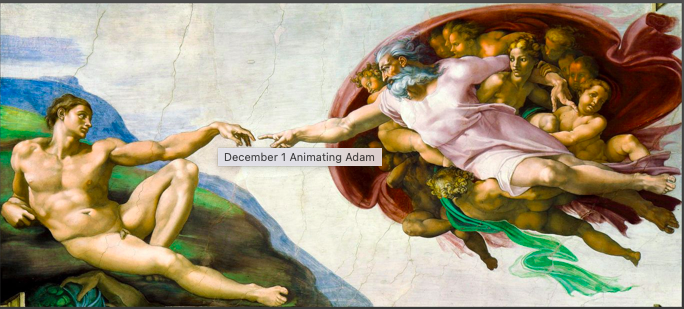
Michelangelo’s creation of Adam doesn’t seem to fit the Lord’s words we hear in our first reading today from Isaiah.  

I am the LORD, your God,
    who grasp your right hand;
It is I who say to you, “Fear not,
    I will help you.”
Fear not, O worm Jacob,
    O maggot Israel;
I will help you, says the LORD;
    your redeemer is the Holy One of Israel.

(Isaiah 41:13-21

Michelangelo’s Adam could be an ad for a modern health spa, hardly someone who fits Isaiah’s description of Jacob and Israel, as a worm or maggot. He represents the Renaissance ideal of human power and beauty. Hardly someone with fears, he might be a picture of today’s confident, flourishing humanity.

So why does God reach out to touch him, since he seems to have everything? Could his nakedness indicate a nakedness within, a spiritual emptiness, a need for meaning that only God, the Creator, can give? Is he humanity today?

Describing Michelangelo’s reimagining of the Genesis story, an early biographer and friend  Ascanio Condivi, said: “with his hand God is seen as giving Adam the precepts for what he should do and not do.”

That seems to be what we ask for this Advent when we celebrate the coming of the Word, Jesus Christ. “Renew our minds and hearts, Lord. Teach us how to live and what to do.”