David’s Last Days: 2 Samuel 15-18

The last few weekdays we have been reading at Mass from the dark chapters of David’s life following  his murder of Uriah and his affair with Uriah’s wife Bathsheba. (2 Samuel 9-20)  Our readings this week are from 2 Samuel 15-18 as he faces the consequences of his sin.

In Monday’s account David must flee from Jerusalem because his own son, Absalom, takes over his kingship by popular acclaim. The people abandon him, and even as he flees from Jerusalem, David’s cursed and stoned and called a murderer. Absalom’s tragic death following that humiliation only deepens his misery. (Tuesday)

Sin has consequences, human consequences, we’re reminded.  “If he does wrong, I will correct him with the rod of men and with human chastisements.” (2 Samuel 7, 14)

“ The rod of men” strikes David hard; he not only faces reaction to his own sins but to the sins of his predecessor Saul as well. He lives in a world of violence and revenge, a world not perfect. 

David’s not perfect either. He’s imperfect till be dies.  But David will not fail, God supports him. Our readings for Thursday and Friday praise David as a man and king “The LORD forgave him his sins and exalted his strength forever.” ( Sirach )

David orders a census as he regains his throne and expands his kingdom. To take a census doesn’t strike us as wrong at first. We take surveys and censuses all the time.                                        But David recognizes that his census taking is an act of pride. He’s making his own calculations more important than the wisdom of God. He’s making his own war preparations and plans more important than the power and plans of God. 

Still, the last words about David in the scriptures praise him. How easy to type him as a murderer, an adulterer, a bad father, a failed leader. We humans type people– today we do that a lot. David was more than all those things. He reminds us how complex we humans are. And also how great the mercy of God is.  
Our Conversion

“On that journey as I drew near to Damascus,
about noon a great light from the sky suddenly shone around me.
I fell to the ground and heard a voice saying to me,
‘Saul, Saul, why are you persecuting me?’
I replied, ‘Who are you, sir?’
And he said to me,
‘I am Jesus the Nazorean whom you are persecuting.’
My companions saw the light
but did not hear the voice of the one who spoke to me.
I asked, ‘What shall I do, sir?’
The Lord answered me, ‘Get up and go into Damascus,
and there you will be told about everything
appointed for you to do.’
Since I could see nothing because of the brightness of that light,
I was led by hand by my companions and entered Damascus.”  Acts 22:8-16

If this account of Paul’s conversion is the only way we see conversion happening, we may tend to look for conversion in some great light from the sky and a voice from heaven knocking us to the ground. Conversion doesn’t happen ordinarily that way. The longer reading of Paul’s conversion for our feast ( Acts 9: 1-22) describes conversion more fully, I think.

St. Francis de Sales, whose feast we celebrated yesterday, probably describes best how God works to convert us- in ordinary ways.   God works with us as he works in creation, day by day, morning and night. The farmer in the parables of Jesus hardly notices or understands what’s happening, and we’re like him. Conversion happens through a life time.

We sometimes also think of conversion as a personal gift – God making us better people. But conversion goes beyond changing us, it’s calls us to change the world beyond us. The Feast of Paul’s conversion is followed by the feast of two of his disciples, Timothy and Titus, who continued Paul’s mission in a new way, as they were given charge of the churches of Ephesus and Crete. Paul’s conversion was more than a personal gift. He had a mission to the church and to the world.   

Conversion is not a one time grace. In our antiphons for his feast, Paul himself acknowledges his need for the daily grace of God that strengthens him and helps him meets challenges he never expected. 

Conversion is not limited to people either. Pope John XXIII called for the Second Vatican Council on the Feast of the Conversion of St. Paul, January 25, 1959. He saw the council as a converting grace for the church and a contribution to the conversion of the world. 

As an event of conversion, the council is not just a shining moment of a few years, but continual event that gives grace in the years and centuries ahead.  

Finally, notice the place of the sacraments of baptism and the Eucharist in the longer account as he is instructed by Ananias: ” Immediately things like scales fell from his eyes and he regained his sight. He got up and was baptized, and when he had eaten, he recovered his strength.

We receive converting grace through sacraments.

3rd Sunday b: God’s Call

For this week’s homily please watch the video below.

We have  two stories in our readings today about people being called by God. The 1st story is about the call of Jonah who is told to go into the great city of Nineveh and change that city.  The 2nd story, our gospel, is about the call of Peter and Andrews, James and John, to be disciples of Jesus.

Whenever we hear stories of people called by God in the scriptures we’re meant to think about our own call, our own mission in life, so let’s look at these two stories.

First, both of the stories tell us to believe that life is a call from God. We have been called into life by God. You or I didn’t get here by ourselves. Life is a gift God gives us. Life is distinct gift. There will never be another you or me.

 Each of us have been given a mission in life. Each of us is called to do what God gives us to do. “Follow me,” Jesus says.

Jesus says simply to Peter and Andrew, James and John, “Come after me and I will make you fishers of men.” They slowly understand what Jesus calls them to do. It’s the same with us. We slowly understand what God calls us to do, but we have to believe we have a mission. 

The fishermen in our gospel knew fishing takes a lot of patience. We have a catch to make, but we’re not sure when we’ll make it. Our own mission in life may not be known easily or right away. That’s why we need to follow Jesus. God is with us, he never loses interest in us. Wherever we are, we have a mission. 

The story of Jonah is another story of God’s call. He’s called by God to go to the great city of Nineveh and change that city.  But Jonah doesn’t want to go near Nineveh, so he gets on a boat at Joppa that’s going in the opposite direction. 

You remember what happens. A great storm comes up and the sailors on the ship are convinced it’s Jonah’s fault, so they throw him into the sea and he’s swallowed up by a whale. 

Jonah is a classic symbol of someone who refuses to do what God asks him to do. Jonah in the whale is a symbol of people who get swallowed up by a drinking problem, or a drug problem or a sex problem. 

Yet God delivers him, and a mission still awaits him. Jonan is a symbol of God’s patience with us. He didn’t let Jonah go. He pursued him in spite of his resistance. And God is that way with us.

Religion and Politics?

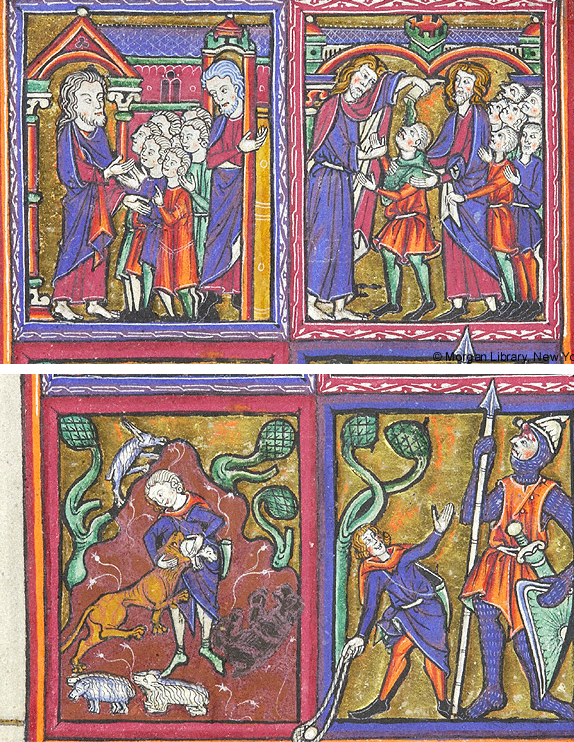
Story of David. Morgan Library, NY

Our reading from the Book of Samuel these days raises that question. Are religion and politics separate lanes that never intersect? Does God has no role in politics? You can’t say that watching the Prophet Samuel repeatedly challenging rulers like Saul and David. It’s also important to notice too that Samuel can get things wrong.

“Fill your horn with oil, and be on your way,” God says to Samuel, “I am sending you to Jesse of Bethlehem, for I have chosen my king from among his sons.” Samuel goes through all of Jesse’s sons, but none fit the bill. “Not him, not him, not him,” God says as one after another are brought to Samuel. “Are these all the sons you have?” Samuel asks.

Jesse replied, “There is still the youngest, who is tending the sheep.” “Send for him,” Samuel says, “we will not begin the sacrificial banquet until he arrives here.” So David is brought to them, ” ruddy, a youth handsome to behold and making a splendid appearance.”

The LORD said, “There–anoint him, for this is he!”

Then Samuel, with the horn of oil in hand, anoints him in the midst of his brothers;   ‘and from that day on, the Spirit of the LORD rushed upon David.” (I Samuel 16,1-13)

“Anoint him, there he is,” God says. The prophet pours the horn of olive oil on David. What does the oil signify? A power not his own, a power that is God’s grace, to lead his people. The grace of God is needed to lead.

We can’t block out the world we live in. The messy, uncertain, brutal, sometimes going nowhere world we read about in the Book of Samuel reminds us that God never abandons the world as it is. It’s not Saul’s world or David’s world or even Samuel’s world; It’s God’s world and God’s plan.

Hard to see in the constant blast of news and political commentaries we get from the media. We think like humans do.We can throw up our hands and turn it all off, but this is our world to understand and care for and pray for.

We’re told to pray for our world, our leaders and ourselves that we may receive God’s wisdom and grace to see and hear God here and now

Almighty and eternal God,
you have revealed your glory to all nations.
God of power and might, wisdom and justice,
through you authority is rightly administered,
laws are enacted, and judgment is decreed.

Assist with your spirit of counsel and fortitude
the President of these United States,
that his administration may be conducted in righteousness, and be useful to your people over whom he presides.

May he encourage due respect for virtue and religion.
May he execute the laws with justice and mercy.
May he seek to restrain crime, vice, and immorality.

Let the light of your divine wisdom
direct the deliberations of Congress,
and shine forth in all the proceedings and laws framed
for our rule and government.
May they seek to preserve peace, promote national happiness, and continue to bring us the blessings of liberty and equality.

We pray for the governor of this state 

for the members of the legislature,
for judges, elected civil officials,
and all others who are entrusted to guard our political welfare.
By your powerful protection, may they discharge their duties with honesty and ability.

We likewise commend to your unbounded mercy
all citizens of the United States,
that we be blessed in the knowledge and sanctified in the observance of your holy law.

May we be united in that peace which the world cannot give and, after enjoying the blessings of this life, be admitted to those which are eternal.

We pray to you, who are Lord and God,
for ever and ever. Amen.

(Adapted from a prayer for the inauguration of George Washington by Archbishop John Carroll, first Catholic bishop in the United States)

2nd Sunday b: Speak Lord

For this week’s homily please watch the video below.

Nobody goes through life alone. We may think we do, but from the beginning others are part of our life. They care for us, guide and support us; they’re with us. So whatever we may think, we don’t go through life alone.

Our two readings today, the 2nd Sunday of the year, tells us that. Our first reading is a wonderful reading from the Book of Samuel. The young boy Samuel is sleeping in the temple near the ark of God and he hears someone calling him, but he doesn’t know who it is or what’s happening.

 So he goes to the old priest Eli and asks him. “Did you call me. What do you want?” “No I didn’t call you, go back to sleep,” the old priest says. Three times this happens. 

Eli is supposed to be the young boy’s mentor, but sometimes mentors don’t have all the answers.

Finally, the priest recognizes this isn’t a nightmare or the boy’s imagination.  Go to sleep and when you hear that call say, “Speak Lord, your servant is listening.”

We don’t go through life alone. Above all, God’s with us. God’s a quiet presence in our lives, and we recognize him only by listening, by humbly listening. “Speak, Lord, your servant is listening. 

Our reading says young Samuel was not familiar with God. None of are, I suppose. But one of the most important things we do in life is to become familiar with God, to recognize the presence of God in our life.

And how do we do this? By putting aside things that preoccupy us, that make us self-absorbed and self-centered, humbly recognizing the presence of God as we go on day by day .”Speak, Lord, your servant is listening.” 

We have to admit we are living in a world today that seems to recognize God less and less. Our culture is almost deaf to God’s presence, and that deafness brings about a loneliness that’s part of life today. There’s a lot of loneliness in our world today. We’re missing the wisdom of God.

We’re not meant to go through life alone.

Our gospel reading from John’s gospel is about the call of the disciples. Like Samuel, their call involved listening, listening to Jesus. “This is my beloved Son, listen to him,” a heavenly voice at the Jordan River says when Jesus was baptized. The followers of Jesus are called to listen to him. We miss so much when we don’t listen to him.

Our reading reminds us also that people were brought to Jesus by someone else. John the Baptist points him out to some, Andrew brings his brother Peter to him. Philip brings Nathaniel. There are people always with us in life, inviting us, supporting us, pointing things out to us, and we in turn are called to invite and support others. 

We don’t go through life alone. We go to God together. We belong to a church. Some people today believe they don’t need a church anymore. They can do it all themselves. But we go to God together.

Dorothy Day, who worked for the poor in the last century over in the Bowery in New York City and was one of the great women of our time, was asked why did she stayed in the church. She was a pacifist against war; she often got into conflict with bishops and fellow Catholics over her strong positions. She was asked why she kept going to church if she found so much opposition there.

“I had heard many say that they wanted to worship God in their own way and did not need a Church in which to praise him, nor a body of people with whom to associate themselves. But I did not agree to this. My very experience as a radical, my whole make-up, led me to want to associate with others, with the masses, in loving and praising God.” (p. 139)

She wrote that in her autobiography, “The Long Loneliness,” a spiritual classic from a woman of faith living with broken humanity.

We are not alone in life. God is with us. We need to grow in familiarity with God. We go to go together. 

Hearing Things in the Night

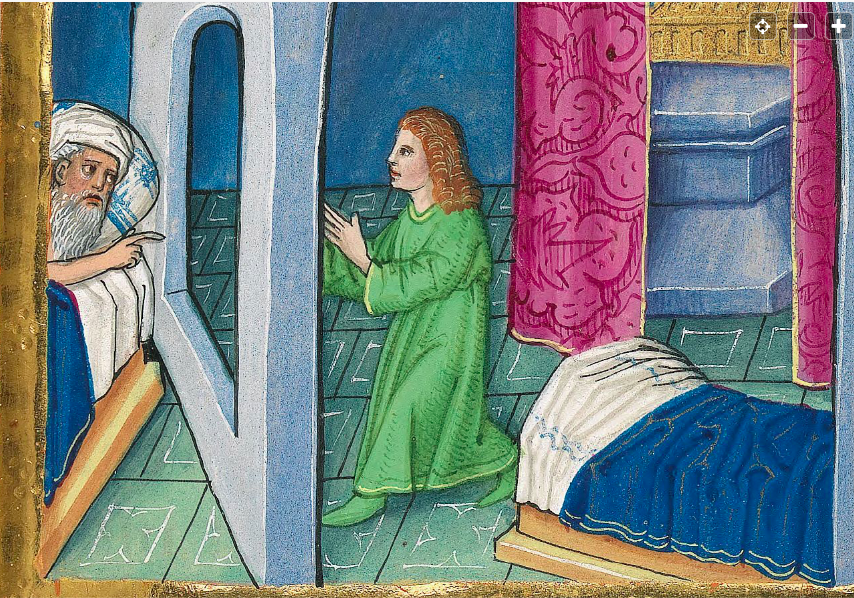
The Call of Samuel. Furtmyer Bible Library of Congress

The Jewish scriptures tell us we need prophets and people with vision, and we need to encourage them. Isn’t that still true today?

In the Book of Samuel, which we’re reading today, a young boy Samuel is looking for advice from Eli, an old priest in the temple at Shilo. The old priest is not very good at giving advice. He almost sent Samuel’s mother Hannah away when she came to the temple to pray for a son.

Young Samuel hears God calling in the night but it’s a very indistinct call; he’s a young boy and doesn’t know what to make of it. The old priest Eli doesn’t help much at first. No one’s there, he says, go back to sleep. The temple at Shilo is a sleepy place.

Finally, the old man recognizes God’s calling the young boy. “Go to sleep, and if you are called say ‘Speak, Lord, your servant is listening'”, he says to the young boy.

Wise advice. Believe that God speaks to you. Believe, even in the night. Listen humbly like a servant. Don’t let the darkness of night or your own small vision dissuade you. God has a mission for you. Listen. Pray.

Be with me today, O Lord. May all I do today begin with you, O Lord.        Plant dreams and hopes within my soul, revive my tired spirit, be with me today.May all I do today continue with your help, O Lord. Be at my side and walk with me. Be my support today. May all I do today reach far and wide, O Lord. My thoughts, my work, my life: Make them blessings for your kingdom; Let them go beyond today. Today is new, unlike any other day, for God makes each day different. Today God’s everyday grace falls on my soul like abundant seed, Though I may hardly see it. Today is one of those days Jesus promised to be with me, a companion on my journey. And my life today, if I trust him, has consequences.


“ I have a mission…I am a link in a chain, a bond of connection between persons. God has not created me for naught…Therefore I will trust him. What ever, where ever I am, I can never be thrown away. God does nothing in vain. He knows what he is about.” (John Henry Newman)

Our churches can become sleepy places. “Boring, boring” people say.

Speak, Lord, and help us to listen.

“Absalom, Absalom, my son”

Stories from the Old Testament often have a raw quality that may cause us to turn away from them. Too much murder, rape, lies and disloyalty in them, we say. Not uplifting at all.

After the Prophet Nathan accuses David of his sins of murder and adultery, he tells him “the sword shall never depart from your house.” (2 Samuel 12, 10) In our first reading today at Mass the prophet’s message is fulfilled. David’s son Absalom  betrays his father and tries to take his throne. (2 Samuel 15, 13 ff) All that’s said about Absalom points him out as a bad kid.

“An informant came to David with the report, ‘The children of Israel have transferred their loyalty to Absalom.’” David flees from Jerusalem to escape Absalom and his army; he crosses the Kidron Valley to the Mount of Olives and then heads for the wilderness around the Jordan River for safety.

Jesus came to Jerusalem by that same route, we remember. He also crossed the Kidron Valley to the Mount of Olives to pray as he faced betrayal and death.

David’s advisors want him to kill his scheming son, but David refuses, because of his deep love for him. He becomes inconsolable when the young man meets a tragic death. “Absalom, Absalom, my son!” His love seems unexplainable.

And so is the love of Jesus, unexplainable.