7th Sunday of Easter

For this week’s homily please watch the video below.

Today’s Readings: www.usccb.org

If we look carefully at our readings at Sunday Mass we can always find ourselves and the world we live in. . Today, for example, in our first reading from the Acts of the Apostles, we see a church rebuilding after the Resurrection of Jesus from the dead, rebuilding from a failure.

They’re rebuilding from a scandal created by Judas, who betrayed Jesus and then killed himself. Peter says to the early Christian community, that it’s time to deal with Judas,

“who was the guide for those who arrested Jesus. He was numbered among us and was allotted a share in this ministry. “ We need someone to take his place.

Judas must have been a problem for the early church. The gospels  put him at the end of the list of apostles and tell us  he’s the one who betrayed Jesus, but Judas must have been an important disciple, not one of the least. For one thing, the gospels indicate he was in charge of their money. Which means he was someone they trusted. He must have been a talented man.

He certainly knew what was going on at the time. He could see the handwriting on the wall. The enemies of Jesus were going to put him to death. Judas must have been a shrewd judge of the time, a smart man. Yet,  despite all the good he had seen Jesus do, despite all the words he had heard say,  whatever went on his mind, he betrayed Jesus. 

He wasn’t the only one. All of Jesus’ disciples failed him.  When his enemies arrested him and put him to death, they all left him and fled.  Peter, who in our first reading is calling for a replacement for Judas in our reading today, cursed and swore that he never knew Jesus.  He could have just as well call for a replacement of himself.

The other disciples also failed him.  They all knew they  were involved in the massive scandal of the Cross. I think that any corporation today experiencing a scandal like that  would fire its president and its board of directors and get somebody else. 

I wonder if we could see in the way they elected a successor to Judas the sense of  insecurity that all the disciples had.  They were all involved, they were all complicit, in the death of Jesus. They’re not sure who they should chose, so they cast lots.

But Jesus didn’t fire them, he gave them new life and new responsibilities and a new vision.

I said at the beginning, we can always find ourselves and the world we live in in our readings at Mass. This certainly can apply to our church with its scandals and failures.  

But also there are scandals and failures in our world and so many of the institutions in our world. Right now, for example, the world is spending trillions of dollars on arming itself with every kind of instrument of war and mass destruction. We’re perfecting the art of war and throwing peace away, while so many die of starvation and lack of the common supports of life. We are living in a world filled with scandals and failures.

That’s why it’so important to listen to our gospel today, another reading that tells us about ourselves and the world we live in.

Jesus prays for his disciples at the Last Supper, even as he knows they will fail him.  When he rises from the dead and ascends into heaven he still prays for them and for us and for all the world. When Jesus ascends into heaven he doesn’t forget us. “I will not leave you orphans,” he told his disciples and he tells us.  He remembers  the church he founded and the world he came to save. He prays and his restoring grace is given.

When we come to church to pray we enter into the prayer of Jesus. He is praying for us and the world we live in. He prays for us in heaven as he prayed for us on earth. 

“Holy Father, keep them in your name that you have given me,

so that they may be one just as we are one…

I do not ask that you take them out of the world

but that you keep them from the evil one…

As you sent me into the world,

so I sent them into the world.

And I consecrate myself for them,

so that they also may be consecrated in truth.”

Reinterpreting Life

IMG_0500

Reinterpreting life is at the heart of the Easter mystery. It calls us to see life differently. Like the artist who reinterpreted the Cross on Calvary and made it the glorious sign we see above, we’re called to reinterpret the Calvary of our world today. Listen to the 4th century Saint Ephrem the Syrian:

Glory be to you, Lord,
You raised your cross like a bridge to span the jaws of death, that we might go from the land of death to the land of the living.
Glory be to you, Lord,
You took on a human body that every human being might live.

You are alive. Those who killed you sowed your living body in the earth as farmers sow grain, and it sprang up and brought forth an abundant harvest of human beings from the dead.

Come, brothers and sisters, let’s offer our love. Pour out our treasury of hymns and prayers before him who offered himself on the cross to enrich us all.”

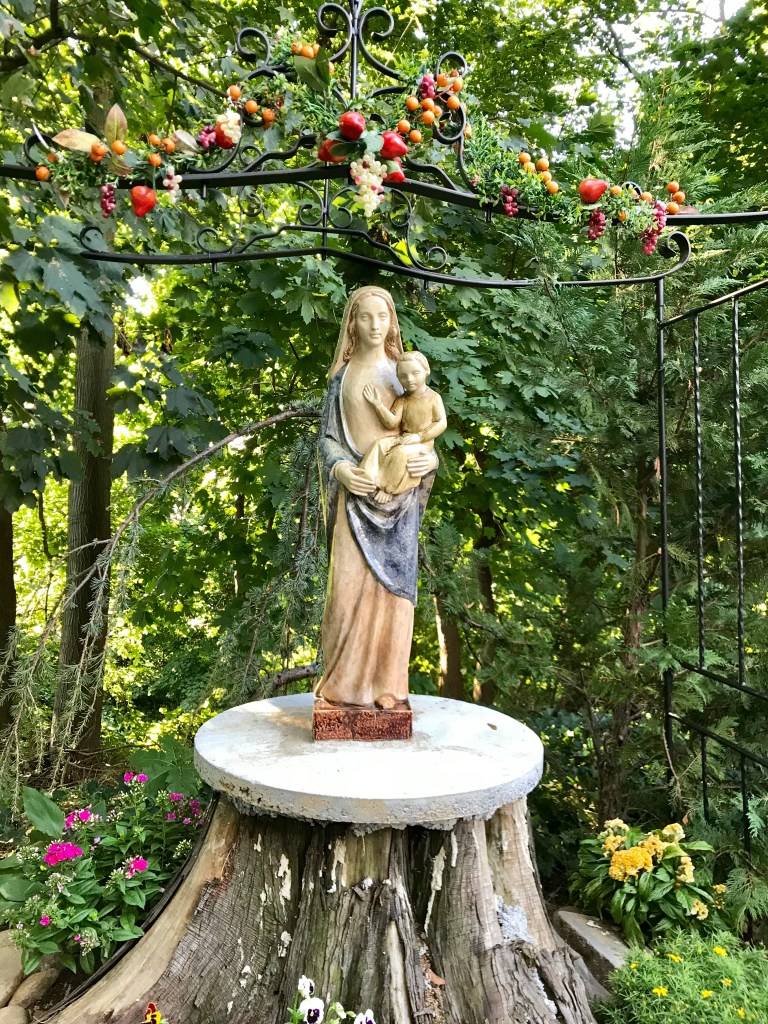
Reinterpreting life through the mystery of the Cross is at the heart of the charism of my community, the Passionists. In our Mary Garden here at the monastery, Mary stands with her Son on the stump of a cedar tree. A dead tree, yet brought to life by the presence of Jesus carried in Mary’s arms.

The Cross of Jesus helps us see life in our world, a “Faithful Cross” it’s called in an ancient hymn. And it is.

There is so much death in our world today. We need to reinterpret our time by the light of the mystery of the Cross of Jesus.

St. Paul at Thessaloniki, Philippi and Athens

We’re reading about the journeys of St. Paul from the Acts of the Apostles this week of the Easter season. Luke carefully notes the various places Paul and his companions set up churches as they go from Jerusalem to Rome. The gospel must be preached everywhere in the world, Jesus said. 

Paul’s journeys are often called travel journeys and our Bibles supply maps to help us follow them. But Paul’s journeys are more than journeys of travel; Luke sees the gospel being proclaimed to the world in many dimensions. There are twists and turns that reveal God’s surprising ways his plan for the church develops.

Look at the accounts this week. On Monday Paul speaks to women at their place of prayer along the water in Thessaloniki and he invites Lydia–or rather she invited herself–-to join him in his mission. Just as he does in his gospel, Luke wants us to see that women are meant to hear the Good News and have a role in bringing its message to others.

On Tuesday Paul and Silas are thrown into prison at Philippi. (Acts 17:22-34) Not only is the jailor and his household converted to the gospel, but Luke tells us the prisoners were listening as they prayed in the night. And so, as he does often in his gospel, Luke points out that the poor must hear the gospel. Most of these prisoners will never get to one of Paul’s house churches, but they must hear the gospel all the same.  

On Wednesday, Paul speaks to the intellectuals in Athens.The results of his preaching don’t seem promising, only a handful seem to respond. But the gospel has to be brought to places like Athens. The gospel has to be brought into the world of learning and science, a world often a showcase of human pride. Still, it has to be proclaimed to those searching for the truth.

The missionary journeys are more than careful, well-planned journeys from place to place conceived by Paul for establishing churches. They are God’s way for the spread of the gospel. His plan is not ours, and that’s why it’s hard for us to understand.

Readings: 4th Week of Easter

This week’s readings from the Acts of the Apostles describe the growth of the church in the Gentile world. Peter journeys to Joppa, the seaport  Jonah embarked from on his mission to Nineveh. On his way he raises up a paralyzed man at Lydda and in Joppa  he raise a young girl, Tabitha, from the dead–signs similar to those Jesus worked.(Saturday, 3rd Week of Easter) 

Some, however, question Peter for baptizing the Roman soldier Cornelius and eating at table with him. (Monday) “God has given life-giving repentance to the Gentiles too,” Peter responds, initiating a new phase in the church’s growth. His response is based, not on human judgment, but because he has seen signs from the Spirit.

The readings from Acts from Wednesday to Saturday describe Barnabas and Saul’s opening campaign into the Gentile world. Let’s not ignore, though, the reading from Tuesday which recalls the unknown survivors of the persecution of Stephen who, driven into the Gentile world, “speak to the Greeks, proclaiming the Lord Jesus to them. The hand of the Lord was with them and a great number turned to the Lord.” Clearly, others besides those we know brought the gospel to the Gentiles.

We are all involved, not just a chosen few, in bringing the gospel to the world.

In the  Gospel readings from John (Monday-Wednesday) Jesus continues to speak of himself as the Good Shepherd. As Risen Lord, he goes before us, guiding his flock to final pasture. We hear his voice, not the voice of a stranger. His voice is the same as the Father’s voice.

On Thursday, the readings from John bring us back to the supper room. For the remaining days of the Easter season, we will listen to Jesus’ words of encouragement and love for his own who are in this world.

Resurrection Thinking

Some  years ago  Anglican Bishop N. T. Wright, a highly regarded New Testament scholar, addressed the Catholic Bishops of Italy on the resurrection of Jesus Christ.  His thoughts on the  resurrection were particularly interesting. The theme of the Italian bishops’ conference was “Jesus, our Contemporary.”

He began  with this challenging picture of the Risen Christ.

“ On the one hand, it is precisely because Jesus is risen from the dead that he is alive in a new, unique way; that he is able to be with us as a living presence, which we know in prayer and silence, in reading scripture and in the sacraments, and (not least) in the service of the poor.

“Jesus is truly our contemporary. But at the same time in his resurrection Jesus stands over against us. He is different. He is the first fruits; we are the harvest that still awaits. He has gone on ahead while we wait behind.

“What is more, the meaning of his resurrection cannot be reduced to anything so comfortable as simple regarding him as ‘contemporary’ in the sense of a friend beside us, a smiling and comforting presence. Because he is raised from the dead, he is Lord of the world, sovereign over the whole cosmos, the one before whom we bow the knee, believing that in the end every creature will come to do so as well.

“It’s not enough that Jesus intervenes at the moment of our death. He is the Lord of creation.”

According to Wright our belief in Jesus as Lord of creation has been undermined by the thinking of the Enlightenment, which placed God (if God exists) beyond our world. We are the lords of creation. This life and all in it is in our hands to shape and control as we think best.

Our belief in the Risen Christ is influenced by this thinking, Wright believes. The only role we give to the Risen Lord is to save us from death and bring us to heaven. But he is Lord of Creation, present here and now. We must live in him today and continue his work, not in a heavy-handed way, but humbly as Jesus called for in his teaching on the beatitudes.

“This is how Jesus wants to run the world: by calling people to be peacemakers, gentle, lowly, hungry for justice. When God wants to change the world, he doesn’t send in the tanks; he sends in the meek, the pure in heart, those who weep for the world’s sorrows and ache for its wrongs. And by the time the power-brokers notice what’s going on, Jesus’ followers have set up schools and hospitals, they have fed the hungry and cared for the orphans and the widows. That’s what the early church was known for, and it’s why they turned the world upside down. In the early centuries the main thing that emperors knew about bishops was that they were always taking the side of the poor. Wouldn’t it be good if it were the same today.”

The Hellenists’ Complaint

The 6th chapter of Luke’s Acts of the Apostles which we started to read on Saturday of the 2nd week of Easter begins with a social problem we shouldn’t overlook.  Some new converts to Christianity are being treated unfairly. “As the number of disciples continued to grow, the Hellenists complained against the Hebrews because their widows were being neglected in the daily distribution.”( Acts 6:1. Saturday, 2nd week of Easter) 

If we substitute “Immigrants” for “Hellenists” in that text a more familiar situation emerges. New-comers are plainly not treated fairly, especially the poorer among them and they’re looking for something more.

The “Hebrews” are the first followers of Jesus, mostly Jews from Galilee. They’re Jewish Christians at home in the Jewish world, who fit into the religious and political Judaism of their time in spite of the friction that came from following Jesus of Nazareth.

They’re the establishment.

In every age immigrants, once they gain a footing in their new home, learn to speak out for their needs. The Hellenists, led by Stephen, began to speak out. Stephen’s fiery words seem to be only about  religious matters, but he’s also criticizing the closed world of Judaism. Should we add the closed world of early Jewish Christianity as well? 

Stephen’s criticism cost him his life and initiated the Jewish reaction that led to the expulsion of the Hellenists. They become immigrants again but, as Luke notes, they bring the gospel to new peoples.

It’s  a misconception to believe, as some do, that Christianity spread easily without problems and sufferings early on. It’s also a misconception to believe that it spread solely due to the genius of Paul the Apostle. Paul was a great figure in the spread of Christianity, but the Acts of the Apostles read this week reminds us there were others, like the deacon Philip, who brought the gospel to Samaria. (Wednesday)

We wonder, too, about the Ethiopian official Philip baptizes. He surely brought the gospel to Africa. (Thursday) There were many others, not just apostles, not solely Paul, but immigrants like Stephen, who fulfilled  a divine plan they hardly understood.

Luke concentrates of Paul’s mission and pays scant attention to the other missionaries who brought the gospel to world around them. Nor does Luke recognize social factors, like immigration, that led the spread of Christianity. He doesn’t tell the whole story. 

We are in the midst of an age of massive immigration, due to wars, climate change, religious discrimination and other issues. We tend to see these issues only in social or political terms.

This week’s readings from Luke remind us there’s more. God’s plan is also being fulfilled.