April showers. Spring rains. A bowl of Easter Water stands near our altar during the Easter season.
Cyril of Jerusalem has a wonderful sermon on water that he preached to catechumens centuries ago. Here are a couple of lines:
“Water comes down from heaven as rain, and although it is always the same itself, it produces many different effects, one in the palm tree, another in the vine, and so on throughout the whole of creation. It does not come down, now as one thing, now as another, but while remaining essentially the same, it adapts itself to the needs of every creature that receives it.”
The saint goes on to say that just as water adapts itself to every creature, the Holy Spirit gives life to each one according to its needs and to benefit the common good. The Spirit’s coming is gentle, not felt as a burden, with tenderness, as a true friend, to save, heal, counsel, strengthen and console.
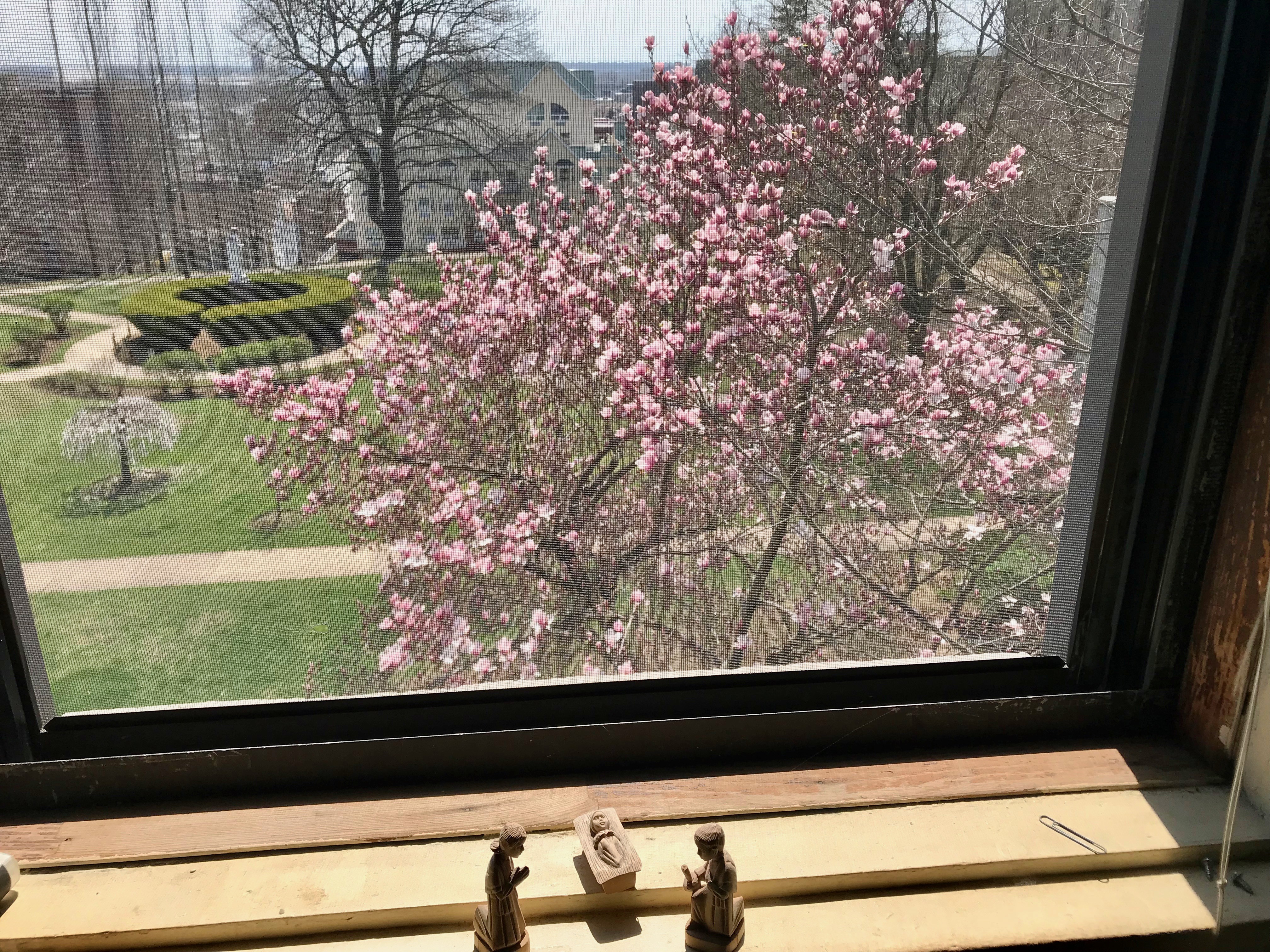
So back to spring rains. They have come this year. The magnolia trees outside my room testify they’ve come, and the other trees and plants in our garden testify too. The rain falling on the earth does what it always does. Like the Spirit of God, water brings life.
Might we learn from the spring rains bringing life to all the varied plants, all shapes, all sizes, even some we might think useless or of no account?. Might we learn from the spring rains?
Send the spring rains, Lord, on our varied earth and human family.
I went through the recent book lists from the New York Times the other day and as far as I can judge religion is off the charts. It’s not mentioned in the media. People are leaving the churches. You might say religion has been put in jail, like the apostles in our reading from Acts yesterday. (Acts 5: 17-21) and Peter later (Acts 12: 1-19).
Peter’s release from his chains is a dramatic narrative. He’s not only freed from prison but heads out to Caesarea where another dramatic event occurs: the conversion of the Roman solider Cornelius and his household. The gospel is received by the Roman world.
The Word of God can’t be chained and banished from society. It will be unchained. God will give it new power over human hearts and minds.
I made a virtual pilgrimage to the church of St. Peter in Chains these days and saw the chains from Jerusalem and Rome. They’re signs something’s coming.
The Solemnity of the Incarnation of the Lord, usually celebrated on March 25, is celebrated this year on April 8. The Angel Gabriel came to Nazareth and invited Mary to become the mother of Jesus. ”Behold the handmaid of the Lord,” she said. On this day we celebrate the Word becoming flesh and dwelling among us. (John 1)
This feast is celebrated by all the ancient Christian churches. The feast is closely connected to other mysteries of Christ. We celebrate Jesus conceived in Mary’s womb today. Nine months from now her pregnancy ends and we celebrate the birth of Jesus at Christmas. Some ancient church calendars also saw March 25th as the day Jesus was crucified and then rose from the dead, so this feast is linked to the Easter mysteries. Some calendars also celebrate the creation of the world on March 25..
I remember a PBS special “What Darwin Never Knew” produced by Nova awhile ago. I don’t remember or understand a lot of the scientific material it contained, but its description of DNAs and embryonic development caught my attention.
According to scientists, embryos from different living beings–humans, animals, birds, fish– appear remarkably alike at their early stage of development, as if they were from the same source. Then, something triggers a different development in each species. Humans sprout arms and legs and begin human development. Other species develop in their own way.
It’s a complex, fascinating path all living things take in their embryonic development. The Letter to the Hebrews in today’s Mass emphasizes the bodily existence of Jesus.“ A body you prepared for me… behold, I come to do your will, O God.’’ He shares a bodily existence with all human beings and with all creatures. All creatures journey into life. All creation is on a journey to life through Jesus Christ, the Word of God.
“The Word was made flesh.” The early Gnostics denied or depreciated the body, and so early theologian theologians, like St. Irenaeus, emphasized the bodily existence of the Word. Jesus followed the same process of development within the womb as we do and after his birth continued to develop “in wisdom and age and grace” as humans do. He faithfully followed the path of human development.
The early theologians also said that through the body Jesus Christ assumed all that he would redeem. In his body he took on human nature. By becoming flesh he also took to himself the created world. From the very beginning, at his conception in the womb, Jesus Christ brought all creation to himself to redeem it.
“Blessed is the fruit of your womb,” Elizabeth says to Mary.(Luke 1,42) The Feast of the Annunciation calls us to renew our respect for life, from its beginning to its end. It’s a time to remember Mary’s acceptance of human life and her respect for the life in her womb.
“ Blessed are you among women and blessed is the fruit of your womb, Jesus.”
The Paschal Candle is a symbol of the Risen Christ which we place as a flaming sign of his presence next to the scripture readings and our altar at the Easter Vigil. Jesus Christ, who enlightens and empowers our world, helps us understand the mystery of his death and resurrection during the Easter Season.
In blessing the candle we proclaim it a sign of “Christ, yesterday and today, the beginning and the end, the Alpha and Omega. All time belongs to him and all the ages, to him be glory and power, through every age and for ever. Amen.”
We marked the small cross on the candle with red wax markings and prayed “ By his holy and glorious wounds, may Christ the Lord guard and protect us. Amen”
The candle will burn in our chapel next to scripture readings and the altar where we offer bread and wine throughout the Easter Season. The Risen Christ is with us.
Sr. Andrew of Crete describes Jesus’ entrance into Jerusalem today as his enters the “dark regions” of our fallen world where so much evil dwells:. “Let our souls take the place of the welcoming branches” strewn before the Lord, the saint tells us, and humbly take part in his journey, with the children who cried out: “Blessed is he who comes in the name of the Lord.” (Office of Readings, Palm Sunday)
Why not take the palm blessed in church today and put it on a cross in your homes to welcome this great mystery?
We’re not spectators in this story. Instead, we are invited into it. Our involvement is more than just listening or going to church services. Our involvement should change us.
Think of those who were changed that day by the passion of Christ. There was Simon of Cyrene, who came from work in the fields hardly expecting to be caught up in a stranger’s tragedy. He saw God in the suffering man whose cross he helped bear. Can we, who so often ignore the sufferings of others, become more aware of what others are going through and walk with them ? If we do, we heard this story.
There was the thief crucified with Jesus. He’s called a “revolutionary” in one of a translations today. How about a “terrorist,” or any term that describes the lowlife of society. He cried out in the dark for forgiveness and was heard. Can we believe in a God so merciful that he can forgive us, that he can forgive anybody, caught in a life of failure and sin?
This is a story meant to give hope to those who don’t believe they are any good at all. If we can believe in mercy so great, then we have heard this story.
There was Joseph of Aramithea who bravely goes to the powerful Roman Procurator Pontius Pilate to ask for the body of Jesus to bury it. Before this he seems a wishy-washy religious leader. If we find ourselves less cowardly in speaking up to the powerful of our own world, then we have heard this story.
“My God, My God, why have you forsaken me?” How easily we fall into believing our world forsaken, that God is nowhere near us! If we can believe God’s care never fails, not matter what, then we have heard this story.
Mary, his mother, and the holy women, the disciple John, and yes, Peter and others who deserted him were there that day. What they experienced then, they never forgot. They remembered the raw suffering, the cruel death, the unmeasured sadness. But they saw God’s love in the One who was arrested and condemned, who was crucified under Pontius Pilate and who rose again on the third day.
If we too are touched by the overwhelming love of God we see here, then we have heard this story.
Finally, this story does not end in a tomb. Death itself, the mystery we all face, is conquered when Jesus rises from the dead. When we hope we will live in him who died and rose again, we have heard this story.
Listen to this story this holy week. The Lord speaks “with a well-trained tongue, a word to the weary that will rouse them.”



 The Victor's Place