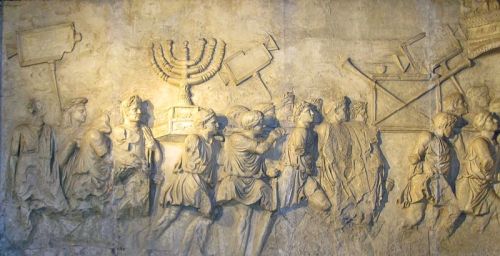
Keep in mind the year 70 when reading the Gospel of Mark and the letters of James and Peter in this first week of ordinary time. In the year 70 Roman armies destroyed Jerusalem and its temple and brought its treasures and many Jews as slaves in triumph to Rome. By the year 81 the Emperor Domitian built the Arch of Titus at the entrance to the Roman Forum to honor Titus, his brother, the general who crushed the Jewish revolt. Scenes of Titus’ army returning with the treasures and Jewish slaves–still visible on the arch today– would remind everyone of Roman might.
Arch of Titus, Roman Forum, Rome
A few years before the year 70, Peter and Paul, leading figures of Christian expansion in the empire, were put to death under Nero. His persecution was unexpected. The years of Christian expansion described in the Acts of the Apostles– our readings during easter time– seemed over. Surely, Jewish and Gentile Christians experienced fear and questioned as a result of these crushing events?
The Gospel of Mark and the letters of James and Peter were written for Christians facing perilous times.
In Mark’s gospel Jesus tells his disciples: “The Son of Man is to be handed over to men and they will kill him, and three days after his death the Son of Man will rise.” But they did not understand the saying, and they were afraid to question him“ (Mark 9)
The year 70 made Christians question the coming of the kingdom. Keep the year 70 in mind when reading the scriptures from Mark, James and Peter these weeks in the lectionary . We never know.
This week we’re coming to the end of the Easter season and the time devoted especially to Mystagogic Catechesis. Mystagogic Catechesis is an old term inspired by the time that Jesus after his resurrection began to wean his followers away from knowing him physically to knowing him through signs, like water, bread and wine, like gathering together to remember him in the scriptures, like seeing him in the poor and suffering who are wounded like him, also seeing his plan in the signs of the times they were living in. Mystagogic Catechesis is a catechesis for recognizing Jesus Christ in signs.
Even though “they rejoiced at the sight of the Lord” the disciples of Jesus found this new way hard to understand. They saw Jesus physically less and less. We see their uneasiness, their questioning, in the gospel narratives read in the Easter season. He taught the patiently, but still they found it hard to see him in another way, through signs.
The Old Testament scriptures were important signs Jesus offered his disciples after rising from the dead. (Luke24L13-27) During the Easter season the scriptures are important signs offered to us. The resurrection appearances of Jesus from the four gospels, especially from the Gospel of John, are gospels we read in the early weeks of Easter. The meeting of Jesus with Nicodemus, the miracle of the loaves and fish, and the Last Supper Discourse of Jesus– all from John’s Gospel– are read on the following weeks. The Acts of the Apostles, describing the surprising growth of the church after the resurrection, is read all through the Easter season.
Those who follow Jesus share the experience of his disciples as they face the mystery of his death and resurrection.
In their catechetical sermons after easter, saints like Ambrose and Cyril of Jerusalem saw the unease in the newly baptized they taught. “Is this it?” St. Ambrose begins one his catechetical sermons to newly baptized Christians. “Is this it? You’re saying to yourself.” The Christian life is not Paradise, the saint reminds them. The Christian life here on earth is not seeing completely or knowing everything clearly. The Christian life is a life of signs, signs that come with the sign of the cross.
Following the Second Vatican Council, the church gives Mystagogic Catechesis a more prominent place in her liturgy. In the past, Mystagogic Catechesis took place in the one week after Easter and was focused on the newly baptized. In the church’s liturgy now Mystagogic Catechesis takes place, not for just one week, but for all the Easter season, and beyond the Easter season to every Sunday celebration. It is meant, not just for the newly baptized, but for the whole Christian community.
Mystagogic Catechesis is not limited to the seven sacraments, but is sacramental in the broad sense the early church understood the term. For example, it sees the church as a sacrament. That’s why we read the Acts of the Apostles all through the Easter season, to understand the mystery of the church.
The church’s promotion of Mystagogic Catechesis also brings a shift in catechesis and preaching. Mystagogic Catechesis is based on the scriptures, rites and prayers of the liturgy, not the catechism. It moves us into another way of teaching and praying. Not a new way, but a way found in the early church and in the church up to the Council of Trent.
Mystagogic Catechesis puts an emphasis on the liturgy, its prayers, readings and signs, as the preeminent place where we learn and pray. “Christ is always present in His Church, especially in her liturgical celebrations…The liturgy is the summit toward which the activity of the Church is directed; at the same time it is the font from which all her power flows. (SC 7, 10)
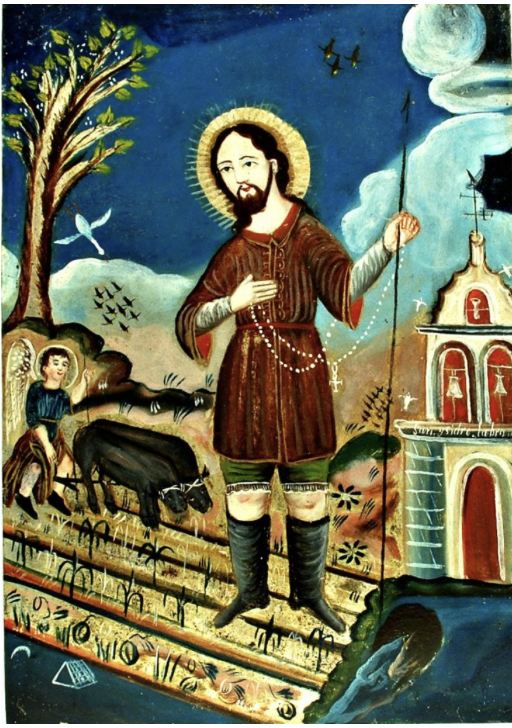
Usually the church celebrates saints’ feast days on the day of their death, but Isidore, the Farmer’s feast is celebrated May 15, when farmers begin sowing spring time seed in their fields. He is the patron of farmers and agricultural workers and also patron of Madrid, Spain.
Isidore was born into a poor family in Madrid about 1080 and worked for a rich landowner all of his life. He was a strong Christian who began his work with prayer, often at Mass, and prayed often during the day as he plowed the fields and cared for the farm. With the little he had he took care of the poor. He and his wife, Maria, always had something ready in their home for someone hungry and in need.
Isidore loved God’s creation and the creatures that belonged to it. They say one winter day as he was carrying some grain from the storehouse he saw some hungry birds searching for food. He spilled out half the grain to feed them and, miraculously, when he arrived home the bags were still full.
You can see why he’s the patron of farmers and agricultural workers. In the United States he’s patron of the Catholic Rural Life Ministry started in 1923 to foster the spirituality of people living in rural America.
Lord God, all creation is yours, and you call us to serve you by caring for the gifts that surround us. May the example of Saint Isidore urge us to share our food with the hungry and to work for the salvation of all.. We ask this through our Lord Jesus Christ,
If we look carefully at our readings at Sunday Mass we can always find ourselves and the world we live in. . Today, for example, in our first reading from the Acts of the Apostles, we see a church rebuilding after the Resurrection of Jesus from the dead, rebuilding from a failure.
They’re rebuilding from a scandal created by Judas, who betrayed Jesus and then killed himself. Peter says to the early Christian community, that it’s time to deal with Judas,
“who was the guide for those who arrested Jesus. He was numbered among us and was allotted a share in this ministry. “ We need someone to take his place.
Judas must have been a problem for the early church. The gospels put him at the end of the list of apostles and tell us he’s the one who betrayed Jesus, but Judas must have been an important disciple, not one of the least. For one thing, the gospels indicate he was in charge of their money. Which means he was someone they trusted. He must have been a talented man.
He certainly knew what was going on at the time. He could see the handwriting on the wall. The enemies of Jesus were going to put him to death. Judas must have been a shrewd judge of the time, a smart man. Yet, despite all the good he had seen Jesus do, despite all the words he had heard say, whatever went on his mind, he betrayed Jesus.
He wasn’t the only one. All of Jesus’ disciples failed him. When his enemies arrested him and put him to death, they all left him and fled. Peter, who in our first reading is calling for a replacement for Judas in our reading today, cursed and swore that he never knew Jesus. He could have just as well call for a replacement of himself.
The other disciples also failed him. They all knew they were involved in the massive scandal of the Cross. I think that any corporation today experiencing a scandal like that would fire its president and its board of directors and get somebody else.
I wonder if we could see in the way they elected a successor to Judas the sense of insecurity that all the disciples had. They were all involved, they were all complicit, in the death of Jesus. They’re not sure who they should chose, so they cast lots.
But Jesus didn’t fire them, he gave them new life and new responsibilities and a new vision.
I said at the beginning, we can always find ourselves and the world we live in in our readings at Mass. This certainly can apply to our church with its scandals and failures.
But also there are scandals and failures in our world and so many of the institutions in our world. Right now, for example, the world is spending trillions of dollars on arming itself with every kind of instrument of war and mass destruction. We’re perfecting the art of war and throwing peace away, while so many die of starvation and lack of the common supports of life. We are living in a world filled with scandals and failures.
That’s why it’so important to listen to our gospel today, another reading that tells us about ourselves and the world we live in.
Jesus prays for his disciples at the Last Supper, even as he knows they will fail him. When he rises from the dead and ascends into heaven he still prays for them and for us and for all the world. When Jesus ascends into heaven he doesn’t forget us. “I will not leave you orphans,” he told his disciples and he tells us. He remembers the church he founded and the world he came to save. He prays and his restoring grace is given.
When we come to church to pray we enter into the prayer of Jesus. He is praying for us and the world we live in. He prays for us in heaven as he prayed for us on earth.
“Holy Father, keep them in your name that you have given me,
Apollos is mentioned in Saturday’s reading from the Acts of the Apostles (18,23-28). He reminds us that Peter, Paul and the other apostles were not the only teachers in the early church. Others brought the message of Christ to the cities and towns of the Roman Empire. Apollos was one of them.
He’s an eloquent, learned teacher who came to Ephesus from Alexandria, one of the great centers of Jewish and Christian learning, and he drew a following by preaching about Jesus. But Apollos doesn’t know everything, so a Jewish couple, Priscilla and Acquila, “took him aside and explained to him the Way of God more accurately.”
They were disciples of Paul who supported him with a job in their tent business. They traveled with Paul and certainly listened to his teaching, but I don’t think they were ever considered teachers as he and Apollos were. They were considered “hearers of the word,” more likely. Well informed, for sure, but still among those we would call today “the faithful.”
Yet, let’s not forget what important teachers “the faithful” are, as Priscilla and Aquila remind us.
I remember a story a brilliant priest told me long ago about a baptism he was conducting for an infant born to a member of his family. His father was the baby’s sponsor and according to the rite then was expected to recite the Creed.
“Can you say the Creed, Dad?” the priest said to his father.
“Who do you think taught it to you?,” the father sharply replied.
Faith can’t survive in this world without the faithful, ordinary Priscillas and Aquilas explaining it and passing it on. It begins with parents, godparents and family passing on the faith to children. It continues in daily life as ordinary Christians share their faith with others. The church today needs to strongly acknowledge this key mission of the laity.
Pope Francis is urging the laity to speak out in his call for a synodal church.
Reinterpreting life is at the heart of the Easter mystery. It calls us to see life differently. Like the artist who reinterpreted the Cross on Calvary and made it the glorious sign we see above, we’re called to reinterpret the Calvary of our world today. Listen to the 4th century Saint Ephrem the Syrian:
Glory be to you, Lord, You raised your cross like a bridge to span the jaws of death, that we might go from the land of death to the land of the living. Glory be to you, Lord, You took on a human body that every human being might live.
You are alive. Those who killed you sowed your living body in the earth as farmers sow grain, and it sprang up and brought forth an abundant harvest of human beings from the dead.
Come, brothers and sisters, let’s offer our love. Pour out our treasury of hymns and prayers before him who offered himself on the cross to enrich us all.”
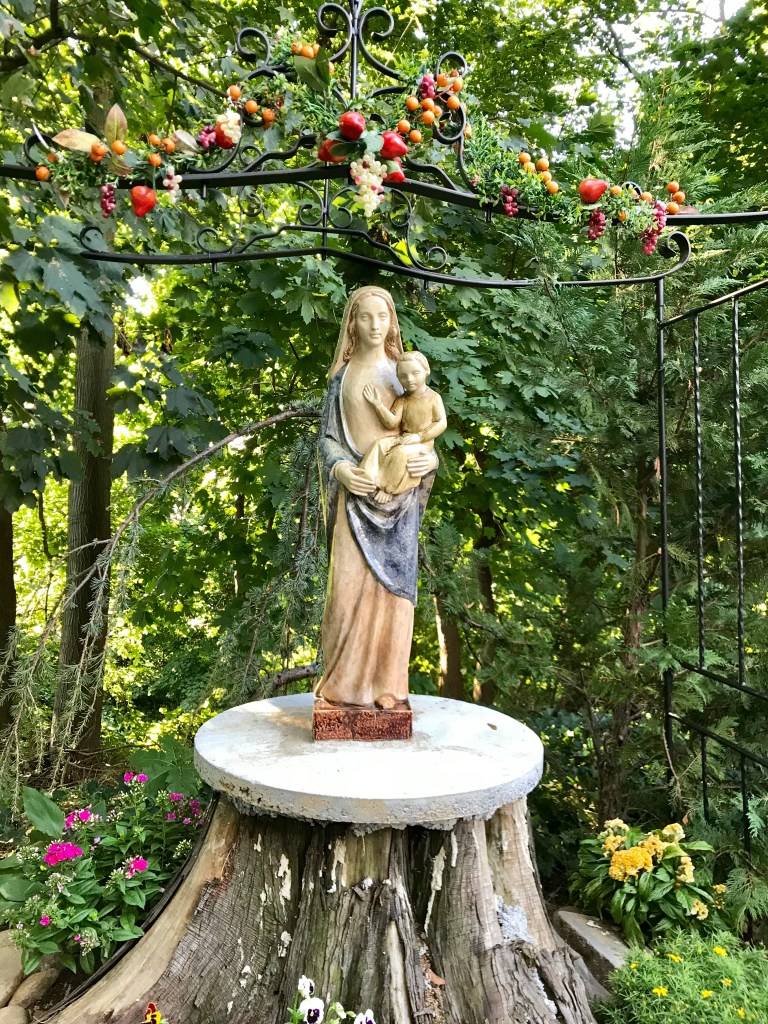
Reinterpreting life through the mystery of the Cross is at the heart of the charism of my community, the Passionists. In our Mary Garden here at the monastery, Mary stands with her Son on the stump of a cedar tree. A dead tree, yet brought to life by the presence of Jesus carried in Mary’s arms.
The Cross of Jesus helps us see life in our world, a “Faithful Cross” it’s called in an ancient hymn. And it is.
There is so much death in our world today. We need to reinterpret our time by the light of the mystery of the Cross of Jesus.
We’re reading about the journeys of St. Paul from the Acts of the Apostles this week of the Easter season. Luke carefully notes the various places Paul and his companions set up churches as they go from Jerusalem to Rome. The gospel must be preached everywhere in the world, Jesus said.
Paul’s journeys are often called travel journeys and our Bibles supply maps to help us follow them. But Paul’s journeys are more than journeys of travel; Luke sees the gospel being proclaimed to the world in many dimensions. There are twists and turns that reveal God’s surprising ways his plan for the church develops.
Look at the accounts this week. On Monday Paul speaks to women at their place of prayer along the water in Thessaloniki and he invites Lydia–or rather she invited herself–-to join him in his mission. Just as he does in his gospel, Luke wants us to see that women are meant to hear the Good News and have a role in bringing its message to others.
On Tuesday Paul and Silas are thrown into prison at Philippi. (Acts 17:22-34) Not only is the jailor and his household converted to the gospel, but Luke tells us the prisoners were listening as they prayed in the night. And so, as he does often in his gospel, Luke points out that the poor must hear the gospel. Most of these prisoners will never get to one of Paul’s house churches, but they must hear the gospel all the same.
On Wednesday, Paul speaks to the intellectuals in Athens.The results of his preaching don’t seem promising, only a handful seem to respond. But the gospel has to be brought to places like Athens. The gospel has to be brought into the world of learning and science, a world often a showcase of human pride. Still, it has to be proclaimed to those searching for the truth.
The missionary journeys are more than careful, well-planned journeys from place to place conceived by Paul for establishing churches. They are God’s way for the spread of the gospel. His plan is not ours, and that’s why it’s hard for us to understand.




 The Victor's Place