Wise Words for Today:Ezekiel 24:1-11

In our first readings for yesterday and today at Mass, the Prophet Ezekiel ( 24,1-11) has some wise but hard words for secular and religious leaders. St. Matthew’s gospel today about the workers in the vineyard (Matthew 20,1-16) has some lessons for ordinary people too.

Yesterday Ezekiel spoke against the King of Tyre for making himself a god. Clever, successful, sure of himself, the King of Tyre sits on the throne that belongs to God alone. He will be pulled from his throne and put to a violent death. 

Remember, though, Ezekiel is a Jewish exile in Babylon. He’s really speaking, not about the ruler in Tyre, but about the ruler in Babylon. Leaders like him shouldn’t make themselves gods. Only God is king over all. That’s true today as well as then. 

Today, Ezekiel excoriates the shepherds of Israel, the Jewish religious leaders, who gouge their sheep for their own benefit. Woe to these shepherds, the Lord says.

Notice that God doesn’t say he will replace the shepherds with other shepherds. God himself will be their shepherd.

 “Thus says the Lord GOD: I swear I am coming against these shepherds. I will claim my sheep from them and put a stop to their shepherding my sheep …I will save my sheep… I myself will look after and tend my sheep.”

There’s no sign that God gives up on his people in our reading. In fact, God becomes more engaged than ever. He comes when times are bad. “I myself will look after and tend my sheep.” The Lord is our shepherd.

The gospel reading from Matthew about the workers in the vineyard may also say something to us today. First, it says the owner of the vineyard is looking for a harvest. He wants it, it’s close to his heart, and so he calls laborers, as many as he can get, at any time he can get them. 

God wills a kingdom to come.

The laborers ( they’re us) have their own ideas how it will come. They want to control the way things are done. They have fixed ideas and dispute the owner of the vineyard. He’s not fair, they say. Actually, he’s far more generous than their ideas make him to be.

Keep looking at the Word of God. Far wiser that what you hear and see on CNN, Fox, CBS, the New York Times, ABC. or Facebook, or Twitter…..
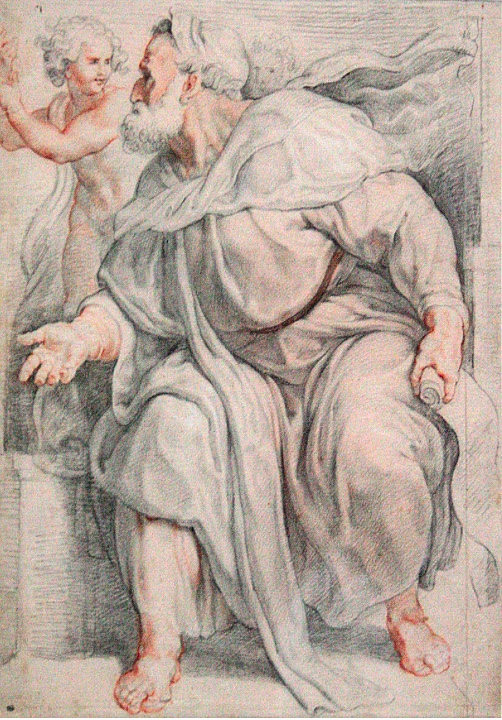
Listen to Ezechiel

The Prophet Ezechiel, Rubens

We usually look to the New Testament for wisdom day by day. The Old Testament readings in our lectionary don’t seem as relevant as the New; the words themselves– “Old,” “New”– suggest that. The Fathers of the Church, though, preached and reflected on the Old Testament a lot, more  than we do. For one thing, they saw in the Old Testament their mission to be involved in the world of their day.

During his ministry Jesus was cautious about saying anything the Romans and those occupying Palestine might see as meant for them. He’s careful about social or political statements that could end his ministry quickly. Look what happened to John the Baptist, for example. In today’s gospel reading (Matthew 19,23-30) Jesus tells his disciples, with Peter as their head, that the rich will find it hard to enter the kingdom of heaven. He’s cautious about indicating who the rich are.

The Prophet Ezechiel (Ez. 28,1-10) in our Old Testament reading today, however, speaks out against the rich and powerful of his time by name. He inveighs against the Prince of Tyre, a small Phoenician kingdom entrenched along the Mediterranean Sea, where Lebanon is today. Smart traders and skillful politicians, they saw themselves as a model society for that part of the world.

Ezechiel like so many of the prophets was a social critic. He’s warning  the Jewish ruling class in exile in Babylon then about seeing Tyre as their model for rebuilding Jerusalem. He sees too much of Tyre’s unjust ways and arrogance to buy into becoming a nation like them.

In our own time and place, we shouldn’t lose our voice for criticizing social issues, prophets like Ezekiel seems to say. While we struggle with our own personal sins and failures, we need to keep promoting a just society throughout the world. God calls us to work for issues of social justice, like immigration and poverty, for example.

We need to listen to Ezekiel.

20th Sunday b: Wisdom for All

For this week’s homily please watch the video below.

20th Sunday b: Bread of Life

Our first reading this Sunday is from the Book of Proverbs. I think of this reading from the Old Testament as a collection of common sense advice that a Jewish grandfather might give to his grandchildren as they get ready to go on the journey of life. 

 He invites them into a house of wisdom where there’s plenty to eat and to drink. It’s a house filled with common sense wisdom, where you learn what to do and what not to do in life. 

The Book of Proverbs is filled with short little sayings centuries old but never out of date. It’s advice about how to live and what to stay away from. It’s based on human experience that doesn’t change over the years.

Let me give you some examples:

An idle hand makes poor,

A busy hand brings riches.

A son who gathers in summer is a credit;

a son who sleeps during harvest, a disgrace.

A wise heart accepts advice,

but a know it all will trip and fall. 

Judaism accepted human experience; Christianity accepts human experience too. If you don’t do anything, you won’t get anything done. Take advantage of what’s there, don’t let  the opportunities of life slip by. If you think you know it all, you don’t. 

The Book of Proverbs is a beautiful introduction to our gospel.  Jesus, the Wisdom of God, tells the crowd that he is bread from heaven. He has come with a wisdom that doesn’t come from human reason or human experience. He doesn’t deny human reason or human experience, but he goes beyond human wisdom. He brings us the wisdom of faith. 

Those he spoke to in the gospel were descendants of a people who believed that God could free them from the slavery of Egypt and then lead them through a desert to a promised land. They believed  a power beyond human power could do this, but then they murmured in disbelief. Now, Jesus said to them,  you murmur in disbelief when I say,   “Whoever eats my flesh and drinks my blood has eternal life, and I will raise him on the last day…Whoever remains in me, and I in him, I will raise him up on the last day. I am the Bread of life. “

Jesus claims he is beyond the manna their ancestors ate in the desert and died. He’s the “true Bread from heaven.” So “taste and see the goodness of the Lord.”

Our religion welcomes human wisdom. We don’t deny science or what real human experience teaches us.  But faith brings us beyond what science or human reason can tell. In the Eucharist the Risen Jesus speaks to us. He is more than flesh as we know it. He comes with a promise of life beyond what we know or can conceive. He promises to be food for our journey from this life till eternal life. He is a friend at our side.

‘Lord, I am not worthy

that you should enter under my roof,

but only say the word and my soul shall be healed.’“

That’s our prayer preparing for communion at Mass. The words were first spoken to Jesus by a Roman centurion who came to him in Capernaum asking that his servant be cured. “I will come and cure him”, Jesus told him. The centurion replied, “Lord, I am not worthy that you should come under my roof, only say the word and my servant will be healed.” (Matthew 8:5-13)

We make his prayer of faith our own as we approach the Lord in the Eucharist. He comes to make our souls a place of wisdom. 

Come and stay with us. Let us taste your goodness, the goodness of the Lord.”

Ezechiel, for those over Thirty

We‘re reading the Prophet Ezekiel at Mass these days. Early Jewish scholars considered him hard to read; only those over 30 should read him, some said. We have the same difficultly. The lectionary for today, Friday in the 19th week of the year, offers a gruesome story of infanticide. A infant girl is thrown out to die. Not a pretty story to look at.

It’s a story harsh to hear and hard to understand. Infanticide, a form of abortion. child abuse, gender discrimination, prostitution, ingratitude, forgetfulness of God. Ezechiel describes his own society in dark terms. Yet, all the while God is there. We’re offered a shorter version in our lectionary to spare us from the ugly details.

But don’t miss God’s intervention:

“You became mine, says the Lord GOD.Then I bathed you with water, washed away your blood, and anointed you with oil. I clothed you with an embroidered gown, put sandals of fine leather on your feet; I gave you a fine linen sash and silk robes to wear. I adorned you with jewelry… You were exceedingly beautiful, with the dignity of a queen.”

“But you were captivated by your own beauty,
you used your renown to make yourself a harlot,
and you lavished your harlotry on every passer-by,
whose own you became.”

“Yet I will remember the covenant I made with you when you were a girl,
and I will set up an everlasting covenant with you,
that you may remember and be covered with confusion,
and that you may be utterly silenced for shame
when I pardon you for all you have done, says the Lord GOD.”
{Ezechiel 16, 1-69)

Ezeckiel’ story of the abandoned girl is a story of sin and redemption. All the while God is there.

Look at the hard times, don’t ignore or hide from them, but see them with the eyes of God, the prophet says. “Thus says the Lord GOD,” I swear I am coming… I will claim my sheep…I will save my sheep…I myself will look after and tend my sheep.” (Ezekiel 34,1-11)

Good words for us today?

The Humble Flowers and Plants

St. Augustine, commenting on the feast of St. Lawrence which we celebrated the other day, says you don’t have to be a martyr to follow Jesus Christ. You can be who you are, where you are, by following him in his humanity. We all have our place, like the many flowers and plants in a garden.

The garden of the Lord includes – yes, it truly includes – not only the roses of martyrs but also the lilies of virgins, and the ivy of married people, and the violets of widows. There is absolutely no kind of human beings who need to despair of their call; Christ suffered for all. It was very truly written about him: who wishes all  to be saved, and to come to the acknowledgement of the truth.

  So let us understand how Christians ought to follow Christ, short of the shedding of blood, short of the danger of suffering death. The Apostle says, speaking of the Lord Christ, Who, though he was in the form of God, did not think it robbery to be equal to God. What incomparable greatness! But he emptied himself, taking the form of a servant, and being made in the likeness of men, and found in condition as a man. What unequalled humility! (Augustine, On the Feast of St.Lawrence)

I notice in our garden these days some little plants and flowers I don’t know. There they are springing up unannounced and unnoticed. I don’t know their names or what they’re good for, but they bring their own beauty and completeness to our garden.

St. Francis de Sales used this same analogy to describe the various ways of holiness. So let’s notice and let’s learn from the humble flowers and plants in our garden. Not crabgrass, though. I don’t think it’s humble.

Faith, a Ticket to Success? Jeremiah 26:1-9

You can’t listen to the story of the Prophet Jeremiah, our first reading these days,  without thinking about the passion of Jesus.  In fact, readings from the Book of Jeremiah are common readings for Holy Week. We see Jesus in Jeremiah.

God tells Jeremiah to “hold nothing back,” but speak the truth to those in power and the false prophets of the day, no matter how unpopular it is.  Jesus did the same.

Like Jeremiah, Jesus was innocent, but was framed by the powerful as guilty. They questioned his authority, but he would not deny his mission.

Only a few voices seem to stand up for Jeremiah and only a few stood up for Jesus. Neither had many faithful followers at their time of trial. Yet both were carried along by God’s power and their names vindicated.

Jeremiah, like Jesus and  John the Baptist who suffered a lonely death at the hands of Herod Antipas belonged to a brave company.

Some would have us see our faith as a ticket to success, an inoculation against failure or suffering.  Believe and nothing bad will happen to you. Yet, as you look at Jesus, the prophets and the saints, you see a more realistic profile of faith. We’re promised victory, yes, but only by accepting the mystery of the cross.

Keep an eye on Jeremiah and John. Keep an eye on the passion of Jesus. Follow them.

Don’t Look Down on Yourself?

July 30th is the feast of St. Peter Chrysologus, a bishop of Ravenna in Italy, who died around 450 AD. The prayer for his feast describes him as “an outstanding preacher of your Incarnate Word.”  You can see why in this excerpt from one of his sermons:

“Why do you look down on yourself who are so precious to God? Why think so little of yourself when you are so honored by him? Why do you ask how you were created, and don’t want to know why you were made?

“This entire visible universe is yours to dwell in.  It was for you that the light dispelled the overshadowing gloom; for you the night was regulated and the day was measured: for you the heavens were brightened with the brilliance of the sun, the moon and the stars. The earth was adorned with flowers, trees and fruit; lovely living things were created in the air, the fields, and the seas for you, lest you lose the joy of God’s creation in sad loneliness.

“And the Creator is still devising things that can add to your glory. He has made you in his image that you might make the invisible Creator present on earth; he has made you his legate, so that the vast empire of the world might have the Lord’s representative.

“Then in his mercy God assumed what he made in you; he wanted now to be truly manifest in men and women, to be revealed in them as in an image. Now he would be in reality what he was in symbol.”