PassionistsPray. Org

Thanks to some talented friends, we have a new online site for our websites and blogs: PassionistsPray.org . The name captures the ministry of my community, the Passionists – to teach and support prayer. We hope you find resources here that bring you closer to God. Bookmark the site. PassionistsPray.org .Here’s a snapshot of the opening page:

1 Corithians 15: Like Seed We Shall Rise

Mary Garden, Passionist Monastery, Jamaica New York

On Thursday we begin reading in our lectionary from Chapter 15 of the 1st Letter to the Corinthians, an important source about the resurrection of the body. “I believe in the resurrection of the body and life everlasting.”

Some Corinthians denied the resurrection, and so In response Paul quotes a basic summary of Christian teaching that he and others received regarding the death and resurrection of Jesus. “For I handed on to you as of first importance what I also received: that Christ died for our sins in accordance with the Scriptures; that he was buried; that he was raised on the third day in accordance with the Scriptures.”  ( 1 Corinthians 15, )

Our preaching is empty, meaningless if there is no resurrection, Paul continues. To deny it means  “ those who have fallen asleep in Christ have perished…If for this life only we have hoped in Christ, we are the most pitiable people of all.”

It’s going into fall in the Northeast USA now. Flowers are beginning to shrivel into dark balls, losing their beauty and going to seed. Flowers in our Mary Garden are falling to the ground and dying. But their seed says “We’ll live again.” 

Good to spend awhile in a garden now, because seed is the analogy Paul uses in speaking of the resurrection of the body. Like the flower, we have our time, then we die. But we will live again. 

We’re children of Adam, from dust, returning to dust. Yet, we’re members of Jesus Christ, who  through the mystery of his death and resurrection gives us life, Paul says. 

We’re children of the flowers too, let’s not forget. We came after they evolved 140 million years ago. Without the food, medicine and beauty they provide we cannot live.  Is that why, I wonder, we call on them in times of death and celebrations of life? Maybe too, in times of uncertainty, like now, they give us wisdom.

Paul used them as a teacher, reminding the Corinthians that what “ is sown corruptible is raised incorruptible; what is sown dishonorable is raised glorious; what is sown weak is raised powerful;  what is sown a natural body is raised a spiritual body. There is a natural body, there is also a spiritual one.”

Not only will we rise, but creation itself will rise again.

Feasts are for Reflection

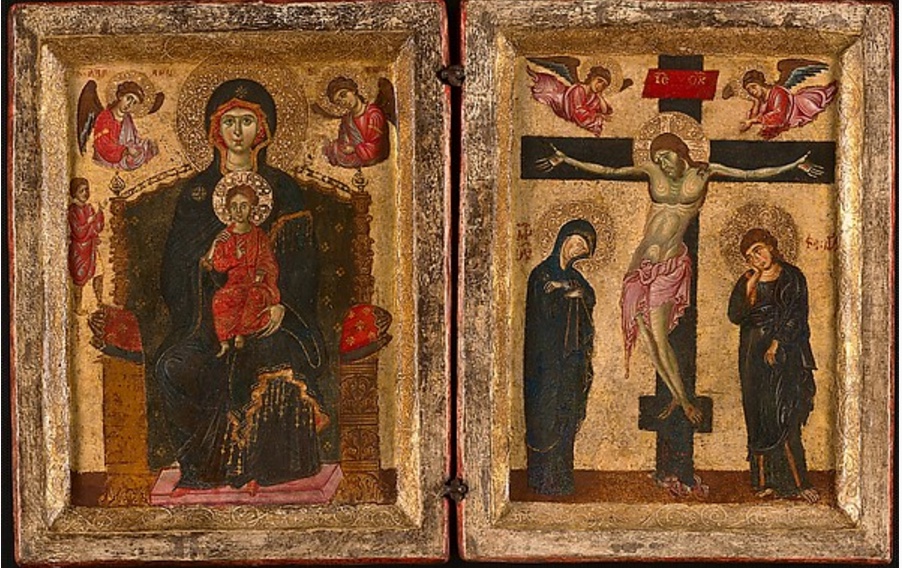
Ryrson cross

A 13th century European pilgrim to the Holy Land brought this icon home as a reminder of his pilgrimage. What places did that pilgrim visit? Surely, Bethlehem where Jesus was born, and Jerusalem where he was crucified and rose  from the dead. In both places , Mary was there with her Son.

In the picture on the left Mary is a joyful mother holding her Son, a divine Son whom the angels praise.  She is a daughter of Abraham, Isaac and Jacob, a daughter of the human family whom she represents. She never loses that joy, which she invites us to share.

In the picture on the right, Mary stands with John, an image of the church, beneath the cross of Jesus. Angels are astonished at the sight. Jesus seems to enfold his mother and the disciple whom he loves in his arms..

The gospel reading from St. John for the feast of Mary’s Sorrows says simply that Mary stood by the cross of Jesus. She’s a brave woman, not afraid to come close to the fearful place where Jesus was put to death. The Book of Judith, ordinarily the 1st reading for the feast, praises Judith, the brave and wise Jewish woman who’s not afraid to stand with her people at a dangerous moment in their history. Two women of courage face suffering and the challenge it brings.

The prayers, traditions and art of this feast take up the theme of Mary standing by the cross. She’s remembered  in poetry, music and art. “Stabat Mater” Here’s an example in Gregorian Chant and Pergolesi’s magnificent baroque setting.

At the cross her station keeping
Stood the mournful mother keeping
Close to Jesus to the last.

Women mystics, like St.Bridgid of Sweden, a mother herself and an important pilgrim to the Holy Land, saw the life of Jesus, particularly his passion, through a mother’s eyes. Wouldn’t Mary draw close to her Son’s cross and then hold him in her arms as they brought him down. The gospels do not mention it, but women like Bridgid were sure it was  so.

Women mystics like Bridgid gave us the Pieta.

A study of the Pieta in art in early medieval France shows the various ways this scene was pictured in art before Michaelangelo’s Pieta became an overpowering icon surpassing others. “Often she is viewed as caught up in the horror of the moment, but she is also shown praying or even gazing into the distance, as if contemplating comforting memories or the reunion to come. Her demeanor ranges from youthful innocence—the Purity that Time cannot age—to careworn maturity—Our Lady of Sorrows.”

Sorrow. like joy, has a range of faces. Mary shows us them all.

Luke 7: A Summary of Lucan Theology

Raising the Widow’s Son. James Tissot

Commentators say that the 7th chapter of Luke’s Gospel, our lectionary reading this week, is where you can see Luke’s  theology best expressed. He is not following  Mark or Matthew in his presentation of Jesus. His arrangement of stories about Jesus and his teaching is entirely his own.  In fact, Luke adds a story in this chapter found nowhere else in the gospels– Jesus raises a widow’s son to life.

It happens at Naim, not Capernaum or the other towns around the Sea of Galilee where Jesus ministered. Not Nazareth, his hometown. Not Bethany, where Jesus responded to friends like Martha and Mary when their brother Lazarus died. We are not sure where Niam was. 

 The woman has no name, no influential friends or family connected to Jesus; she is a widow with no resources. She is a nobody. Yet Jesus performs this great miracle for her. He raises her only son from death and gives him to her.

In yesterday’s reading we read the account of the centurion, whose beloved servant was cured by Jesus and whose faith amazed him. The story emphasizes Jesus call of the gentiles.

On Thursday we will read of the sinful woman who anoints his feet weeping and dries his feet with her hair in the house of a pharisee. Again, Luke presents Jesus reaching with mercy to someone, a woman, whom his society rejects. 

Jesus prefers  the poor and welcomes all in Luke’s Gospel.  Surely, Luke wrote his gospel for a community like 1 Corinthians, which we’re reading now with Luke’s Gospel, where the poor seem excluded and only the well-off are welcome at the Table of the Lord. 

On Friday Luke again mentions women as he describes Jesus evangelizing one town after another in Judea. (Luke 8:1-3) He’s  accompanied by the Twelve, but also some women. They’re obviously not women like the poor widow, but women with resources and talents. One of them is even connected to the court of Herod. They are vital to the mission, Luke insists. They stay with Jesus through his passion and are witnesses of his resurrection. 

The Lord’s Supper: 1 Corinthians 11:17-26

The Word of God we read in the scriptures at Mass prepares us for the Word of God we receive at communion. That’s particularly true of our readings today. In our first reading St. Paul tells the Corinthians that the Lord’s supper, the Eucharist, has become a time for them to get together with their friends to have a good time. In fact, they don’t want anyone there who’s not one of their friends. That isn’t the Lord’s supper.

Paul then reminds them what the Lord’s supper is:

“For I received from the Lord what I also handed on to you, that the Lord Jesus, on the night he was handed over, took bread and, after he had given thanks, broke it and said, “This is my Body that is for you. Do this in remembrance of me.”In the same way also the cup, after supper, saying,”This cup is the new covenant in my Blood. Do this, as often as you drink it, in remembrance of me.” For as often as you eat this bread and drink the cup, you proclaim the death of the Lord until he comes.” (1 Corinthians 11:17-26)

In today’s gospel from Luke another reading prepares us to receive the Lord Jesus himself. A Roman centurion, probably head of the garrison there, sends the Jewish elders to ask Jesus to come and cure his servant, who is close to him. 

As Jesus goes to cure his servant, the centurion sent his friends to tell him “Lord, do not trouble yourself, for I am not worthy to have you enter under my roof. Therefore, I did not consider myself worthy to come to you; but say the word and let my servant be healed.”

He knows the power of Jesus. He also knows his own unworthiness. 

We says the centurion’s words before we receive communion at Mass. “Lord, I am not worthy that you should enter under my roof, but only say the word and my soul shall be healed.”

24th Sunday b: Who is Jesus Christ?

For this week’s homily please watch the video below.

Luke 6:12-19:

Jesus departed to the mountain to pray,
and he spent the night in prayer to God.
When day came, he called his disciples to himself,
and from them he chose Twelve, whom he also named Apostles:
Simon, whom he named Peter, and his brother Andrew,
James, John, Philip, Bartholomew,
Matthew, Thomas, James the son of Alphaeus,
Simon who was called a Zealot,
and Judas the son of James,
and Judas Iscariot, who became a traitor.

Luke’s Gospel is a gospel of prayer. He often presents Jesus at prayer at important points in his ministry: at his baptism (Lk 3:21); at the choice of the Twelve (Luke 6:12); before Peter’s confession (Lk 9:18); at the transfiguration (Lk 9:28; when he teaches his disciples to pray (Lk 11:1; at the Last Supper (Lk 22:32); on the Mount of Olives (Lk22:41); on the cross (Lk 23:46).

After praying the night in prayer Jesus calls twelve apostles who will accompany him and bear witness to his mission. Why does he pray before important times like this? Why should we pray before important times?

Yes, we need wisdom and strength for what we have to do, but prayer should be,, most of all, an acknowledgement of God’s plan and God’s will. “Your will be done,” was an essential part of the prayer of Jesus. It should be essential to our prayer too.

We pray for many things, but most of all, we pray that God’s will, infinitely wiser and infinitely better than our own, be done.

Today’s readings

A Day with the Saints

I am the presenter for  a day of reflection on saints at Thomas Berry Place this Wednesday. Last week the film Cabrini, the story of Saint Francis Xavier Cabrini, was shown at the retreat house, so the day offers a good opportunity to discuss the film. I’m hoping some who come for the day may have seen it.

I’m interested in saints. Wednesday I’m going to reflect on our church calendar of saints for September. We ask saints to intercede for us, but they also are our teachers of faith. St. Peter Claver, the Jesuit who ministered to African slaves in Columbia, South America, in the 17th century, is remembered in all the churches of the United States on September 9. Like Mother Cabrini God called him to face the question of immigration, forced immigration in his case. With Mother Cabrini he faced the challenge of seeing Christ in the stranger.

I will be talking about other saints of September, like St. Gregory the Great, an early pope, St. Helena, who is associated with the Feast of the Exaltation of the Cross, September 14, Saints Cornelius and Cyprian, who struggled with the issue of forgiveness in the church, St. Matthew, author of a gospel.

The saints are a school of teachers to learn from. 

Our church calendar was revised in 1975 and like the lectionary of scripture readings, it’s the basic catechism we need to study from year to year.

You’re welcome to come Wednesday  to Thomas Berry Place in Jamaica, NY, from 9:30 am to 2pm, if you like. Just sign up at 929 357 6700.

Fr. Victor Hoagland