we are “being built on the foundation of the Apostles and prophets, with Christ Jesus himself as the capstone. Through him the whole structure is held together and grows into a temple sacred in the Lord…” (Ephesians 2: 19-22)
That picture of the church is brought before us every month with a feast of an apostle, We celebrated two apostles yesterday, Simon and Jude. On a feast of the apostles we look back and look forward. We belong to a growing church meant to embrace people from every nation, time and place. It’s a church bound for glory. That’s the church we belong to.
We belong to a church described as a building, not a complete building, but one “being built.” The foundation is the apostles and prophets. Jesus Christ is the cornerstone, holding everything together and ensuring it grows to the “sacred temple of the Lord.”
Yet, in our part of the world, is our church growing? It looks like it’s falling apart. Perhaps we don’t see how big our church is. It’s bigger than we think. Some weeks ago Pope Francis was in Southeast Asia and commented on the growing church he saw there. A youthful, enthusiastic church, he said. We see only a part of the church.
The apostles brought their message to all the earth. They do not just report their memories of Jesus; they brought their message to others, to the ends of the earth. Accounts of their missionary journeys may not all be historically true, but their conviction of a universal mission was certainly true. They call us to this same mission; a great church is being built and we are part of it.
“We have inherited heaven along with the apostles,” our morning prayer says. “On the foundations stones of the heavenly Jerusalem, the names of the twelve apostles of the Lamb are written,” we read in morning prayer. That’s where we are headed. We see only so much..
For this week’s homily please watch the video below.
For the last five Sundays or so, Mark’s gospel describes the journey of Jesus and his disciples from Galilee to Jerusalem where he’ll die and rise from the dead. It’s not a day by day account of the journey or a list of each place they pass; the gospel is more interested in the people Jesus encounters and invites to follow him along the way.
Good ordinary people, as far as we can judge. Peter and his brother Andrew, the other fishermen from Galilee, James and John, were among the first who follow him. Good, solid reasonable people. The rich young man who meets Jesus on the way– our gospel reading a few weeks ago– a good, solid individual. Jesus calls him to follow him.
But Mark indicates his followers often fail to understand him, especially his message about suffering and death. Yet he calls them anyway, even though over and over Mark says, “They did not understand him.”
“You think like human beings think,” Jesus says to Peter, who wanted him to put thoughts of suffering and death from his mind. James and John are looking for positions in Jesus’ earthly kingdom, a sure thing. The rich young man’s afraid of losing what he has. They think like human beings think. They don’t understand him.
Of course, Mark’s gospel says that’s the way we think too. We’re limited, we’re self-serving, we’re afraid to trust in the wisdom and promises of God. We think like human beings.
At one point in Mark’s gospel, the disciples throw up their hands in desperation after Jesus admonishes them, “Then who can be saved?” Are you looking for a perfect remnant?
Today’s gospel seems to answer that question. “As Jesus was leaving Jericho near the end of his journey, Bartimaeus, a blind man, the son of Timaeus, is sitting by the roadside begging.” The blind beggar sits there by the road. He can’t see. And he has nothing to recommend him. Nobody wants to look at him, but Jesus calls him and gives him his sight.
Not only does Jesus give him sight, but Bartimaeus, the son of Timaeus, gets up and follows Jesus on the way, up to Jerusalem.
In a simple, beautiful way, Mark’s Gospels presents a powerful story of God’s mercy. The blind man is a symbol of humanity, blind to so much. But God’s mercy is stronger than human understanding, human weakness, even human sin. God’s mercy helps us to see, to get up and to go with Jesus to Jerusalem.
A powerful story of hope. It’s not a small remnant that will be saved. It’s an immense throng. Listen to Jeremiah, our first reading.
“The LORD has delivered his people, the remnant of Israel. Behold, I will bring them back from the land of the north; I will gather them from the ends of the world, with the blind and the lame in their midst, the mothers and those with child; they shall return as an immense throng. They departed in tears, but I will console them and guide them; I will lead them to brooks of water, on a level road, so that none shall stumble. For I am a father to Israel, Ephraim is my first-born.”
Our readings these days from Paul’s Letter to the Ephesians and Luke’s gospel speak of a people on a journey, longing to see God’s face. But first, there’s a mountain to climb before standing in God’s holy place. Not an easy climb. (Responsorial psalm, Friday)
I, a prisoner for the Lord, urge you to live in a manner worthy of the call you have received, with all humility and gentleness, with patience, bearing with one another through love, striving to preserve the unity of the spirit through the bond of peace; one Body and one Spirit, as you were also called to the one hope of your call; one Lord, one faith, one baptism; one God and Father of all, who is over all and through all and in all. (Ephesians 4:1-6)
Paul calls for patience, unity and peace from his flock in Ephesus, whose leader is now a prisoner. Most likely, they feel adrift. When the shepherd is struck the sheep scatter.
And so Paul promises the care of the Good Shepherd who cares for his flock from on high, whose care never ceases.
The one who descended is also the one who ascended far above all the heavens, that he might fill all things. And he gave some as Apostles, others as prophets, others as evangelists, others as pastors and teachers, to equip the holy ones for the work of ministry, for building up the Body of Christ, until we all attain to the unity of faith and knowledge of the Son of God, to mature manhood to the extent of the full stature of Christ, so that we may no longer be infants, tossed by waves and swept along by every wind of teaching arising from human trickery, from their cunning in the interests of deceitful scheming. Rather, living the truth in love, we should grow in every way into him who is the head, Christ, from whom the whole Body, joined and held together by every supporting ligament, with the proper functioning of each part, brings about the Body’s growth and builds itself up in love. (Ephesians 4:7-16)
A monastery is a house of prayer to pursue the “happy” or blessed life. Our Passionist priests and brothers in Jamaica, NY faithfully pray the Liturgy of the Hours every morning and evening, which prepares them to give the bread of the Word and the Eucharist at Mass and to serve in various ministries. Prayer and the Eucharist, the daily bread of apostles, fuel works of mercy.
In a letter to a Roman noblewoman named Proba, St. Augustine offers valuable insights on prayer. The bishop of Hippo, whose rule of life continues to guide monastic communities today, understood the value of “prayer at appointed hours.” Although he was an extremely busy bishop, St. Augustine kindled his desire for God throughout the day by lifting his heart in prayer from sunrise to sunset. Forgetfulness of God in the midst of constant work makes the heart “lukewarm” and “chill” over time.
Thankfully, we can redeem the time. As the earth revolves around the sun, children of God revolve in the orbit of the Blessed Trinity. Space and time, the materials of our journey from birth to eternity, belong to the Father, Creator of all things through his Word and Spirit. Jesus, who frequently spent the night in prayer, models our way home to the Father.
Can one pray during a busy schedule? St. Augustine teaches that “even in these actions” (work responsibilities), we pray by continually longing for God. Many words are unnecessary. The desert monks discovered that short but frequent prayers, “hurled like swift javelins,” keep the heart and mind fixed on the Lord.
“Ask and it will be given to you; seek and you will find; knock and the door will be opened to you” (Matthew 7:7). Persistence in prayer with sighs and tears unite us with the ineffable God, “for he has established all things through his Word and does not seek human words.” As a monastery is a house of prayer, so are all of us “temples” of prayer in the Holy Spirit (Romans 8:26-27).
The Passionists Pray website offers resources for daily prayer, which can be accessed here.
From a letter to Proba by Saint Augustine, bishop
Let us turn our mind to the task of prayer at appointed hours
Let us always desire the happy life from the Lord God and always pray for it. But for this very reason we turn our mind to the task of prayer at appointed hours, since that desire grows lukewarm, so to speak, from our involvement in other concerns and occupations. We remind ourselves through the words of prayer to focus our attention on the object of our desire; otherwise, the desire that began to grow lukewarm may grow chill altogether and may be totally extinguished unless it is repeatedly stirred into flame.
Therefore, when the Apostle says: Let your petitions become known before God, this should not be taken in the sense that they are in fact becoming known to God who certainly knew them even before they were made, but that they are becoming known before men through boasting.
Since this is the case, it is not wrong or useless to pray even for a long time when there is the opportunity. I mean when it does not keep us from performing the other good and necessary actions we are obliged to do. But even in these actions, as I have said, we must always pray with that desire. To pray for a longer time is not the same as to pray by multiplying words, as some people suppose. Lengthy talk is one thing, a prayerful disposition which lasts a long time is another. For it is even written in reference to the Lord himself that he spent the night in prayer and that he prayed at great length. Was he not giving us an example by this? In time, he prays when it is appropriate; and in eternity, he hears our prayers with the Father.
The monks in Egypt are said to offer frequent prayers, but these are very short and hurled like swift javelins. Otherwise their watchful attention, a very necessary quality for anyone at prayer, could be dulled and could disappear through protracted delays. They also clearly demonstrate through this practice that a person must not quickly divert such attention if it lasts, just as one must not allow it to be blunted if it cannot last.
Excessive talking should be kept out of prayer but that does not mean that one should not spend much time in prayer so long as a fervent attitude continues to accompany his prayer. To talk at length in prayer is to perform a necessary action with an excess of words. To spend much time in prayer is to knock with a persistent and holy fervor at the door of the one whom we beseech. This task is generally accomplished more through sighs than words, more through weeping than speech. He places our tears in his sight, and our sighs are not hidden from him, for he has established all things through his Word and does not seek human words.
Reference
The passage from St. Augustine can be found in the Office of Readings for Monday of the 29th Week in Ordinary Time.
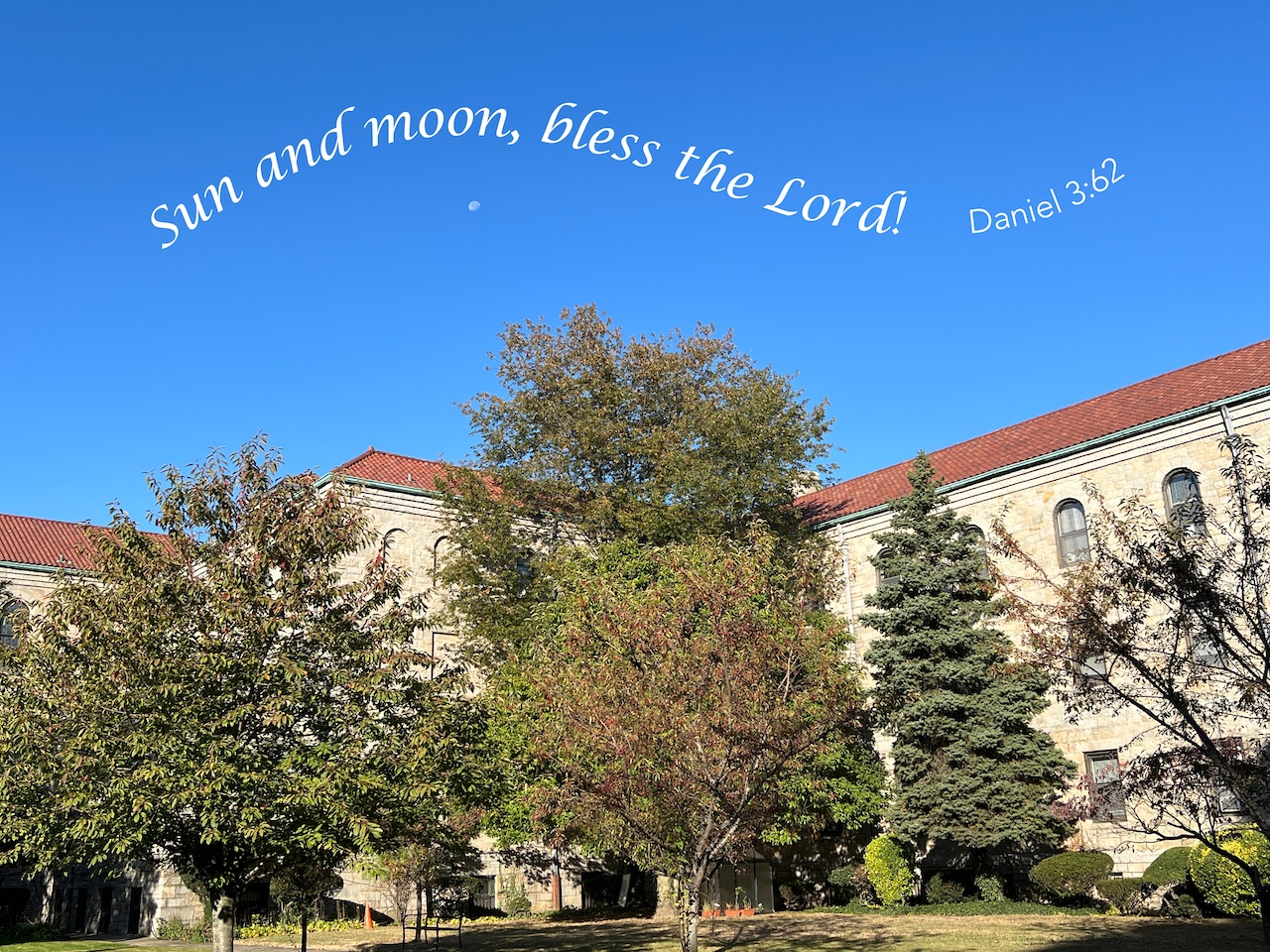
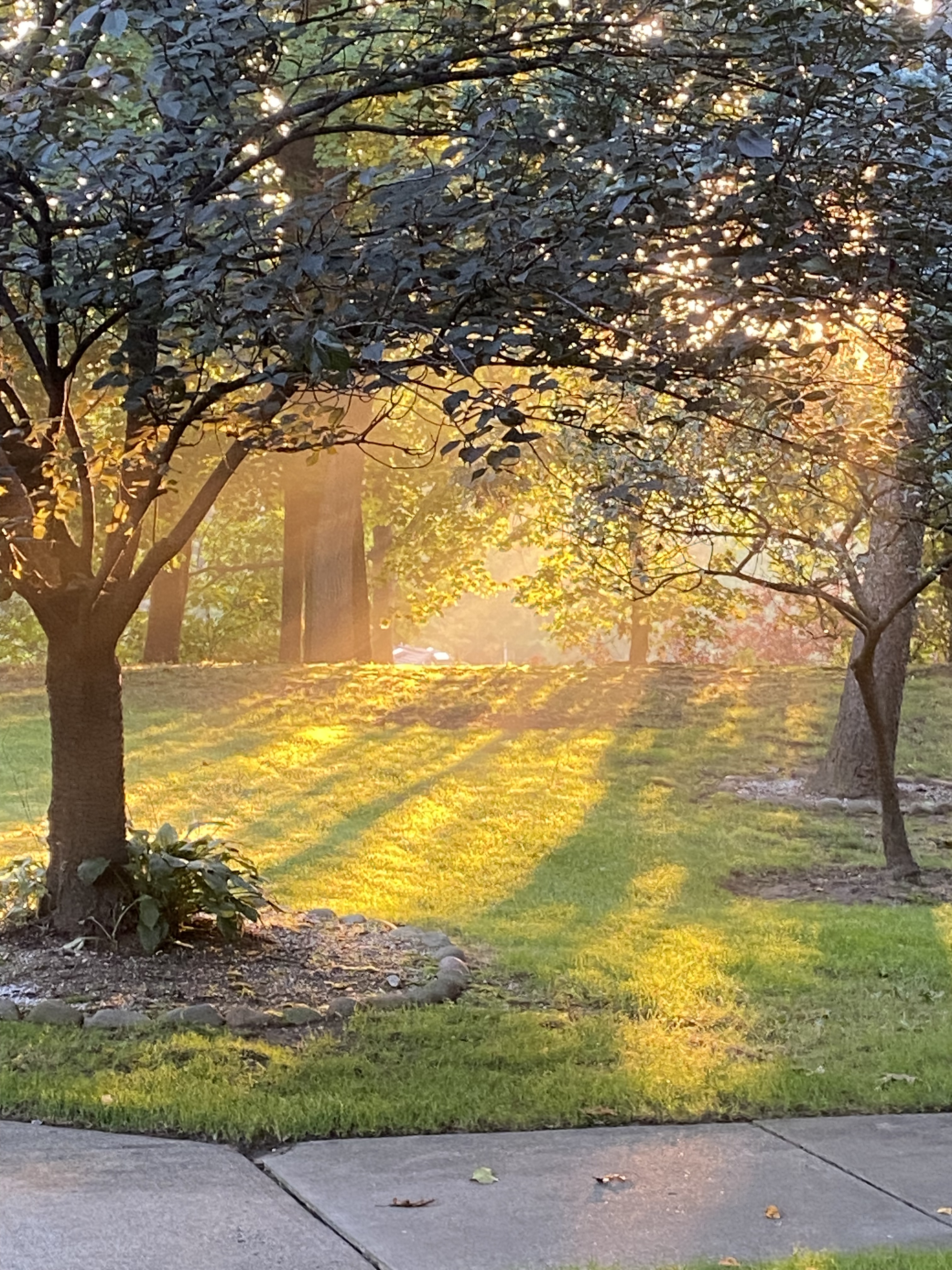
The autumn sun has a special brilliance as it rises in the morning bathing our oak trees, our spruce, our plum and cherry trees with light. Toward the end of the 1st century, St. Clement of Rome wrote a letter to the Christians of Corinth, the church St. Paul wrote two letters to earlier.
In lyrical language Clement pictures God’s great plan for creation. “Fix your gaze on the Father and Creator of the whole world.” You can see the Creator in the world he made.
“By God’s direction the heavens are in motion, and they are subject to him in peace. Day and night they fulfill the course God has established. The sun, the moon and the choirs of stars revolve in harmony at his command in their appointed paths without deviation….The earth blossoms in the proper seasons and produces abundant food…”
The destiny of creation is not destruction but resurrection. The world has its fierce, stormy seas, but God commands the seas.
“ Consider, beloved, how the Lord keeps reminding us of the resurrection that is to come, of which he has made the Lord Jesus Christ the first fruits by raising him from the dead. Let us look, beloved, at the resurrection that occurs at its appointed time. Day and night show us a resurrection; the night lies in sleep, day rises again; the day departs, night takes its place. Let us think about the harvest; how does the sowing take place, and in what manner? The sower goes out and casts each seed onto the ground. Dry and bare, they fall into the earth and decay. Then the greatness of the Lord’s providence raises them up again from decay, and out of one many are produced and yield fruit.”
It’s not nature mysticism Clement recommends. It’s a world seen through the eyes of faith. God’s “great providence” is at work.
Sunrise through the trees in our garden the other day whispered that to me.
You are the light of the world. A city set on a mountain cannot be hidden. Nor do they light a lamp and then put it under a bushel basket; it is set on a lampstand, where it gives light to all in the house.
Matthew 5:14-15
Jesus, the light of the world, purifies hearts and illuminates minds in the truth, restoring lost sons and daughters to the Father. Every child redeemed by the Lamb of God is a Christ-bearer and therefore, a light-bearer, but from where does the light shine?
In a reading by St. Maximus the Confessor, he identifies the lamp of the parable with Jesus Christ and the lampstand as Holy Church. As the Head and the Body are inseparable, the lamp and the lampstand together illumine the “house, which is the world,” filling all people with divine knowledge.
In an age of profound skepticism and disappointment in the institutional Church, St. Maximus’ vision challenges us to lift up our eyes to the mountain of the Lord (Zechariah 8:3), praying to become one with Christ collectively in the communion of saints. For it is by the virtuous lives of the saints that a world parched for mercy and truth is drawn to the Church as its Mother.
In the old covenant, “the word was hidden under the bushel, that is, under the letter of the law,” veiling the eternal light. In the new covenant of grace in the Father, Son, and Holy Spirit, Christified saints become living letters of the law inscribed not on tablets of stone but on hearts of flesh, vivified by the Spirit (2 Corinthians 3:3).
Bereft of the lamp, the lampstand is dark and empty—a tomb of death and despair. Catholics experience the effects of the empty lampstand in the Church on Good Friday to Holy Saturday every year when the Blessed Sacrament is removed from the sanctuary. At dawn on Easter morning, with millions of candles piercing the darkness around the world, the Body of Christ rises with its Head from the empty tomb, joyfully singing “Alleluia! Christ is risen!”
From an inquiry addressed to Thalassius by Saint Maximus the Confessor, abbot
The light that illumines all men
The lamp set upon the lampstand is Jesus Christ, the true light from the Father, the light that enlightens every man who comes into the world. In taking our own flesh he has become, and is rightly called, a lamp, for he is the connatural wisdom and word of the Father. He is proclaimed in the Church of God in accordance with orthodox faith, and he is lifted up and resplendent among the nations through the lives of those who live virtuously in observance of the commandments. So he gives light to all in the house (that is, in this world), just as he himself, God the Word, says: No one lights a lamp and puts it under a bushel, but on a stand, and it gives light to all in the house. Clearly he is calling himself the lamp, he who was by nature God, and became flesh according to God’s saving purpose.
I think the great David understood this when he spoke of the Lord as a lamp, saying: Your word is a lamp to my feet and a light to my path. For God delivers us from the darkness of ignorance and sin, and hence he is greeted as a lamp in Scripture.
Lamp-like indeed, he alone dispelled the gloom of ignorance and the darkness of evil and became the way of salvation for all men. Through virtue and knowledge, he leads to the Father those who are resolved to walk by him, who is the way of righteousness, in obedience to the divine commandments. He has designated holy Church the lampstand, over which the word of God sheds light through preaching, and illumines with the rays of truth whoever is in this house which is the world, and fills the minds of all men with divine knowledge.
This word is most unwilling to be kept under a bushel; it wills to be set in a high place, upon the sublime beauty of the Church. For while the word was hidden under the bushel, that is, under the letter of the law, it deprived all men of eternal light. For then it could not give spiritual contemplation to men striving to strip themselves of a sensuality that is illusory, capable only of deceit, and able to perceive only decadent bodies like their own. But the word wills to be set upon a lampstand, the Church, where rational worship is offered in the spirit, that it may enlighten all men. For the letter, when it is not spiritually understood, bears a carnal sense only, which restricts its expression and does not allow the real force of what is written to reach the hearer’s mind.
Let us, then, not light the lamp by contemplation and action, only to put it under a bushel—that lamp, I mean, which is the enlightening word of knowledge—lest we be condemned for restricting by the letter the incomprehensible power of wisdom. Rather let us place it upon the lampstand of holy Church, on the heights of true contemplation, where it may kindle for all men the light of divine teaching.
Reference
The passage from St. Maximus the Confessor can be found in the Office of Readings for Wednesday of the 28th Week in Ordinary Time.
Scholars are usually cautious about what they say or write, particularly if other scholars are checking on what they say. The scholars commenting on the Letter to the Ephesians, our reading in our liturgy, might be typical. They say the letter may or may not be written to the church at Ephesus. No particular references to that church or any problems it has. They wonder too if Paul wrote the letter, or was it written by a secretary. Paul wrote it from prison; was he in prison in Jerusalem or in Rome?
Scholars can only go so far when they sift through the words of scripture. And that where believers come in:
“The sacred synod also earnestly and especially urges all the Christian faithful… to learn by frequent reading of the divine Scriptures the “excellent knowledge of Jesus Christ” (Phil. 3:8). “For ignorance of the Scriptures is ignorance of Christ.”(5) Therefore, they should gladly put themselves in touch with the sacred text itself, whether it be through the liturgy, rich in the divine word, or through devotional reading,,, And let them remember that prayer should accompany the reading of Sacred Scripture, so that God and man may talk together; for ‘we speak to Him when we pray; we hear Him when we read the divine saying.’ (Dei Verbum 25 )
That strong statement from the Second Vatican Council asks ordinary Christians to read and pray the scriptures. The good commentaries and translations from the scholars are there, now it’s the turn of ordinary Christians to do their part. That’s not a small matter.
The Constitution on Holy Scripture from Vatican II speaks of a growth in understanding of the plan of God and our place in it that takes place through the prayerful reading of the scriptures:
“For there is a growth in the understanding of the realities and the words which have been handed down. This happens through the contemplation and study made by believers, who treasure these things in their hearts (see Luke, 2:19, 51)… For as the centuries succeed one another, the Church constantly moves forward toward the fullness of divine truth until the words of God reach their complete fulfillment in her.” ( Dei Verbum 8 )
The Spirit awaits our prayerful reading of the scriptures to bring God’s blessings to us, ordinary believers that we are.
Statue of St. Paul of the Cross at the Passionist Monastery in Jamaica, NY
“Let everything in creation draw you to God. Refresh your mind with some innocent recreation and needful rest, if it were only to saunter through the garden or the fields, listening to the sermon preached by the flowers, the trees, the meadows, the sun, the sky, and the whole universe. You will find that they exhort you to love and praise God; that they excite you to extol the greatness of the Sovereign Architect who has given them their being.”
For the injustices against the native peoples and the land God provided,“Lord, have mercy.”
For the brave missionaries that ministered to them. “Thanks be to God.”
The native peoples are often forgotten in the story of the “discovery” of America. Our heroes tend to be the settlers who came on ships, built towns and cities, explored the land and gave us what we have today. But it came at a price.
If you ever visit New York harbor by way of the Staten Island Ferry look at the shores now crowded by the buildings and piers of today. Native peoples once fished, hunted and traded in large numbers here. The water was fresher then, fish and shellfish plentiful, the air cleaner, the earth less damaged by human activity.
The National Museum of the American Indian , located in the old customs house across from Battery Park near the ferry, is a good place to remember the role of the native peoples in the story of America. They traded with the Europeans; they were their guides into an unknown land; they provided many of the foods that fed growing populations in Europe and America. They respected the land more than those who came after them.
A young Indian woman, Kateri Tekakwitha and a Jesuit priest, Isaac Jogues, are figures to remember in the customs house. They represent the clash of civilizations that occurred when Europeans and native peoples met. Across the street from the customs house is the statue of Christopher Columbus.
Europeans brought disease. Smallpox disfigured and partially blinded Kateri Tekakwitha, a young Mohawk woman who lived along the Mohawk River past Albany, NY. The native peoples had no immunity to small pox and other diseases. Three out of ten died from it. By some estimates 5 million native people lived in North America when the first Europeans arrived. Within a hundred years there were only 500,000. Besides disease, the major cause of their diminishment, the native peoples also suffered from wars and greed.
At the museum, besides Kateri Tekakwitha remember Father Isaac Jogues, the Jesuit missionary who, while attempting to advance peace-keeping efforts with the Mohawks at Ossernonon (Auriesville) was killed by a war party on October 18, 1646. Previously, in 1642 Jogues had been captured by this same tribe. He escaped in 1643, fled here to New Amsterdam (New York City) and then was put on a ship for France by a kindly Dutch minister.
The French missionaries came to the New World out of the turmoils of the Old World expecting a new Pentecost among the native peoples here, but it didn’t turn out that way. Instead, disease and political maneuvering made the native peoples suspicious of foreigners and the seed of the gospel fell on hard ground.
Letters back to France from the early Jesuits–marvelously preserved in “The Jesuit Relations”–often express the missionaries’ disappointment over their scarce harvest, but it didn’t stop them. They were well grounded in the mystery of the Cross.
“My God, it grieves me greatly that you are not known, that in this savage wilderness all have not been converted to you, that sin has not been driven from it. My God, even if all the brutal tortures which prisoners in this region must endure should fall on me, I offer myself most willingly to them and I alone shall suffer them all.” St. John de Brebéuf
The Indian woman and the priest persevered. We forget how difficult it is when civilizations clash– like now. We remember the Christian missionaries: Saints John de Brébeuf and Isaac Jogues, Priests and their compassions on October 19th..
Columbus, Central Park, NYC
Indian behind symbols of European trade and expansion: Customs House, New York City
Here’s a video on the Jesuit Martyrs at Auriesville:


 The Victor's Place