On Friday January 10 , 2025 a magnificent church was dedicated over the site of Jesus’ Baptism. The site is in Jordanian territory at el-Maghtas, about 6 kilometers from the Dead Sea. The large church, St. John the Baptist, and pilgrim center, entrusted to the Catholic Church, was begun following excavations in 1996 by Jordanian archeologists. Recognized by UNIESCO, It is probably the “Bethany beyond the Jordan” mentioned in the New Testament where Jesus was baptized and John the Baptist preached.
Christ is bathed in light; let us also be bathed in light. Christ is baptized; let us also go down with him, and rise with him.
John is baptizing when Jesus draws near. Perhaps he comes to sanctify his baptizer; certainly he comes to bury sinful humanity in the waters. He comes to sanctify the Jordan for our sake and in readiness for us; he who is spirit and flesh comes to begin a new creation through the Spirit and water.
The Baptist protests; Jesus insists. Then John says: I ought to be baptized by you. He is the lamp in the presence of the sun, the voice in the presence of the Word, the friend in the presence of the Bridegroom, the greatest of all born of woman in the presence of the firstborn of all creation, the one who leapt in his mother’s womb in the presence of him who was adored in the womb, the forerunner and future forerunner in the presence of him who has already come and is to come again. I ought to be baptized by you: we should also add, “and for you,” for John is to be baptized in blood, washed clean like Peter, not only by the washing of his feet.
Jesus rises from the waters; the world rises with him. The heavens, like Paradise with its flaming sword, closed by Adam for himself and his descendants, are rent open. The Spirit comes to him as to an equal, bearing witness to his Godhead. A voice bears witness to him from heaven, his place of origin. The Spirit descends in bodily form like the dove that so long ago announced the ending of the flood and so gives honour to the body that is one with God.
Today let us do honour to Christ’s baptism and celebrate this feast in holiness. Be cleansed entirely and continue to be cleansed. Nothing gives such pleasure to God as the conversion and salvation of men, for whom his every word and every revelation exist. He wants you to become a living force for all mankind, lights shining in the world. You are to be radiant lights as you stand beside Christ, the great light, bathed in the glory of him who is the light of heaven. You are to enjoy more and more the pure and dazzling light of the Trinity, as now you have received – though not in its fullness – a ray of its splendour, proceeding from the one God, in Christ Jesus our Lord, to whom be glory and power for ever and ever. Amen.
Jesus and his disciples went into the region of Judea, where he spent some time with them baptizing. John was also baptizing in Aenon near Salim, because there was an abundance of water there, and people came to be baptized, for John had not yet been imprisoned. Now a dispute arose between the disciples of John and a Jew about ceremonial washings. So they came to John and said to him, “Rabbi, the one who was with you across the Jordan, to whom you testified, here he is baptizing and everyone is coming to him.” John answered and said, “No one can receive anything except what has been given from heaven. You yourselves can testify that I said that I am not the Christ, but that I was sent before him. The one who has the bride is the bridegroom; the best man, who stands and listens for him, rejoices greatly at the bridegroom’s voice. So this joy of mine has been made complete. He must increase; I must decrease.” (John 3: 22-30)
We close the week of readings for the feasts of the Epiphany and the Baptism of Jesus with a difficult reading from John’s gospel, which takes us to the Jordan Valley where John the Baptist originally preached and baptized.
According to Raymond Brown in his commentary on John, this account in the 3rd chapter of John’s gospel describes a baptismal activity of Jesus and his disciples that took place earlier on, immediately after Jesus was baptized by John. After gathering disciples– some pointed out by the Baptist himself – Jesus began a baptismal ministry that other disciples of John objected to.
The reading from John’s gospel is placed here, the day before the Feast of the Baptism of Jesus, to remind us as we read the various accounts of his baptism from Mark, Matthew and Luke, that Jesus began a baptismal ministry in Judea before he went to Galilee.
In Baptism we not only become God’s children but we’re called to bring his invitation to others. Baptist calls us to ministry.
In our reading we also hear John the Baptist’s beautiful confession: “I am not the Christ, but that I was sent before him. The one who has the bride is the bridegroom; the best man, who stands and listens for him, rejoices greatly at the bridegroom’s voice. So this joy of mine has been made complete.”
The land where Jesus lived spoke to him and inspired so many of his parables. The sea did too.
Jesus went out along the sea. All the crowd came to him and he taught them. As he passed by, he saw Levi, son of Alphaeus, sitting at the customs post. Jesus said to him, “Follow me.” And he got up and followed Jesus. (Mark 2:13)
From the Jordan where he heard his Father’s voice and the Spirit rested on him, Jesus went to Capernaum on the Sea of Galilee where he taught crowds and called disciples.
I remember looking quietly on the waters of the Sea of Galilee years ago on a visit.. At night a stillness centuries old takes over. The waters of the Jordan flow into it on their way to the Dead Sea. The river winds almost 200 miles from the Golan mountains in the north into the Sea of Galilee, then on to the Dead Sea in the south, a direct distance of about 60 miles. The river falls almost 3,000 feet on its way to the Dead Sea,.
.Jesus’ ministry began in the Jordan River. The waters spoke to him more strongly than they do to us today. The Jordan was sacred to the Jews from the time they miraculously crossed it on their way to the Promised Land. The great Jewish prophet Elijah came from a town near the river’s banks. Later he sought safety from his enemies there.
Elijah’s successor, the Prophet Elisha, also came from the Jordan. He told the Syrian general Namann to bathe in the river to be cured of his leprosy, and he was cured. Ancient hot springs near Tiberias on the Sea of Galilee still witness to the river’s curative powers.
At the time of Jesus, the river’s fresh flowing waters were the life-blood of the land, making the Sea of Galilee teem with fish and the plains along its banks fertile for agriculture. Pilgrims from Galilee followed the Jordan on their way to Jericho and then to Jerusalem and its temple. The river always spoke of life.
The Jordan Today
The river is still life to the region. It’s the primary source of its drinking water and crucial for its agriculture. Its water is a major point of controversy today between Israel and its Arab neighbors.
Nourishing Prophets
The Jordan nourished prophets. Somewhere near Jericho John the Baptist preached to and baptized pilgrims going to the Holy City. The place– hardly a desert as we may think of it– offered enough food for survival, like the “ grass-hoppers and wild honey” John ate. It was also an uncultivated place that taught you to depend on what God provided.
Jesus taught this too. “I tell you do not worry about your life, what you will eat, or drink, or about your body, what you will wear… Your heavenly Father knows that you need them all.” (Mt 6, 25 ff) The desert was a place for learning to put worry aside and trust in the goodness of God.
Water is a sign of life. When Jesus entered the waters of the Jordan, he acknowledged his heavenly Father as the ultimate Source of Life, the creator of all things. Like the prophets Elijah and John the Baptist, Jesus remained in this wilderness near the water for forty days before his divine mission. He also baptized and taught there with his first disciples. He readied himself there to depend on God for everything.
The Jordan after Jesus
Later, when the Roman empire accepted Christianity in the 4th century, Christians came to the Jordan River in great numbers on Easter and on the Feast of the Epiphany to remember the One baptized there. They bathed in the sacred waters, and many took some of it home in small containers.
Early Christian pilgrims like Egeria, a nun from Gaul who came to the Holy Land around the year 415 AD, left an account of her visit to the Jordan where Jesus was baptized. Monks who settled near the river knew a place called Salim, near Jericho. The town, associated with the priest Melchisedech, was surrounded by fertile land with a revered spring that flowed into the Jordan close by. Here’s Egeria’s description:
“We came to a very beautiful fruit orchard, in the center of which the priest showed us a spring of the very purest and best water, which gives rise to a real stream. In front of the spring there is a sort of pool where it seems that St. John the Baptist administered baptism. Then the saintly priest said to us: ‘To this day this garden is known as the garden of St. John.’ There are many other brothers, holy monks coming from various places, who come to wash in that spring.
“The saintly priest also told us that even today all those who are to be baptized in this village, that is in the church of Melchisedech, are always baptized in this very spring at Easter; they return very early by candlelight with the clergy and the monks, singing psalms and antiphons; and all who have been baptized are led back early from the spring to the church of Melchisedech.”
A 19th Century Pilgrim at the Jordan
Christians in great numbers visited the Jordan River. Towards the end of the 19th century, an English vicar, Cunningham Geikie, described Christian pilgrims following the venerable tradition of visiting its waters.
“Holy water is traditionally carried away by ship masters visiting the river as pilgrims to sprinkle their ships before a voyage; and we are told that all pilgrims alike went into the water wearing a linen garment, which they sacredly preserved as a winding sheet to be wrapped around them at their death.
“The scene of the yearly bathing of pilgrims now is near the ford, about two miles above the Dead Sea, each sect having its own particular spot, which it fondly believes to be exactly where our Savior was baptized…
“Each Easter Monday thousands of pilgrims start, in a great caravan, from Jerusalem, under the protection of the Turkish government; a white flag and loud music going before them, while Turkish soldiers, with the green standard of the prophet, close the long procession. On the Greek Easter Monday, the same spectacle is repeated, four or five thousand pilgrims joining in the second caravan. Formerly the numbers going to the Jordan each year was much greater, from fifteen to twenty thousand….”(Cunningham Geikie, The Holy Land and the Bible,Vol 2, New York, 1890 pp 404-405)
The Jordan and Christian Baptism
Today, every Catholic parish church has its baptistery where the mystery of the baptism of Jesus is celebrated for new believers. Some eastern Christian churches call their baptisteries simply “the Jordan.”
Today the site of Jesus’ Baptism, according to archeologists, is in Jordanian territory at el-Maghtas, where a large church and pilgrim center has been built following excavations begun in 1996 by Jordanian archeologists. It is probably the “Bethany beyond the Jordan” mentioned in the New Testament where Jesus was baptized and John the Baptist preached.
The Jordan River offers its own commentary on the mystery of death and resurrection of Jesus, expressed in his baptism. At one end of the river is the Sea of Galilee brimming with life, and at the other end is the Dead Sea a symbol of death. The river holds these two realities together, and if we reverse its course we can see the gift God gives us through Jesus Christ.
Like him, we pass through the waters of baptism from death to life.
Jesus returned to Galilee in the power of the Spirit, and news of him spread throughout the whole region. He taught in their synagogues and was praised by all.
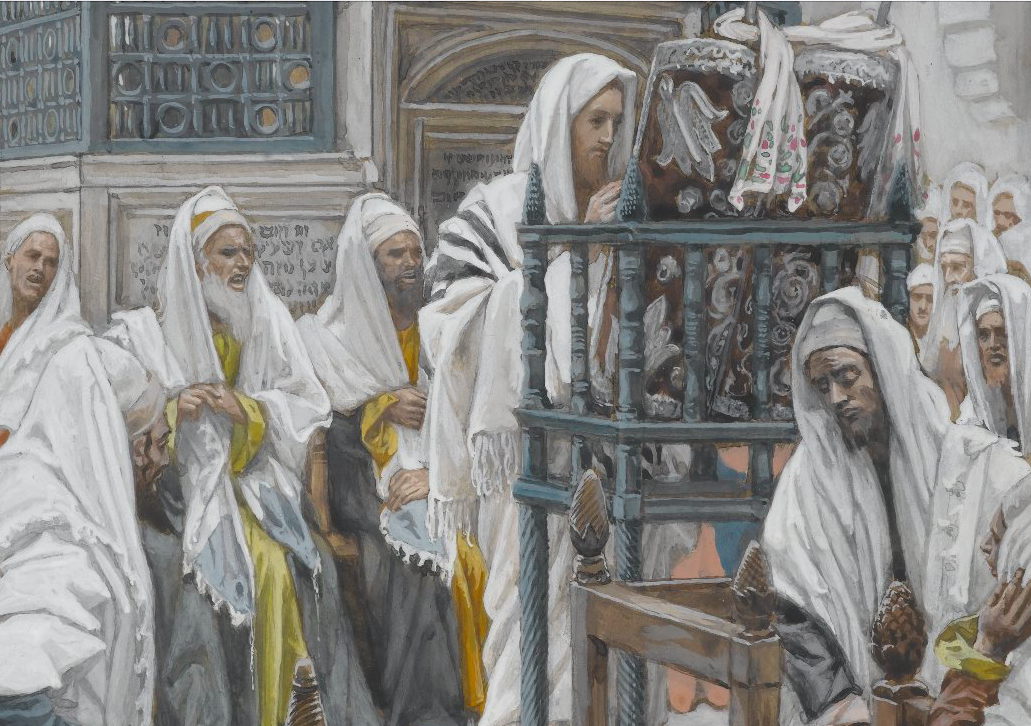
He came to Nazareth, where he had grown up, and went according to his custom into the synagogue on the sabbath day. He stood up to read and was handed a scroll of the prophet Isaiah. He unrolled the scroll and found the passage where it was written:
The Spirit of the Lord is upon me, because he has anointed me to bring glad tidings to the poor. He has sent me to proclaim liberty to captives and recovery of sight to the blind, to let the oppressed go free, and to proclaim a year acceptable to the Lord.
Rolling up the scroll, he handed it back to the attendant and sat down, and the eyes of all in the synagogue looked intently at him. He said to them, “Today this Scripture passage is fulfilled in your hearing.” And all spoke highly of him and were amazed at the gracious words that came from his mouth. (Luke 4:14-24)
Our readings this week, taken from all four gospels, are summaries of the mission of Jesus pointed out to us in the responsorial psalm.
Lord, every nation on earth will adore you.
Our reading today from Luke’s gospel is one of the strongest accounts of the rejection of Jesus by his own people at Nazareth, but instead of ending with them attempting to throw him to his death from the hill today’s reading ends:
And all spoke highly of him and were amazed at the gracious words that came from his mouth. (Luke 4:14-24)
Even his own people will recapture their amazement at the words that come from the mouth of Jesus! He will enter Nazareth again and people will welcome him.
The mystery of the Epiphany and Baptism are not limited to past history, they predict God’s plan yet to come.
Noah’s ark, the Magi, the Slaughter of the Innocents. “They’re just myths,” you hear it said. I don’t like those stories dismissed that way, because it easily leads to a further dismissal: ”Is any of it true? Probably not.”
We think straight reporting is the only thing true. “Just the facts, Mam.” Everything else is fake news. But are these stories fake?
“The Secrets of Noah’s Ark” a recent Nova program on PBS examining the biblical story makes good sense to me. In early times, floods were common in the “Fertile Crescent” the area in Mesopotamia {modern Iraq} where the Tigris and Euphrates Rivers and the ancient city of Babylon were located. So you had to keep boats handy– you never know.
You had to be ready for a great flood too, but people have short memories and people then, as now, tend to forget “the big ones.” “As it was in the days of Noah, so it will be at the coming of the Son of Man. In those days before the flood, they were eating and drinking, marrying and giving in marriage, up to the day that Noah entered the ark. They did not know until the flood came and carried them all away.” (Matthew 24, 37-38)
I suspect some Babylonian priests– meteorologists and story tellers of their time– came up with a flood story thousands of years before the Noah story to keep the people of their day on their toes – and maybe challenge some early climate change deniers too. It reinforced important advice: “ Keep your boats in good shape and make sure there’s also a big boat around for ‘the big one.’”
Exile of Jews to Babylon
In 587 BC, thousands of Jews were driven from Jerusalem, destroyed by Babylonian armies, and were forced to make the thousand mile journey in Babylon. It was their Exile. When they heard the story of the great flood they saw it as a symbol of their own tragic circumstances. “By the rivers of Babylon, we sat and wept, remembering Zion.” (Psalm137)
Returning from exile, the Jews incorporated their version of the flood story into the Torah. It became a reminder to keep the covenant God made with them and beware of living unfaithfully as “in the days of Noah.”
Does real history underlie the story of the Magi and the Slaughter of the Innocents? Begin with Herod the Great, ruler of Palestine then, whom secular sources and many archeological monuments from the time describe quite well. Herod was a micro-manager who built fortified palaces in Jerusalem, the Herodium outside Bethlehem and other places to keep watch over his kingdom.
Citadel, Herod’s Palace Fortress, Jerusalem
Herodium, Mountain Fortress of Herod the Great
He promoted trade with the outside world; he built the seaport of Caesarea Maritima on the Mediterranean Sea and cultivated the trade routes from Yemen and other eastern parts that led all the way to Rome. He would have kept tabs on those arriving with spices and luxury goods of all kinds. He knew who came and went.
Were the Magi wealthy eastern traders, quite knowledgeable about the religious world of the people with whom they traded? Did they hear of the Child in Bethlehem? Herod’s advisors and everyone else knew Bethlehem was associated with the legendary King David and there were prophecies about an heir to his throne coming from there. Did the foreigners visit the Child, bring their gifts, gold, frankincense and myrrh, the prizes of their trade, and then quickly leave, well aware of Herod’s paranoia, quick temper and brutality.
Given Herod’s jealous hold on power, the story of the slaughter of the Innocents in Matthew’s Gospel doesn’t seem unlikely, True, it’s not mentioned in any secular source, but neither are many other tragic stories of the time. Bethlehem, after all, was a small town, off the beaten track. The death of perhaps 20 or so infants might go unnoticed and be quickly forgotten.
Matthew’s story is hardly a myth. Rather, it sees things through God’s eyes. The star points to the real power guiding human history; the magi represent the rest of the world coming to adore the Child. Angelic powers are always at our side. The slaughtered infants are like so many tragic deaths that seem to question God’s promise of life, but God doesn’t forget, the story says, even if human history doesn’t remember. “The souls of the just are in the hands of God and no torment shall touch them.”
If you ever visit Bethlehem, go to see the Herodium, Herod’s massive fortified palace looking down on the nearby town. Joseph wouldn’t need much urging to take the Child and his mother from this place,would he? Go to the Citadel in Jerusalem built on the highest spot in the city. You can walk where Herod once walked and imagine him looking down on his kingdom. But it was not his kingdom, after all, it was God’s. Go to Caesaria Martima, the splendid port city created by Herod. Did the Magi’s caravans reach here?
Then ask yourself if the stories of Jesus’ birth and infancy are myths.
There’s always a temptation to make God distant and abstract. After all, God dwells “in light inaccessible,” the scriptures say. God is beyond the eyes of our mind and body.But God reveals himself in Jesus Christ, the “image of the invisible God.” The first followers of Jesus saw him with their own eyes and proclaimed that “the grace and kindness of our God has appeared” in him.
The First Letter of John, written as that first generation of eyewitnesses to the gospel was passing on, tells a new generation (certainly us too) to believe in Jesus Christ. As eyewitnesses pass on and years go by, we’re tempted to forget or minimize his place in our world and in our lives.
John’s letter warns about the dangers of docetism and gnosticism, two heresies supporting that temptation. A note in the New American Bible describes what these strange sounding heresies are all about:
“The specific heresy described in this letter cannot be identified exactly, but it is a form of docetism or gnosticism; the former doctrine denied the humanity of Christ to insure that his divinity was untainted, and the latter viewed the appearance of Christ as a mere stepping-stone to higher knowledge of God.”
He came “through water and Blood,” John writes. He urges us not to forget the humanity of Jesus Christ, the humble way he became flesh and shared our experience. God comes to us that way too. He was baptized in the waters of the Jordan uniting all nations journeying to God’s Kingdom. He died and shed his blood for us. Don’t forget the mystery of his death and resurrection.
“God gave us eternal life, and this life is in his Son.”
Love for one another is an essential part of loving God:
Beloved, we love God because he first loved us. If anyone says, “I love God,” but hates his brother, he is a liar; for whoever does not love a brother whom he has seen cannot love God whom he has not seen. This is the commandment we have from him: Whoever loves God must also love his brother.
Today, as we remember the mysterious visitors from afar who came seeking the new-born King of the Jews, I remember wandering years ago through the catacombs of Rome where early Roman Christians buried their dead. On the burial places of their loved ones they scratched the name of the deceased, little symbols and prayers, sometimes a picture from the bible.
In the catacombs of Priscilla is a 3rd century grave belongs to a Roman woman named Severa. Her simple profile appears with an inscription that reads, “Severa, may you live with God.” Severa points to the figures of the three Magi coming with their gifts to the little Child sitting on Mary’s lap. Over the Child is a star and the figure of a man, probably Balaam, the prophet who predicted a star would announce a new king in Judea. (Numbers 24,15-19)
What did this mean to Severa, you wonder? She lived in Rome, so many miles from where the Child was born, yet she believed in promise he made to those strangers who once brought him gifts. His gift to Severa was greater than gold, frankincense and myrrh. The Child promised her eternal life. She would live with God.
The theme of the three kings is common in early Christian art.
Severa’s faith, contained in the Apostles’ Creed, is the same as ours today. God made this world and guides it to its destiny. Jesus Christ is God’s Son, born of Mary, he suffered under Pontius Pilate, was crucified, died and was buried. On the third day he rose from the dead.
Severa believed in his promise: the resurrection of the body and life everlasting. She knew, too, the story of Herod, the powerful king, who threatened the life of the new born Child. Powerful emperors ruling then were like the ruthless king, but Severa knew the Child was more powerful than them all. He would bring her to another world, God’s world.
John was standing with two of his disciples, and as he watched Jesus walk by, he said, “Behold, the Lamb of God.” The two disciples heard what he said and followed Jesus. Jesus turned and saw them following him and said to them, “What are you looking for?” They said to him, “Rabbi” (which translated means Teacher), “where are you staying?” He said to them, “Come, and you will see.” So they went and saw where he was staying, and they stayed with him that day. It was about four in the afternoon. Andrew, the brother of Simon Peter, was one of the two who heard John and followed Jesus. He first found his own brother Simon and told him, “We have found the Messiah,” which is translated Christ. Then he brought him to Jesus. Jesus looked at him and said, “You are Simon the son of John; you will be called Cephas,” which is translated Peter. (Jn 1:35-42)
John the Baptist recognized Jesus as the Lamb of God and testified that “he is the Son of God.” John’s Gospel does not describe in detail John the Baptist baptizing Jesus. Instead, it describes the Baptist telling two of his own disciples, Andrew, brother of Peter, and John, son of Zebedee to follow Jesus. Andrew, calls his brother Simon to come and meet the Messiah. In turn, Jesus calls Nathaniel, from Cana in Galilee and Philip to follow him.
All is ready for Jesus’ mission to begin in Cana in Galilee. He will continue to announce the coming of God’s kingdom, but it will not be immediate as John announces it. All nations must receive Jesus’ message of mercy and love All nations must receive the invitation to become children of God through God’s Son, Jesus Christ.
The waters of the Jordan must reach the ends of the earth. The responsorial psalm for today asks the natural world to join to proclaiming the gospel.
Let the sea and what fills it resound, the world and those who dwell in it; Let the rivers clap their hands, the mountains shout with them for joy before the LORD.
All the ends of the earth have seen the saving power of God.
That happens, as our gospel indicates, through Peter, Andrew, Nathaniel and the rest, including us.
We’re reading the First Letter of John at the end of the Christmas season.The letter challenges some early Christians who thought it was completely beneath God’s nature to assume our lowly humanity and so they claimed Jesus was not truly divine; the Word did not become flesh. Mary could not possibly be “Mother of God.” Maybe God could come in a perfect world, but not the world of “now.”
John’s letter insists on the mystery of the Incarnation. That mystery happens, not just when Mary accepts the angel’s invitation, not just at the birth of Christ and the events that took place around it. That mystery happens now..
“Beloved, we are God’s children now; what we shall be has not yet been revealed. We do know that when it is revealed we shall be like him, for we shall see him as he is.”
“We are God’s children now,” in our time and place. We live the mystery of the Incarnation, like the mystery of his death and resurrection, now in our time and place. Its a challenging mystery for the time and place that’s ours now, that can seem so unworthy of God’s presence.
The saints help us appreciatete the mystery of the Incarnation because they lived that mystery in their time and place. This week in the Christmas season we celebrate a number of saints. St.Basil the Great and St. Gregory Nazianzen, 4th century Christian bishops. St. Elizabeth Seton and St. John Neumann, from the early years in our American church. On January 5, the Passionists remember St. Charles Houben, CP.
St. Basil the Great was a learned teacher, a brilliant philosopher and theologian who knew the philosophers and sciences of his day. He also was a man of action. He founded religious communities, hospitals, homes for the poor. He was an outstanding bishop of church in Asia Minor, known throughout the Christian world.
But the church then was tightly controlled by an emperor who believed and demanded others believe what the Letter of John condemned– that Jesus was a godly man, but not God. Basil, a strong believer in the divinity of Christ, was not afraid to confront those who said otherwise, even the powerful political establishment .
His letters reveal how he struggled with the now of his times and place. He was falsely accused, undermined, threatened with exile. He bemoaned the division of Christians caused by too many controversies. He was hurt by suspicions of his own orthodoxy. He felt alone and outnumbered.
Each of the saints we celebrate this week did what he did. They lived the mystery of the Incarnation of Jesus, inseparable from the mystery of his death and resurrection, in their own time and place. They proclaimed the gospel they received – the Word became flesh.







 The Victor's Place