Two worlds are described in the readings at Mass these weekdays. The Gospel of Mark tells of the world around Capernaum by the Sea of Galilee, where Jesus called his first disciples, encountered a demon in the synagogue, cured Peter’s mother in law, the paralyzed man and the leper– where he was fiercely opposed. (Mark 1,14-2,12) He became involved in a world like ours..
The world described in the Letter to the Hebrews is a world beyond this one, the world of the Risen Lord where he sits at the right hand of God the Father Almighty..
The Letter to the Hebrews describes him further as a High Priest entering a heavenly sanctuary to intercede for us, a merciful High Priest. He is the same Jesus who entered Capernaum and cured Peter’s mother in law, the paralyzed man and the leper. He’s knows our humanity with its yearning, its weakness and hardness; he carries the wounds of suffering and death.
It’s hard to keep these two worlds in mind, but our readings, like our creed, tell us to do it. The worlds are not sealed off, they’re joined. They have a common goal: “Our Father, thy will done, thy kingdom come.” The Risen Jesus is present in both of these worlds as Savior and Redeemer. Through him, God’s kingdom will come.
Unfortunately, we may think only of the world we see now, unsure or confused about a world beyond this one. We may see the world beyond as an escape from this life, an isolated world in the clouds.
Both worlds are important to keep in mind. Together they help us see life in the full. A gift of God, greater than we can imagine.
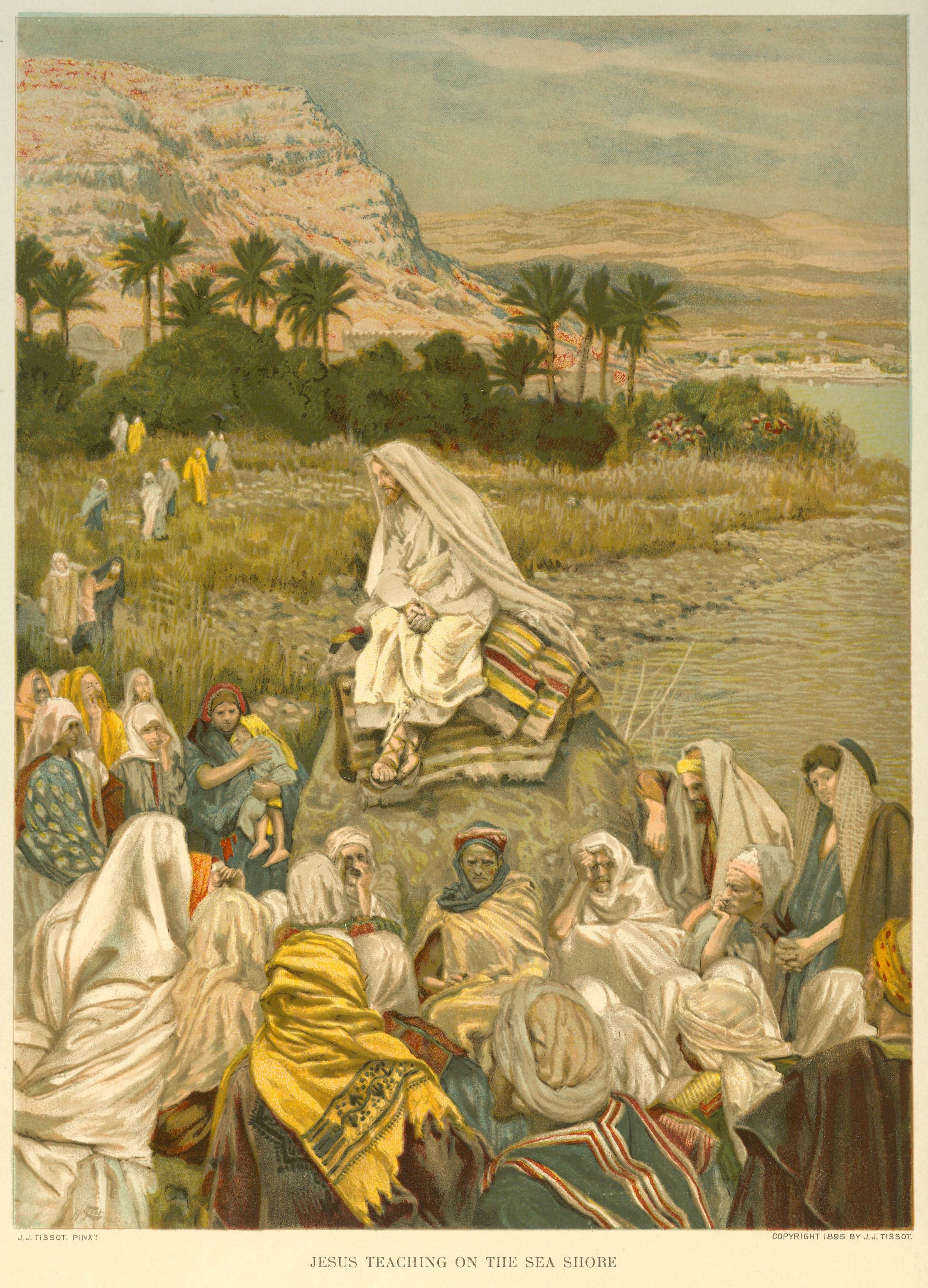
In its first chapters Mark’s gospel highlights the remarkable actions of Jesus in the towns near the Sea of Galilee as he confronts demons and heals many. Only in chapter 4 does Mark give examples of his teaching.
For Mark, what Jesus did was more important than what he said. When he taught, he taught in parables– “without parables he did not speak to them.”
“A parable is a metaphor or simile drawn from nature or common life, arresting the hearer by its vividness or strangeness and leaving the mind in sufficient doubt about its precise application to tease it into active thought.” (C.H. Dodd)
Jesus drew his parables from the natural, religious and political worlds around him. Galilee was a land of farms and vineyards, farmers and fishermen, so when Jesus spoke of the ways of seed and soil, of nets cast into the sea, he spoke of a world his hearers knew well. When he spoke of David feeding his followers on the Sabbath or Elijah the prophet, or scribes and Pharisees, his hearers knew those figures as well.
What about his political world? Galilee then was ruled by Herod Antipas, an ambitious descendant of Herod the Great and a member of a family fighting fiercely for positions of power under Rome’s thumb. He ambitiously expanded Galilee’s economy. Large cities like Tiberias, Sephorris, Caesarea Philippi, Caesarea Maritima were being built, roads to ship Galilee’s produce were laid out. Funding for its development came from the collection of taxes. Some grew rich; many did not. The burden fell on the poor.
The scribes and pharisees were not the only ones who saw themselves targets of the parables Jesus spoke. The “Herodians”, followers of Herod Antipas, also saw the political world they represented attacked. (Mark 3: 6)
The parables of Jesus, in C. H. Dodd’s words, are meant “to tease the mind into active thought.” They call us to think and question, to wonder and then act. In his parables Jesus asks “What do you think and what will you do about it ?”
We don’t live in the time of Jesus, but his parables still call us. His parables drawn from nature may be especially important today as our world faces climate change. We need to re-engage more deeply with nature and it seasons and its care
But we also need to engage in our religious and political worlds as he did. We’re not spectators looking on, accepting what we see on a screen. HIs parables are meant to tease our minds into active thought. What do you think and what will you do about it ?”
“What do you think of your church and what will you do about it?”
“What do you think of your country and what will you do about it?”
“What do you think of your world and what will you do about it?”
Our yearly church calendar celebrates saints from every age and place because saints are examples of God’s grace present always and everywhere. Some saints are singled out for their importance. St. Paul the Apostle, whose dramatic conversion is celebrated on January 25th, is one of them. His martyrdom, along with Peter, is celebrated June 29th and we read extensively from his writings throughout the church year.
An account of Paul’s conversion ( Acts 22: 3-13) – one of three found in the Acts of the Apostles – is read first at his feast day Mass. Mark’s gospel for the feast recalls Jesu after his resurrection telling his disciples to “Go into the whole world and proclaim the gospel to every creature.” (Mark 16: 15-18) St. Luke devotes much of the Acts to Paul’s missionary journeys ending in Rome. The apostle fulfilled that command of Jesus.
Paul writes to the Corinthians:
“I am the least of the apostles; in fact, since I persecuted the Church of God, I hardly deserve the name apostle; but by God’s grace that is what I am, and the grace that he gave me has not been fruitless. On the contrary, I have worked harder than any of the others: or rather, not I but the grace of God that is with me. ( 1 Corthinians 15:9-10)
St. Paul is an example of how far we can rise, from the depths to the heights, and for that reason the church celebrates his conversion. He never forgot that God’s grace raised him from the dust to become a powerful force in his church and in the world. He never forgot he was a Pharisee who became one of Jesus’ most loyal disciples. His conversion gave him a boldness to go fearlessly to the ends of the earth
“Saul, Saul, why do you persecute me?” Jesus says to him from a blinding light. He never forgot the moment he was blinded by a light that made him see.
“Paul, more than anyone else, has shown us what we really are, and in what our nobility consists, and of what virtue a human being is capable. Each day he aimed ever higher; each day he rose up with greater ardour and faced with new eagerness the dangers that threatened him. He summed up his attitude in the words: I forget what is behind me and push on to what lies ahead. When he saw death imminent, he bade others share his joy: Rejoice and be glad with me! And when danger, injustice and abuse threatened, he said: I am content with weakness, mistreatment and persecution. These he called the weapons of righteousness, thus telling us that he derived immense profit from them… ” ( St. John Chrysostom)
O God, who taught the whole world through the preaching of the blessed Apostle Paul, draw us, we pray, nearer to you through the example of him whose conversion we celebrate today, and so make us witnesses to your truth in the world.Through our Lord Jesus Christ, your Son, who lives and reigns with you in the unity of the Holy Spirit, God, for ever and ever.Amen.
Pope John XXIII called for a Second Vatican Council on the Feast of the Conversion of Paul, January 25, 1959. He called for the church to be converted.
Hold fast to the hope that lies before us. This we have as an anchor of the soul, sure and firm, which reaches into the interior behind the veil, where Jesus has entered on our behalf as forerunner, becoming high priest forever according to the order of Melchizedek. Hebrews 6:10-20
Travelers on the Mediterranean Sea from one port to another in early times were never sure on its unpredictable waters. An anchor became a symbol of their safe arrival . Large ancient seaports on the Mediterranean like Alexandria and Antioch adopted the anchor as a symbol for their city. Welcome home!
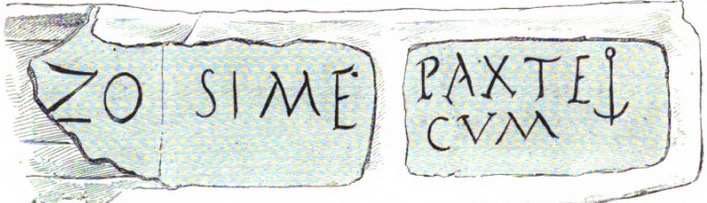
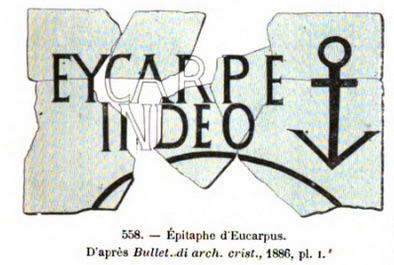
Hope is “an anchor of the soul”, the Letter to the Hebrews says. Early Christians adopted the sign as a symbol of their hope for reaching their heavenly port, the kingdom of God. Anchors are common inscriptions in the Christian catacombs expressing hope in Jesus Christ.
The anchor closely resembles a cross and surely that was what early Christians thought it to be. It’s the most common, and sometimes the only mark, found on the earliest Christian graves in the ancient Roman catacombs of Priscilla, Domitilla and Callistus.
“Pax tecum,” “Peace be with you” the inscription (above) next to an anchor on one of these gravesites reads. “Eucarpus is with God” is the inscription of the deceased on the grave (below) half destroyed by robbers looking for valuables long ago.
Agnes knew that sign, and I would expect it’s found among the number of inscriptions that marked her grave on the Via Nomentana where she is buried.
Contemporary historians have problems with the accounts of early martyrs of the Roman church like Agnes, Cecilia, Anastasia, Sebastian, Lawrence, John and Paul– all honored in the Roman liturgy and commemorated in ancient churches throughout the city. We’re celebrating Sebastian, January 20, and Agnes, January 21, this month .
Our age wants facts, real evidence, so are the accounts of these early saints true? One thing I find helpful when considering the early accounts of the Christian martyrs is to remember that Emperor Diocletian, who unleashed the last and greatest persecution of Christianity, wanted to completely obliterate Christianity throughout the Roman empire. Not only did he put many Christians to death, but also tried to destroy all their written records, scriptures, places where they prayed. He wanted no record of their heroes, their saints and martyrs left. The emperor succeeded in destroying most of the records kept by the church of Rome.
Stories about the Roman saints were then reconstructed by Christians after the persecutions, and these accounts, instead of looking like court records–a form they often took before– appeared as embellished legends.
Their stories, though embellished, are basically true. They were Christians who believed so strongly in Jesus Christ that they died for their belief. Not only popes, like Fabian, deacons like Lawrence, but young girls like Agnes, women like Cecilia, soldiers like Sebastian witnessed to their faith by dying for it.
The historian Peter Brown, in one of his brilliant books on early Christianity, offers an important insight into the martyrs. The Romans were not impressed so much by the bravery of these Christian martyrs–the Romans prided themselves for their ability to die bravely. Rather, they marveled at the vision of another world they saw them professing as they died. They believed that world was far more glorious than this one, and Jesus Christ was their Lord and Savior, calling them on.
The legends of martyrs like Agnes, who dies surrounded by heavenly visions and miraculous signs, shows us a heavenly world already revealed now in this one. Do they help us look ahead? I think so.
Take a look at the video on Saint Sebastian, above.
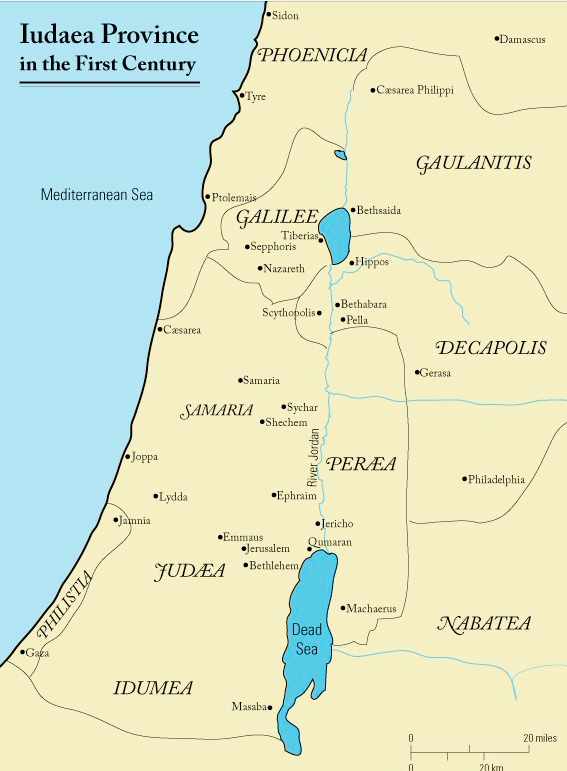
We know much more about the world Jesus lived in as historians and archeologists uncover it today. They help us understand the scriptures better too, so it’s good to stare at a map every once in awhile and think of Jesus’ world.
Galilee, the site where Mark begins his account of Jesus’ ministry was a thriving part of Palestine then. Economists would say the region around the Sea of Galilee was doing well economically under the leadership of Herod Antipas (4 BC-39 AD), even though many were left out while others got rich.
Herod Antipas is mentioned a number of times in the New Testament. Jesus called him “that Fox.” He ordered John the Baptist beheaded and later wondered if Jesus might be John come back from the dead. Pontius Pilate sent Jesus to Herod before sentencing him to death, but Jesus never said a word to him. Another interesting connection to Herod: Johanna, wife of Herod’s steward Cusa, was a follower of Jesus who stood with Mary and the other women at his cross.
Like his father, Herod the Great, Herod Antipas loved to build, and his splendid Greco-Roman city of Tiberias arose from 20 and 27 AD, along the Sea of Galilee, not far from where Jesus lived in Nazareth and Capernaum, was one of his projects. Tiberias had a Roman gate, stadium, spacious squares with marble statues, a grand palace with a golden roof and a large synagogue. The ruins of Herod’s city lie south of the present city of Tiberias
To pay for it, Herod relied on his tax-collectors in the cities and towns in his district–places like Capernaum and Nazareth– to squeeze the fishermen and farmers for whatever they could get.
Herod also built Sepphoris, a Roman city near Nazareth, Caesarea on the sea coast, and Caesarea Philippi to the north. He was an ambitious ruler, ruthlessly protective of this empire of his dreams.
In Mark’s Gospel when the “Herodians” join with the Pharisees, we see Herod’s growing unease with this new prophet in his territory. (Mark 3:6) Herod’s execution of John the Baptist ( Mark 6:14-29) shows further concern. Jesus was opposed, not just by religious leaders, but by political leaders of his time as well. I have a feeling that the gospel writers are very careful not to blame the political leaders too much.
The world Jesus knew changed after the destruction of Jerusalem and its temple by the Romans in 70 AD. Pharisees and scribes from Jerusalem flocked to Tiberias and Galilee and made it a base for reconstituting Judaism. Instead of the temple, the synagogue became the center of Jewish life and worship. Tiberias itself became the site of over 12 synagogues and an important place for Jewish learning. A rabbinic school established in the city eventually produced around the 4th century the Palestinian Talmud, a written collection of rabbinic teachings on Jewish laws and traditions. Jewish historians describe the early centuries after the destruction of Jerusalem as the time of Talmudic Judaism.
Some scholars say the Gospel of Matthew, the most contentious and polemical of the gospels, may have been written near Tiberias around the year 90 AD. (Other places they suggest are Antioch in Syria and Sepphoris, not too far from Nazareth).
Matthew’s Gospel, written later than Mark’s Gospel, seems to reflect the growing struggle between the Jewish authorities in Tiberias and Galilee’s Jewish Christians over the future of Judaism. The sharp critique of the scribes and pharisees in the 23rd chapter of Matthew is an example of the contentious spirit that existed on both sides.
I think the followers of Jesus lost the battle with the new Jewish establishment in Galilee at the end of the 1st century and most moved on to other places. Few remained in Galilee. Could the final words of Jesus to his eleven disciples in Matthew’s gospel might be advice to leave as well as a call to mission?
“The eleven disciples went to Galilee, to the mountain to which Jesus had ordered them. When they saw him they worshipped, but they doubted. Then Jesus approached and said to them, “All power in heaven and on earth has been given to me. Go, therefore, and make disciples of all nations, baptizing them in the name of the Father, and of the Son, and of the Holy Spirit, teaching them to observe all that I have commanded you. And behold, I am with you always, until the end of the age.” (Mt 28, 16-20)
The Christian presence in the Holy Land increased after Constantine gained control of the Roman empire in the 4th century and favored the Christian Church. Yet even as Christians came and built churches and shrines over the places where tradition said Jesus lived and ministered, Galilee remained a Jewish stronghold.
When Muslims conquered the Holy Land in the 7th century, Christians and Jews alike came under their rule. Because of harsh Muslim rule under the Seljuk Turks and their destruction of the great Christian shrine of the Holy Sepulcher in Jerusalem in the 11th century, Crusaders from Europe invaded Palestine and re-established a Christian presence again. Evidence of Crusader churches and fortresses can be seen today.
Muslims regained control of the Holy Land in the 13th century and remained in power till the 20th century. Under Ottoman rule, Jews were treated more favorably than Christians, but as the fortunes of the Ottoman Empire declined so did the economy of Palestine. By the 19th century, Jews, Christians and Muslims lived in a land that was poor and neglected.
As nation states formed in Europe in the 17th century, persecutions of the Jews increased and so did Jewish aspirations to return to their ancestral lands. By the 19th century Jews from Russia and Poland were settling again in parts of Palestine, in Jerusalem as well as in Galilee. After the holocaust, the Jewish population dramatically increased. The Christian presence today is small and increasingly limited.
I found this interesting glimpse of life in the Jewish city of Tiberias by an English visitor at the end of the 19th century:
“The Jews are very numerous in Tiberias, it and Safed being, after Jerusalem and Hebron, the two holiest towns; for the Messiah is one day, they believe, to rise from the waters of the lake and land at Tiberias, and Safed is to be the seat of his throne…Prayer must be repeated at Tiberias at least twice a week, to keep the world from being destroyed…The Israelites of Tiberias are chiefly from Russian Poland, and do not speak German. Poor, thin, and ragged, they are certainly far from attractive; but the women are neatly dressed, many of them in white and look much better than the men. “ Cunningham Geikie, The Holy Land and the Bible,Vol 2, New York, 1890 p 543
Tiberias today little resembles the city the visitor describes. It’s a modern Jewish city now, with fashionable hotels and spas.
We’re reading from the Epistle to the Hebrews these days at Mass until February 8th. In his “Introduction to the New Testament’ Raymond Brown calls the work “a conundrum”. Who wrote it, where and when it was written, to whom, why? Hard to figure out.
Indications are the letter was written most likely in Rome after the destruction of the Jewish temple in Jerusalem in 70, to Jewish Christians there. The early Roman church, composed mainly of Jewish converts, was strongly attached to Jerusalem and its worship and wanted to reconstruct the temple and renew its worship. Martin Goodman’s “Rome and Jerusalem” (New York 2008) offers an interesting picture of the longing Jews and Jewish Christians had afterwards to rebuild the temple and revive its rites.
Our letter sees Christ fulfilling the Jewish past and creating something new. He is the new Temple and High Priest:
Brothers and sisters: In times past, God spoke in partial and various ways to our ancestors through the prophets; in these last days, he spoke to us through the Son, whom he made heir of all things and through whom he created the universe, who is the refulgence of his glory, the very imprint of his being, and who sustains all things by his mighty word. When he had accomplished purification from sins, he took his seat at the right hand of the Majesty on high, as far superior to the angels as the name he has inherited is more excellent than theirs.
For to which of the angels did God ever say: You are my Son; this day I have begotten you? Or again: I will be a father to him, and he shall be a Son to me? And again, when he leads the first born into the world, he says Let all the angels of God worship him. (Hebrews 1)
Do we face something like this today, a yearning to recreate the world and the church of the past we loved. We can’t recreate what has been, something new lies before us.
The Letter to the Hebrews tells us to face the future bravely, and keep before us the One who holds the key to what’s to come. In his lifetime, Jesus struggled with his own times; in his hands are the kingdom to come:
“Keep your eye fixed on Jesus, the leader and perfecter of faith, For the sake of the joy put before him, he endured the cross, despising the shame, and has taken his place at the right hand of the Father. Consider how he faced such opposition from sinners, in order that you may not grow weary and lose heart.”
The Gospel of Mark which follows the Letter to the Hebrews in our readings reveals the One who faced such opposition and endured the cross.
The Christmas Season closes after the Baptism of Jesus, which we celebrate this Sunday. The Christmas celebrations are over. Ordinary time begins. Does that mean there’s nothing to do till Lent and the Easter season?
Sure there is. Ordinary Time is a time for daily prayer, and daily prayer is never over. The Second Vatican Council’s Constitution on the Liturgy says that daily prayer is at the heart of the Christian life and created a daily lectionary of scripture readings so “ the treasures of the bible be opened more lavishly for the faithful at the table of God’s word.” (SC 51)
The daily lectionary is a treasure for praying with the scriptures, but don’t take it for granted. Treasures, Jesus said, are usually hidden and you have to dig for them. That’s what we do in daily prayer. The liturgy is always a “work”, our daily work, an important work, a daily prayer. It’s the “summit” of the Christian life. We’re always at the beginning, not at the end.
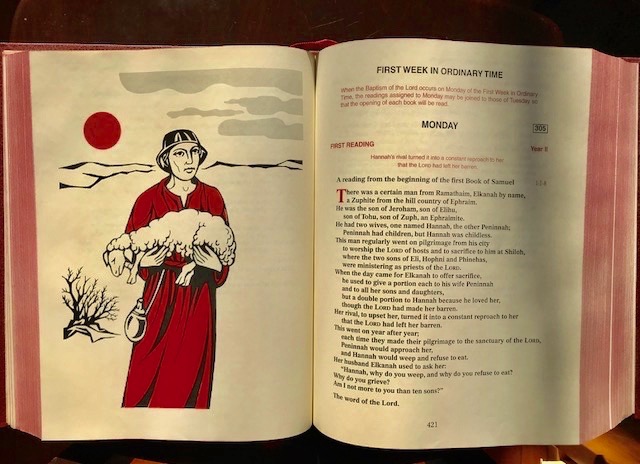
We begin Monday to read the Letter to the Hebrews and the Gospel of Mark from our lectionary. There are feasts of the Lord and his saints to celebrate in the days ahead. It’s a lifelong learning we’re into, a school God provides,and we learn day by day.


 The Victor's Place