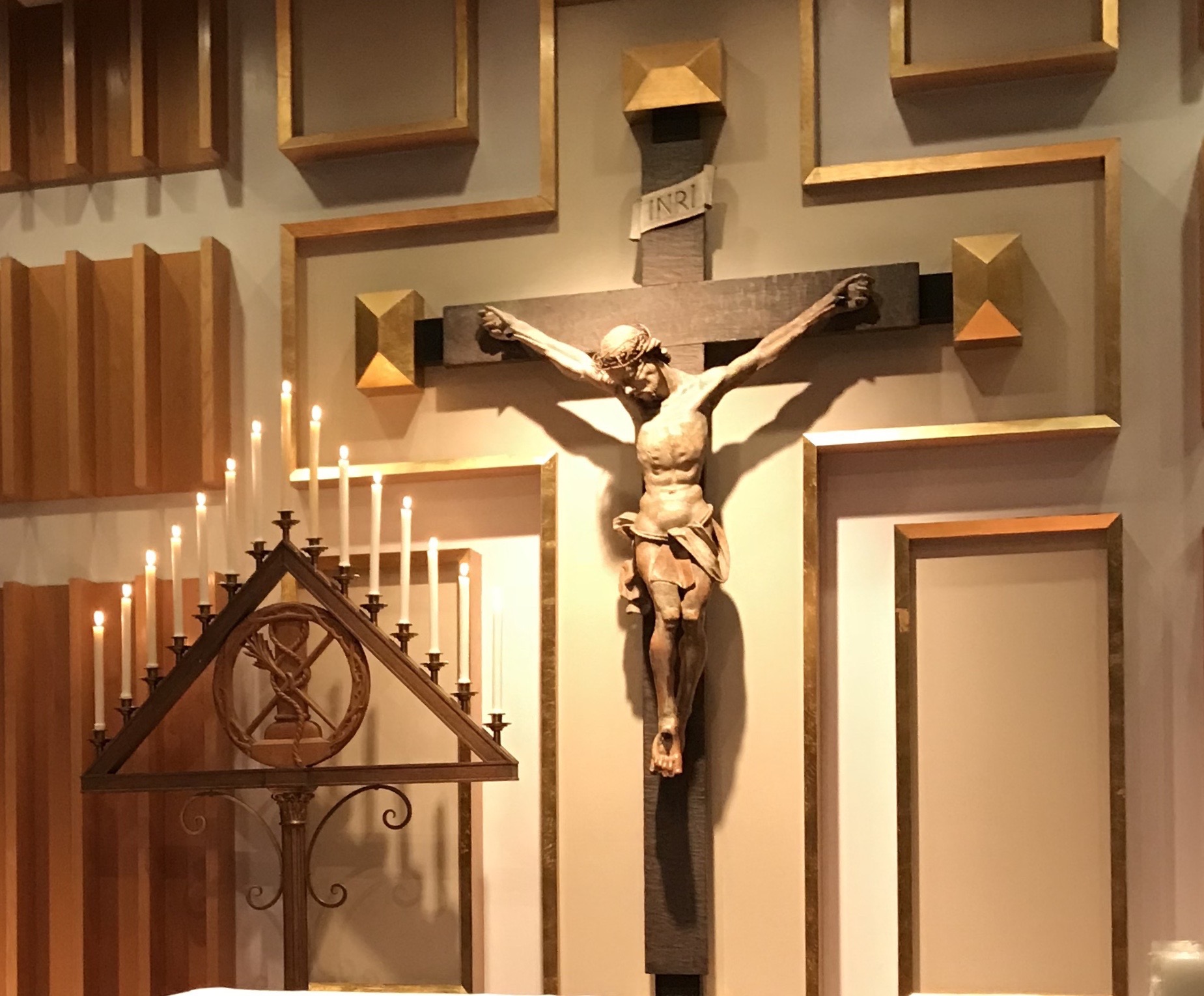
Tenebrae: Good Friday


Tenebrae for Good Friday begins with a reflective reading of Psalm 22, which is quoted 13 times in the gospel stories of the Passion of Jesus. The psalm reveals someone in the midst of hard suffering, yet with no bitterness, no complaints of injustice, no lashing out against an enemy. It reveals Jesus in his Passion to us.

“We meet a simple abandonment into the hands of God, and in this surrender there is peace. The psalmist asks so little of God; only that God hear his cry of abandonment. (v.2) Once God induces a mystic presence so that the psalmist can whisper ‘You heard me’ (v 21) the psalm modulates into a song of Thanksgiving.

“The psalm leads us into the suffering heart of Jesus,” who does not simply reflect on his own sufferings; he identified himself with the agony and faith of generations of persecuted, afflicted peoples.”
(Fr. Carroll Stuhlmueller, CP, Psalm 1, Wilmington, Del, USA 141-151)

In his passion, then, Jesus is aware of more than his own suffering. Our reading from the Letter to the Hebrews sees Christ as high priest of the good things that have come to be. “ (Hebrews 9, 11-28)

What are “the good things that have come to be? ” Even on Calvary we see them. Blood and water flow from his side as the soldier pierces him with a lance. Blood and water are universal signs of life. Humans need both to live.

In our final reading for Tenebrae, Saint John Chrysostom sees in them Christ fashioning his church as Eve was fashioned from Adam’s side as he slept a deep sleep. Blood and water are signs of Christ’s gift of life to us and his life-giving sacraments.

The saint says further: “As a woman nourishes her child with her own blood and milk, so does Christ unceasingly nourish with his own blood those to whom he himself has given life.”
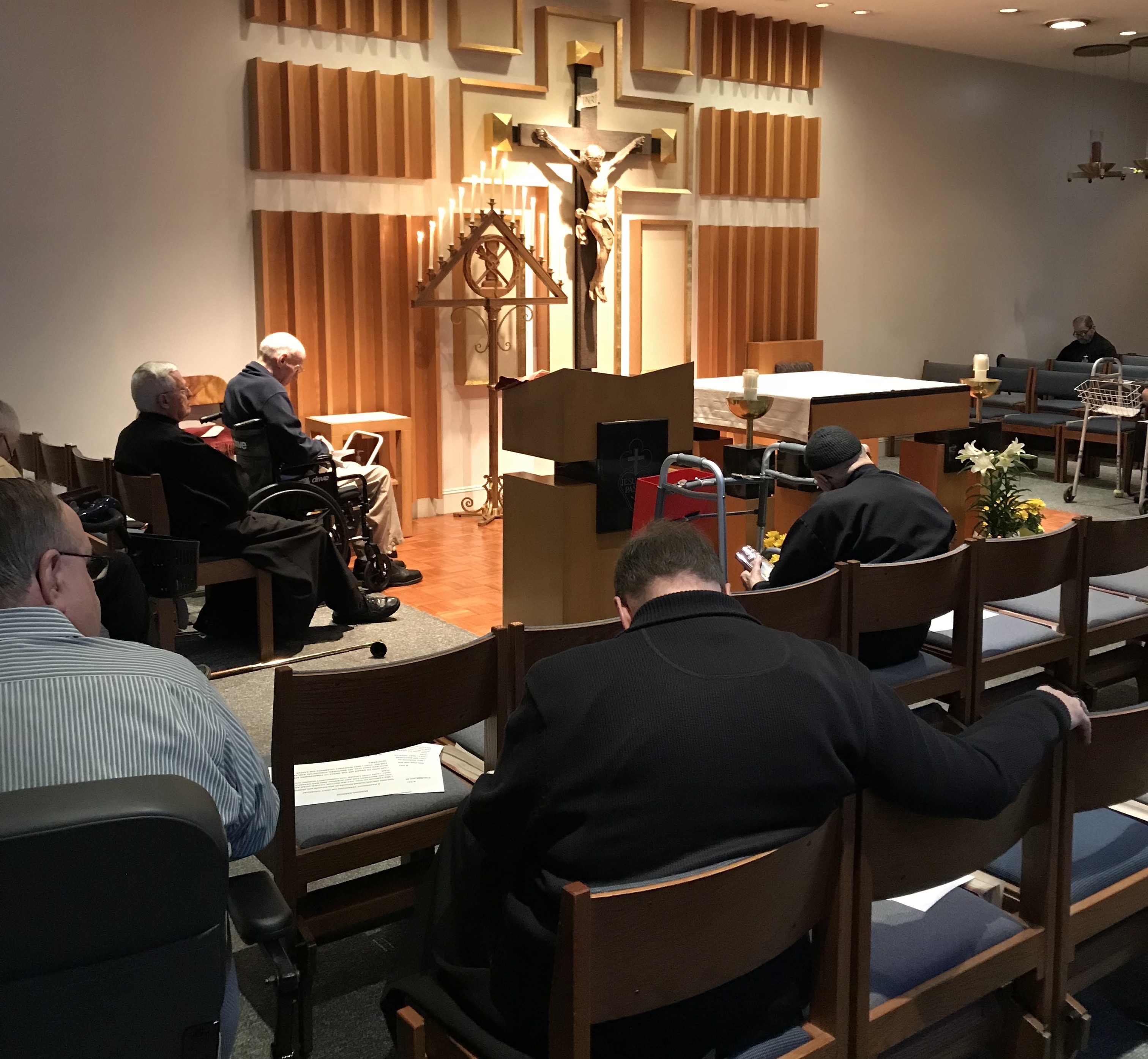
More than whips and thorns and nails, good things come about on Calvary. Jesus give us life here, life that conquers darkness and death.
Words from the Cross

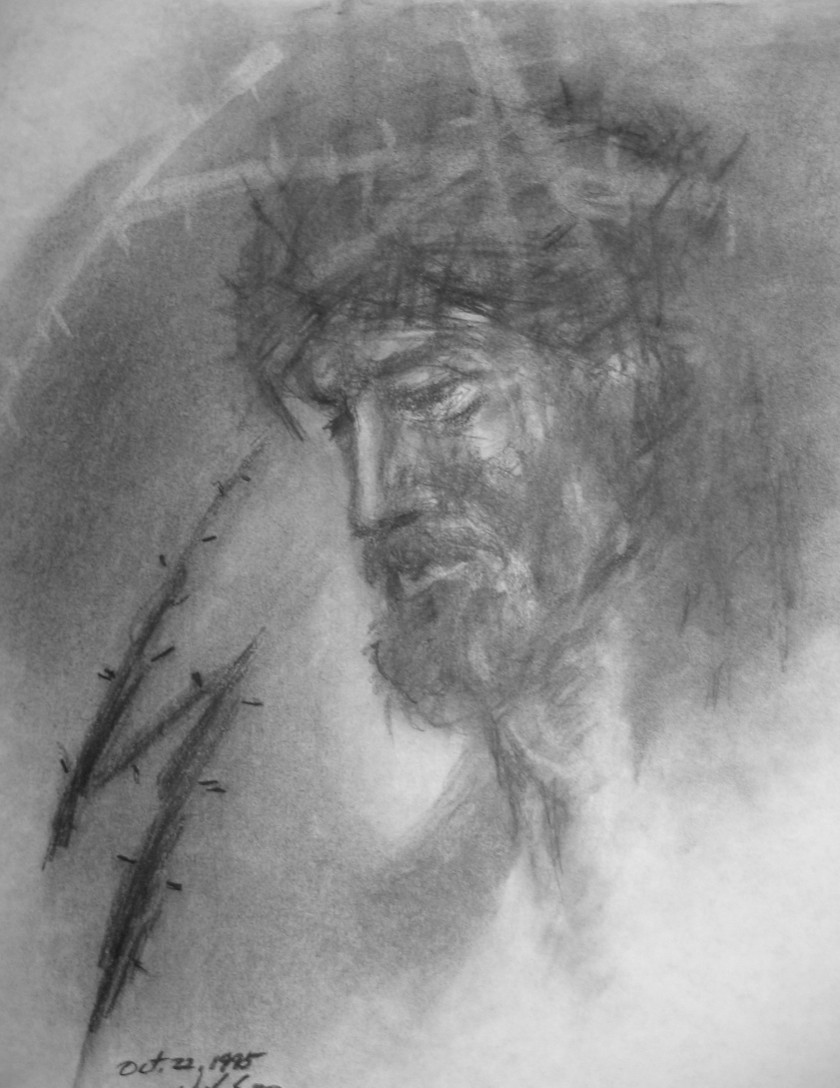
Christ crowned
Jesus on the Crosss. Duk Soon Fwang

Jesus spoke the language of his time and place, and so he used the Jewish scriptures to speak of his suffering. In Mark’s gospel his only words on the cross are from Psalm 22, “My God, my God, why have you forsaken me.” It’s a cry of lament. The psalm is a window into Jesus’ mind and his feelings as he suffered and died.

In the psalm we hear the voice of someone suffering so much as to feel abandoned by God. Life and hope seem gone, the blessings of God taken away. Still, they hold on. The psalm ends with a cry of faith: “God did not turn away from me, but heard me when I cried out.”

The psalm describes the real, acute pain Jesus endured:

“Like water my life drains away;
all my bones are disjointed.
My heart has become like wax,
it melts away within me.
As dry as a potsherd is my throat;
my tongue cleaves to my palate;
you lay me in the dust of death.”

There’s no relief in his suffering, no comfort from the abuse of his enemies:

“ I am a worm, not a man, scorned by men,
despised by the people.
All who see me mock me;
they curl their lips and jeer;
they shake their heads at me:
“He relied on the LORD—let him deliver him;
if he loves him, let him rescue him.”

The love he knew all his life, from childhood and his mother’s womb, the respect he had from his years of his ministry, the warmth of God’s presence seem gone. Where is God, the psalm complains “ who drew me forth from my mother’s womb and made me safe from my mother’s breast?”

“They have pierced my hands and my feet
I can count all my bones.
They stare at me and gloat;
they divide my garments among them;
for my clothing they cast lots.”

The gospel writers later used this psalm to frame the story of the Passion of Jesus.

Paul the Apostle says in his Letter to the Philippians, that Jesus ” who was in the form of God, emptied himself, taking the form of a slave, and coming in human likeness and found human in appearance, he humbled himself becoming obedient to death, even to death on a cross.”

Jesus became human, even taking on the humanity of a slave, dying on a cross. Far from being immune to the human experience of death, Jesus took on the darkest form of human experience: he became a slave on a cross.

Psalm 22 gives no answer for the suffering it describes. It says only that God does not abandon his creatures when suffering occurs, even suffering of the worst kind.

God did not abandon Jesus on the Cross, Paul tells the Philippians. He “ greatly exalted him and bestowed on him the name
that is above every name,

that at the name of Jesus
every knee should bend,
of those in heaven and on earth and under the earth,

and every tongue confess that
Jesus Christ is Lord,
to the glory of God the Father.”

In other words, God raised Jesus from the dead and glorified him. Again, there is no answer for suffering, but we have a promise in Jesus of resurrection, the resurrection even of a slave on the cross. In Jesus’ death we’re assured that God is present to those who seem most abandoned. God’s love enters the most desperate circumstances and most unpromising situations.

“God so loved the world that he sent his only Son,” John’s gospel says.
Nothing in creation or humanity is abandoned by God, the creator. God sent his Son into the world, not to condemn it, but to save it and give it life.

We look at Jesus on the Cross to draw hope for ourselves and our world from him. This is a blessed mystery. We bend our knee before it and confess with our tongue, that Jesus Christ is our Lord and Savior.

Holy Thursday

On the evening of Holy Thursday, as we enter the Easter Triduum, we will relive the Mass in which we commemorate the Last Supper and what happened there. It is the evening when Christ left his disciples the testament of his love in the Eucharist, not as a memento, but as a memorial, as his everlasting presence. 

Every time we celebrate the Eucharist we renew this mystery of redemption. In this Sacrament, Jesus substituted the sacrificial victim — the Paschal lamb — with himself: his Body and Blood grant us salvation from the slavery of sin and death. The salvation from every form of slavery is there.

On this evening, he asks us to love one another by becoming servants to one another, as he did in washing the disciples’ feet, a gesture that anticipates his bloody oblation on the cross. And indeed, the Master and Lord will die on the next day to purify not the feet, but the hearts and the entire life of his disciples. He was a servant to us and by the service of his sacrifice he redeemed us all.

Pope Francis

For today’s homily, please play the video file below:

God of infinite compassion, to love you is to be made holy. Fill our hearts with your love. By the death of your Son you have given us hope, born of faith. By his rising again fulfill this hope in the perfect love of heaven where he lives and reigns with you, and the Holy Spirit, One God, forever and ever. Amen.

Holy Thursday: Mass of Chrism

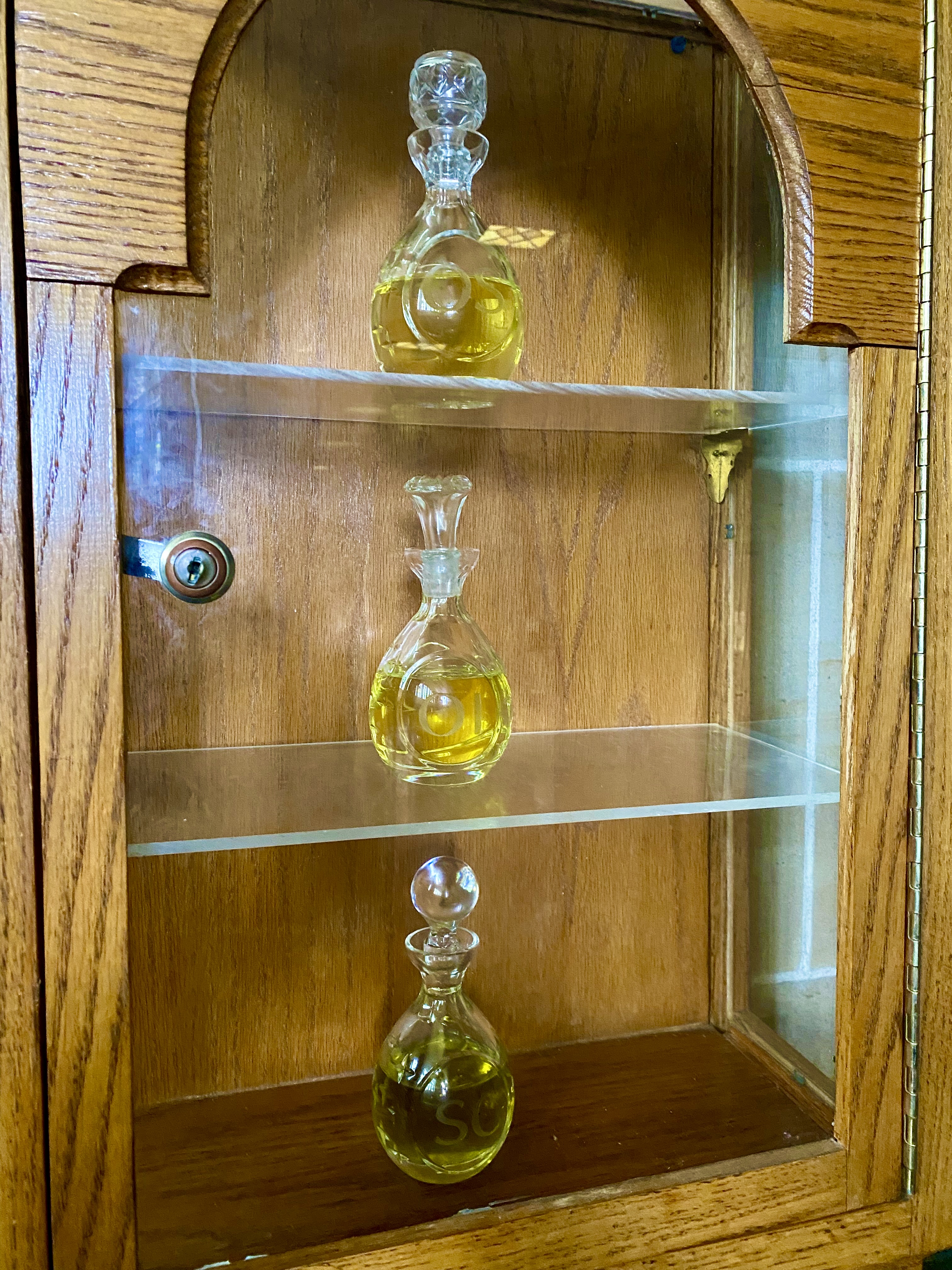
During the Chrism Mass, typically celebrated on Holy Thursday before the Triduum, the bishop blesses holy oils used in the sacraments of the church.

  1. Oil of Catechumens: The oil used to anoint those preparing for baptism, signifying cleansing and strengthening. It is a symbol of the Holy Spirit who frees us from sin and fortifies us for our journey of faith.
  2. Oil of the Sick: The oil used in the Sacrament of Anointing of the Sick, bringing healing, comfort, and strength to those who are ill.  It signifies God’s grace and presence, offering physical and spiritual healing, as well as forgiveness of sins .
  3. Holy Chrism: The oil, a mixture of olive oil and perfume, consecrated by the bishop for use in the sacraments of Baptism, Confirmation, and Holy Orders.  It signifies consecration and the seal of the Holy Spirit, marking individuals as belonging to Christ and empowering them to share in his mission.  The word “Christ” (Messiah) means “the anointed one,” highlighting the connection between Jesus and the anointing with oil 3.

Holy oils are tangible signs of God’s grace and presence in the lives of believers, accompanying them through significant moments of their faith journey, from initiation into the Church to healing and preparation for eternal life 6.

THE EASTER TRIDUUM

We are entering the most sacred period of our church’s year, the Easter Triduum, a time all are invited  to participate in the mysteries of Christ’s suffering, death, and resurrection.  The  three-day observance begins on the evening of Holy Thursday and reaches its high point on Easter Sunday, concluding with evening prayer..

The Triduum includes:

Holy Thursday, when the church commemorates the Last Supper, during which Jesus instituted the Eucharist, the sacrament of his Body and Blood. On Holy Thursday morning, before the Triduum, the Chrism Mass also takes place, when sacramental oils are blessed for use in the churches sacramental life.

On Good Friday,  the church listens  to the account of the Lord’s Passion and venerates the wood of the Cross.

Holy Saturday begins with silence and prayer in anticipation of the Easter Vigil is a  celebration of the Resurrection of Jesus Christ. At the Easter Vigil the saving power of the Paschal Mystery is communicated through baptism.

In summary, the Triduum is a three-day period encompassing Holy Thursday, Good Friday, and Holy Saturday, culminating in the celebration of Easter Sunday. It is a time to remember the Passion, death, and Resurrection of Jesus Christ, the central events of the Christian faith.

A Prayer for Judas?

Matthew’s gospel today describes the betrayal of Jesus by Judas, one of his disciples. Who approaches the chief priests offering to betray Jesus and is given thirty pieces of silver. Then he joins the other disciples at the supper.

Jesus announces “One of you will betray me.”   “Surely it is not I?” Judas says. “You have said so,” Jesus answers. 

We wonder what Judas’ motives were and how God ultimately judged him.

Our first reading from the Book of Isaiah focuses on the Servant of God, Jesus, who does not turn away from his work of forgiveness, in spite of those who beat him. Though “an outcast to his brothers and a stranger to his mother’s sons” he does not draw back from the work of mercy.

“Lord, in your great love answer me,” he says in the psalm response “for the poor and his own in bonds.” Is his prayer for Judas?                                                                                                                                                                                                                                                                                                                                                                                                                                                                                                                                                                                                                                                                                                                                                                                                                                                                                                                                                                                                                                                                                                                                                                                                                                                                                                                                                                                                                                                                                                                                                                                                                                                                                                                                                                                                                                                                                                      

Wednesday of Holy Week

Lent 1
Readings

The gospels tell us little about the twelve disciples of Jesus. Peter is the best known;  Jesus gave him a special role and also lived in his house in Capernaum.

Then, there’s Judas. Matthew’s gospel has more information about him than any other New Testament source and so we read his gospel  on “Spy Wednesday,”  the day in Holy Week recalling  Judas’ offer  to hand Jesus over for thirty pieces of silver.(Matthew 26,14-25)

“Surely it is not I?” the disciples say one after the other when Jesus announces someone will betray him. And we say so too, as we watch Judas being pointed out. With Peter also we say we will not deny him. But the readings for these days caution us that there’s a communion of sinners as well as a communion of saints.

We are never far from the disciples who once sat at table with Jesus. We’re also sinful. We come as sinners to the Easter triduum, which begins Holy Thursday evening ends on Easter Sunday. We  hope for the mercy Jesus gave to those who left him the night before he died.

“We who wish to find the All, who is God, must cast ourselves into nothingness. God is “I AM; we are they who are not, for dig as deeply as we can, we will find nothing, nothing. And we who are sinners are worse than nothing.
“God, out of nothing created the visible and invisible world. The infinite Good, by drawing good from evil through justifying sinners, performs a greater work of omnipotence than if he were to create a thousand worlds more vast and beautiful than this one. For in justifying sinners, he draws them from sin, an abyss darker and deeper than nothingness itself.” (St. Paul of the Cross, Letter 248 )

O God, who willed your Son to submit for our sake

to the yoke of the Cross,

so that you might drive from us the power of the enemy,

grant us, your servants, to attain the grace of the resurrection.

Through our Lord Jesus Christ, your Son. Amen.

Tuesday of Holy Week

Lent 1
Readings
The gospels from Monday to Thursday in Holy Week take us away from the crowded temple area in Jerusalem where Jesus spoke before many of his avowed enemies. These days he eats at table with “his own.” In Bethany six days before Passover he eats with Martha , Mary and Lazarus, whom he raised from the dead. Mary anointed his feet with precious oil in a beautiful outpouring of her love.

The gospels for Tuesday and Wednesday bring us to the table in Jerusalem where he eats with the twelve who followed him. Love is poured out here too, but these gospels describe a love with great cost. “I tell you solemnly, one of you will betray me,” Jesus says to them. Friends that followed him abandon him. Judas dips his hand into the dish with him and then goes out into the night. Peter will deny him three times; the others flee. Jesus must face suffering and death alone.

Are we unlike them?

Does a troubled Jesus face us too, “his own,” to whom he gave new life in the waters of baptism and Bread at his table. Will we not betray or deny? Are we sure we will not go away? The gospels are not just about what’s past; they’re also about now.

We think the saints exaggerate when they call themselves great sinners, but they know the truth. That’s the way St. Paul of the Cross described himself in his account of his forty day retreat as a young man:

“I rejoiced that our great God should wish to use so great a sinner, and on the other hand, I knew not where to cast myself, knowing myself so wretched. Enough! I know I shall tell my beloved Jesus that all creatures shall sing of his mercies.” (Letter 2)

Almighty ever-living God,

grant us so to celebrate the mysteries of the Lord’s Passion

that we may merit to receive your pardon.

Through our Lord Jesus Christ, your Son.


They must have stayed in Bethany


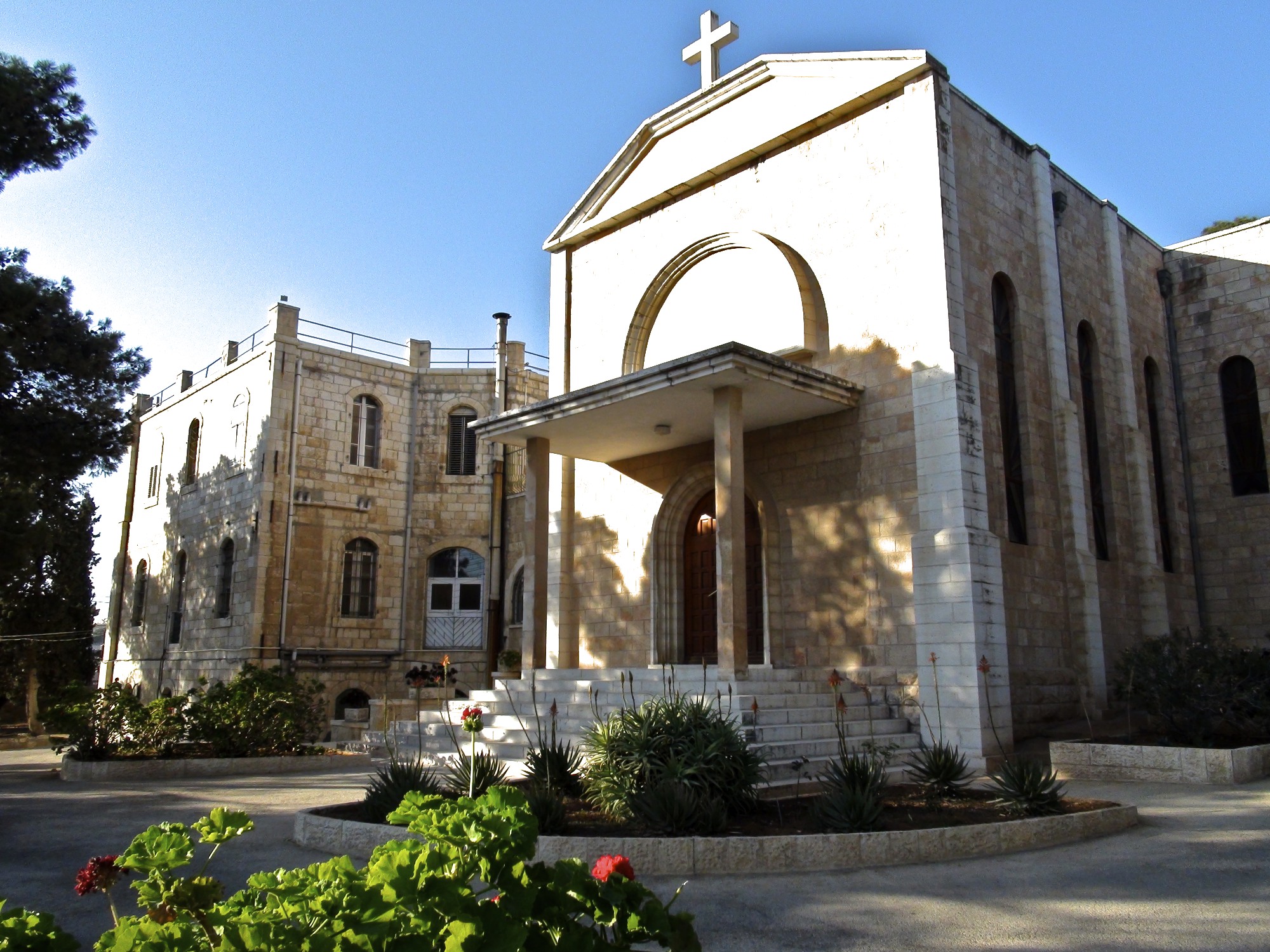
Bethany, St. Martha

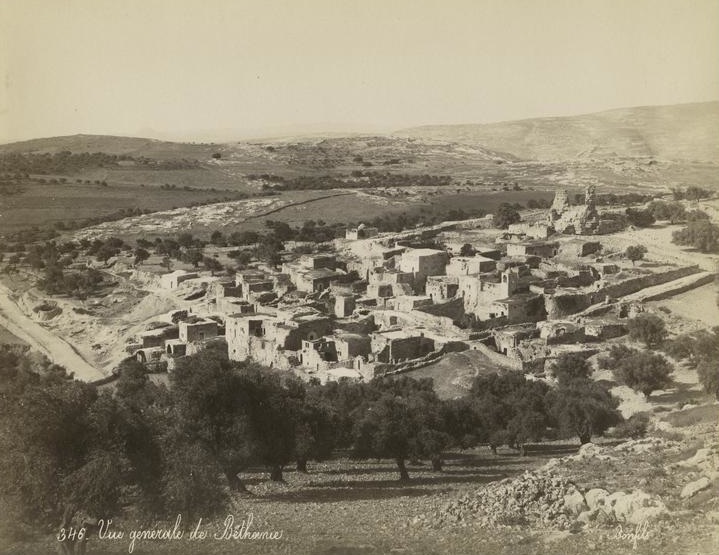
Where did Jesus and his followers stay when they came to Jerusalem for Passover? Where was the meal with Martha, Mary and Lazarus? John’s gospel points to Bethany near the Mount of Olives. Bethany is now part of East Jerusalem, a contentious area of the city today. At the time of Jesus it was where pilgrims from Galilee stayed when they come up for the feasts.

The meal in Bethany recalled today in our gospel says that Lazarus and his sisters, Martha and Mary, were friends of Jesus. He raised Lazarus from the dead. Bethany was a safe place for Jesus and his followers to stay.

My community, the Passionists, have the Church of St. Martha and a retreat house in the ancient village of Bethany. Olive trees still grace the land, as they did in Jesus’ time. Ancient caves are found here. They probably provided shelter for pilgrims to the feasts. Could Jesus have stayed in a cave like this? Bethany evokes memories of the time Jesus was here. 

Caves in Bethany, St. Martha

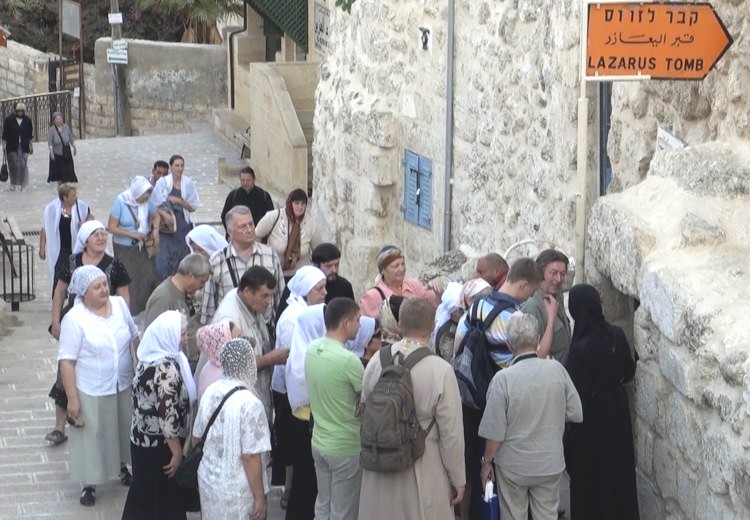
The traditional tomb of Lazarus, whom Jesus raised from the dead,  is a short distance from St. Martha’s, although an Israeli security wall blocks access to it now.

Slavic pilgrims Lazarus Tomb, Bethany


From Bethany Jesus and the others would walk a couple of miles to the temple. He taught there and made claims that unsettled the city’s leaders, then he returned to the safety of Bethany, among friends. Judas knew the place. On Holy Thursday he gave Jesus up as he prayed in Gethsemane, the Garden of Olives, just over the hill from Bethany.

Luke’s narrative of the Passion mentions a crowd of people followed Jesus on the way to his death “including many women who mourned and lamented him. Jesus turned to them and said, ‘Daughters of Jerusalem, do not weep for me; weep instead for yourselves and for your children…’” 

Bethany 1800s

Women from Galilee followed him to Jerusalem and they were there when he died and was buried.. Mary, his mother was one of them. I’m sure Martha and Mary from Bethany would have been there too. Mary, the mother of Jesus, and the other women from Galilee must have stayed in Bethany. They must have returned there after his death and burial.

Would Lazarus give them some comfort and hope?


Monday of Holy Week

Lent 1


Readings

As Holy Week begins, today’s gospel brings us to  a meal in Bethany  honoring Jesus after the resurrection of Lazarus. Raising Lazarus from the dead is the great sign in John’s Gospel for understanding the death and resurrection of Jesus. Lazarus is a symbol of humanity God reaches to save through the death and resurrection of his Son. (John 12,1-11) This is a meal Jesus eats with “his own.” His last meal will be a Passover supper.

Martha serves the meal. Lazarus newly alive, is at the table. But the one drawing most attention is their sister Mary. Sensing what’s coming, she kneels before Jesus and anoints his feet with precious oil and dries them with her hair. “And the house was filled with the fragrance of the oil.”

The precious oil, signifying her love and gratitude, also anoints Jesus for his burial. Our gospel makes only a passing reference to evil:  Judas, “the one who would betray him,” complains that the anointing is a waste, but his voice is silenced. Believers honor the one they love.

Lazarus is the brother of us all who “sit in the shadow of death.” Mary represents us all.

An artist friend of mine painted this picture of Mary anointing Jesus. How fitting that Holy Week begins with this gospel when we’re called to follow Mary and kneel and pour out the oil of our love on him whose life was poured out for us.

The Anointing. Duk Soon Fwang

“May the holy cross of our good Jesus be ever planted in our hearts so that our souls may be grafted onto this tree of life and by the infinite merits of the death of the Author of life we may produce worthwhile fruits of penance.” (St. Paul of the Cross,Letter 11)

Let my prayer rise up before you like incense,
The raising of my hands like an evening offering. Ps 141
We thank you with Mary of Bethany for your love and your promise of life. May we love you in return and believe in your promise.

Morning and Evening Prayer here.

Children’s Prayers here.