Learning from Plants, Trees and Flowers

I discovered on Google books an old study of plants and trees by Richard Folkard, an English botanist. (Plant Lore, Legends and Lyrics, London 1884)  It’s a treasure of information.

Folkard says that from earliest times people saw religious meaning in plants, flowers and trees. He writes especially about how they were seen in medieval times.

“In the dark ages the Catholic monks , who cultivated with assiduity all sorts of herbs and flowers in their monastic gardens , came in time to associate them with traditions of the Church , and to look upon them as emblems of particular saints . Aware , also , of the innate love of humanity for flowers , they selected the most popular as symbols of the Church festivals , and in time every flower became connected with some saint of the Calendar , either from flowering at the time of the saint’s day , or from being connected with the saint in some old legend…

But it was more especially upon the Virgin Mary that the early Church bestowed their floral symbolism … The poetry no less than the piety of Europe has inscribed to her the whole bloom and colouring of the fields and hedges.  The choicest flowers were wrested from the classic Juno , Venus , and Diana , and from the Scandinavian Bertha and Freyja , and bestowed upon the Madonna , whilst floral offerings of every sort were laid upon her shrines . 

Her husband , Joseph , has allotted to him a white Campanula , which in Bologna is known as the little Staff of St. Joseph . In Tuscany the name of St. Joseph’s staff is given to the Oleander. A  legend recounts that the good Joseph possessed originally only an ordinary staff , but that when the angel announced to him that he was destined to be the husband of the Virgin Mary , he became so radiant with joy , that his very staff flowered in his hand…

A Catholic writer complained that at the Reformation the very names of plants were changed in order to divert men’s minds from the least recollection of ancient Christian piety A  Protestant writer of the last century , bewailing the ruthless action of the Puritans in giving to the ” Queen of Beauty ” flowers named after the ” Queen of Heaven , ” says :’Botany , which in ancient times was full of the Blessed Virgin Mary , is now as full of the heathen Venus .’ ” 

Folkard reminds us that the monks were good catechists. That work of theirs is largely ignored today. If you consult Wikipedia’s listings of trees and plants, there’s  hardly a trace of that Catholic tradition. I wonder if we shouldn’t mine that tradition again as we try to enhance our care of the earth. Clover .spearmint, foxglove, lupine,  campanula, marigolds, cowslip, Lady’s mantel, Lady’s bedstraw are more than a genus and species. They once spoke of the mysteries of God. 

Can we learn from them again?

Mary, the Mother of God

In the Acts of the Apostles, which we read through the Easter season, Luke describes the development of the church mainly through the missionary efforts of Peter and Paul. In the later chapters of Acts it’s mostly Paul. 

But it’s important to recognize they’re not the only ones who make the church grow. After Jesus ascended into heaven, forty days after his resurrection, a group of his followers go back to the upper room in Jerusalem, Luke reports.  One of them is Mary, the mother of Jesus. 

All are eyewitnesses to what Jesus said and did before he ascended into heaven. They have a key role in the development of his church. Not only have they seen and heard what Jesus said and did, they have prophetic gifts for preaching and teaching and guiding other believers. Inspired by the Holy Spirit they tell others what that mystery means. They told others then; they tell us now, they will tell those who come after us. They’re permanent eyewitnesses.

Here’s Luke’s description of them: “Then they returned to Jerusalem from the mount called Olivet, which is near Jerusalem, a sabbath day’s journey away. When they entered the city they went to the upper room where they were staying, Peter and John and James and Andrew, Philip and Thomas, Bartholomew and Matthew, James son of Alphaeus, Simon the Zealot, and Judas son of James. All these devoted themselves with one accord to prayer, together with some women, and Mary the mother of Jesus, and his brothers.” (Acts 1, 12-14)

Though Luke singles out Peter and Paul, this larger foundational group is at the heart of the church’s growth. He wouldn’t want us to forget these  “eyewitnesses” in that growing church. Luke especially wouldn’t want us to forget Mary, the mother of Jesus.

Mary is the key eyewitness. She witnessed the birth and origin of Jesus Christ and she also was a witness to his death and resurrection. 

Early pilgrims to the Holy Land often brought home relics and icons to recall their visit, like the icon pictured above. It represents Mary’s role as eyewitness. She knew he was God’s Son, not the “son of a carpenter.

She also knew he was crucified under Pontius Pilate and rose again on the third day.

She is his most important witness. We remember her this month, May. 


St. Philip Neri, (1515-1595)

St.-Philip-2

Philip Neri, whose feast is May 26th, helped rejuvenate the Catholic church in the city of Rome following the Protestant reformation in the 16th century. He’s an important example of the way reform takes place in the church.

Philip came to Rome as a young man, became a priest, and fell in love with the city’s history, its churches and holy places. He roamed the catacombs of St. Sebastian where early Christians were buried and was a regular guide for pilgrims searching for their roots. He promoted pilgrimages to the great churches of St.Peter’s, St.Paul outside the Walls, St. Lawrence, St. Sebastian, Holy Cross, St. John Lateran and St. Mary Major, which are still the major pilgrim churches of the city.

Philip was also a familiar figure on the Roman streets where he engaged ordinary people, especially the young, with cheerfulness and simple conversation. People listened to him and he listened to them. He made people aware of the beauty and joy of an ancient faith.

Philip inspired saints like Ignatius Loyola, Charles Borromeo and Pius V.

In his day Protestants were turning to history to back up their claims against the Catholic Church. At the same time Philip encouraged Catholic scholars and historians like Caesar Baronius to look into the history of their church with fairness and accuracy.  Baronius said of him: “I love the man especially because he wants the truth and doesn’t permit falsehood of any kind.” He supported Galileo: “The bible teaches the way to go to heaven, not the way the heavens go.”

In promoting an honest study of church history and archeology Philip was influential in helping the Catholic Church examine its traditions and roots. At a time when fierce controversy between Protestants and Catholics was the norm, Philip brought gentleness, cheerfulness and friendship and a search for truth to Christian reform. He believed reform would best come about by showing the beauty of faith in art, music and tradition.  He was an unassuming man. A biographer said “ his aim was to do much without appearing to do anything.”

He died in Rome on May 26, 1595, at eighty years of age.

The great Christian scholar John Henry Newman, attracted to Philip Neri,  entered the religious society he founded, the Oratorians.

Here’s one of his prayers I like: ” Let me get through today, and I won’t worry about tomorrow.”

God our Father, you are continually raising to the glory of holiness  those who serve you faithfully.In your love, hear our prayer:  let the Holy Spirit inflame us with that fire with which, in so admirable a way,  he took possession of Saint Philip’s heart.Through our Lord Jesus Christ, your Son,  who lives and reigns with you in the unity of the Holy Spirit,  one God, for ever and ever.Amen.

6th Week of Easter: Readings and Feasts

We’re reading about the journeys of St. Paul from the Acts of the Apostles this week of the Easter season. Luke notes the places Paul and his companions set up churches as they go from Jerusalem to Rome. Their journeys are often called travel journeys; bibles have maps following Paul from place to place. The gospel has to be preached everywhere in the world, Jesus said. 

But Paul’s journeys are more than travel journeys for Luke: the gospel is being proclaimed to the world in many dimensions as we see in this week’s accounts. On Monday Paul speaks to women at their place of prayer along the water in Thessaloniki and he invites Lydia–or rather she invites herself–-to join him in his mission. Just as in his gospel, Luke sees women hearing the Good News and bringing its message to others.

On Tuesday Paul and Silas are thrown into prison at Philippi. (Acts 17:22-34) Not only are the jailor and his household converted to the gospel, but Luke notes the prisoners were listening as they prayed and sang in the night. And so, as Luke does in his gospel he points out the poor must hear the gospel. Most of these prisoners will never get to one of Paul’s house churches, but they hear the gospel all the same.  

On Wednesday, Paul speaks to the intellectuals in Athens.The results of his preaching are not promising, only a handful seem to respond. But the gospel has to be brought to places like Athens. The gospel has to be brought into the world of learning and science. It has to be proclaimed to those searching for the truth.

On Thursday and Friday the readings tell us that Paul after his rejection at Athens, gets a better reception in Corinth, the tough seaport not far from Athens, but worlds away from that proud city. “Do not be afraid. Go on speaking, and do not be silent, for I am with you.” Jesus says in a vision. 

On Saturday, Luke reminds us that Paul had great people with him like Priscilla and Aquila, the wife and husband, who instruct Apollos, a good speaker but weak in his theology.  “When Priscilla and Aquila heard him, they took him aside and explained to him the Way of God more accurately.” Some time ago I told a cousin of mine who wasn’t sure about a sermon she heard in church. “You may be right and he’s wrong.”

The missionary journeys are more than Paul’s journeys from place to place, setting up churches. They meant to bring the gospel to the world in its many dimensions.

Venerable Bede


The Venerable Bede (672-735), whose feast day is May 25th, was destined from his birth to be a monk. Born near Wearmouth Abby in England, he spent his life in that monastery from his earliest years, and became a scholar, teacher and spiritual guide. His commentaries on scripture and the history of England were known far beyond the place where he lived. He is considered the most learned man of his time.

“It’s ever been my delight to learn, to teach and to write,” he said, and he shared his learning with those he lived with; his wisdom inspires us today. Besides the scriptures and historical studies, Bede delighted in music, mathematics and learning about the natural world. He’s honored as a Doctor of the Church.

You can see from an account of his life by Cuthbert, a contemporary,  that his brothers in the monastery liked him and held him in esteem. And he liked them. Until the day of his death he continued to think and teach and write. On the day he died he was finishing up one of his studies, a commentary on the scriptures. When it was done “on the floor of his cell, he sat and sang “Glory be to the Father and to the Son and to the Holy Spirit”; and as he named the Spirit, the Breath of God, he breathed the last breath from his own body. With all the labour that he had given to the praise of God, there can be no doubt that he went into the joys of heaven that he had always longed for.”

Before he died, he wrote this:

“Before setting forth on that inevitable journey, none is wiser than the man who considers—before his soul departs hence—what good or evil he has done, and what judgement his soul will receive after its passing.”

Lord, give us a love of learning and a delight in your wisdom and truth, and the courage to look at ourselves.

6th Sunday of Easter c: He Remains With Us

For this week’s homily, please watch the video below.

As we all know we have a new Pope Leo XIV.  I can’t remember any pope in my time – and I’ve lived under 5 popes–  receiving the media coverage he has gotten.  As the media keeps reminding us, he is head of about 1.3 billion Catholics in the world.

What does the pope do? What does it mean when we say he is head of 1.3 billion Catholics in the world? What does leading the Catholic Church mean?

I ask these questions because our first reading at Mass today describes a very important event that took place at the beginning of our church. It  determined, not only what a pope should do, but the very nature of our church and how we should understand it.  (Acts 15:1-29)

Our first reading describes what’s called  the Council of Jerusalem, a council that took place in Jerusalem after the resurrection of Jesus, as his follower began to bring  his message to the world of their time. 

A problem arose. Jesus and his first followers were all Jews, firmly attached to their Jewish tradition.  Jesus never went beyond Palestine;  his ministry was mostly to Jewish people.  But after his resurrection, he told his followers to go to all nations with his message. Make disciples of all nations. 

Some of his followers thought that meant reaching out only to Jews all over the world. Actually, the first outreach of Jesus’ disciples began in Jewish synagogues. For some of his followers to follow Jesus you had to first be a Jew.  Paul and Barnabas, mentioned in today’s reading. thought otherwise as many non-Jews, Gentiles, were drawn to follow Jesus. Peter, after some hesitation,  thought the same thing, 

To settle the matter, all the apostle gathered in Jerusalem to decide. Their decision– which they saw as coming from the Holy Spirit as well as from themselves– was that all people, not just the Jews, were called to follow Jesus. You didn’t  have to join a synagogue or follow Jewish practices. God is the God of all, all nations, all peoples, are races. God is the God of heaven and earth.

That decision is why our church is called the Catholic Church. Our church is by nature a global church. It’s all over the world. 

The universality of our church may be a special gift to the world today, when wars are pitting one country against another, when so many countries are closing their borders in fear of foreigners, when nations are looking only to their own interests. We’re living in a divided world. It’s longing for a voice reminding  us of our common humanity.  We’re all children of God.                                                                                                                                                                                                                                                           .

Our church is called to be a model of what the world should be. A home for all, whatever your race, or color, or place on the social ladder. I think that’s one reason Leo XIV got the worldwide welcome he did. 

What does a pope do? He shepherd’s a church that’s a home for all. He proclaims the message of Jesus, God’s only Son. That’s why Pope Leo was chosen, not  because he’s an American, but because he’s a missionary at home in the world itself.

On the day of his election, the new pope told the cardinals who elected him to join him in a mission to the world. On the day after, he asked the crowds in St. Peter’s square to join him too on that mission, to follow Jesus Christ and bring his message to all peoples.

 We belong to the Catholic Church. We have to keep our church catholic. We have to be catholic ourselves. 

Love One Another

Jesus said to his disciples:
“This is my commandment: love one another as I love you.
No one has greater love than this,
to lay down one’s life for one’s friends.
You are my friends if you do what I command you.
I no longer call you slaves,
because a slave does not know what his master is doing.
I have called you friends,
because I have told you everything I have heard from my Father.
It was not you who chose me, but I who chose you
and appointed you to go and bear fruit that will remain,
so that whatever you ask the Father in my name he may give you.
This I command you: love one another.”

Jesus asks that we love one another. What’s the love he calls us to have? Love can be of two kinds. We can love someone for what they do for us, what they give us, what we gain from them. That’s called “love of concupiscence.”

Another kind of love is a love that gives to another rather than receives. That’s called a “love of benevolence.” A love that gives.

Jesus loves us, not because we are slaves who can serve him and do something for him,  but as friends whom he freely shares with. He loves to the extent that he lays down his life for us. His love is a love that gives life.

His love is life–going. It makes us able to give life, as his Father gives life. The love he describes is the love found in the Trinity, Father, Son and Holy Spirit.The human family is meant to be joined in a trinitarian love.

“Love one another.”

Second Vatican Council

The Council of Jerusalem, recalled in our readings these last few days, (Acts 15:1-29}, opened the church to the peoples of the world. Over the centuries church councils, as instruments of the Holy Spirit, have guided generations of Christians on their journey to the Kingdom of God. It’s important to study them when we hear, as we do today,  criticisms of the Second Vatican Council, which the Catholic Church follows in our time.

  Early 4th century councils, like Nicea, Ephesus and Chalcedon explored the mystery of  the Trinity and the mystery of Christ. We still recite creeds that summarize their teaching. Churches like St. Peter’s, St. John Lateran and St. Mary Major in Rome recall their work. The good resulting from these councils was not immediately obvious, however. Only in time do councils unfold and reveal their gifts.

The Council of Trent (1545-63), gave us decrees and a catechism for renewing  the church following the Protestant Reformation. The basilica of St. Peter was rebuilt at the time under the leadership of the popes. The council’s calls for reform were not immediately or easily implemented.

The First Vatican Council  (1869-70) continued Trent’s efforts of reform, but was abruptly cut short due to the political situation of the time.  Fr. John O’Malley, SJ, an historian of the councils, gives a short history of the First Vatican Council. 

The Second Vatican Council

The Second Vatican Council (1962-65) was convened by Pope John XXIII to update church practices, foster the reunion of Christian churches and contribute to the well being of the modern world. Its decrees provide a path for the Catholic Church into the future; it shapes the decisions and actions of our church today. 

There was much interest and hope among Catholics for the Second Vatican Council as it ended, but that interest declined, in fact some now see the council as a failure. Like all the great councils, however, the Second Vatican Council must be seen as the work of the Holy Spirit, who works in God’s time and not ours.  Here’s Bishop Barron: 

The Second Vatican Council shaped Catholic life through its reform of the church’s liturgy. The renewed liturgy of Vatican II is the primary prayerbook and the basic catechism of the Catholic Church. 

How is it our prayerbook? We celebrate the mystery of the Risen Christ each Sunday and every day of the year in prayer and sacraments. To know the Risen Christ the council called for a liturgy enriched by the treasures of the scriptures. It accepted insights into scripture that modern studies provide. From a church strongly tied to devotional prayer, the council provided a liturgical prayer rooted in God’s word so that the faithful could engage wisely in the modern world. 

How is it our catechism? The council affirmed the faith found in all the councils of the past. At the same time, It called for a church that is the people of God, united under its pastors, and so asked for a church where all its members have their voices heard and their gifts accepted.

If we look at the history of previous councils, a council’s work is never immediately evident or fulfilled. A council takes time to unfold. This blog is a humble attempt to follow the path of Vatican II.

Mary, the Dawn

13 century England

Father Justin Mulcahy, CP, a beloved teacher and musician who taught generations of Passionists in my province, wrote a hymn anonymously “Mary, the Dawn” under the name “Paul Cross” – St. Paul of the Cross is the founder of the Passionists.

It’s a wonderful hymn and prayer for a Mary Garden describing Mary’s role in the life of Jesus through simple earthly images. She’s the Dawn, he’s the perfect Day, the root, he’s the mystic vine, the grape, he’s the sacred wine, the wheat, he’s the living bread, the rose, he’s the rose blood-red.

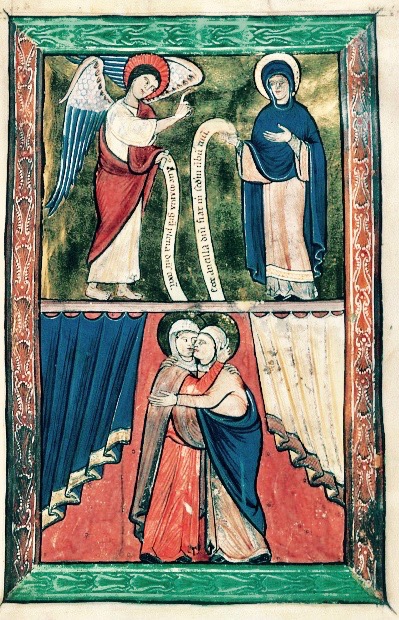
I hope we can sing this song in procession to our Mary Garden for the Feast of Mary’s Visitation. Here it is,, with a few added stanzas at the beginning. I’m adding an organ melody by Greg Martinez

Prayer

Mary, full of grace,
Mother of us all
All sing your praise,
Pray for us all.

Mother of Jesus,
Mother of us all
Show us your Son
Savior of us all.

Mother of seasons,
Earth and sky and sea,
In all our ways
Help us count our days

Mary the Dawn,
Christ the Perfect Day;
Mary the Gate,
Christ the Heav’nly Way!

Mary the Root,
Christ the Mystic Vine;
Mary the Grape,
Christ the Sacred Wine!

Mary the Wheat,
Christ the Living Bread;
Mary the Rose,
Christ the Rose Blood-red!

Mary the Font,
Christ the Cleansing Flood;
Mary the Chalice,
Christ the Saving Blood!

Mary the Temple,
Christ the Temple’s Lord;
Mary the Shrine,
Christ the God adored!

Mary the Mother,
Christ the Mother’s Son.
Both ever blest while endless ages run.
Amen.

The Council of Jerusalem

Our reading at Mass  from the Acts of the Apostles (Acts 15, 7-21) brings us to a critical moment in the life of the early church– the Council of Jerusalem, which decided whether and on what terms gentiles would be accepted into the new Christian movement. Its decision to admit the gentiles led to a rapid expansion of the church as non-Jews from all parts of the Roman world embraced the faith.

Luke Timothy Johnson has a fine commentary on this crucial event. (Acts of the Apostles: Sacra Pagina, Liturgical Press 1992)

Did a meeting really take place? Johnson writes “we can state with considerable confidence that in the first decades of the Christian movement an important meeting was held concerning the legitimacy and basis of the Gentile mission; that participants included Paul and Peter and James and Barnabas; that certain agreements were reached which, in one way or another, secured the basic freedom of the Gentile initiative. The most striking agreement between the sources comes, in fact, at the religious level. With only very slight variation, both Luke and Paul agree that the basis of the mission to the Gentiles was a matter of God’s gift, (Acts15,11. Gal 2,9) and that God was equally at work in the Apostle Paul as he was in the Apostle Peter. (Acts 15,7-8.12; Gal 2,8)”

Notice the hesitancy of  the original Jewish followers of Jesus to accept gentiles into their ranks. That’s evident in Peter’s strong reluctance to meet the Roman centurion Cornelius as he visits believers of his own kind around Joppa. Not only are the disciples slow to recognize their Risen Lord, they’re slow to accept his plans for expanding their ranks. Peter must see signs of God at work in Cornelius before baptizing him and his household. Paul, James and Barnabas also must see God’s gifts in the outsiders they meet before they recognize that God is calling them to believe.

God sows seeds of faith, but we’re as slow to recognize the action of God in others as the first disciples were. We have trouble seeing God’s action in the stranger and in the unexpected. We need  enlightenment.

Johnson notes that the Church’s journey through time is marked by conflict and debate. We must accept those conditions today too. Those who follow Jesus will not always agree with each other; there are strong opinions and differences among believers.

One thing I would add. Besides conflict and debate, our reading today speaks of the “silence” that comes as they debate. We’re in the presence of our transcendent God, whose ways and thoughts are above ours. We need silence to discern God’s will. Too much talk can get in the way.