The lectionary, calendar and other revisions of the church’s prayer after the Second Vatican Council in the 1960s are the work of biblical, liturgical and catechical scholars, mostly from Europe, who were taked with providing a fuller experience of the liturgy for Catholics throughout the world. It was a monumental work and we’re still absorbing it.
The lectionary offers readings, psalms and prayers for Sundays and every day of the year. For Sundays this year we’re reading from the Gospel of Luke..
For weekdays we will be reading from Matthew’s Gospel till the 22nd Week, then we’ll read from Luke’s Gospel. Ending the church year, we’ll read from the accounts of the last time from all the gospels. The lectionary follows this same cycle of gospel readings every year, and so following the lectionary yearly helps us become familiar with the gospels.
The first readings weekdays for ordinary time in our lectionary are arranged in a two year cycle that includes readings from the Old Testament and writings from the New Testament, especially the letters of St. Paul. For the next two weeks we will be reading from Paul’s Second Letter to the Corinthians.
For myself I find following the lectionary a good way to pray. It’s a day by day way of praying. It’s a way of learning the faith seasonally instead of systematically. Year by year, day by day, it reveals the mysteries of God. It’s a school that’s open every day, not confined to a classroom or a catechism or a theology book. It’s for slow learners who forget and have to be reminded year by year. That’s most of us.
I find too that this approach also seems to offer an answer to what’s happening in daily life, in my personal life and in the big world that’s changing so fast today. Not a perfect answer, but enough to see God’s hand in it all.
You can find the readings from the lectionary online at the website of the US Catholic bishops. www.usccb.org I usually link to the readings in this blog, which follows the lectionary.
The Holy Spirit descends on Jesus at his baptism in the form of a dove, the gospels say. Scholars like Luke Timothy Johnson in his commentary on St. Luke’s gospel seem puzzled by the description. What’s the explanation? “Such is the nature of symbols–all are possible,” Johnson writes.
May I hazard an explanation? Doves are regular visitors at my window and at our bird-feeder outside. I notice how confident and unafraid they seem to be, so different from the nervous sparrows flitting from place to place. As far as I can see, the doves are without the usual signs of power, sharp talons and strong wings. What’s their secret?
St. Gregory of Nyssa seems to point to a fearless love in his Commentary on the Song of Songs:
“When love has entirely cast out fear, and fear has been transformed into love, then the unity brought by our Savior will be realized, for all will be united with one another through their union with the supreme Good. They will possess the perfection ascribed to the dove, according to our interpretation of the text “one alone is my dove, my perfect one.”
A fearless, humble love, unafraid of chaos, brings peace. Is that why Noah chose the dove to go into the world engulfed by the flood and not a lion or an eagle? Such is the nature of symbols–all explanations are possible. We could use that kind of fearlessness today, couldn’t we?
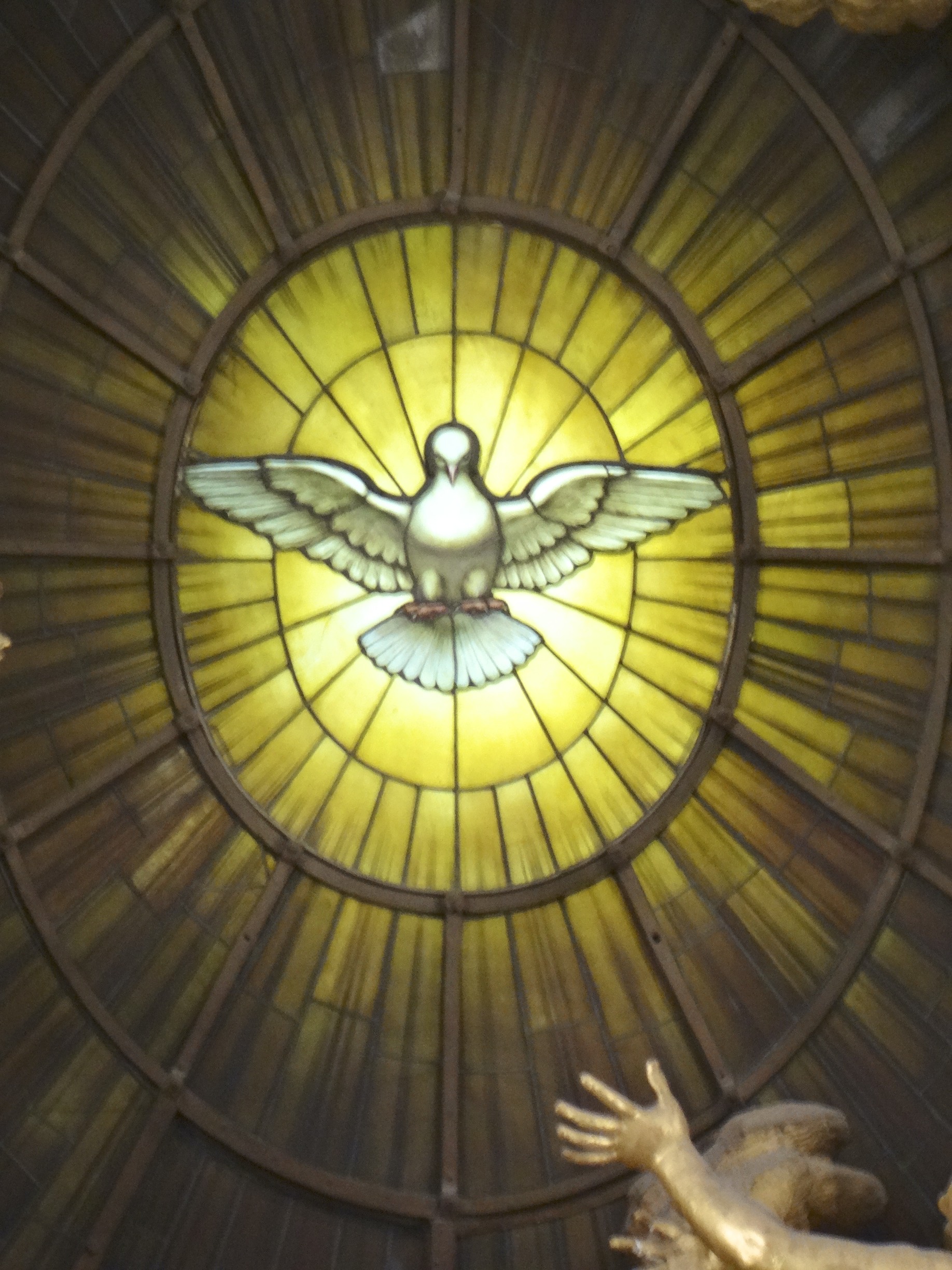
Behind the Chair of St. Peter in the Vatican Basilica in Rome, the artist Bernini created a beautiful alabaster window where a steady light pours into the dark church through the image of the Holy Spirit, in the hovering form of a dove. Light is also a favorite sign of the Holy Spirit.
Day by day, the light comes quietly through the window. Day by day, the Holy Spirit dispenses light for the moment, graces for the world that is now. As Jesus promised, the Holy Spirit dwells with us, his final gift.
For this week’s homily please watch the video below.
Today’s the Feast of Pentecost, when the Holy Spirit came upon the disciples of Jesus. If you notice our readings today describe two different times the Spirit comes. Our first reading, from the Acts of the Apostles, describes the Holy Spirit coming at Pentecost, a Jewish feast 50 days after the Passover, when great numbers of pilgrims came to Jerusalem from all parts of the world to celebrate the feast. They receive the Holy Spirit and become messengers of the Spirit to the world they came from.
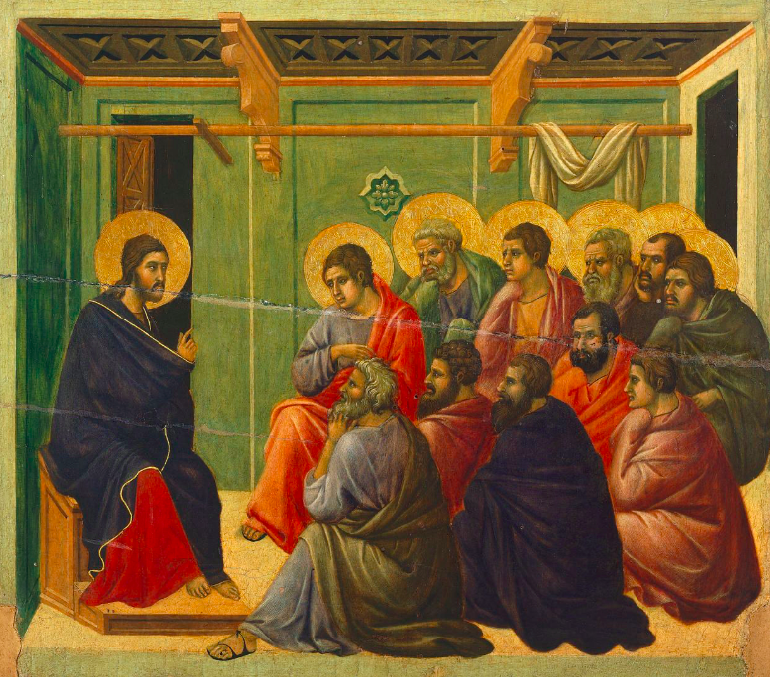
Our gospel describes Holy Spirit coming, not at Pentecost, but Easter Sunday when Jesus’ disciples were locked in the upper room in Jerusalem in fear.
Jesus, risen from the dead, comes to them and breathes on them: “Receive the Holy Spirit,” The Spirit brings them forgiveness and peace. They can leave that room and go out into the world they’re fearful of. The Spirit is with them.
Where are we today if we could see the Spirit coming to us? I think a lot of us today are like those disciples in the upper room– afraid of the world we live in. We may think our world is unmanageable. We’re closing our doors and shutting the windows. We’re afraid. In our country that fear is making us distance ourselves from the rest of the world.
Today, the Feast of Pentecost, we celebrate the coming of the Holy Spirit, whom Jesus promised, not only to his disciples but to us and to the whole world. The Spirit comes not just to help us as individuals, the Spirit’s sent to our world. “Come, Holy Spirit, and renew the face the earth.”
The way we know the Holy Spirit is different than the way we know Jesus. Jesus is God come to us in human flesh; he’s like us. He’s born a child, lives as a human being, he reacts to events and people around him, he speaks in human words, he suffers and dies and rises. However distant his time from ours is, we see and hear him human like ourselves.
But it’s more difficult to describe the Holy Spirit. The scriptures use symbolic ways to describe the Third Person of the Trinity. Our gospel today describes the Spirit as the breath of Jesus Christ. Jesus breathed on his disciples and gave them the Spirit. He promises that the Holy Spirit will remain with us to “complete his work on earth and bring us the fullness of grace.”
Our first reading todays says the Spirit is a driving wind, tongues of fire empowering those to whom he comes to speak with wisdom, with new words, and to reach out to the whole world and act bravely, not fearfully.
The Holy Spirit is described in other ways in the New Testament and in our prayers. The Spirit’s a dove who rests on Jesus when he’s baptized in the Jordan by John. I find myself particular attracted that this image of the Holy Spirit.
There’s a bird feeder outside where I live that’s attracts a lot of house sparrows, but doves are regular visitors too. I notice when a cat comes or a hawk flies over, the sparrows scatter immediately; the doves are the last to go and first back at the feeder. Now, are they simple? You could say also they’re fearless. They’re not afraid of their enemies.
Think about the story of Noah in the ark. Noah wonders if the flood waters are gone, so what does he do ? He sends out a dove, who returns with a twig from an olive plant. There’s life there, you can get out of the ark. The dove is not afraid of floodwaters and dangerous places.
The dove, the Holy Spirit, leads Jesus into the desert, the realm of Satan, after his baptism. The Spirit is not afraid of chaos or evil, but recreates the world. The Holy Spirit is with us today. We don’t have to be afraid..
St. Cyril of Jerusalem has a beautiful description of the Holy Spirit in one of his sermons.How describe the Holy Spirit? He uses two things we know well: water and light.
“The water I shall give will become a fountain of living water, welling up into eternal life. This is a new kind of water, a living, leaping water, welling up for those who are worthy.
But why did Christ call the Spirit water? Because all things depend on water; plants and animals originate in water. Water comes down from heaven as rain, and always the same, it produces many different effects, one in the palm tree, another in the vine, and so on through all of creation. It does not come down, now as one thing, now as another, but remaining essentially the same, it adapts itself to the needs of every creature that receives it.
In the same way the Holy Spirit, whose nature is always the same, simple and indivisible, gives grace to each one as he wills. Like a dry tree whose roots search for water, we search for the water of the Spirit. Although the Spirit never changes, its effects are many and marvellous.
The Spirit makes one teach and another a listener. He gives one the power to cast our devils and another the patience to bear with evil. The Spirit strengthens one’s self-control, shows another how to help the poor. The Spirit’s action is different in different people, but the Spirit is always the same. The Spirit reveals his presence in a particular way for the common good.
The Spirit comes gently, known by his fragrance, not a burden, but light, very light. Rays of light and knowledge mark his approach. With the tenderness of a true friend, the Spirit comes, a protector who saves, heals, teaches, counsels, strengthens, and consoles. The Spirit comes first to enlighten the mind of one who receives him, and then, through him, the minds of others as well.”
Our weekday readings from the Acts of the Apostles and from John’s Gospel end on these last days of the Easter Season. Today’s reading from Luke describes Paul’s two final years in Rome (Acts 28:16-20,30-31), There he preaches to everyone who came to him “with complete assurance and without hindrance”, even though he’s under house arrest, and so the gospel is now preached in Rome, the center of the world.
Readings from John’s Gospel these last days end with Jesus’ prediction of Peter’s death and John’s role as a witness to the gospel, and the important reminder “There are also many other things that Jesus did, but if these were to be described individually, I do not think the whole world would contain the books that would be written.” (John 25 )
Strange, though, that Luke, who describes the death of Stephen the deacon in great detail, says nothing about the deaths of Peter and Paul. He certainly knew the circumstances of their martyrdom in 62 or 63 AD, some years before he wrote Acts.Why didn’t he write about it? It might have cleared up a lot of questions about their deaths that some modern historians have raised.
Perhaps Luke did not want to draw attention to that tragic time when Nero’s persecution put so many innocent Christians to death? Not the time to open those wounds?
We have the graves and remains of Peter and Paul at the Vatican and outside Rome’s walls, but no account of their death that someone like Luke could give. I wonder why he didn’t write about it.
More importantly, both Luke in Acts and John in his gospel want to remind us that following Jesus Christ means following him into the mystery of his death and resurrection.
In the easter season the Risen Christ promises signs and sacraments. The Sacrament of the Eucharist is one of his great signs, but let’s not forget the Sacrament of Baptism, another gift we receive from the Risen Lord. He blesses us in water.
Water is a sign of death and of life, says Saint Basil the Great.
“Like a tomb, the water receives the body, symbolizing death; while the Spirit pours in the quickening power, renewing our souls from the deadness of sin into their original life. This then is what it is to be born again of water and of the Spirit, the water bringing the necessary death while the Spirit creates life within us…
“ Through the Holy Spirit comes our restoration to paradise, our ascension into the kingdom of heaven, our return to the status of adopted children our liberty to call God our Father, our being made partakers of the grace of Christ, our being called children of light, our sharing in eternal glory – in a word, our being brought into a state of all fullness of blessing both in this world and in the world to come, of all the good gifts that are in store for us. Through faith we behold the reflection of their grace as though they were already present, but we still have to wait for the full enjoyment of them. If such is the promise, what will the perfection be like? If these are the first fruits, what will be the complete fulfillment?” Basil the Great, On the Holy Spirit
Jesus promises to remain with us in signs. we hear in John’s account of his final discourse with his disciples. The Eucharist is one important sign, but let’s not forget the other sacraments, like Baptism and the Anointing of the Sick.
One of Jesus’ first healings was of Peter’s mother-in-law who had a fever. Mark’s gospel recalls it in a few words:
“On leaving the synagogue he entered the house of Simon and Andrew with James and John. Simon’s mother-in-law lay sick with a fever. They immediately told him about her. He approached, grasped her hand, and helped her up. Then the fever left her and she waited on them.” (Mark 1,30-31)
Rembrandt’s drawing above captures one detail from Mark’s narrative. “He approached, grasped her hand, and helped her up.” Such a simple gesture. Jesus took her hand and raised her up.
The priest first puts his hand on our head in the Anointing of the Sick. It’s God giving us a hand. It’s a reminder, too, to give a hand to others to help them up. A simple sign, yes, but Jesus left it to us as an example.
What Jesus did, he told his disciples to do. “ He summoned the Twelve* and began to send them out two by two… They drove out many demons, and they anointed with oil many who were sick and cured them.” (Mark 6, 13-14)
We anoint with olive oil, the medicine people turned to in Jesus’ time, the oil the Samaritan put on the man who was beaten by robbers in the Lord’s parable. God’s our medicine, first of all, but the oil is also a practical reminder: Don’t forget to take your pills.
The priest anoints our forehead with oil in the form of a cross and says: “Through this holy anointing, may the Lord in his love and mercy help you with the grace of the Holy Spirit.”
Isn’t is true that the battle against sickness and human weakness often takes place most vigorously in our minds, where we fight fear, discouragement, a sense of being alone? This anointing calls for the grace of the Holy Spirit to guide and strengthen our minds and the way we think.
The priest anoints our hands with oil in the form of a cross and says: “May the Lord who frees you from sin, save you and raise you up.” Our hands are the signs of physical strength. We do so much with our hands. “Prosper the work of our hands,” one of our psalms says. In the Anointing of the Sick God takes our hands to strengthen them, to raise them up. That means more than raising our bodies up physically.
The anointing is not limited to this life, remember. Like all the sacraments, it promises us a share in the mystery of the Resurrection of Jesus. We shall be raised up.
“I pray for them,” Jesus says in John’s gospel as he looks at his disciples in the supper room and also at us who are his own today. We’re so conscious how poorly we pray. We need to remember Jesus is praying for us and in us.
Is it possible to speak to God, we ask ourselves? We’re so easily distracted, so weak in faith, so bound to life as it is. How can we approach God in prayer?
“Let the Son who lives in our hearts, be also on our lips,” St. Cyprian says in his commentary on the Our Father. Jesus joins our weak and stumbling prayers to his own. He prays in and for us and assures us we will be welcomed and heard.
“I pray for them,” Jesus said in the supper room. He prayed for his disciples there in the supper room. When they left they entered the Garden of Gethsemani where they fell asleep, forgetful of everything. A stone’s throw away, Jesus prayed. His prayer was not only for himself but for them as well.
“I pray for them,’ Jesus says in our liturgical prayers. We speak to God the Father “through Jesus Christ, your Son, who lives and reigns with you and the Holy Spirit, One God, forever and ever. Amen.”
Whenever we pray, whether with others in public prayer or praying alone, he enters our prayer. “Let us pray with confidence to the Father in the words our Savior gave us,” we say as we begin the Our Father at Mass.
Our confidence in prayer comes, not from our own wisdom, or holiness or faith, but from Jesus who says “I pray for them.”
Charles Lwanga and Companions. Bro. Michael Moran,CP
The martyrdom of St. Charles Lwanga and twenty-one companions in Uganda, Africa in 1885-86 was the start of a remarkable growth of Christianity on that continent. The White Fathers, Catholic missionaries who reached Uganda in 1879, succeeded in converting a number of native Africans who were servants of King Mwanga, a local Ugandan ruler. But in 1885 the king began persecuting Christians.
Charles Lwanga was in charge of the pages in the kingʼs court. The king wanted some of the pages as sexual partners. His Christian pages refused and he threatened them with torture and death. Led by Charles, they rejected the kingʼs advances and so the king, summoning them before him, asked if they were going to continue to deny him as Christians. “Till death!” they answered. “Then put them to death!” the king shouted.
Three pages died on the road to their execution at Namugonga. Many bystanders were amazed at the courage and calm of Charles and his companions. On Ascension Day, 1886, they were wrapped up in reed mats and set afire for their faith. The following year an extraordinary number of Ugandans became Christian.
The grace of God was working in them, the prayer for their feast on June 3 says: “Father, you have made the blood of martyrs the seed of Christians.””
Africa has a history of martyrs, Pope Paul VI recalled at their canonization; the early Christian martyrs St. Cyprian, Saints Felicity and Perpetua, the 4th century Martyrs of Sicilli, whose relics are venerated in the Passionist church of Saints John and Paul in Rome.
Charles Lwanga and his companions opened a new page in the history of holiness in Africa. Paying tribute to them, Pope Paul recommended not forgetting “ those members of the Anglican Church who also died for the name of Christ.” Pope Francis recently spoke of “an ecumenism of blood”, as Christians from different denominations suffer persecution today.
“These African martyrs herald the dawn of a new age.”
Christian activity in Africa began in the 1st century in Alexandria in Egypt and other parts of Roman Africa, but the 7th century Islamic conquest caused a deep decline in Christianity there. In modern times Christianity reached south as the European powers colonized the continent. By 2005 Catholics numbered 135 million Africans out of a population of 809 million. By 2025, African Catholics are expected to be one-sixth of the world’s Catholic population. A new Christian Era has begun.
“Go out to all nations, baptizing them in the name of the Father, and of the Son, and of the Holy Spirit, Amen.”
The Holy Spirit is “poured out on all flesh,” Peter tells the crowd at Pentecost who represent all peoples. The Spirit is like water poured out, St. Cyril of Jerusalem tells his hearers:
“The water I shall give him will become in him a fountain of living water, welling up into eternal life. This is a new kind of water, a living, leaping water, welling up for those who are worthy. But why did Christ call the grace of the Spirit water? Because all things are dependent on water; plants and animals have their origin in water. Water comes down from heaven as rain, and although it is always the same in itself, it produces many different effects, one in the palm tree, another in the vine, and so on throughout the whole of creation. It does not come down, now as one thing, now as another, but while remaining essentially the same, it adapts itself to the needs of every creature that receives it.
“In the same way the Holy Spirit, whose nature is always the same, simple and indivisible, apportions grace to each one as he wills. Like a dry tree which puts forth shoots when watered, the soul bears the fruit of holiness when repentance has made it worthy of receiving the Holy Spirit. Although the Spirit never changes, the effects of his action, by the will of God and in the name of Christ, are both many and marvellous.
“The Spirit makes one person a teacher of divine truth, inspires another to prophesy, gives another the power of casting out devils, enables another to interpret holy Scripture. The Spirit strengthens one person’s self-control, shows another how to help the poor, teaches another to fast and lead a life of asceticism, makes another oblivious to the needs of the body, trains another for martyrdom. His action is different in different people, but the Spirit himself is always the same. In each person, Scripture says, the Spirit reveals his presence in a particular way for the common good.
“The Spirit comes gently and makes himself known by his fragrance. He is not felt as a burden, for he is light, very light. Rays of light and knowledge stream before him as he approaches. The Spirit comes with the tenderness of a true friend and protector to save, to heal, to teach, to counsel, to strengthen, to console. The Spirit comes to enlighten the mind first of the one who receives him, and then, through him, the minds of others as well.
“As light strikes the eyes of a person who comes out of darkness into the sunshine and enables him to see clearly things he could not discern before, so light floods the soul of someone counted worthy of receiving the Holy Spirit and enables him to see things beyond the range of human vision, things hitherto undreamed of.” (Catechesis)
The readings at Mass approaching the Feast of Pentecost speak of closure. Jesus speaks his last words to his disciples before his death. Paul bids farewell to the elders at Ephesus and in Jerusalem is taken into custody for judgment in Rome.
It’s not the end, however, but a beginning.
We’re entering Ordinary time, when we celebrate feasts of the saints more extensively, as our June calendar indicates. St. Justin, the philosopher (June 1), engages the learned in Rome; St. Charles Lwanga and his companions (June 3) cause a new birth of Christianity in Africa; St. Boniface (June 5) brings the gospel to the fractured Germanic tribes of Europe. No, it’s not over, the gospel will be preached in every age.
We’re going to need good leadership. That’s why we read Paul’s Letter to Timothy immediately after Pentecost. Paul’s advice is especially interesting. “Stir into flame the gift of God that you have through the imposition of my hands. For God did not give us a spirit of cowardice, but rather of power and love and self-control. So do not be ashamed of your testimony to our Lord, nor of me, a prisoner for his sake; but bear your share of hardship for the Gospel with the strength that comes from God.” Timothy is losing a powerful mentor, but the Spirit never leaves the church without pastors.
We’re not left orphans. The Holy Spirit broods over the world, constantly making all things new. Every age will have its saints. The calendar of saints is the calendar written by the Holy Spirit. The saints are signs of the Holy Spirit. No age, however critical, is without them.
Come, Holy Spirit, fill the hearts of your faithful people. Send us saints for the healing and new vision that will benefit our church and our world. We need them.





 The Victor's Place