August 4th is the feast of St. John Vianney, (1786-1859) the patron of parish priests. Born in Lyon, France, he wanted to become a priest but had to wait because of family obligations. He struggled to become a priest because of his limited education.
Once ordained he was made pastor of a small parish in an out of the way place called Ars. “He cared for this parish in a marvelous way by his preaching , his mortification, prayer and good works,” his biography says. He was especially good hearing confessions and soon people were coming from everywhere to Ars.
Good to pray for parish priests, struggling to minister in the church today as it goes through difficult times of change and questioning.We need more John Vianneys.
John Vianney knew the value of prayer. He wanted to become like St. Francis of Assisi and St. Colette who “used to see our Lord and talk to him as we talk to one another. How unlike them we are! How often we come to church and have no idea what to do and what to ask for. We know how to speak to another human being, but not to God. “
His simple sermons challenged and changed those who heard him. Hurray for simple sermons and priests who preach them.
A Catechism on prayer, by St John Mary Vianney
The noble task of man, to pray and to love
Consider, children, a Christian’s treasure is not on earth, it is in heaven. Well then, our thoughts should turn to where our treasure is.
Man has a noble task: that of prayer and love. To pray and to love, that is the happiness of man on earth.
Prayer is nothing else than union with God. When the heart is pure and united with God it is consoled and filled with sweetness; it is dazzled by a marvellous light. In this intimate union God and the soul are like two pieces of wax moulded into one; they cannot any more be separated. It is a very wonderful thing, this union of God with his insignificant creature, a happiness passing all understanding.
We had deserved to be left incapable of praying; but God in his goodness has permitted us to speak to him. Our prayer is an incense that is delightful to God.
My children, your hearts are small, but prayer enlarges them and renders them capable of loving God. Prayer is a foretaste of heaven, an overflowing of heaven. It never leaves us without sweetness; it is like honey, it descends into the soul and sweetens everything. In a prayer well made, troubles vanish like snow under the rays of the sun.
Prayer makes time seem to pass quickly, and so pleasantly that one fails to notice how long it is. When I was parish priest of Bresse, once almost all my colleagues were ill, and as I made long journeys I used to pray to God, and, I assure you, the time did not seem long to me. There are those who lose themselves in prayer, like a fish in water, because they are absorbed in God. There is no division in their hearts. How I love those noble souls! Saint Francis of Assisi and Saint Colette saw our Lord and spoke to him as we speak to one another.
As for ourselves, how often do we come to church without thinking what we are going to do or for what we are going to ask. And yet, when we go to call upon someone, we have no difficulty in remembering why it was we came. Some appear as if they were about to say to God: ‘I am just going to say a couple of words, so I can get away quickly.’ I often think that when we come to adore our Lord we should get all we ask if we asked for it with a lively faith and a pure heart.
The Lectionary Readings this week from the Book of Numbers and the Book of Deuteronomy continue to describe the journey of the Israelites to the Promised Land led by Moses. Not an easy journey, not an easy people.
They grumble, they/re jealous, they doubt. They’re hardly heroic as they journey on. Listen to their laments: “Would that we had meat for food! We remember the fish we used to eat without cost in Egypt and the cucumbers, the melons, the leeks, the onions, and the garlic. But now we are famished; we see nothing before us but this manna.”
Moses is hardly a secure leader. unaffected by them:
“Why do you treat your servant so badly?” Moses asked the LORD.”Why are you so displeased with me that you burden me with all this people?Was it I who conceived all this people? Or was it I who gave them birth, that you tell me to carry them at my bosom, like a foster father carrying an infant,to the land you have promised under oath to their fathers?Where can I get meat to give to all this people? For they are crying to me, ‘Give us meat for our food.’ I cannot carry all this people by myself,for they are too heavy for me If this is the way you will deal with me, then please do me the favor of killing me at once, so that I need no longer face this distress.”
Exhausted by the journey, Moses has hqd enough.
Are the new people of God so different from their ancestors in the desert? Are its leaders better than Moses?
One reason we read the Old Testament is it’s a mirror for the New.
For this week’s homily please watch the video below.
( I preached this homily today at the Maritime Academy in Kings Point, NY)
For the last four Sundays our readings from St. Luke describe the journey Jesus takes from Galilee to Jerusalem where he’ll suffer and die and rise again.
He calls people to follow him, some don’t want to follow him at all. Some don’t understand what following him means.
Two weeks ago in our Sunday gospel, for example, a teacher of the law asks Jesus
“What must I do to inherit eternal life?” Jesus tells him to love God and love his neighbor.
You get the impression the teacher of the law isn’t really interested in Jesus’ answer. Rather he’s trying to make a point. He wants to discredit Jesus, or perhaps he just wants to show off what he knows. Some people today are like him.
Today’s gospel is about another person who approaches Jesus: “Someone in the crowd said to Jesus “Teacher, tell my brother to share the inheritance with me.”
He’s not interested in following Jesus either, he just wants Jesus to back him up. He’s interested in money. He’s fighting with his brother over an inheritance–not an unusual story, by the way. A lot of families fight about money.
Jesus tells the man “I’m not here as your lawyer or financial advisor.” Then, he cautions him about greed. “Life is not about all the things you have.”
He continues with the story of a rich farmer feverishly building barns for storing his wealth and his harvest: “This will do it! I can eat, drink and be merry for the rest of my life.”
“You fool,” God says. “You and your wealth can go in a night.”
The rich farmer only thinks about himself, not about others or the land he farms.
Now, suppose the parable became a parable about a fisherman who makes his living on the sea, or about someone like you pursuing a career on the sea. How do you look at your role as maritime people. Just a job? The sea just a place to make money?
Or do you have a call to care for the sea?
Tomorrow some friends and I are going up to Auriesville and Fonda, two towns along the Mohawk River that centuries ago were Indian villages. Auriesville was where a Jesuit priest, Isaac Jogues, and three companions were martyred in the 17th century. St. Kateri Takakwitha was born in the Indian village of Auriesville and lived for 24 years in nearby Fonda.
The native peoples in those villages on the Mohawk River centuries ago likely came to fish and trade in the waters here around New York City. The waters teemed with fish then. New York Harbor was home to some of the largest oyster beds on the planet. The early European explorers marveled at our harbor, its rivers and waterways, a place of paradise.
What are its waters like now? Mostly polluted. Still a trading place for ships great and small, but no fish and or oysters worth eating. Greed and human ignorance have taken away valuable water resources from our city. We made water a commodity.
Greed and human ignorance threaten the waters of our world today. So many regard them only as commodity to be plundered for whatever minerals we need.
“If today you hear his voice, harden not your hearts.”
Is God’s word meant for you? Today’s psalm says it is. The native peoples long ago delighted in the waters you look at every day. They cared for them better than we do.
Your life is more than making money and eating, drinking and making merry. Learn about the waters of the earth. Care for them. They need caring for.
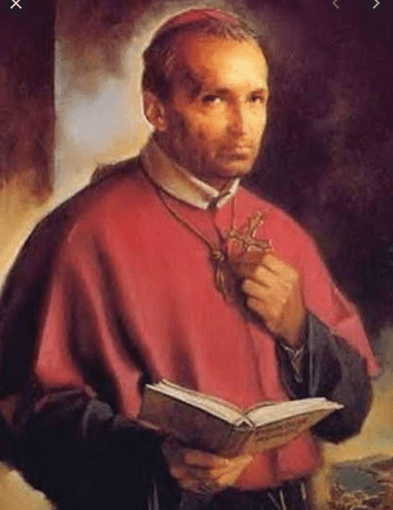
Alphonsus Liguori (1696-1787) was born near Naples, Italy, into a noble family. He began life as a lawyer but gave up law to become a priest and devote himself to bringing the gospel to the poor. His sermons and instructions were simple. “I never preached a sermon that the poorest old woman in the congregation didn’t understand,” he claimed. In 1732 he founded the Redemptorists, the Congregation of the Holy Redeemer.
A prolific writer, poet and musician, Alphonsus authored a series of devotional books on Mary and important works on moral theology. He advocated leniency and mercy towards people, steering a course between severity and laxity. In hearing confessions, he said he never denied anyone absolution. We can see why he’s an example for pastoral workers today.
In 1762, he became bishop of Sant Agata dei Goti, a small diocese near Naples, where he worked to reform the clergy and renew its people in their faith. In 1775 he resigned his bishopric because of his health, but continued writing religious and devotional tracts till his death in 1787. In 1816 he was canonized by Pope Gregory XVI. Pope Pius IX declared him a doctor of the church in 1871.
“Hasn’t God a claim on our love? From all eternity God has loved us. ‘ I first loved you. You had not yet appeared in the light of day, nor did the world yet exist, but already I loved you. From all eternity I have loved you.’
God gave us a soul endowed with memory, intellect and will; he gave us a body equipped with the senses; it was for us that he created heaven and earth and all things. The truth is the eternal Father went so far as to give us his only Son.
By giving us his Son, whom he did not spare precisely so that he might spare us, he bestowed on us at once every good: grace, love and heaven; for all these goods are certainly inferior to the Son. He who did not spare his own Son, but handed him over for all of us: how could he fail to give us along with his Son all good things?”
The prayer for his feast day points out it’s our turn to do what Alphonse’s did:
O God who constantly raise up in your church new examples of virtue, grant that we may follow so closely in the footsteps of the Bishop Saint Alphonsus in his zeal for souls as to attain the same rewards that are his in heaven.
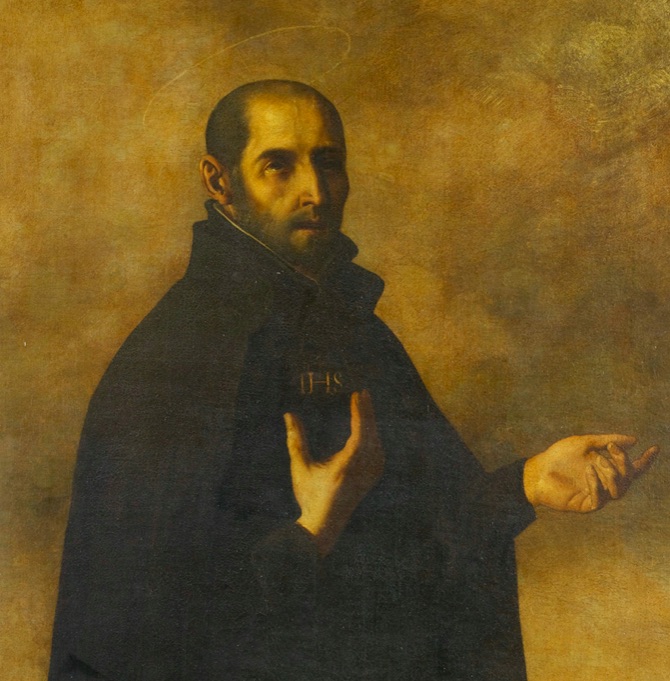
Conversion experiences of saints like Ignatius Loyola are important. His conversion came about as he was recuperating from a serious battle wound in his family’s castle.He was looking for something to read, and the only books his sister-in-law had available were a Life of Christ and Lives of the Saints.
The Life of Christ, by Ludolph of Saxony, was likely the book he read. It invites the reader to enter the gospel story, and so Ignatius, the battle hardened soldier who already knew the basics of faith from the time of his Baptism, began to know Jesus in another way. The soldier who showed no mercy, learned mercy. The man trained to be hard and unfeeling, became tender by knowing Jesus in his Passion. He became a soldier of another kind.
The Passion of Jesus was the gospel story Ignatius reflected on most . Go in and stand with someone there, the book said, and see what they see and listen to them. Most likely Ignatius the soldier would stand with the soldiers there, familiar as he was with those hard, efficient men finishing the job and anxious to head back to the barracks Yet the day Jesus was crucified, one of them, the one in charge, suddenly saw Another hanging on the cross with the criminals of the day.”Truly, this man was the Son of God.”
Everything, everyone else on that dark hill changed then: the leaders shouting for death, the soldiers finishing up, the curious passing by, the women looking on from a distance. . Everything, everyone changed. The earth quaked and the tombs were opened. The Son of God saw them all as his Father’s children.
Too much to take in? Too much for the mind and moreso for the heart. That’s why the mystery of Jesus, especially his Passion, became a never-ending school for Ignatius. “Truly, this man was the Son of God,” who humbled himself to come among us, accepting even death on a cross. God loves us so.
It’s a school for our feelings too. Feelings of inferiority or superiority, resentment and judgment, futility and denial. The hard soldier and the women looking on learned compassion together. The passion of Jesus is a school of compassion, where we learn to see things and feel things as he did.
The antiphon for morning prayer for his feast sums up his experience. “Would that I might know Christ and the power of his resurrection and that I might share in his sufferings.”
The saints, from every time and place, invited Ignatius to be a disciple of Jesus too. You didn’t have to be a fisherman from Galilee to follow Jesus, they said, or a learned scholar. Just follow him day by day, And so Ignatius, the soldier, accepted the daily graces he was given.
Born in Spain, Ignatius Loyola was a soldier, severely wounded in battle, who experienced a remarkable conversion during his recuperation. He became the founder of the Jesuits. Here’s the story of his conversion described by an early follower :
Ignatius was passionately fond of reading worldly books of fiction and tales of knight-errantry. When he felt he was getting better, he asked for some of these books to pass the time. But no book of that sort could be found in the house; instead they gave him a life of Christ and a collection of the lives of saints written in Spanish.
By constantly reading these books he began to be attracted to what he found narrated there. Sometimes in the midst of his reading he would reflect on what he had read. Yet at other times he would dwell on many of the things which he had been accustomed to dwell on previously.
But at this point our Lord came to his assistance, insuring that these thoughts were followed by others which arose from his current reading. While reading the life of Christ our Lord or the lives of the saints, he would reflect and reason with himself: “What if I should do what Saint Francis or Saint Dominic did?” In this way he let his mind dwell on many thoughts; they lasted a while until other things took their place. Then those vain and worldly images would come into his mind and remain a long time. This sequence of thoughts persisted with him for a long time.
But there was a difference. When Ignatius reflected on worldly thoughts, he felt intense pleasure; but when he gave them up out of weariness, he felt dry and depressed. Yet when he thought of living the rigorous sort of life he knew the saints had lived, he not only experienced pleasure when he actually thought about it, but even after he dismissed these thoughts, he still experienced great joy. Yet he did not pay attention to this, nor did he appreciate it until one day, in a moment of insight, he began to marvel at the difference.
Then he understood his experience: thoughts of one kind left him sad, the others full of joy. And this was the first time he applied a process of reasoning to his religious experience. Later on, when he began to formulate his spiritual exercises, he used this experience as an illustration to explain the doctrine he taught his disciples on the discernment of spirits.
From Ignatius loyola’s own words, taken down by Luis González
In this Wednesday’s Gospel (Mt 13: 44-46) our Lord gives us two short, beautiful parables about what “The Kingdom of Heaven is like .” He first tells us the story of a “person” who finds this treasure in a field, hides it again, and gives everything he/she has in order to buy that field.
Who is this person? What is this treasure? Why buy the whole field? Is the treasure too big to walk away with? Then there is the story of the merchant who also gives up everything he has to be able to buy this “pearl of great value” (or “price”).
I used to think of both parables as exhortations to give up all our worldly “possessions” in order to deserve the right to enter the Kingdom of God, and the salvation that it offers. I still think that this is the primary meaning of these stories, and it is indeed important and beautiful. However, over the years, I have wondered whether these parables also invite us to consider the Heart of this Master of the Kingdom. How does this King feel about us? Here are three little stories that have always moved me. I hold them like treasures in my own heart. In a way, they remind me of the Passion of our Lord Jesus Christ:
C.S. Lewis has this wonderful image of the Diver, who stands naked, divested of everything He had, at the brink of a high cliff. He opens out his arms, and dives headlong into the dark, violent sea below. He enters the freezing water and pushes mightily toward the even-colder bottom, past mud and filth, until He snatches the object that He was looking for out of the thick muck. He swims back up, but it is too late. He is out of air, He is about to die. But somehow He rises up full of life! He reaches the surface and opens His hand toward heaven to offer the prize He has rescued. It is the Pearl of Great Value: you and me, humanity, all of Creation.
Armando Guerra (in English it means “making war!”) is truly a soldier of God. He preaches these great talks at our Emmaus Men’s Retreats in Miami, FL. He likes to tell us that a “pearl of great value” is the product of great pain. As many of us learned In grade school the oyster winds up with a grain of sand or a small rock stuck within its shell, irritating its soft body. The oyster covers this painful object with a smooth, shiny substance called nacar, or mother-of-pearl. This only makes the object larger and torments the animal even more. The smooth rounded object grows and grows as this agonizing process keeps on repeating itself until the oyster dies. Yet, when the shell is opened up, a beautiful, valuable pearl is found inside. How can so much beauty come from so much suffering? Thank You Beloved Jesus, savior, crucified and risen! May we suffer with You in hope and trust, even joy.
The last story. Sometimes, at the end of a painful talk about self-knowledge, Armando passes around this box that looks a lot like a souvenir treasure chest (maybe he got it at Disney World), and he reads for us the parable of the treasure in the field. He has us consider that the “person” in the parable is God. He has buried this treasure in the field of His heart. He has given everything He has, even His life for it. What’s inside this “treasure chest” ? He lets us look within, one-by-one. Armando has cleverly cut and pasted a mirror at the bottom of the box. When you look inside the treasure chest, you see yourself. It seems this Kingdom of God is a Reign that is primarily ruled by the infinite power of Love. Thank You Father !
On their journey through the desert they set up a meeting tent:
“Whenever Moses went out to the tent, the people would all rise and stand at the entrance of their own tents, watching Moses until he entered the tent. As Moses entered the tent, the column of cloud would come down and stand at its entrance while the LORD spoke with Moses. On seeing the column of cloud stand at the entrance of the tent, all the people would rise and worship at the entrance of their own tents. The LORD used to speak to Moses face to face, as one man speaks to another.”
The tent, the cloud, the pillar of fire were signs of God’s dynamic presence, a presence not fixed, but leading them to another place. The Exodus story is a story of God’s presence leading humanity on.
God leads them to a place they don’t know. God’s not a wall making them safe and settled; God’s on the move, and God moves them on.
In his book “The Mystery of the Temple” the theologian Yves Congar, OP, says we need these “long” Old Testament stories to remind us of the dynamic presence of a God of tents who is a pillar of fire by night and a cloud by day.
God is our guide, the only map we have, who moves each of us and all of history to a new stage. “We are always tempted to confine ourselves to what we see and touch, to be satisfied with this and to think that a preliminary achievement fulfills God’s promise, ” Congar writes.
“Abraham thought God’s promise was fulfilled in Ismael, Joshua thought it was the conquest of Canaan. Solomon thought it was in his immediate descendants…”but these promises were capable of more complete fulfillment which would only materialize after long periods of waiting and urgently needed purification. Only the prophets–and this, in fact, is their task–draw attention to the process of development from seminal promises and to the progress of the latter towards their accomplishment through successive stages of fulfillment continuously transcending one another.” (p 31-32)
We may think it’s the end, but it’s only a beginning.
Finally, God speaks most familiarly with Moses in the desert, a place of homelessness and unease, the Book of Exodus says: “The Lord used to speak to Moses face to face, as one man speaks to another.”
Will that be true for us too? Does God speak most familiarly with us when we’re in the desert, not sure where life is heading?
The feast of Martha, Mary and Lazarus, the family at Bethany, (once feast of St. Martha alone) is celebrated on July 29th. The family were all friends of Jesus, who blessed them with one of his most important miracles– raising Lazarus from the dead. The church wants us to see them all together, for Jesus affected them all by his presence.
But Martha still stands out in today’s feast. The gospel readings from St. John and St. Luke feature her. Martha met Jesus when her brother Lazarus died and spoke those beautiful words of faith when Jesus asked if she believed he could bring life to the dead. “Yes, Lord, I have come to believe that you are the Christ, the Son of God, the one who is coming into the world.” ( John 11: )
Her faith was also the faith of Mary and Lazarus too. Jesus was at home with them.
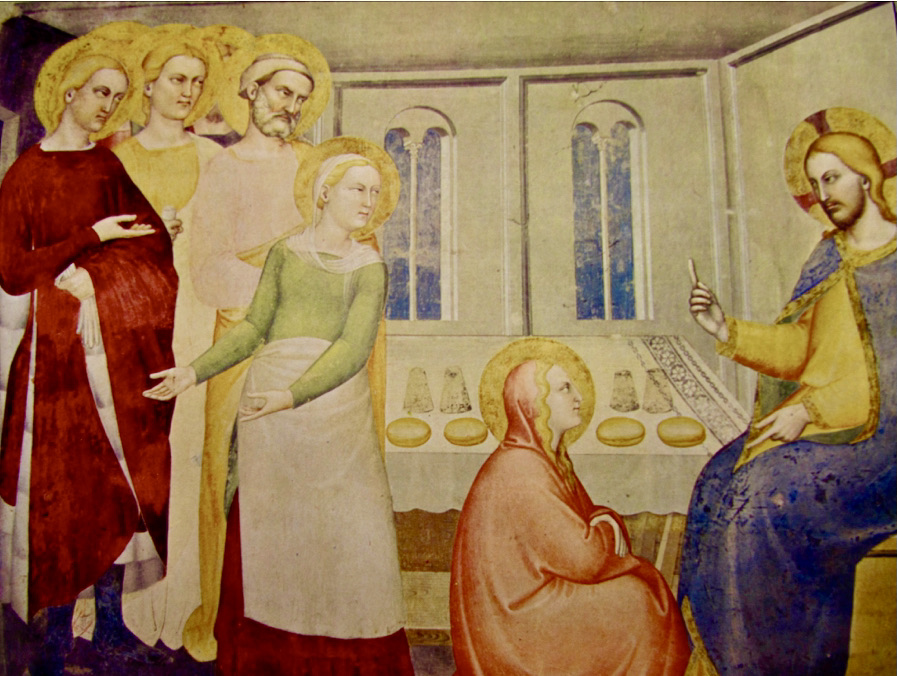
Yet, there’s another side of Martha I can’t resist. The Martha who does everything and sometimes runs out of steam doing it. No matter how strong our faith, we’re still human. Isn’t Bethany Martha’s house? That’s what the gospels seem to indicate.That’s why this favorite picture of Martha introduces this blog.
The 13th century Tuscan artist, Giovanni di Milano, brings us to Bethany where Jesus is visiting Martha and Mary. The table’s set for four people. That would be Jesus, Lazarus, Mary and Martha.
All of a sudden a knock on the door, and standing there are some of Jesus’ disciples, led by Peter. One of them gestures towards Peter, as if saying “he told us to come.”
Poor Martha in her apron holds up her hands, “What am I supposed to do?”
There will be no miracle, except the miracle of Martha’s hospitality. More than four will be fed.
That story’s in the gospel if we let our imagination roam a little bit, like the artist does. And here’s a look at Bethany today.
Almighty ever-living God, your Son was welcomed to Bethany, Martha’s house, as a guest. Grant, we pray, that through her intercession and that of her brother and sister we may serve Christ faithfully in our brothers and sisters and finally be received by you into your heavenly home. Through our Lord Jesus Christ, your Son, who lives and reigns with you in the unity of the Holy Spirit, one God, for ever and ever.




 The Victor's Place