We’re reading today at Mass one of the three long discourses Moses speaks to the people poised to enter and take possession of the land they have been promised.
Here are his words…as they are. They speak for themselves.
Think! The heavens, even the highest heavens,
belong to the LORD, your God,
as well as the earth and everything on it.
Yet in his love for your fathers the LORD was so attached to them as to choose you, their descendants,
in preference to all other peoples, as indeed he has now done.
Circumcise your hearts, therefore, and be no longer stiff-necked.
For the LORD, your God, is the God of gods,
the LORD of lords, the great God, mighty and awesome,
who has no favorites, accepts no bribes;
who executes justice for the orphan and the widow,
and befriends the alien, feeding and clothing him.
So you too must befriend the alien,
for you were once aliens yourselves in the land of Egypt.
The liturgy of the church leads us into the mystery of Jesus Christ. It’s also leads us into the mystery of the Church, especially as we celebrate the saints over the church year. .
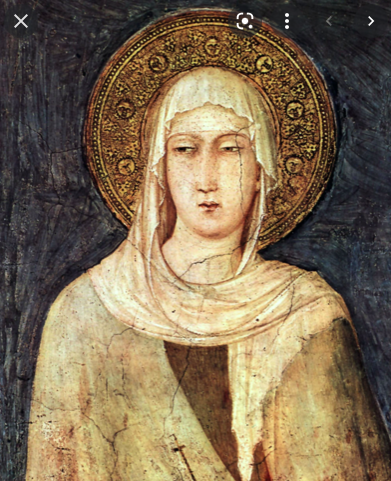
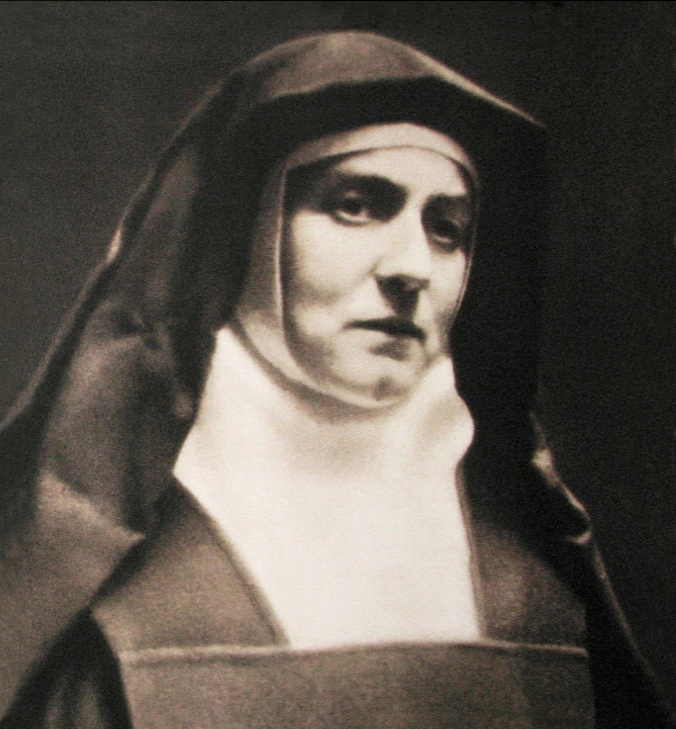
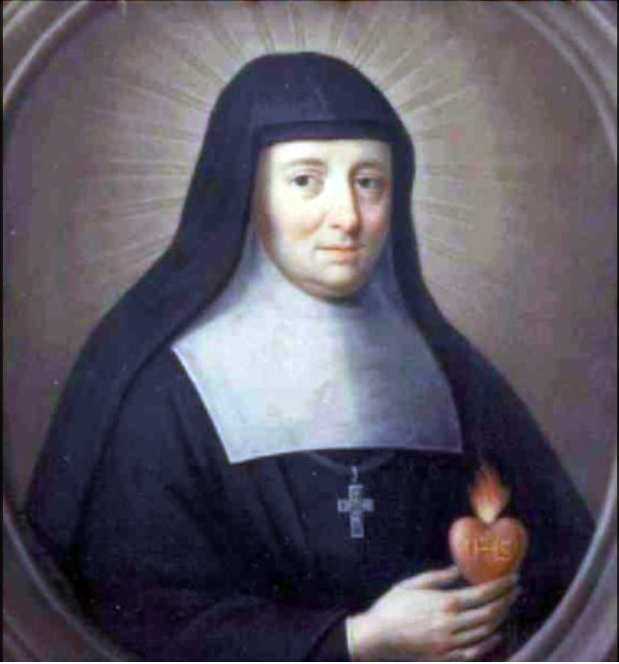
August is a month for celebrating a variety of saints from different times and places. There’s Lawrence from late 3rd century Rome, and Clare from 12th century Italy , Jane Chantal from 17th century France and Teresa Benedicta and Maximilian Kolbe from our own time. Each one sheds light on the mystery of the church through time.
St. Lawrence was a deacon who served the poor in a turbulent time. What does he tell us? He is a witness to the enduring command of the church to serve the poor. He also reminds us that the church, like Jesus Christ, dies and rises again.
Four days before his death on August 10, 258, Pope Sixtus and four deacons were seized and executed in the catacombs of St. Callistus. Their death, followed by Lawrence’s death and the Roman government’s appropriation of church’s resources deprived the church of its leaders and left it penniless. Yet the church emerged from that critical time stronger and attracting more members than ever before.
The church shares in the mystery of Jesus Christ, dying and rising. The church also shares in that mystery in our time.
What does St. Clare tell us? She founded a religious community in the 13th century that drew together women from all ranks of society; from royalty to the poorest peasants. Historians see an early advocate of women’s rights in her.
What can we learn from her? The church engages the society it lives in. It gets involved in its issues and brings it her gifts.
What does Saint Jane Frances de Chantal tell us? Like Clare of Assisi, she founded a religious community for women, the Visitandines, influenced by St. Francis de Sales and his spiritual teaching. As a widow with children she wished to explore a new model for religious life, one less rigorous than older models, where women together could pursue a devout life and serve their neighbor. Though she had to settle for a more structured church model, Jane Frances de Chantel brought new life to the church.
She tells us that the church is meant to explore new ways and new structures in its path through this world.
What do SaintsTeresa Benedicta and Maximilian Kolbe, who died in a Nazi concentration camp in 1942, tell us? The church always enters the suffering of its time, no matter how unexplainable or evil it is.
Our feasts and our saints connect us to the times we live in. Atomic bombs were dropped on Hiroshima and Nagasaki on August 6th, the Feast of the Transfiguration of Jesus on the mountain, and August 9, the memorial of Edith Stein, Sister Teresa Benedicta.
On the mountain Jesus appeared in a blinding light of glory, heralding glory for all creation. On August 6th a blinding light of destruction appeared at Hiroshima threatening the glory promised to creation. Humanity itself shares in that threatening event. The concentration camps of the 2nd World War, which we remember with Sister Teresa Benedicta, are also signs of endangered human life. We cannot take the promise of glory lightly. We must pray for it.
The saints open the mystery of the church and the mystery of our world to us.
August 10th is the Feast of St. Lawrence, the deacon, who ranks after Peter and Paul as a patron of the Church of Rome. The Emperor Constantine built a church honoring him on the Via Tiburtina, near one of the major gateways to the city in the 4th century. Lawrence was a Christian martyr, but he was something more.
Lawrence was a deacon of the Roman church in the middle of the 3rd century when Rome began experiencing wars and political instability. Gothic tribes breached the Roman lines along the Rhine River and the Persians invaded in the east.
The only thing to do was expand the army, and that’s what the Emperor Valerian did. He built walls and expanded armies. That cost money, of course, and in Rome the burden fell heavily on the poor. Famine and plague only worsened their situation.
The Christian church stepped in to help. Christians were still relatively few in numbers then, not wealthy, but they gave generously to the poor, and the Roman people admired what they saw.
Lawrence, the deacon, was behind this extraordinary Christian effort. After all, Jesus said: “I was hungry, and you gave me to eat; I was thirsty, you gave me to drink; I was sick and you visited me.”
Lawrence giving to the poor: Fra Angelico
Rome’s leaders became upset by the church’s growng popularity. They also wondered if the church’s money couldn’t be channeled towards their war effort. And so, in 257 an edict was published to imprison church leaders and confiscate church money. A second edict in 258 caused blood to flow. Pope Sixtus II and four deacons were seized in the catacombs of St. Callistus and executed on August 6th. Lawrence, the deacon, was seized and executed on August 10th. That’s why his feast day is today.
Popular stories later offered a colorful account of Lawrence’s martyrdom shaping his story and the way artists pictured him:
The Roman prefect, anxious for the church’s money, promised Lawrence freedom if he would transfer it over to him. Lawrence asked for three days to get the church’s treasures together for delivery to the prefect’s house. Then, after distributing the church’s monies to the poor, he gathered them and brought them to the prefect’s door. “Here are the church’s treasures,” he told the official, “ – the blind, the lame, the orphans and the old.”
The prefect ordered Lawrence burned alive on a gridiron. Those witnessing his execution said the saint went to his death cheerfully, even joking with his executioners. “Turn me over, I’m done on this side.”
After these events the Roman church gained a flood of converts. Respect for Christianity grew, not just because of its brave martyrs, but because of its outreach to the poor.
Constantine honored Lawrence, not just because he died for his faith, but because of his care of the poor. He would rely on the church, not just for its political support, but for its care of the poor.
Wherever you go in Rome, you are going to find Lawrence. There are other churches honoring him; he’s often pictured with Peter and Paul, the founders of the Roman church; Michelangelo has him among the blessed at the last judgment in the Sistine Chapel. Lawrence represents something important in the church.
A large fresco of the saint stands at the entrance to the Vatican Museum’s Chapel of Nicholas V with its priceless works of art. Lawrence seems blind to the riches all around him as he boldly proclaims the message inscribed beneath his feet: The Poor are the Treasures of the Church.
They should always be the treasures of the church.
Pope John Paul II preached this homily on the occasion of her canonization.
4. Dear brothers and sisters! Because she was Jewish, Edith Stein was taken with her sister Rosa and many other Catholic Jews from the Netherlands to the concentration camp in Auschwitz, where she died with them in the gas chambers. Today we remember them all with deep respect. A few days before her deportation, the woman religious had dismissed the question about a possible rescue: “Do not do it! Why should I be spared? Is it not right that I should gain no advantage from my Baptism? If I cannot share the lot of my brothers and sisters, my life, in a certain sense, is destroyed”.
From now on, as we celebrate the memory of this new saint from year to year, we must also remember the Shoah, that cruel plan to exterminate a people — a plan to which millions of our Jewish brothers and sisters fell victim. May the Lord let his face shine upon them and grant them peace (cf. Nm 6:25f.).
For the love of God and man, once again I raise an anguished cry: May such criminal deeds never be repeated against any ethnic group, against any race, in any corner of this world! It is a cry to everyone: to all people of goodwill; to all who believe in the Just and Eternal God; to all who know they are joined to Christ, the Word of God made man. We must all stand together: human dignity is at stake. There is only one human family. The new saint also insisted on this: “Our love of neighbour is the measure of our love of God. For Christians — and not only for them — no one is a ‘stranger’. The love of Christ knows no borders”.
5. Dear brothers and sisters! The love of Christ was the fire that inflamed the life of St Teresa Benedicta of the Cross. Long before she realized it, she was caught by this fire. At the beginning she devoted herself to freedom. For a long time Edith Stein was a seeker. Her mind never tired of searching and her heart always yearned for hope. She traveled the arduous path of philosophy with passionate enthusiasm. Eventually she was rewarded: she seized the truth. Or better: she was seized by it. Then she discovered that truth had a name: Jesus Christ. From that moment on, the incarnate Word was her One and All. Looking back as a Carmelite on this period of her life, she wrote to a Benedictine nun: “Whoever seeks the truth is seeking God, whether consciously or unconsciously”.
Although Edith Stein had been brought up religiously by her Jewish mother, at the age of 14 she “had consciously and deliberately stopped praying”. She wanted to rely exclusively on herself and was concerned to assert her freedom in making decisions about her life. At the end of a long journey, she came to the surprising realization: only those who commit themselves to the love of Christ become truly free.
This woman had to face the challenges of such a radically changing century as our own. Her experience is an example to us. The modern world boasts of the enticing door which says: everything is permitted. It ignores the narrow gate of discernment and renunciation. I am speaking especially to you, young Christians, particularly to the many altar servers who have come to Rome these days on pilgrimage: Pay attention! Your life is not an endless series of open doors! Listen to your heart! Do not stay on the surface, but go to the heart of things!And when the time is right, have the courage to decide! The Lord is waiting for you to put your freedom in his good hands.
6. St Teresa Benedicta of the Cross was able to understand that the love of Christ and human freedom are intertwined, because love and truth have an intrinsic relationship. The quest for truth and its expression in love did not seem at odds to her; on the contrary she realized that they call for one another.
In our time, truth is often mistaken for the opinion of the majority. In addition, there is a widespread belief that one should use the truth even against love or vice versa. But truth and love need each other. St Teresa Benedicta is a witness to this. The “martyr for love”, who gave her life for her friends, let no one surpass her in love. At the same time, with her whole being she sought the truth, of which she wrote: “No spiritual work comes into the world without great suffering. It always challenges the whole person”.
St Teresa Benedicta of the Cross says to us all: Do not accept anything as the truth if it lacks love. And do not accept anything as love which lacks truth! One without the other becomes a destructive lie.
7. Finally, the new saint teaches us that love for Christ undergoes suffering. Whoever truly loves does not stop at the prospect of suffering: he accepts communion in suffering with the one he loves.
Aware of what her Jewish origins implied, Edith Stein spoke eloquently about them: “Beneath the Cross I understood the destiny of God’s People…. Indeed, today I know far better what it means to be the Lord’s bride under the sign of the Cross. But since it is a mystery, it can never be understood by reason alone”.
The mystery of the Cross gradually enveloped her whole life, spurring her to the point of making the supreme sacrifice. As a bride on the Cross, Sr Teresa Benedicta did not only write profound pages about the “science of the Cross”, but was thoroughly trained in the school of the Cross. Many of our contemporaries would like to silence the Cross. But nothing is more eloquent than the Cross when silenced! The true message of suffering is a lesson of love. Love makes suffering fruitful and suffering deepens love.
Through the experience of the Cross, Edith Stein was able to open the way to a new encounter with the God of Abraham, Isaac and Jacob, the Father of our Lord Jesus Christ. Faith and the Cross proved inseparable to her. Having matured in the school of the Cross, she found the roots to which the tree of her own life was attached. She understood that it was very important for her “to be a daughter of the chosen people and to belong to Christ not only spiritually, but also through blood”.
8. “God is spirit, and those who worship him must worship in spirit and truth” (Jn 4:24).
Dear brothers and sisters, the divine Teacher spoke these words to the Samaritan woman at Jacob’s well. What he gave his chance but attentive listener we also find in the life of Edith Stein, in her “ascent of Mount Carmel”. The depth of the divine mystery became perceptible to her in the silence of contemplation. Gradually, throughout her life, as she grew in the knowledge of God, worshiping him in spirit and truth, she experienced ever more clearly her specific vocation to ascend the Cross with Christ, to embrace it with serenity and trust, to love it by following in the footsteps of her beloved Spouse: St Teresa Benedicta of the Cross is offered to us today as a model to inspire us and a protectress to call upon.
We give thanks to God for this gift. May the new saint be an example to us in our commitment to serve freedom, in our search for the truth. May her witness constantly strengthen the bridge of mutual understanding between Jews and Christians.
St Teresa Benedicta of the Cross, pray for us! Amen.
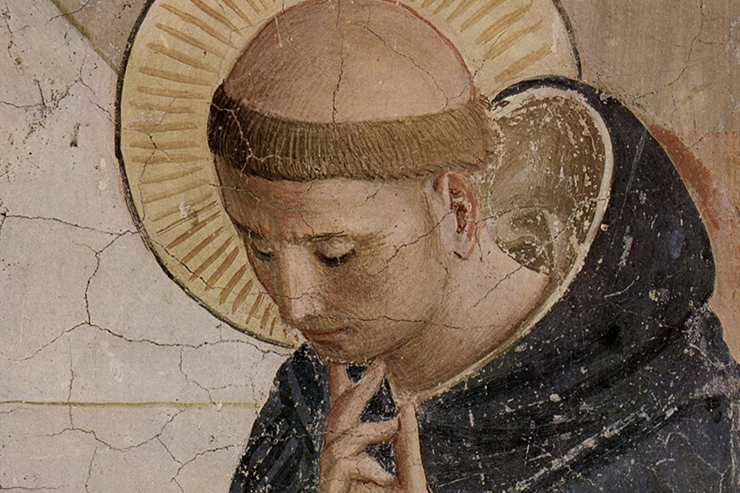
St. Dominic, who’s feast is August 8th, is a saint universally celebrated in the Catholic Church. Why is he universally celebrated?
Dominic, who lived at the beginning of the 13th century, faced the Albigensians , a gnostic movement strongly entrenched around Toulouse in France that was drawing believers away from the church. Dominic gathered preachers to bring the teaching of the gospel to the area. Preaching the gospel, according to Dominic, meant not only to understand your faith, but to know what those who differ from you believe. He established communities of followers, the Dominicans, near universities such as Paris and Bologna.
They were to study and pray. Study and prayer and a simple life would help them know the truth and bring it to their world.His community still has that vital role in the church today.
The prayers for Dominic’s feast ask that the gifts of study and prayer and a simple life remain in the church. We need people who think and pray and preach.
One of Dominic’s biographers mentions something about him that’s true of all the saints, I think. Saints look redeemed. Dominic’s face was joyful, which came from a joyful heart and a soul at peace. He believed God was with him.
“He was a man of great equanimity, except when moved to compassion and mercy. And since a joyful heart animate the face, he displayed the peaceful composure of a spiritual man in the kindness he manifested outwardly and by the cheerfulness of his countenance.”
That same “cheerfulness of countenance” seems to be what people remark about Pope Francis. That doesn’t mean smiling continuously, but that joy is our “default,” it’s the attitude usually there. Fra Angelico seems to capture the peacefulness of Dominic in his portrait of the saint. (above)
Martyrdom of Sixtus II and Companions. 14th century ms.
Today we remember the martyrs, Pope Sixtus II and four deacons who were seized while celebrating the Eucharist in the catacombs of Calixtus in 3rd century. Rome and were martyred August 6, 258. Four days after, Lawrence the deacon was executed. I’ll tell his story that day.
History has its lessons for us. With the deaths of Pope Sixtus and his deacons the Roman church lost its leadership and also, as we will see in the story of Lawrence, its financial resources. It was a way Rome’s emperors, like Valerian, got rid of annoying groups like the Christians – kill the leaders and take away the group’s assets.
In the USA and other western countries the church is experiencing loss too as churches close, the leadership of bishops and priests is weakened, and members leave. History says the church after the Valerian persecution recovered stronger than ever. Should we hope for that today?
Jesus predicted that the sheep would be scattered when the Shepherd was struck. That happened to him. Yet resurrection and a surprising birth of the church followed his death. We believe in the mystery of his death and resurrection. It’s our hope for the church today.
As the community had no water, they held a council against Moses and Aaron. The people contended with Moses, exclaiming, “Would that we too had perished with our kinsmen in the Lord’s presence! Why have you brought the LORD’s assembly into this desert where we and our livestock are dying? Why did you lead us out of Egypt, only to bring us to this wretched place which has neither grain nor figs nor vines nor pomegranates? Here there is not even water to drink!” But Moses and Aaron went away from the assembly to the entrance of the meeting tent, where they fell prostrate.
Then the glory of the LORD appeared to them, and the LORD said to Moses, “Take your staff and assemble the community, you and your brother Aaron, and in their presence order the rock to yield its waters. From the rock you shall bring forth water for the congregation and their livestock to drink.” So Moses took his staff from its place before the LORD, as he was ordered. He and Aaron assembled the community in front of the rock, where he said to them, “Listen to me, you rebels! Are we to bring water for you out of this rock?” Then, raising his hand, Moses struck the rock twice with his staff, and water gushed out in abundance for the people and their livestock to drink. But the LORD said to Moses and Aaron, “Because you were not faithful to me in showing forth my sanctity before the children of Israel, you shall not lead this community into the land I will give them.”
These are the waters of Meribah, where the children of Israel contended against the Lord, and where the LORD revealed his sanctity among them. Numbers 20:1-13
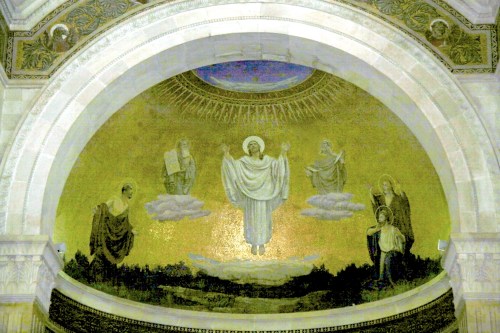
As the world around us looks like it’s falling apart, today’s Feast of the Transfiguration is a welcome reminder there’s glory ahead. Let’s climb that holy mountain to see far and wide. On the mountain of the Transfiguration, Jesus revealed God’s plan for saving the world. “This is my Son, my beloved, listen to him,” God says.
“It is good to be here,” the disciples say in the gospel story, and they invite us to join them. The mystery of the Transfiguration anticipates in a transitory way the glory to come in God’s kingdom. Yes, it will come, beyond anything we know here.
When Jesus is transfigured before the eyes of his disciples on the mountain, two figures talk with him: Elijah and Moses. Why are they there?
They were prophets told by God to free others from slavery, yet they suffered to do it. Appearing with Jesus they’re reminders that glory calls for sacrifice. Jesus suffered so God’s kingdom will come.
Church of the Transfiguration
On the mountain Jesus proclaims that all creation will be transfigured, but first the Messiah must suffer before it takes place.
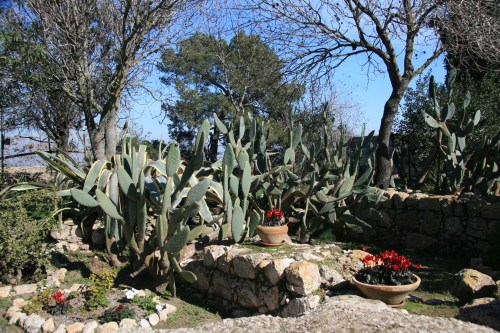
Garden, Church of the Transfiguration
Years ago I visited Mount Tabor in the Holy Land, traditional site of the transfiguration. Outside the church was a beautiful garden with plants and flowers from all over the world. All creation waits to be transfigured, they say.
The Feast of the Transfiguration of the Lord is celebrated by Christian churches all over the world, in the Ukraine, Russia, Syria and the Middle East. Can we bring to that holy mountain today places of war and violence, poverty and homelessness, where glory seems so far away? You will be transfigured too.
” Therefore, since each of us possesses God in his heart and is being transformed into his divine image, we also should cry out with joy: It is good for us to be here – here where all things shine with divine radiance, where there is joy and gladness and exultation; where there is nothing in our hearts but peace, serenity and stillness; where God is seen. For here, in our hearts, Christ takes up his abode together with the Father, saying as he enters: Today salvation has come to this house. With Christ, our hearts receive all the wealth of his eternal blessings, and there where they are stored up for us in him, we see reflected as in a mirror both the first fruits and the whole of the world to come.”
Sermon for the Feast of the Transfiguration, Anastasius of Sinai, bishop
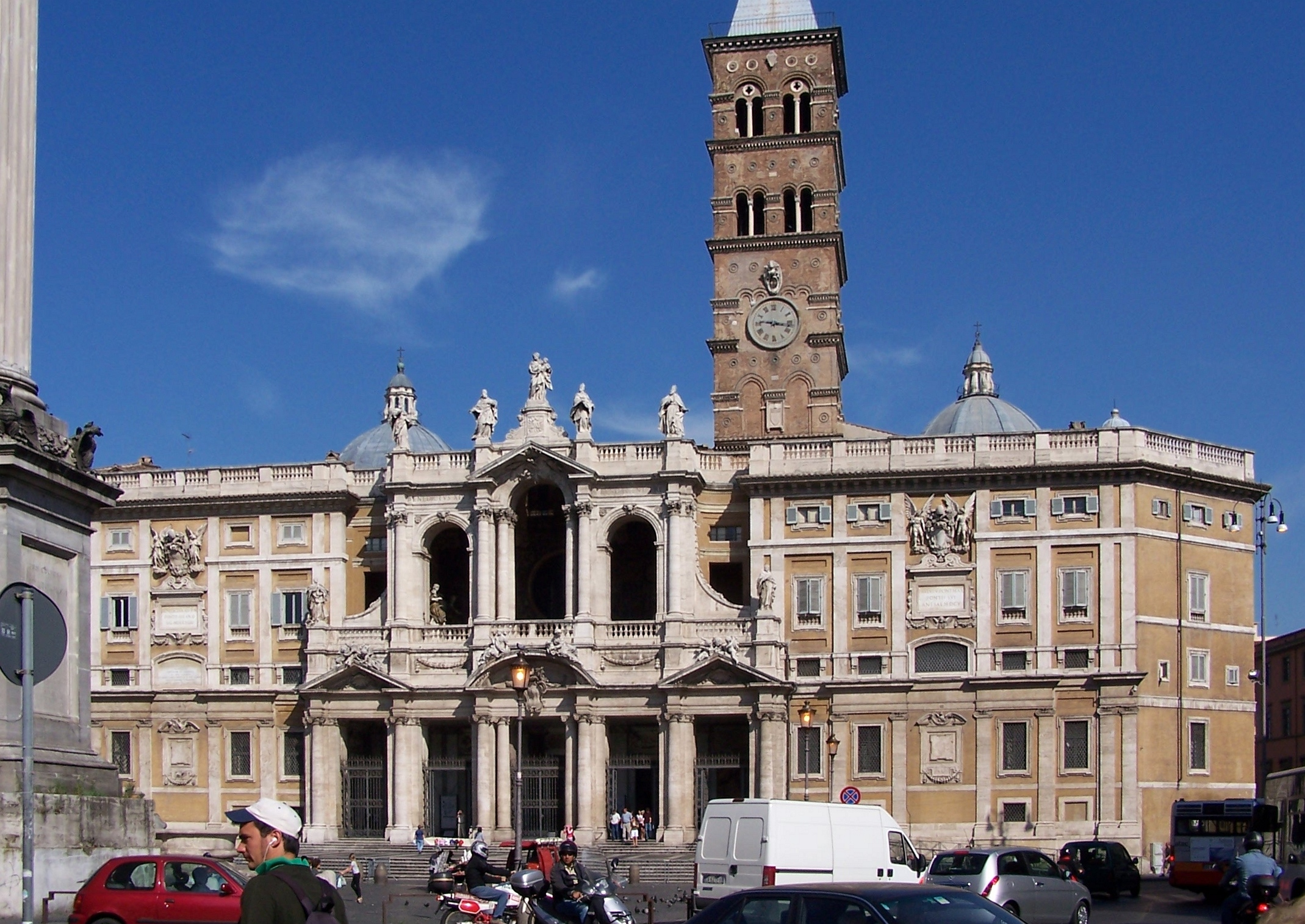
On the summit of the Esquiline Hill, a short distance from the Lateran Basilica, is the church of St. Mary Major, begun in the early 5th century and completed by Pope Sixtus III (432-440.)
Salus Populi Romani, c 5th century
Mary, the mother of Jesus, is honored here as the Mother of God. . In 431, the Council of Ephesus repudiated Nestorius, the patriarch of Constantinople, for refusing to call her “Mother of God.”
The title is important because it safeguards Christian belief in the mystery of the Incarnation: Jesus is God and man, the council said. For the Christian world Mary is the defender of Jesus, her son, who was both human and divine.
Devotion to Mary ran high in the Christian world after the Ephesus council, and churches dedicated to Mary arose everywhere. In the city of Constantinople alone, 250 churches and shrines in her honor were built before the 8th century. Pictures, icons of Mary holding her divine child multiplied, especially in churches of the East, where they became objects of special devotion.
Mary’s title, Mother of God, does not make her a goddess, otherwise how could she have given birth to Christ who is truly human? Yet, she can be called Mother of God, because Jesus who is truly her human son is truly Son of God from all eternity as well.
The 5th century, however, was hardly a good time to build a church in Rome. In 410, Alaric and his Goths shocked the Roman world by sacking a city all thought invincible. In 455 the Vandals under Genseric vandalized Rome. Twice more in the century other barbarian tribes invaded.
In far off Palestine St. Jerome cried out in disbelief at Rome’s misfortunes, which he saw heralding the end of the world. In Africa St. Augustine wrote “The City of God” in response to the followers of Rome’s traditional religions, who said Christian weakness caused the city’s devastation. Christians were not the cause of the city’s misfortunes, St. Augustine wrote; two loves are at work in the world building two cities. One love builds an evil city; Christianity builds the City of God, promoting love and justice.
The English historian Edward Gibbon called this period a time of decline and fall, the end of the Roman Empire. God’s plan does not lead to decline and fall, they say, but to triumph in Christ. God’s plan does not lead to decline and fall, they say, but to triumph in Christ. God’s plan does not lead to decline and fall, this church says. On the walls of St. Mary Major has stories from the Old and New Testaments calling for courage and hope.
In the church of St. Mary Major, Mary appears as Jesus’ mother and closest disciple. To use a phrase of St. Pope John Paul II, this church is “a school of Mary” who teaches mysteries she has learned. A noticeable number of women from the Old and New Testaments surround her: she represents those who seem powerless, but are empowered by God.
The great 13th century mosaic in the church’s apse of Mary crowned by Jesus Christ as heaven’s queen proclaims God’s triumph in her, but also his triumph in the church as well. She is taken up to heaven “to be the beginning and pattern of the church in its perfection, and a sign of hope and comfort for your people on their pilgrim way.” (Preface of the Assumption)
It shouldn’t surprise us that many of the mysteries in which Mary had a special role were first celebrated here as liturgical feasts. The Christmas liturgy, especially the midnight Mass on December 25th , began in this church in the 5th century and spread to other churches of the west.
A replica of the cave under the church of the Nativity at Bethlehem, the traditional site of Jesus’ birth, was constructed here early on.. After the Muslim conquest of the Holy Land in the 7th century, Christian refugees placed relics here purported to be from the crib that bore the Christ Child and relics of St.Matthew, an evangelist who told the story of Jesus birth.
Relics of the Crib from Bethlehem
Besides the Christmas liturgy, other great Marian feasts, such as her Immaculate Conception and Assumption, developed their liturgical forms in this church.
Built on a hill where all could see it, near Rome’s eastern walls so often threatened by barbarian armies, St. Mary Major affirms Christianity’s ultimate answer to its enemies. It is not military might, but the power of faith and love that triumphs in the end.
Visiting St.Mary Major
The church’s 18th century façade was built to enhance the appearance of this important church at a time when many visitors, especially from England and Germany, were traveling to Rome on the Grand Tour to visit its classical and religious sites.
The church’s interior, with its splendid 5th century mosaics along the upper part of the nave, retains its original form better than any other of the major basilicas of Rome.
The Sistine Chapel at the right hand side of the nave was built to house a silver reliquary with relics of the crib brought from the Holy Land in the 8th century. Two popes, Sixtus V and Pius V are buried there.
The Borghese Chapel at the left hand side of the nave honors the ancient icon of the Virgin and Child,”Salus populist Romani”, that Roman Christians have reverenced for centuries. A reproduction of the icon is a nice remembrance to bring home. Pope Francis has requested to be buried here.
The magnificent 13th century mosaic in the apse of the basilica presents the Coronation of Mary in heaven. It’s surrounded by 5th century mosaics depicting scenes from the birth of Jesus and the life of Mary.









 The Victor's Place