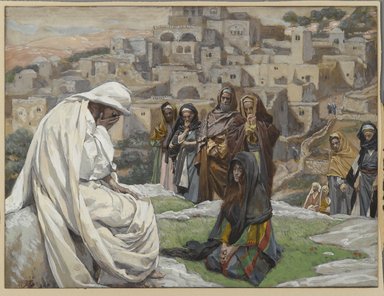
As Jesus drew near Jerusalem, he saw the city and wept over it, saying, “If this day you only knew what makes for peace– but now it is hidden from your eyes. For the days are coming upon you when your enemies will raise a palisade against you; they will encircle you and hem you in on all sides. They will smash you to the ground and your children within you, and they will not leave one stone upon another within you because you did not recognize the time of your visitation.”
Jesus weeps over Jerusalem. The first thing he does as he arrives at the city, Luke’s Gospel today says. Looking over our world today, we weep too.
Luke’s Gospel begins today with these words “While people were listening to Jesus speak, he proceeded to tell a parable because he was near Jerusalem and they thought that the Kingdom of God would appear there immediately.” (Luke 19:11)
His journey to Jerusalem, nearly complete, Jesus tells a parable to those who thought the Kingdom of God was to appear immediately when he reached the city. It’s a parable about a nobleman who went off to a distant country to obtain a kingdom and then return.
The nobleman, of course, is Jesus himself who speaks of his own resurrection “to a distant country”. His followers will remain with gold coins in their hands and the command to “trade till I come.”
It seems strange that the servant Jesus so strongly condemns is the one who seems so cautious. “ Sir, here is your gold coin; I kept it stored away in a handkerchief.” But this servant is afraid of the time he’s living in and does nothing.
In Luke’s time, this servant was like those whom Paul warns in his Letter to the Thessalonians. Disappointed because they see Jesus’ promises unfulfilled, they do nothing. Or like the disciples on the way to Emmaus, shocked by a crucified Lord and his death, they head to hide in the safety of their own homes.
In our time, who might this servant be? We are living in a world where promises, human and divine, seem unfulfilled. Shall be do nothing? What’s the gold coin in our hand?
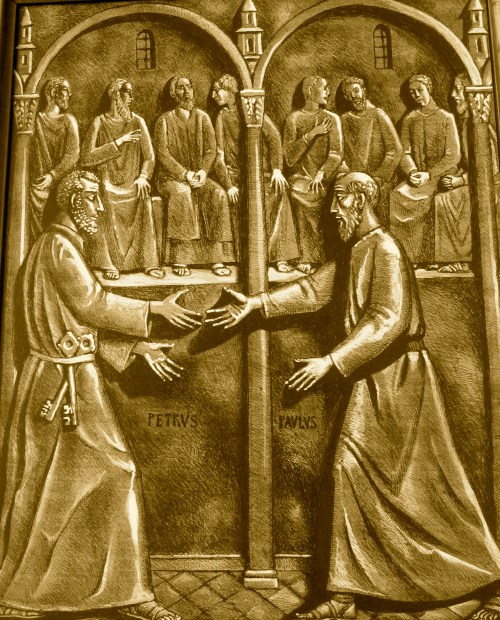
On November 18th, we honor the great apostles, Peter and Paul, remembering the dedication of the two ancient churches built over their graves. Peter is honored in the Vatican Basilica of St. Peter; Paul is honored in the Basilica of St. Paul, outside the Aurelian Walls along the Via Ostiense. The two apostles are founders and teachers of the Roman church.
Constantine built churches over the apostles’ graves in the middle of the 4th century. Besides honoring the apostles Peter and Paul, the churches were part of a wider plan of prayer, instruction and pilgrimage still seen in the Holy Year pilgrimages to Rome today. An early example of evangelization and catechesis.
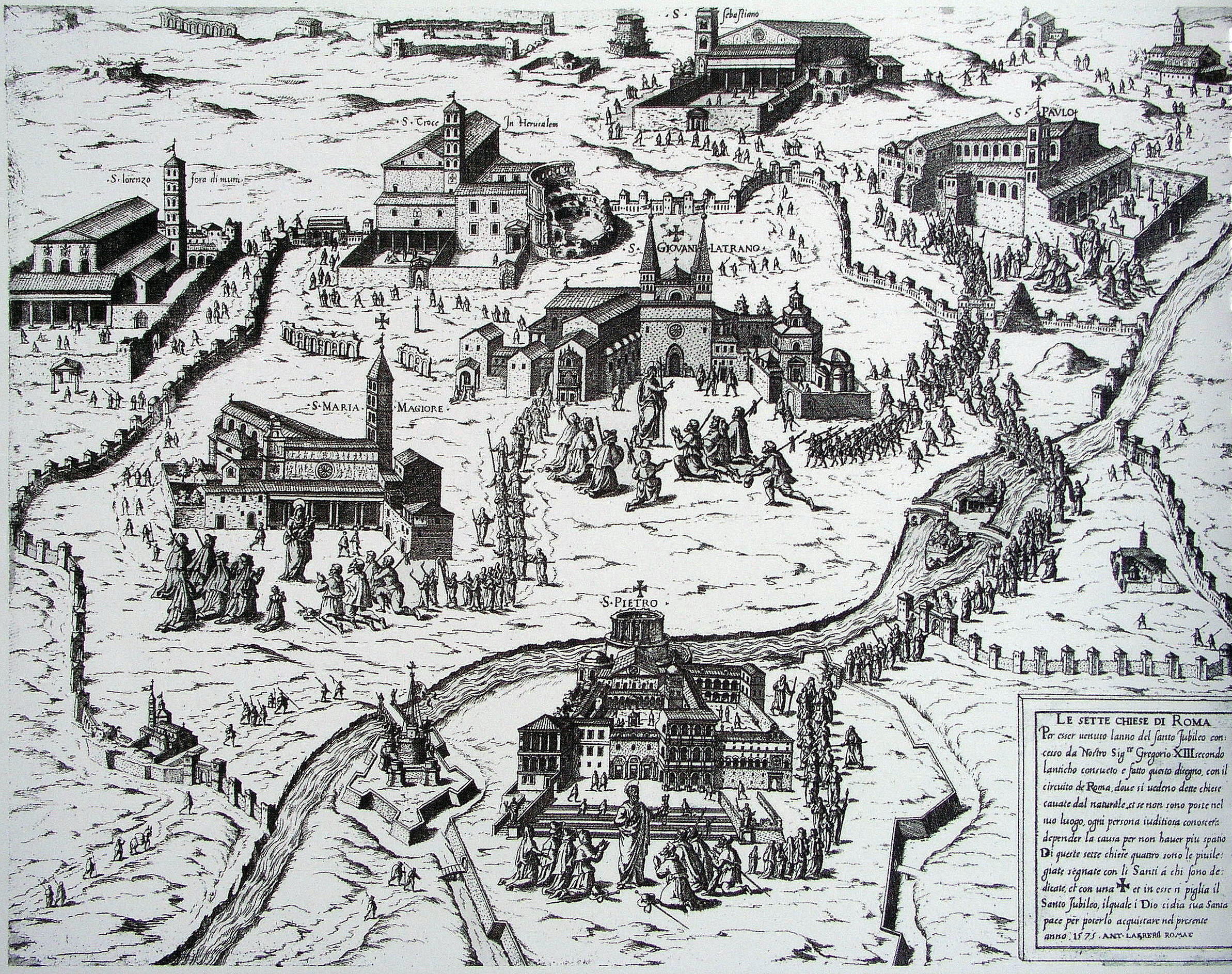
From earliest times pilgrims followed a path from one church to the other, visiting a number of other Christian shrines – St. Agnes and St. Lawrence, for example–on their way. A later pilgrim map based on that ancient pilgrimage journey offers an example.
Pilgrim Map, 17th century, Wikipedia Commons
Peter was crucified on the Vatican Hill in 64 near the obelisk not far from the circus of the emperors Caligula and Nero and was butried nearby. Constantine erected a basilica over his burial site in 326, while Sylvester was pope. Later in 1626 the present basilica replaced Constantine’s church. It’s in the process of reconstruction in the illustration above. Recent excavations have confirmed Peter’s burial place under the papal altar of this church.
Paul, tradition says, was beheaded on the Ostian Way, outside the ancient city walls, in 67. Constantine built a shrine church over the gave in 325; it was enlarged by Theodosius I in386. The church was rebuilt after a fire in 1823, according to its original measurements. The apostle’s grave lies before the main altar of the church.
Defend your Church, O Lord, by the protection of the holy Apostles, that, as she received from them. the beginnings of her knowledge of things divine, so through them she may receive, even to the end of the world, an increase in heavenly grace. Through our Lord Jesus Christ, your Son. (Collect for the feast)
This week’s Mass readings from the 1st Book of Maccabees tell the story of the re-dedication of the temple of Jerusalem three years after its profanation by Antiochus Epiphanes. About the year 167 BC, Jews under Judas Maccabeus took up the weapons of their time, re-conquered Jerusalem and restored the temple, the heart of their religion.
The first reading on Friday describes the rededication of the temple to its former glory. The Jews continue to celebrate it in the feast of Hannukah. (1 Maccabees 4,36-61}
The New Testament writers, certainly aware of this historic event, recall Jesus cleansing the temple.(Friday’s gospel) Entering Jerusalem after his journey from Galilee, “ Jesus went into the temple area and proceeded to drive out those who were selling things, saying to them, ‘It is written, My house shall be a house of prayer, but you have made it a den of thieves.’” Then, “every day he was teaching in the temple area” until he was arrested and put to death. (Luke 19,45-48)
Cleansing the temple was a symbolic act. By it, Jesus signified he is the presence of God, the Word made flesh, the new temple of God.
Luke says Jesus taught in the temple “every day.” Even from his early days he taught in the temple, Luke writes. As our eternal high priest, he teaches us every day and brings us every day to his Father and our Father.
Jesus is the indestructible temple, the indestructible Presence of God among us. Witnesses at his trial before he died were half right when they said he spoke of destroying the temple. He was speaking of the temple of his own body. Death seemed to destroy him, but he was raised up bodily on the third day.We share in this mystery as “members of his body.”
Still, as sacramental people we need places like temples and churches to come together, to pray and to meet God who “dwells among us.” We need churches and holy places and instinctively revolt seeing them go, or not frequented.
Old stories, like the story of the Maccabees, carry lessons and raise questions. The Maccabees took the military option to restore and pursue the Kingdom. What are our military options today when we have atomic weapons, drones, cryptoweaponry at our disposal? New laws? Persuasion?
November 17th, is the feast of St. Elizabeth of Hungary. At 14 she married Louis, ruler of Thuringia, and lived happily with him for 8 years until he died in 1227. Then, inspired by St. Francis of Assisi, she made the resources of her kingdom serve the poor, especially after floods, famine and plague struck that land in 1226.
Her spiritual director, Conrad of Marbugh, wrote this masterful little biography of her after she died:
“She was a lifelong friend of the poor and gave herself entirely to relieving the hungry. She ordered that one of her castles should be converted into a hospital in which she gathered many of the weak and feeble. She generously gave alms to all who were in need, not only in that place but in all the territories of her husband’s empire. She spent all her own revenue from her husband’s four principalities, and finally she sold her luxurious’ possessions and rich clothes for the sake of the poor.
Twice a day, in the morning and in the evening, Elizabeth went to visit the sick. She personally cared for those who were particularly repulsive; to some she gave food, to others clothing; some she carried on her own shoulders, and performed many other kindly services. Her husband, of happy memory, gladly approved of these charitable works. Finally, when her husband died, she sought the highest perfection; filled with tears, she implored me to let her beg for alms from door to door.
On Good Friday of that year, when the altars had been stripped, she laid her hands on the altar in a chapel in her own town, where she had established the Friars Minor, and before witnesses she voluntarily renounced all worldly display and everything that our Saviour in the gospel advises us to abandon. Even then she saw that she could still be distracted by the cares and worldly glory which had surrounded her while her husband was alive.
Against my will she followed me to Marburg. Here in the town she built a hospice where she gathered together the weak and the feeble. There she attended the most wretched and contemptible at her own table.
Apart from those active good works, I declare before God that I have seldom seen a more contemplative woman. When she was coming from private prayer, some religious men and women often saw her face shining marvellously and light coming from her eyes like the rays of the sun.
Before her death I heard her confession. When I asked what should be done about her goods and possessions, she replied that anything which seemed to be hers belonged to the poor. She asked me to distribute everything except one worn out dress in which she wished to be buried. When all this had been decided, she received the body of our Lord. Afterward, until vespers, she spoke often of the holiest things she had heard in sermons. Then, she devoutly commended to God all who were sitting near her, and as if falling into a gentle sleep, she died.”
Elizabeth was a woman of status and privilege. She had celebrity status, but that did not cause her to live in a bubble of luxury. Influenced by the Franciscan movement she reached out to those who had nothing; she used her wealth, power and influence to serve the poor. For that reason people of her day esteemed her.
She’s an example today for people in power, politicians, those who control the media, “influencers”. She had an eye for the poor. We need powerful people today to keep the poor in mind.
Successful people these days believe how you begin the day is important. Some get up early and make a little time for themselves; some read before they get to work; some jot down what needs to be done in the day ahead; some practice “mindfulness.” Little mention of praying.
Shouldn’t prayer be on that list too? I’m not sure what “mindfulness”is. It seems to mean getting your thoughts together, breathing in and breathing out, gathering strength and attention for the day. Reaching into yourself.
Instead of reaching into yourself, prayer reaches out to God, who is much stronger than we are and stands ready to help.
Our own spiritual tradition says that daily prayer is important and points to the beginning of the day and the end of the day, morning and evening. as the best times to approach God in prayer. The Liturgy of the Hours, the church’s official prayer, says those hours are the principal hours for praying.
Jesus prayed in the morning and evening, the scriptures say. He prayed at other times too, but in the morning and evening he prayed the prayers his people prayed, the psalms. He knew them by heart and prayed them each day.
We prayed those same prayers this morning in our chapel and we’ll pray them this evening at vespers, evening prayer. Before I lifted a finger this morning, I heard these words as I entered my day:
“He has strengthened the bars of your gates,
He has blessed the children within you.
He established peace on your borders,
He feeds you with the finest wheat.” ( Psalm 147, Friday Morning IV )
And this evening as the night comes, the symbol of sleep and death:
“The eyes of all creatures look to you
and you give them their food in due time.
You open wide your hand,
grant the desires of all who live.” (Psalm 145, Friday Evening IV)
God’s hand is opened wide to receive us and to give.
I wish more were aware of the treasure we have in our morning and evening prayers–the Liturgy of the Hours. The Second Vatican Council wanted the prayer of the church to be extended to all its people but its efforts only got so far, I’m afraid. Still more to go.
Lord and Creator of all, especially of our human family, You are our God and Father, Ruler of your children, Lord of life and death, guide and benefactor of our souls.
You fashion and transform all things in due time through your creative Word, In your wisdom and providence receive those who have gone ahead of us in the journey from this life. They have reached the place of rest before us, walking the same road we do.
Receive us too when our time comes, guiding us through the years, as long as it good for us. Prepare us to love and hope in you, to be untroubled, not shrinking back on the day of death, like those who love this world too much. Instead, may we set out eagerly for that everlasting and blessed life which is in Christ Jesus.
You ask so little of us and give so much. Hoping in you and loving you, let us endure everything and give thanks for everything that befalls us, since everything can bring us to salvation.
That was one of the first question and answer I learned from my catechism many years ago.
The Pharisees ask a question somewhat like that as Jesus approaches Jerusalem with his followers:
“When is the kingdom of God coming?”
Jesus responds: “The coming of the Kingdom of God cannot be observed, and no one will announce, ‘Look, here it is,’ or, ‘There it is.’For behold, the Kingdom of God is among you.” (Luke 17:20-25)
The catechism of the scriptures, which we listen to now, says “The kingdom of God is among you.” The Greek word translated “among” can also be translated “within” so some translations have “The kingdom of God is within you.” But commentators say it’s better we look for the kingdom of God among us than simply within us.
Yes, God who is everywhere is within us, holding us and all things in being. God makes a home in us, Jesus says, but we should not limit God’s presence to human beings or see God working only in us. God is among us, in others and in the universe we are part of. God is not present among us as an observer, God is building a kingdom that we may not observe. We can miss it, the parables of Jesus indicate.
Especially in times like our, the kingdom that’s coming is hard to see.
It’s hard to see Jesus in the bread and wine, in his followers, in the wars and the destruction happening in our environment.
That’s what eyes of faith are for. Lord, that we may see.
The United States Catholic Bishops issued this Special Message yesterday during that November meeting in Baltimore, In a vote 216 votes in favor, 5 votes against, and 3 abstentions, the bishops overwhelmingly approved the Special Message, with sustained applause of the body following the vote.
As pastors, we the bishops of the United States are bound to our people by ties of communion and compassion in Our Lord Jesus Christ. We are disturbed when we see among our people a climate of fear and anxiety around questions of profiling and immigration enforcement. We are saddened by the state of contemporary debate and the vilification of immigrants. We are concerned about the conditions in detention centers and the lack of access to pastoral care. We lament that some immigrants in the United States have arbitrarily lost their legal status. We are troubled by threats against the sanctity of houses of worship and the special nature of hospitals and schools. We are grieved when we meet parents who fear being detained when taking their children to school and when we try to console family members who have already been separated from their loved ones.
Despite obstacles and prejudices, generations of immigrants have made enormous contributions to the well-being of our nation. We as Catholic bishops love our country and pray for its peace and prosperity. For this very reason, we feel compelled now in this environment to raise our voices in defense of God-given human dignity.
Catholic teaching exhorts nations to recognize the fundamental dignity of all persons, including immigrants. We bishops advocate for a meaningful reform of our nation’s immigration laws and procedures. Human dignity and national security are not in conflict. Both are possible if people of good will work together.
We recognize that nations have a responsibility to regulate their borders and establish a just and orderly immigration system for the sake of the common good. Without such processes, immigrants face the risk of trafficking and other forms of exploitation. Safe and legal pathways serve as an antidote to such risks.
The Church’s teaching rests on the foundational concern for the human person, as created in the image and likeness of God (Genesis 1:27). As pastors, we look to Sacred Scripture and the example of the Lord Himself, where we find the wisdom of God’s compassion. The priority of the Lord, as the Prophets remind us, is for those who are most vulnerable: the widow, the orphan, the poor, and the stranger (Zechariah 7:10). In the Lord Jesus, we see the One who became poor for our sake (2 Corinthians 8:9), we see the Good Samaritan who lifts us from the dust (Luke 10:30–37), and we see the One who is found in the least of these (Matthew 25). The Church’s concern for neighbor and our concern here for immigrants is a response to the Lord’s command to love as He has loved us (John 13:34).
To our immigrant brothers and sisters, we stand with you in your suffering, since, when one member suffers, all suffer (cf. 1 Corinthians 12:26). You are not alone!
We note with gratitude that so many of our clergy, consecrated religious, and lay faithful already accompany and assist immigrants in meeting their basic human needs. We urge all people of good will to continue and expand such efforts.
We oppose the indiscriminate mass deportation of people. We pray for an end to dehumanizing rhetoric and violence, whether directed at immigrants or at law enforcement. We pray that the Lord may guide the leaders of our nation, and we are grateful for past and present opportunities to dialogue with public and elected officials. In this dialogue, we will continue to advocate for meaningful immigration reform.
As disciples of the Lord, we remain men and women of hope, and hope does not disappoint! (cf. Romans 5:5)
May the mantle of Our Lady of Guadalupe enfold us all in her maternal and loving care and draw us ever closer to the heart of Christ.


 The Victor's Place